Is Manus AI Free? Free Plan, Credits, and Limits
Manus AI is free to start on a limited-credit Free plan, but heavier autonomous agent work usually needs paid Pro or Team credits. Official docs and the pricing page define Free, Pro, and Team credit models, complexity-based burn, Chat mode as a lower-cost path, and shared Team pools. This guide maps those limits so you know when Free is enough and when paid credits become the real product.


Yes, Manus AI is free to start (with credit limits)
Official Manus examples put a standard analysis task at 200 credits, a standard website build at 360 credits, and a complex multi-integration app at 900 credits. Against a Free plan that only includes limited monthly credits, that range is why a flat "yes, Manus is free" answer misleads. Free is real for exploration. Heavier autonomous work is a credit product.
Official docs lay out the structure clearly: a Free plan with limited monthly credits, a Pro plan with a generous monthly credit allocation, and a Team plan with a shared team credit pool, with consumption based on task complexity and resources required.
Quick answers:
- Is Manus AI free? Yes. There is a Free plan for trying Manus and exploring core capabilities.
- Is it free forever with unlimited agent runs? No. Free includes limited monthly credits. Plan credits reset on the billing cycle. Heavy multi-step agent tasks burn credits quickly.
- What are you paying for on Pro or Team? Larger monthly credit pools, higher practical capacity for research, sites, slides, and concurrent work, plus team sharing on Team.
- What happens when credits run out? Manus notifies you when balance is low. You can buy add-on credits or upgrade. Free users upgrade to a membership for more credits.
Authoritative sources for current packaging:
Prices and exact Free allotments can change. Re-check those pages and your in-product balance before you budget.
Related guides
- Is Devin AI Free? Free Plan Limits and Paid Upgrade PathsDevin AI is free to start: Cognition lists a Free plan at $0 with light agent quota, limited models, and unlimited...
- OpenClaw Free Tier: Features, Limits, and SetupOpenClaw agents connect to persistent Fastio workspaces with scalable cloud storage and usage credits. Review Starter,...
- Manus AI Pricing and Credit Consumption GuideManus AI pricing operates on a credit-based billing system across Free, Pro, and Team tiers, complemented by a...
- How to Configure Manus AI Local Installation and Folder PermissionsThis step-by-step guide covers the official manus ai download and local setup. Learn how to authorize local folder...
- Manus AI vs Question AI: Choosing the Best AI for Academic ResearchIn 2025, overall adoption of artificial intelligence tools among researchers jumped from 57% in 2024 to 84% in 2025,...
- How to Set Up a Manus AI File Handoff WorkflowA Manus file handoff workflow is the automated pipeline that retrieves files from a completed agent task sandbox and...
More on this subject: Manus (52 guides)
What the Manus Free plan actually covers
Treat Free as a real product tier for evaluation, not a full production agent budget.
What Free is designed for
Official plan language positions Free as:
- Perfect for trying out Manus AI and understanding its capabilities
- Limited monthly credits
- Access to core capabilities
- Best for individual users exploring Manus AI
The help center also states that free users can upgrade to a membership for more credits, which confirms Free is a permanent entry tier with a ceiling, not only a time-boxed trial. The marketing pricing page still uses "start free" / free trial messaging around paid plans, so you may see both Free and trial language depending on the surface you land on. For commercial decisions, use the Free plan definition in the plans docs plus your live credit balance.
Credit types that matter on Free
Manus consumes several credit buckets. Official consumption order is:
- Event credits
- Daily credits
- Monthly credits
- Add-on credits
- Free credits
Important expiry rules from the same help page:
- Monthly credits come from subscription and refresh on your subscription date each month
- Free credits and add-on credits never expire
- Event credits expire when the event ends
That distinction is easy to miss. "Limited Free" does not mean every free balance behaves the same way. Free credits that never expire can sit as residual balance after promotions or grants, while monthly plan credits still reset.
What Free is not
Free is a poor fit when you need:
- Repeated deep research, multi-page site builds, or long browser automation loops
- High concurrency (paid tiers advertise 20 concurrent and 20 scheduled tasks on individual Pro packages)
- A shared credit pool across teammates (Team and Enterprise territory)
- Predictable weekly production output without watching a balance meter
If your first successful Manus run is a multi-hour agent project, expect Free to feel tight after a small number of complex jobs. If your first runs are short Chat answers and tightly scoped tasks, Free can last long enough to learn the product.
Free vs free trial wording
People mix three ideas:
- Free plan: ongoing limited credits for individuals exploring Manus
- Paid trial messaging: pricing page copy that invites people to start and try paid usage
- Add-on top-ups: purchased packs that never expire (documented for paid use when monthly credits are not enough)
When Manus pricing copy talks about a free trial, treat that language as the path into paid capacity, and treat the Free plan as the ongoing $0 exploration tier with hard credit limits.
Free vs Pro vs Team credit model
Once the question shifts from "is it free?" to "is Free enough?", compare credit model and collaboration, not feature slogans.
Free
- Limited monthly credits
- Core capabilities for individual exploration
- Upgrade path to membership when Free runs short
- Best for: learning Manus, short tasks, validating whether agent mode fits your work
Pro (individual paid tiers)
Official docs describe Pro as generous monthly credits, full access to capabilities, and priority support for professionals and freelancers. The public pricing page currently surfaces individual packages by monthly credit size rather than only a single Pro SKU name:
- Standard monthly usage: 4,000 credits per month, 300 refresh credits every day, 20 concurrent tasks, 20 scheduled tasks
- Customizable monthly usage: 8,000 credits per month, same 300 daily refresh pattern, same 20 / 20 concurrency and scheduling
- Extended usage: 40,000 credits per month, 300 daily refresh, Free Cloud Computer called out on that tier, same 20 / 20 limits
Annual billing is advertised with about 17% savings versus monthly. Exact dollar stickers animate on the pricing page and can move with promotions (the page often shows sale framing). Independent 2026 breakdowns commonly quote individual Pro entry around the same level as Team seat pricing. Always confirm the live number on manus.im/pricing.
Team
Official Team packaging is explicit:
- US$20 per seat / month, or US$200 per seat / year (about 17% annual savings)
- 4,000 credits per seat per month, pooled so the whole team shares the total
- Shared projects, skills, and instructions
- Admin dashboard with usage tracking and access control
- Team owners and super admins can purchase add-on credits; auto-purchase can be enabled so work does not stop mid-task
Docs also state that Team and Enterprise include shared credit pools all members can access. That is the main commercial reason to leave individual Free or Pro: one pool, one bill, less wasted headroom on light users.
Practical free vs paid table
Stay Free: occasional Chat, small demos, learning credit burn patterns
- Move to Pro (4,000+ monthly): regular research, slides, sites, or multi-step agent work in one seat
- Move to Pro (8,000 or 40,000): daily heavy agent loops, Wide Research style sustained work, or batch production
- Move to Team ($20/seat): more than one person needs Manus under one shared pool and admin view
- Buy add-ons: spike months where plan credits are close enough but you do not want a permanent tier jump
How this differs from "unlimited free chat" tools
Manus prices action, not only answers. Browser automation, code execution, and multi-step planning sit on virtual machines and third-party APIs. That is why Free can be real and still insufficient for production agent workflows.


Keep Manus deliverables in one shared workspace
Store research packs, site exports, and review files where agents and humans share version history, permissions, and MCP access. Start with a 14-day free trial on Starter, Business, or Enterprise.
How Manus AI credits work and how fast they burn
Credits are Manus's usage unit. Official help says the more complex or lengthy the task, the more credits it requires. Consumption primarily comes from:
- LLM tokens for planning, decisions, and generation
- Virtual machines for file operations, browser automation, and code execution
- Third-party APIs for integrated external services
Credits are only consumed during active task processing. Completed tasks, plus storage or deployment of their outputs, do not keep draining the meter. Manus also states it fully refunds credits for tasks that fail due to its own technical issues.
Official burn examples (not guesses)
Manus publishes concrete examples on the credits help page:
- Standard data analysis and visualization research: about 15 minutes, 200 credits (NBA scoring efficiency chart)
- Standard website design, code, and deployment: about 25 minutes, 360 credits (wedding invitation webpage)
- Complex app development with data integration and deployment: about 80 minutes, 900 credits (daily sky events web app)
Those three numbers are the practical core of the Free conversation. If Free is "limited monthly credits," a few complex agent builds can consume most of a light exploration budget. Chat-only questions are far cheaper than full agent runs, which is why mode choice matters as much as plan choice.
Chat mode vs full autonomous agent work
Official optimization guidance is blunt: simple questions do not need the full autonomous agent.
Use Chat mode for quick queries to save credits. That is the competitor-gap detail most "yes it's free" posts skip.
Use this split:
- Chat mode: definitions, short rewrites, planning a prompt, reviewing intermediate text, quick checks
- Full agent / tool-heavy runs: multi-source research, browser loops, code execution, site generation, long scheduled jobs
The same product can feel free or expensive depending on which mode you default to. If every "quick question" spins a full agent session with a cloud environment, Free dies early. If you reserve agent mode for jobs that need tools, Free lasts longer and Pro becomes a capacity decision instead of a panic upgrade.
Other official ways to reduce burn
From the plans docs:
- Be specific. "Research the top 5 AI trends in healthcare for 2024 and create a summary report" beats "Research AI."
- Batch related work into one request when that reduces overhead from repeated task startup.
- Review intermediate results before authorizing the next expensive phase of a multi-step job.
- Use dashboard estimates before starting a task, and review similar past tasks for calibration.
Monitoring
The dashboard is meant to show:
- Current balance
- Usage history by task
- Spending insights by task type
- Low-balance alerts
If you cannot answer "what burned my last 500 credits?" you will mis-buy either too small a plan or too many panic add-ons.

What happens when Manus AI credits run out
Official FAQ language is simple. You are notified when the balance is low. To continue, you can purchase additional credits or upgrade your plan. Free users are directed to membership for more credits. Members who need still more can switch to a higher plan or buy packs.
Plan credits vs add-on credits
Two refill paths:
- Monthly renewal: plan credit balance refills at the start of each billing cycle based on the plan
- Credit add-ons: buy packs anytime to supplement the monthly allocation; add-on credits never expire (plans docs). Team FAQ adds that add-ons remain valid as long as the Team subscription stays active, and that owners can enable auto-purchase
Also know the reset rule: plan credits reset monthly. Purchased add-on credits are the non-expiring buffer. Do not assume unused monthly Pro or Team allocation rolls over unless your account UI explicitly says otherwise for a specific credit type.
Team pool behavior when empty
On Team, credits are pooled. Light users effectively subsidize heavy users until the shared pool is empty. When the pool is gone, work stops for everyone drawing from it unless someone buys add-ons or seats that add more monthly credits. That is better than five separate Free balances, but it still requires an owner watching the admin dashboard.
A sane response when you hit zero mid-project
- Stop launching new multi-step agent tasks.
- Switch remaining questions to Chat mode if you still have any residual free or daily credits.
- Export or copy outputs you care about into durable storage outside the session.
- Decide: one-time add-on for a spike, or plan upgrade if burn is structural.
- Before restarting the agent, rewrite the prompt with tighter scope so the next 200 to 900 credits buy a finished deliverable, not another exploration loop.
When Free is enough, and where Manus outputs should live
Free is enough when Manus is a sandbox: learn the UI, run one research sample, generate a small site, and measure real credit burn against official examples. Free stops being enough when Manus becomes weekly production capacity for research packs, client sites, slide decks, or scheduled agent jobs. At that point the product you need is Pro or Team credits, not another Free signup.
There is a second limit Free and Pro never solve: where finished work lives after the agent session. Manus can generate websites, charts, research, and files inside its environment. Teams still need a durable place for handoff, review, and reuse. Common options work for parts of that problem:
- Local disk or git for source and one-developer control
- Object storage (S3, GCS) for bulk artifacts
- Google Drive, Dropbox, OneDrive, or Box for casual human sharing
Those are fine defaults. Gaps appear when agents and humans need the same folder tree, version history after overwrites, permissions finer than "link with the whole company," and search that works by meaning rather than filename alone.
For that coordination layer, teams often add a shared workspace platform such as Fast.io next to Manus, not inside it. Fast.io is not a Manus feature. It is the place agent outputs become team assets:
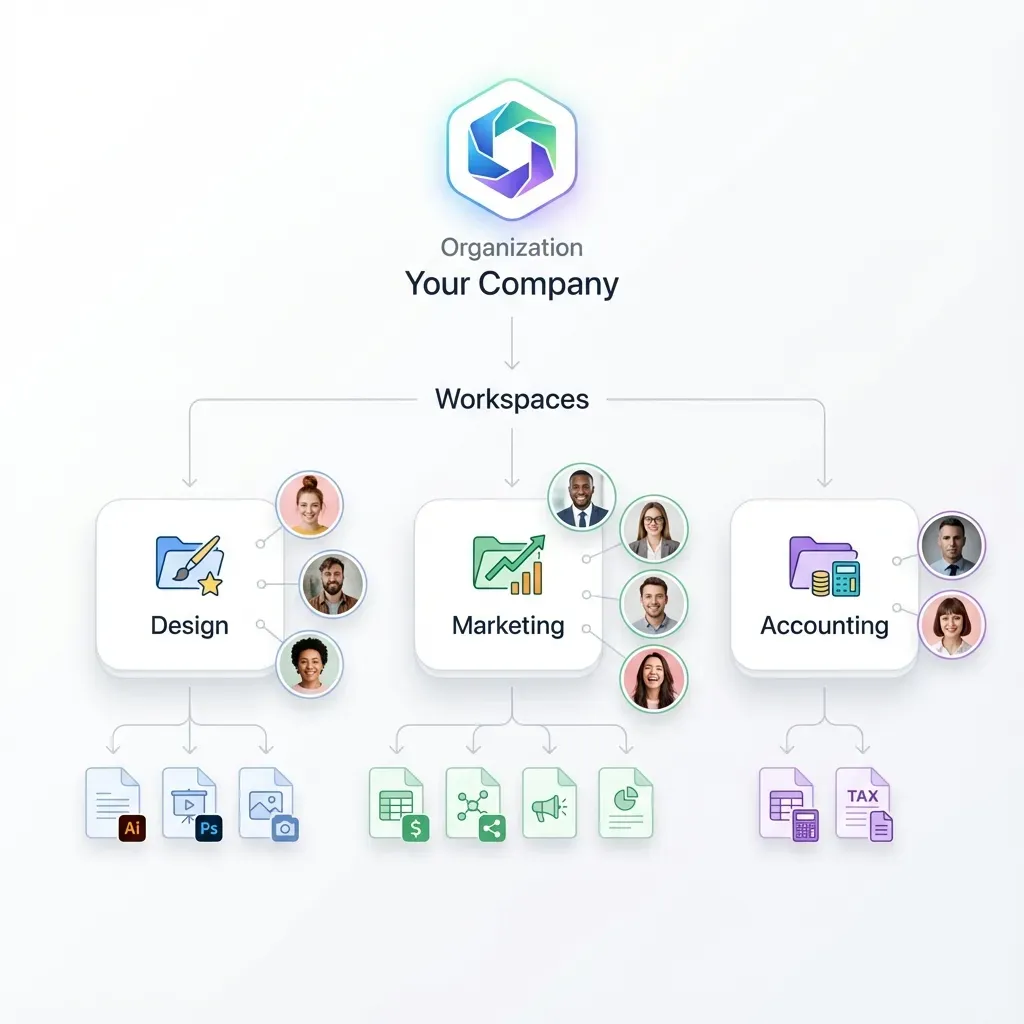
- Org-owned workspaces humans and agents can both use
- Per-file version history when agents rewrite deliverables
- Permissions at org, workspace, folder, and file level
- Detailed activity log for who changed what
- Branded shares (Send, Receive, Exchange) for reviewers who should not get full workspace access
- Intelligence Mode for auto-indexed search and chat with citations
- Metadata Views when PDFs, decks, or scans need structured fields in a queryable table
- Consolidated MCP access over Streamable HTTP at
/mcpand legacy SSE at/sse(see mcp.fast.io and mcp.fast.io/skill.md) - Ownership transfer when an agent stages structure and a human takes org ownership
Fast.io organizations run on paid plans (Starter $9.99/mo, Business $49.99/mo, Enterprise $199.99/mo) after a 14-day free trial that requires a credit card. That commercial model is different from Manus Free: Fast.io is the durable workspace and handoff layer, Manus is the action engine that burns credits while working.
A practical Free-to-paid path
- Create a Free Manus account and run one Chat task plus one small agent task.
- Compare those burns to official examples (200, 360, 900 credits) and your remaining balance.
- If you only need occasional agent runs, stay Free and keep using Chat for cheap questions.
- If you run multi-step agent work weekly, move to Pro at a monthly credit size that matches your average week, not your busiest day.
- If two or more people share the load, move to Team at $20/seat/month with pooled 4,000 credits per seat.
- Park research packs, site exports, and client-facing files in a shared workspace with version history so a credit cliff does not strand the only copy of the work.
Re-check manus.im/pricing and plans docs before you lock a budget. Credit packages and promotions change even when the Free-with-limits structure stays stable.
Sources
References used to verify factual claims in this guide.
-
Manus Free plan has limited monthly credits and core capabilities; Pro has generous monthly credits and full capabilities; Team has a shared credit pool with collaboration and admin controls; credits consume by task complexity; Chat mode is recommended for simple queries; plan credits reset monthly; add-on credits never expire; low balance triggers notification with upgrade or purchase options.
-
Pricing page lists individual packages with 4,000, 8,000, and 40,000 credits per month; 300 refresh credits everyday; 20 concurrent and 20 scheduled tasks; Free Cloud Computer on the 40,000-credit package; annual billing advertised with about 17% savings; free trial / start messaging on plan CTAs.
-
Credits measure usage by complexity and duration; consumption drivers include LLM tokens, virtual machines, and third-party APIs; credits only consume during active processing; official examples use 200, 360, and 900 credits; free users upgrade for more credits; consumption order is event, daily, monthly, add-on, then free credits; free and add-on credits never expire; monthly credits refresh on subscription date.
-
Team plan is US$20 per seat per month or US$200 per seat per year; 4,000 credits per seat per month shared by all team members; admin dashboard with usage tracking; team owners can purchase add-on credits and enable auto-purchase.
Frequently Asked Questions
Is Manus AI free forever?
Manus offers an ongoing Free plan with limited monthly credits for individual exploration, so you can keep a free account. It is not free unlimited agent capacity forever. Plan credits reset on the billing cycle, complex tasks burn credits based on complexity, and production-scale work typically needs Pro or Team.
How do Manus AI credits work?
Credits measure Manus usage. Burn scales with task complexity and mainly comes from LLM tokens, virtual machines for browser and code work, and third-party APIs. Credits are only spent during active processing. Official examples include about 200 credits for a standard analysis task, 360 for a standard website build, and 900 for a complex multi-integration app. Chat mode is recommended for simple queries to save credits versus full autonomous agent runs.
What happens when Manus AI credits run out?
Manus notifies you when the balance is low. Free users upgrade to a membership for more credits. Paid users can buy add-on credit packs that do not expire, upgrade to a higher plan, or on Team enable auto-purchase so work is not interrupted. Plan credits refill on the subscription cycle; add-ons are the non-expiring top-up path.
Does Manus AI have a free plan or only a free trial?
Official plans documentation lists a Free plan with limited monthly credits alongside Pro and Team. Pricing marketing also uses free-trial language for getting started on paid capacity. Treat Free as the ongoing limited tier and trial language as the path into paid credits. Confirm what your account shows after signup.
How many credits do Pro and Team plans include?
The public pricing page lists individual packages at 4,000, 8,000, and 40,000 credits per month, each with 300 refresh credits every day and up to 20 concurrent and 20 scheduled tasks. Team is listed at US$20 per seat per month with 4,000 credits per seat pooled across the team. Exact Free allotments and dollar prices can change, so verify on manus.im/pricing and manus.im/team.
Can teams share Manus AI credits?
Yes. Official docs state Team and Enterprise plans include shared credit pools. The Team page shows 4,000 credits per seat per month added to a pool all members can use, with admin usage tracking. Free and individual Pro seats are not a multi-user shared pool.
How can I make Free or paid Manus credits last longer?
Use Chat mode for simple questions, write specific prompts, batch related work, review intermediate results before expensive next steps, and check dashboard estimates before starting. Avoid defaulting every small question into a full multi-tool agent session that spins virtual machines and browser automation.
Related Resources

Keep Manus deliverables in one shared workspace
Store research packs, site exports, and review files where agents and humans share version history, permissions, and MCP access. Start with a 14-day free trial on Starter, Business, or Enterprise.