Llama 3.2 Context Window: 128K Limits for Vision and Edge Models
The Llama 3.2 context window is 128,000 tokens, supporting simultaneous ingestion of high-resolution image tokens and text across edge and enterprise deployments. While 1B and 3B models bring long-context processing to edge devices, full 128K sequences create high Key-Value cache memory overhead. In multimodal 11B and 90B models, vision tiles convert to thousands of tokens, making external retrieval via MCP essential to prevent GPU memory exhaustion on local workstations.


Llama 3.2 Context Window Limits Across 1B, 3B, 11B, and 90B Models
Meta's official model specifications document that the Llama 3.2 collection of multilingual models natively supports a context window of 131,072 tokens across both lightweight text models and multimodal vision models, while specialized on-device quantized checkpoints reduce context to 8,192 tokens for resource-constrained hardware. This 128k token context window ceiling, first introduced in the Llama 3 series, provides architectural parity across distinct model parameter classes. Whether deploying a compact 1B model on an edge device or a 90B vision model on an enterprise cluster, engineering teams have access to the same 128,000-token addressable context space.
In practical terms, a 128,000-token context window accommodates approximately 96,000 English words, corresponding to roughly 300 to 350 pages of single-spaced text. This sequence capacity allows developers to feed complete software libraries, extensive regulatory filings, or prolonged multi-turn agent interactions directly into the Llama model in a single prompt.
Parameter Classes and Context Configurations
The Llama 3 release comprises four primary model sizes, divided into text-only edge models and multimodal vision models:
Llama 3.21B: A lightweight text-only model of approximately 1.2 billion parameters (1.23B), this Llama generative model supports context tokens up to 131,072 positions for on-device deployment, local summarization, multilingual query rewriting, and agent tool calling. It features 16 transformer layers, 32 attention heads, and 8 Key-Value heads using Grouped-Query Attention (GQA).Llama 3.23B: A mid-sized edge model of approximately 3.2 billion parameters (3.21B), this Llama model processes 128k context tokens for instruction following, multi-turn reasoning, and complex agent workflows. It scales to 28 transformer layers, 24 attention heads, and 8 Key-Value heads with GQA.Llama 3.211B Vision: A multimodal model of approximately 11 billion parameters (10.6B) built on top of the Llama 3 text architecture. It integrates a separate vision adapter and image encoder through cross-attention layers, supporting high-resolution image reasoning, document visual question answering (DocVQA), and chart interpretation alongside text across 128k context tokens.Llama 3.290B Vision: An enterprise-tier multimodal model of approximately 89 billion parameters (88.8B) built on the Llama 3 text architecture. It pairs high-capacity text reasoning with cross-attention visual adapters, designed to process complex visual diagrams, multi-image comparison tasks, and extensive textual corpora across 128k context tokens.
The following comparison details parameter counts, attention configurations, context windows, and operational targets across the Llama 3.2 lineup:
Standard Checkpoints Versus 8K Quantized Edge Checkpoints
A critical distinction exists between Meta's standard instruction-tuned checkpoints and its official quantized edge releases. While the standard 1B and 3B models support 131,072 tokens out of the box, the quantized models prepared with PyTorch ExecuTorch, Quantization-Aware Training (QAT), and SpinQuant specify an 8,192-token context length.
Meta designed these 8k quantized variants specifically for mobile Arm CPU backends and embedded devices where allocating memory for a Llama 128k context window Key-Value cache is physically impossible due to constrained RAM and thermal envelopes. Engineers targeting low-power mobile applications must account for this 8k ceiling, whereas developers deploying standard GGUF or vLLM containers on desktop hardware can access the full Llama 128k context window tokens.
Related guides
- Llama 3.1 Context Window: 128K Tokens, RoPE Scaling, and Hardware NeedsThe Llama 3.1 context window is 128,000 tokens across all model sizes (8B, 70B, and 405B), enabled by an adjusted RoPE...
- Qwen Context Window: Model Specifications, Memory Limits, and MCP RetrievalThe Qwen context window is the total sequence capacity of tokens that Alibaba's Qwen models can ingest and generate in...
- Llama 3 Context Window: Limits Across 3.1, 3.2, 3.3, and MCP SearchThe Llama 3 context window is the token buffer defining how much text Meta's open-weights models can interpret at once,...
- Mistral Large Context Window: 128K Token Limits, Retrieval, and Cost OptimizationThe Mistral Large context window supports up to 128,000 tokens of input, enabling processing of extensive codebases and...
- Amazon Nova Context Window: Token Limits for Micro, Lite, Pro, and PremierAmazon Nova context windows span 128,000 tokens for Nova Micro, 300,000 tokens for Nova Lite and Pro, up to 1,000,000...
- AWS Bedrock Context Window: Token Limits, Model Capacities, and Memory ArchitectureThe AWS Bedrock context window defines the maximum sequence of input and output tokens a hosted foundation model...
More on this subject: Agent Memory and Storage (263 guides)
How Image Resolution Tiles Convert to Tokens in Llama 3.2 Vision
Many technical guides discuss multimodal models as if images were simply free text tokens. In reality, processing visual inputs requires converting two-dimensional pixel arrays into discrete embedding vectors that consume space across the Llama 128k context window tokens. In Llama 3.2 Vision models (11B and 90B), high-resolution images can consume thousands of tokens in a single inference call, rapidly eating into context budgets.
Meta avoided early concatenation fusion, where image tokens are simply merged into the initial text embedding sequence. Instead, the Llama 3.2 Vision model uses a separately trained vision adapter that feeds representations from an image encoder into the core transformer via cross-attention layers. Understanding how images convert into tokens requires tracing the pipeline from raw pixels to cross-attention vectors.
The Vision Adapter and Cross-Attention Architecture
The visual processing pipeline integrates a vision encoder based on a Vision Transformer (ViT) with the core language model:
- Image Ingestion: The input pipeline accepts images up to 1120x1120 pixels in resolution.
- Tile Decomposition: The processor slices the image into standardized tiles of 560x560 pixels.
- Patch Generation: Inside each tile, the image is further subdivided into 14x14 pixel patches.
- Cross-Attention Coupling: The resulting patch embeddings pass through cross-attention layers interleaved throughout the language transformer decoder. Text tokens act as queries, while visual embeddings act as keys and values.
Mathematical Conversion: From Tiles to Context Tokens
The exact token footprint of an image depends on its resolution and the resulting tile count:
- Patches per Tile: Each 560x560 tile contains 40 patches along the horizontal axis and 40 patches along the vertical axis (560 divided by 14 equals 40). Multiplying 40 by 40 yields 1,600 patches per tile.
- Base Tile Footprint: A single standard image fitting within 560x560 pixels generates exactly 1,600 visual tokens for the Llama vision model.
- Multi-Tile Scaling: For higher-resolution images, the processor dynamically creates up to 4 tiles arranged in a 2x2 grid, supporting images up to 1120x1120 pixels across the Llama 128k context window tokens.
- Maximum Visual Tokens: When an image requires the full 4 tiles, it generates 4 multiplied by 1,600, resulting in 6,400 visual tokens for the Llama vision model.
The following table outlines how input image dimensions map to tiles, patches, and context token consumption:
Sequence Budgeting and Context Consumption
Because a single high-resolution image consumes 6,400 tokens, visual inputs rapidly deplete Llama model context capacity. A batch of four high-resolution document scans consumes 25,600 tokens, which represents one-fifth of the entire Llama 128k context window before adding system prompts, tool schemas, or dialogue history.
In user prompts, special <|image|> placeholder tokens denote where visual embeddings bind. While the cross-attention mechanism prevents visual tokens from quadratically expanding self-attention matrix computations among text tokens, the Key-Value states for those visual tokens must still be maintained in GPU memory throughout the entire generation cycle.
Why Local KV Caching Exceeds GPU Memory at 128K Context Length
When evaluating Llama 3.2 on local developer machines, engineers often assume that because quantized 1B and 3B models occupy only 1 GB to 2 GB of storage, they can effortlessly process 128k context sequences. This assumption overlooks the Key-Value (KV) cache, which expands linearly with sequence length and quickly outgrows the static model weights.
In transformer architectures using Grouped-Query Attention, the memory required to maintain the KV cache is calculated using a precise formula:
KV Cache Memory (Bytes) = 2 * layers * kv_heads * head_dim * bytes_per_element * sequence_length
The multiplier of 2 accounts for separate key and value matrices. For standard 16-bit floating-point precision (FP16 or BF16), each element consumes 2 bytes.
Mathematical Memory Breakdown by Model Size
Applying this formula across the Llama 3.2 family illustrates why consumer graphics cards run out of memory during long-context execution:
Llama 3.21B: Built with 16 layers, 8 Key-Value heads, and a head dimension of 64. Each token requires 2 * 16 * 8 * 64 * 2 = 32,768 bytes (32 KB). Across a full 131,072-token sequence, the KV cache alone demands 131,072 * 32 KB = 4,294,967,296 bytes, or 4 GiB. While the 4-bit Llama model weights take up only 1 GB, the KV cache across 128k context tokens is more than four times larger than the model itself.Llama 3.23B: Built with 28 layers, 8 Key-Value heads, and a head dimension of 128. Each token requires 2 * 28 * 8 * 128 * 2 = 114,688 bytes (112 KB). Over 131,072 sequence tokens, the Llama model KV cache consumes 131,072 * 112 KB = 15,032,385,536 bytes, or 14 GiB. Combined with 2 GB of 4-bit weights and activation buffers, running the Llama model across 128k context tokens requires roughly 17 GB of VRAM, exceeding standard 16 GB GPUs like the RTX 4080.Llama 3.211B Vision: The text backbone features 32 layers, 8 Key-Value heads, and a head dimension of 128, consuming 128 KB per token. At 131,072 tokens, the text KV cache alone requires 16 GiB for the Llama vision model. When factoring in 8 GB of 4-bit weights and the additional cross-attention cache for 6,400-token images, total memory for the Llama vision model exceeds 26 GB to 30 GB.Llama 3.290B Vision: The text backbone features 80 layers, 8 Key-Value heads, and a head dimension of 128, consuming 320 KB per token. At 131,072 tokens, the text KV cache requires 40 GiB for the Llama vision model. Paired with roughly 50 GB of 4-bit weights, total allocation for the Llama vision model exceeds 95 GB, requiring multiple 80 GB enterprise GPUs.
The table below compares weight sizes and memory footprints across sequence lengths:
Failure Modes on Local Hardware
When local inference engines exceed available graphics memory, systems fail in one of two ways:
- CUDA Out-Of-Memory (OOM) Abort: The inference runtime terminates abruptly, throwing a memory allocation error and discarding all generated output.
- PCIe Memory Paging Collapse: The operating system swaps excess KV cache pages to system RAM over the PCIe bus. When running the Llama model without dedicated GPU memory, token generation speeds plummet from forty tokens per second to less than two tokens per second.
Context Ceilings and File Boundaries in Hosted Interfaces
Memory constraints are not unique to local machines. Hosted workspaces face similar context boundaries. For example, Anthropic documents that in Claude Projects, users can upload an unlimited number of reference files, but the cumulative content must fit within Claude's active context window (see Anthropic's file upload guidelines). When project documentation expands, teams encounter context limits and attention dilution, where models struggle to retrieve details placed in the middle of lengthy prompts.
Rather than stuffing thousands of lines of raw text into sequence memory, a cleaner architecture separates file storage from prompt context.
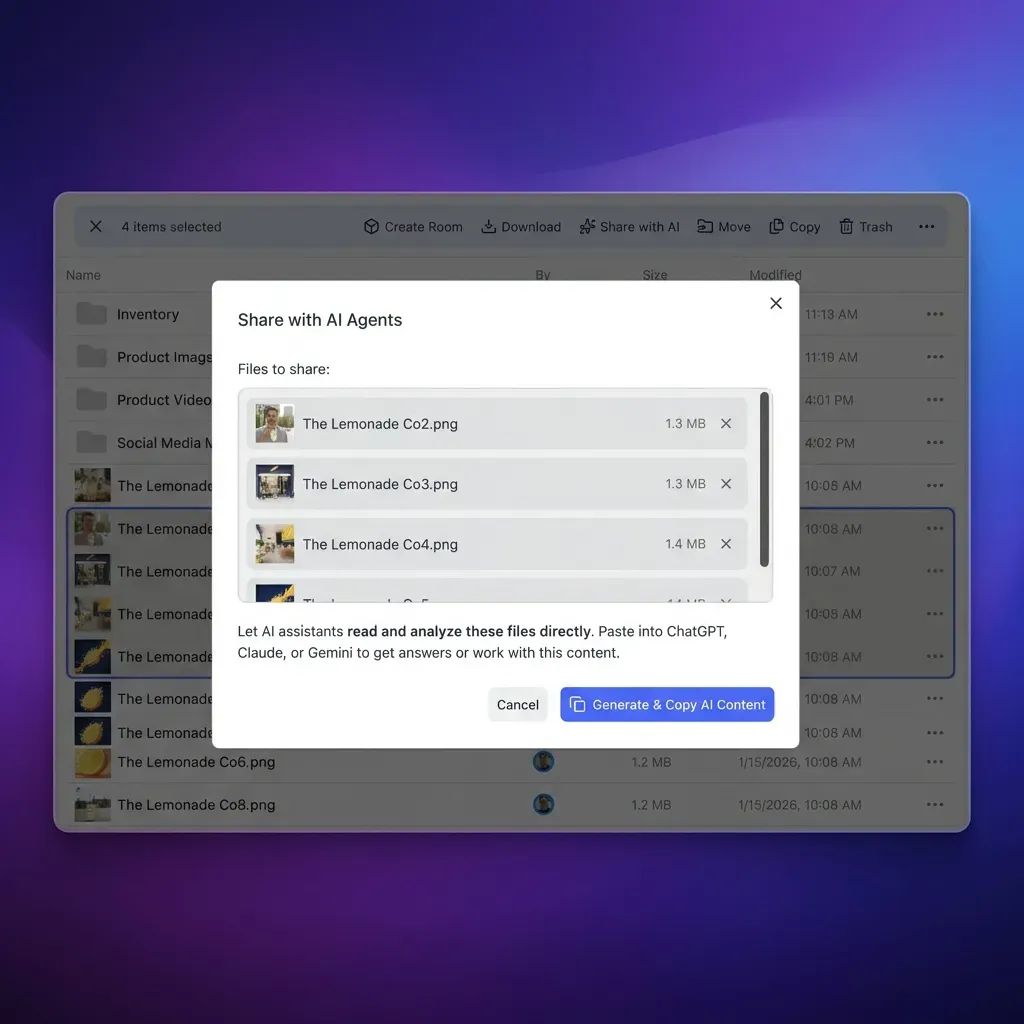


Query Massive Document Corpuses Without Overloading Local GPU Memory
Connect local Llama 3.2 models to persistent Fast.io workspaces using our remote Model Context Protocol server. Index repositories and multimodal documents with Intelligence Mode for fast hybrid search, keeping inference responsive and within local VRAM budgets. Monthly plans start with a trial of up to 14 days (credit card required); annual plans have no trial. Plans are Starter at $9.99/mo, Business at $49.99/mo, and Enterprise at $199.99/mo.
Connecting Llama 3.2 to External Document Repositories Using Remote Fast.io MCP
The architectural solution to Key-Value cache exhaustion is decoupled external retrieval. Instead of forcing local graphics cards to maintain 100,000 tokens of raw text, code, and visual tiles in active memory, you store your complete document corpus in an external cloud workspace and fetch only relevant passages into prompt context on demand.
This workflow keeps your local Llama model operating within a compact 4k or 8k context window across prompt tokens. At an 8k context window, the KV cache for the Llama 3.2 3B model consumes minimal VRAM across input tokens, allowing the model to run at peak generation speed on consumer hardware.
Fast.io provides shared cloud workspaces where human teams and autonomous AI agents collaborate on the same files, version histories, and contextual intelligence.
Indexing Repositories in Fast.io Workspaces
Setting up an external retrieval pipeline for local Llama 3.2 models involves four operational steps:
- Establish a Workspace: Create an organization workspace dedicated to your project documentation, codebases, or multimodal assets.
- Ingest Documents and Media: Upload files directly or connect cloud storage. Cloud Sync is supported for Google Drive, Dropbox, Box, and OneDrive, running one-way or two-way on a schedule or on demand.
- Activate Intelligence Mode: Enable Intelligence Mode in workspace settings. Fast.io automatically indexes incoming files, parsing document hierarchies and generating searchable embeddings without requiring a separate vector database.
- Hybrid Search Retrieval: Fast.io combines full-text BM25 keyword matching with semantic vector search. Lexical matching retrieves exact symbol names, error codes, and API routes without hallucination, while semantic retrieval surfaces conceptual explanations.
Because indexing and vector search execute in the cloud, developer workstations consume zero local GPU memory and zero local disk space for embeddings.
Configuring the Remote Model Context Protocol Server
The Model Context Protocol (MCP) is an open standard that allows local models, coding assistants, and IDE extensions to interact with external tools and storage. Fast.io operates a remote MCP server accessible over Streamable HTTP at https://mcp.fast.io/mcp/code for coding agents and IDE extensions, with client setup documentation at mcp.fast.io/docs.
In your local client configuration file, such as cline_mcp_settings.json for Cline or corresponding configuration files for agent runners, configure the remote Fast.io connection:
{
  "mcpServers": {
    "fastio": {
      "type": "streamableHttp",
      "url": "https://mcp.fast.io/mcp/code"
    }
  }
}
When you connect, sign in to Fastio in the browser window that opens. The Review Permissions screen lets you select Read Only or Read & Write access and choose which organizations and workspaces the connection can reach.
Developers configuring multi-agent systems can explore connection patterns in the storage for agents documentation and the agent onboarding guide.
The External Retrieval Workflow in Practice
With the remote MCP server connected, the Llama model acts as an agile reasoning engine rather than an overloaded storage cache:
- User Query: You ask the model to resolve an architectural question or debug a function across your codebase.
- Tool Invocation: The Llama model detects that the prompt requires project context and issues an MCP tool call to query the specified Fast.io workspace.
- Hybrid Search Execution: Fast.io searches indexed files and extracts the top relevant snippets, complete with file paths and line references.
- Focused Reasoning: The retrieved excerpts occupy only 400 to 600 tokens of prompt context. The local model synthesizes the answer in milliseconds, keeping GPU temperatures low and memory consumption minimal.
Workspace Governance for Agentic Teams
When multiple agents and developers work across the same files, Fast.io provides foundational operational controls:
- Per-File Version History: Every file retains a complete version history. If an agent produces an unintended change, developers can inspect diffs and restore previous versions immediately.
- Detailed Activity Log: Fast.io logs every file read, upload, search, and update in the activity log, providing operational transparency.
- Ownership Transfer: An autonomous agent can establish an organization, build workspace directories, and hand off ownership to a human team lead, while the agent retains operational access.
When to Feed Raw Context Versus Querying External Workspaces
Deciding whether to inject documents directly into the Llama model native 128k context window tokens or retrieve excerpts via remote MCP search depends on document structure, execution frequency, and available hardware.
Appropriate Scenarios for Native 128K Context
Direct prompt injection across the full 128k sequence length is optimal when:
- Single Monolithic Document Analysis: Reviewing an entire academic thesis, legal contract, or regulatory filing where continuous narrative continuity across chapters is necessary.
- Sequential Crash Log Traces: Debugging linear system logs where stack traces and timestamps must remain contiguous to diagnose an intermittent race condition.
- Single-File Refactoring: Restructuring a massive source file where all variable definitions and execution paths exist within a single continuous stream.
- Dedicated High-Memory Cloud GPUs: Running inference for Llama long-context tokens on enterprise infrastructure equipped with 80 GB or 144 GB GPUs where KV cache memory allocation is fully accounted for.
Scenarios Demanding Remote MCP Search
External retrieval via Fast.io's remote MCP server is the superior architectural choice when:
- Multi-File Code Repositories: Codebases containing dozens or hundreds of files where loading everything causes context dilution, high latency, and memory exhaustion.
- Frequently Updated Knowledge Bases: Repositories receiving regular updates. Files imported or uploaded to Fast.io are indexed automatically without manual vector database rebuilds.
- Local Developer Workstations: Deploying Llama models across long-context tokens on 8 GB, 16 GB, or 24 GB consumer GPUs where preserving VRAM is essential for interactive response speeds.
- Production Cost and Latency Control: Production systems seeking to avoid quadratic prefill compute costs by passing 500 targeted tokens per query rather than 100,000 tokens on every conversational turn.
For developer teams deploying Llama models across long-context tokens, monthly plans start with a trial of up to 14 days, which requires a credit card. Plans for teams deploying Llama models across 128k context tokens are Starter at $9.99/mo, Business at $49.99/mo, and Enterprise at $199.99/mo on the Fastio pricing page, providing scalable cloud workspaces, granular access controls, and consolidated MCP tooling.
Sources
References used to verify factual claims in this guide.
-
The Llama 3.2 collection of multilingual models includes pretrained and instruction-tuned generative models in 1B and 3B sizes supporting context windows of up to 128k tokens.
-
To support image recognition tasks across 11B and 90B models, the Llama 3.2-Vision model uses a separately trained vision adapter with cross-attention layers supporting 128k context tokens.
Frequently Asked Questions
What is the context window for Llama 3.2?
The Llama 3.2 context window is 128,000 tokens (131,072 tokens) across all standard model sizes, including the 1B, 3B, 11B Vision, and 90B Vision checkpoints. This matches the 128k context capacity introduced in Llama 3.1, enabling the models to ingest approximately 96,000 words or 300 pages of text in a single prompt.
Does Llama 3.2 1B support 128k context window?
Yes, the standard pre-trained and instruction-tuned Llama 3.2 1B model natively supports context windows of up to 131,072 tokens. However, processing a full sequence in 16-bit precision for Llama long-context tokens requires roughly 4 GiB of VRAM exclusively for the Key-Value cache. For mobile and embedded devices, Meta also provides official 8k quantized checkpoints of the Llama model optimized for Arm CPUs using ExecuTorch across 8,192 context tokens.
How do vision tokens affect Llama 3.2 context limits?
In Llama 3.2 Vision (11B and 90B), images are decomposed into 560x560 pixel tiles with 14x14 patches, generating 1,600 tokens per tile for the Llama vision model. High-resolution images up to 1120x1120 pixels use up to 4 tiles, generating 6,400 visual tokens per image across the Llama 128k context window tokens. These tokens directly consume space in the 128k context window, meaning a batch of four high-resolution images consumes 25,600 tokens.
How much VRAM is required to run Llama 3 models at 128k context?
Running the Llama model 1B at 128k context tokens with 4-bit weights and an FP16 KV cache requires roughly 5 GB of VRAM for the Llama context window. For the `Llama 3.2` 3B model, total VRAM reaches approximately 17 GB for Llama long-context tokens, exceeding standard 16 GB graphics cards unless FP8 KV cache quantization is applied. Llama 3.2 11B Vision requires roughly 28 GB for long-context tokens, and 90B Vision requires approximately 98 GB of total GPU memory.
What is the difference between standard Llama 3.2 models and quantized edge checkpoints?
Standard Llama 3.2 models are full-precision or instruction-tuned checkpoints supporting the complete 128k context window across desktop and server runtimes. Quantized edge checkpoints of the Llama model, developed using Quantization-Aware Training (QAT) and SpinQuant for ExecuTorch, are restricted to an 8k context window across prompt tokens to fit the strict memory and thermal limitations of mobile Arm devices.
How does remote MCP search solve KV cache memory exhaustion?
Remote Model Context Protocol (MCP) search decouples file storage from active GPU memory. Instead of loading an entire repository or document collection into prompt context, files are indexed in a cloud Fast.io workspace. When the Llama model needs information, it queries the workspace via MCP and retrieves only the most relevant 400 to 600 tokens, keeping local KV cache memory under 500 MB.
Related Resources

Query Massive Document Corpuses Without Overloading Local GPU Memory
Connect local Llama 3.2 models to persistent Fast.io workspaces using our remote Model Context Protocol server. Index repositories and multimodal documents with Intelligence Mode for fast hybrid search, keeping inference responsive and within local VRAM budgets. Monthly plans start with a trial of up to 14 days (credit card required); annual plans have no trial. Plans are Starter at $9.99/mo, Business at $49.99/mo, and Enterprise at $199.99/mo.