Llama 3.1 Context Window: 128K Tokens, RoPE Scaling, and Hardware Needs
The Llama 3.1 context window is 128,000 tokens across all model sizes (8B, 70B, and 405B), enabled by an adjusted RoPE base frequency of 500,000. While this sixteen-fold expansion over Llama 3's 8,192-token limit supports extensive inputs, running full sequences locally introduces severe hardware bottlenecks. Because storing the Llama 128k context window Key-Value cache consumes up to 16 GB of VRAM on the 8B model alone, teams decouple storage using remote Model Context Protocol retrieval.


Llama 3.1 Context Window Limits Across 8B, 70B, and 405B Models
Meta trained the original Llama 3 base model on sequences of 8,192 tokens before expanding native context support to 131,072 tokens across Llama 3.1. In the final stages of pre-training, Meta trained Llama 3 on long sequences to support context windows of up to 128K tokens. This sixteen-fold expansion addressed the primary operational constraint of first-generation Llama 3 weights, where an 8,192-token ceiling truncated multi-file code reviews, document processing, and extended agent conversations.
The Llama 3.1 context window is 128,000 tokens across all model sizes (8B, 70B, and 405B), enabled by an adjusted RoPE base frequency of 500,000. In practical terms, 128,000 tokens corresponds to roughly 96,000 words or roughly 300 pages of single-spaced text. This allows engineers to ingest entire system architectures, lengthy legal contracts, or multi-turn conversational logs in a single inference call.
Understanding the context limits of each release requires examining parameter sizes, attention mechanisms, and release specifications:
Parameter Classes and Architectural Uniformity
Unlike prior model generations where smaller checkpoints received constrained context windows, Meta maintained structural parity across the entire Llama 3.1 family:
Llama 3.18B: The lightweight model features 32 transformer layers, 32 attention heads, and 8 Key-Value heads with Grouped-Query Attention (GQA). It supports the full 131,072-token window out of the box, making it a popular choice for developer workstations and local coding assistants.Llama 3.170B: The mid-range model scales to 80 transformer layers, 64 attention heads, and 8 Key-Value heads. Retaining 8 Key-Value heads via GQA restricts Key-Value cache growth relative to standard multi-head attention, enabling enterprise servers to process extended documents without dedicated multi-node clusters.Llama 3.1405B: The flagship model scales to 126 transformer layers, 128 attention heads, and 8 Key-Value heads. Meta designed this architecture as a frontier open-weights model capable of long-sequence reasoning, complex synthetic data generation, and multi-step tool execution across the full 128k token context length.
Related guides
- Llama 3.2 Context Window: 128K Limits for Vision and Edge ModelsThe Llama 3.2 context window is 128,000 tokens, supporting simultaneous ingestion of high-resolution image tokens and...
- Llama 3 Context Window: Limits Across 3.1, 3.2, 3.3, and MCP SearchThe Llama 3 context window is the token buffer defining how much text Meta's open-weights models can interpret at once,...
- Qwen Context Window: Model Specifications, Memory Limits, and MCP RetrievalThe Qwen context window is the total sequence capacity of tokens that Alibaba's Qwen models can ingest and generate in...
- DeepSeek R1 Context Window: Reasoning Tokens and Prompt BudgetsThe DeepSeek-R1 context window is 128,000 tokens, dynamically partitioned between the input prompt, chain-of-thought...
- LiteLLM Context Window Guide: Managing Input Tokens, Fallbacks & StorageIn LiteLLM, the context window is the maximum input token threshold configured per model deployment that determines...
- Mistral Large Context Window: 128K Token Limits, Retrieval, and Cost OptimizationThe Mistral Large context window supports up to 128,000 tokens of input, enabling processing of extensive codebases and...
More on this subject: Agent Memory and Storage (263 guides)
How RoPE Scaling Enables the 128k Token Context Window
Transformer language models require positional information to distinguish the order of tokens in an input sequence. Standard transformers use Rotary Position Embeddings (RoPE), which encode positional relationships by rotating query and key representations in two-dimensional sub-spaces of the embedding layer.
While effective for original Llama base model sequence lengths of 8,192 tokens, this default configuration creates severe frequency crowding when evaluated on longer sequences. High-frequency dimensions rotate too quickly across distant token positions, while low-frequency dimensions fail to differentiate relative distances between far-apart tokens. This leads to attention collapse, where models lose the ability to resolve cross-document references.
Meta's Adjusted RoPE Base Frequency
To expand context support to 131,072 tokens without retraining models from scratch, Meta increased the RoPE base frequency hyperparameter from 10,000 to 500,000.
Increasing the base frequency to 500,000 stretches the wavelength of the rotational positional encoding. By slowing the rotational speed across embedding dimensions, the model retains distinct positional coordinates across extended token sequences. Meta adopted this technique based on empirical research showing that elevated RoPE base frequencies preserve spatial resolution across long sequences while avoiding the mathematical complexity of dynamic position interpolation.
Multi-Stage Long-Context Continued Pre-Training
Changing positional embedding frequencies alone does not grant long-context comprehension. If an engineer takes an 8k-trained checkpoint and alters the base frequency to 500,000 without continued training, model perplexity degrades and retrieval accuracy drops sharply.
Meta addressed this challenge by executing a disciplined continued pre-training regimen on roughly 800 billion tokens of long-sequence data. Rather than jumping directly from 8,192 tokens to 131,072 tokens, the engineering team scaled sequence lengths incrementally across six progressive stages:
- Stage 1 (8k to 16k tokens): Meta trained Llama on long sequences using web text to stabilize attention heads under the updated base frequency.
- Stage 2 (16k to 32k tokens): Meta trained Llama on long sequences of books and manuals to ensure cross-section continuity.
- Stage 3 (32k to 64k tokens): Meta trained Llama on long sequences of synthetic retrieval tasks to recall variables across extended contexts.
- Stage 4 (64k to 100k tokens): Meta trained Llama on long context sequences to counter positional drift and mitigate lost-in-the-middle phenomena.
- Stage 5 (100k to 128k tokens): Meta trained Llama on long sequences to support context windows of 128k tokens across dense research compilations.
- Stage 6 (Final Alignment): Completed targeted post-training with Direct Preference Optimization (DPO) and supervised fine-tuning on long-context instruction datasets.
This staged curriculum prevented catastrophic forgetting. Benchmark evaluations confirmed that Meta trained Llama models maintained identical scores on short-context evaluations while demonstrating high retrieval accuracy on synthetic Needle-in-a-Haystack tests across the full 128k context window.
Why 128k Context Demands Massive GPU Memory for KV Cache
To understand why Llama 128k context sequences overwhelm graphics cards, engineers must distinguish static model weights from dynamic execution buffers. Developers attempting to load large codebases or documentation sets into local inference engines frequently encounter immediate out-of-memory errors.
Total Video RAM (VRAM) allocation during inference comprises three components:
- Model Weights: The static parameters of the neural network. For Llama base model architectures, a 4-bit quantized 8B model requires roughly 5 GB of VRAM, while unquantized 16-bit FP16 weights require approximately 16 GB.
- Activation Buffers: Intermediate memory allocated during the forward attention pass, scaling with prompt length and layer width.
- Key-Value (KV) Cache: Memory reserved to store precomputed key and value vectors for preceding tokens, avoiding redundant recomputation during auto-regressive generation.
Calculating Key-Value Cache Growth
In architectures using Grouped-Query Attention, Key-Value cache memory requirements scale linearly with sequence length according to a strict mathematical formula:
KV Cache Memory (Bytes) = 2 * layers * kv_heads * head_dim * bytes_per_element * sequence_length
For Llama 3.1 8B, the network uses 32 layers, 8 Key-Value heads, a head dimension of 128, and 2 bytes per element for standard 16-bit floating-point precision (FP16 or BF16). Each token consumes:
2 * 32 * 8 * 128 * 2 = 131,072 bytes per token (128 KB)
Over a full 131,072-token sequence, the Key-Value cache alone requires:
131,072 * 128 KB = 16,777,216 KB = 16.0 GiB (roughly 17.18 GB)
For Llama 3.1 70B, the model scales to 80 layers, 8 Key-Value heads, and a head dimension of 128. In 16-bit precision, each token consumes:
2 * 80 * 8 * 128 * 2 = 327,680 bytes per token (320 KB)
At the full sequence limit of 131,072 tokens, the 70B Key-Value cache requires:
131,072 * 320 KB = 41,943,040 KB = 40.0 GiB (roughly 42.95 GB)
The table below outlines total VRAM requirements across common context lengths and parameter sizes, combining quantized weights with Key-Value memory:
Why Consumer GPUs Hit Memory Outages
A developer running a quantized 4-bit Llama base model on a consumer graphics card with 16 GB of VRAM (such as an Nvidia GeForce RTX 4080) starts with roughly 11 GB of headroom after loading model weights. At an 8k context window, the Llama model Key-Value cache consumes only 1 GB of memory across input tokens, allowing rapid generation.
However, expanding the context window to 128k tokens demands 16 GB solely for the Key-Value cache. Combined with 5 GB of Llama base model weights and activation memory, total requirements exceed 21 GB. This immediately exceeds available hardware memory.
When memory limits are breached, inference engines respond in one of two ways:
- Immediate Crash: The CUDA runtime triggers an out-of-memory exception and halts execution.
- PCIe Memory Paging: The engine offloads cache pages to host system RAM over the PCIe bus. Because system RAM bandwidth is over ten times slower than dedicated graphics memory, token generation collapses from forty tokens per second to fewer than two tokens per second.
Key-Value Cache Quantization Trade-offs
To mitigate cache explosion, modern runtimes like vLLM, llama.cpp, and Ollama support Key-Value cache quantization:
- FP8 Cache Quantization: Stores key and value vectors in 8-bit floating-point format. This cuts cache memory in half, reducing the Llama 128k context cache from 16 GB to 8 GB, allowing it to fit into a 24 GB GPU alongside 4-bit weights with minimal loss in accuracy.
- 4-bit Cache Quantization (q4_0): Quarters cache memory, reducing the Llama 128k context window cache to roughly 4 GB. However, 4-bit quantization introduces noticeable quantization noise. In technical coding tasks and syntax parsing, aggressive cache compression causes dropped variable references and hallucinated function arguments.
Context Dilution and File Boundaries in Hosted Interfaces
Memory constraints are not unique to local machines. Hosted workspaces face similar context boundaries. For example, Anthropic documents that in Claude Projects, users can upload an unlimited number of reference files, but the cumulative content must fit within Claude's active context window (see Anthropic's file upload guidelines). When project documentation expands, teams encounter context limits and attention dilution, where models struggle to retrieve details placed in the middle of lengthy prompts.
Rather than stuffing thousands of lines of raw text into sequence memory, a cleaner architecture separates file storage from prompt context.
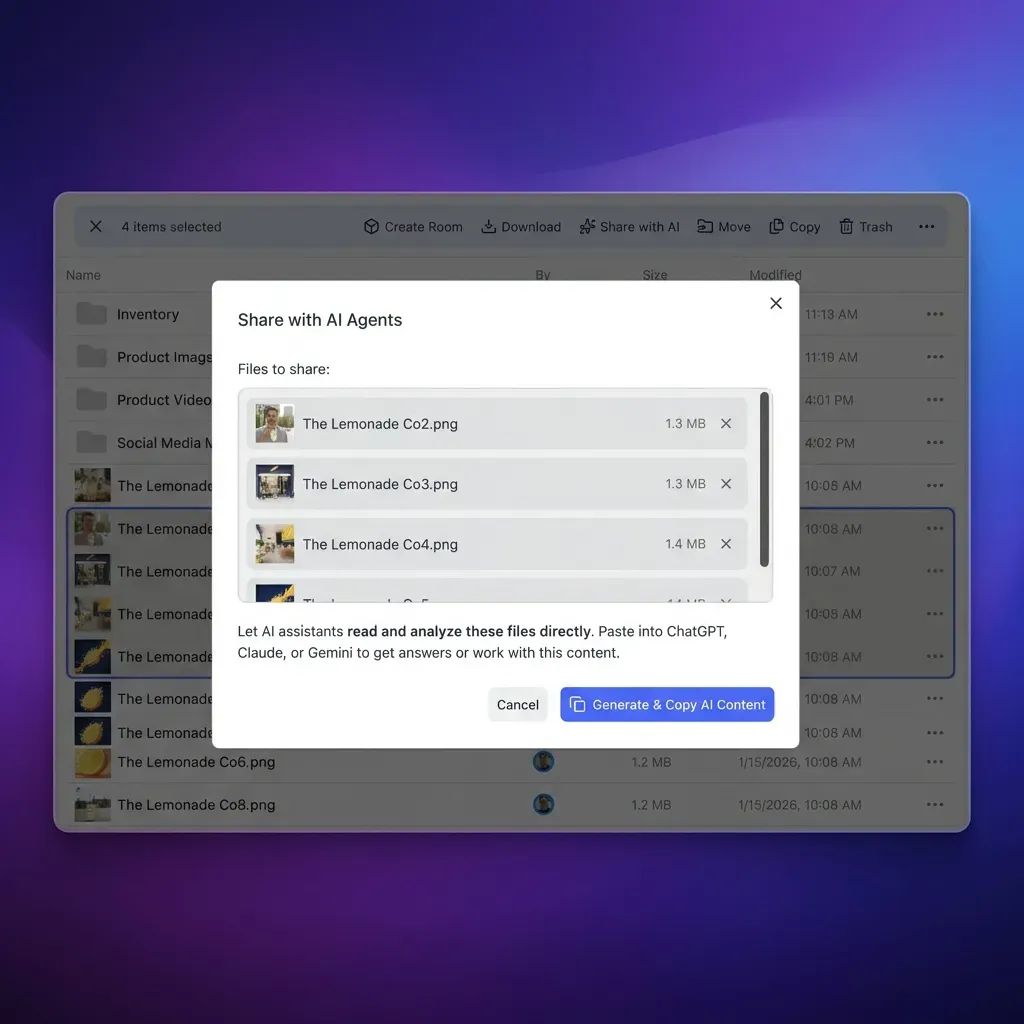


Search Large Document Corpuses Without Overloading Local VRAM
Connect local Llama models to persistent Fast.io workspaces using our remote Model Context Protocol server. Index repositories and documentation with Intelligence Mode for hybrid search, keeping inference fast and within local GPU memory budgets. Monthly plans start with a trial of up to 14 days (credit card required); annual plans have no trial.
How to Connect Llama 3.1 to Document Corpuses via Remote Fast.io MCP
The architectural remedy to Key-Value cache exhaustion is decoupled external retrieval. Instead of forcing local GPUs to retain 100,000 tokens of static documentation in active memory, you store files in an external cloud workspace and fetch only relevant passages into prompt context on demand.
This workflow keeps your local Llama model running across 4k or 8k context window tokens, keeping Key-Value cache memory below 2 GB while inference operates at top generation speeds.
Fast.io provides shared cloud workspaces where human teams and autonomous AI agents collaborate on the same files, version histories, and contextual intelligence.
Indexing Repositories in Fast.io Workspaces
Setting up external knowledge retrieval for local Llama models follows four steps:
- Create a Workspace: Establish an organization workspace dedicated to your codebases, engineering manuals, or reference documents.
- Ingest Files: Upload files directly or connect cloud storage. Cloud Sync ships for Google Drive, Dropbox, Box, and OneDrive, running one-way or two-way, on a schedule or on demand rather than continuously.
- Activate Intelligence Mode: Enable Intelligence Mode in workspace settings. Fast.io automatically indexes files on arrival, parsing document hierarchies and generating searchable embeddings.
- Hybrid Search Retrieval: Fast.io combines BM25 full-text keyword matching with semantic vector retrieval. Exact lexical matching identifies specific function names, API endpoints, variable names, and error codes without hallucination, while semantic search retrieves conceptually related explanations.
Because indexing, storage, and similarity search execute in the Fast.io cloud, local developer workstations consume zero local VRAM and zero CPU cycles managing vector databases.
Connecting via the Remote Model Context Protocol Server
The Model Context Protocol (MCP) is an open standard enabling local models, coding agents, and IDE tools to interact with external data sources. Fast.io operates a remote MCP server accessible over Streamable HTTP at https://mcp.fast.io/mcp/code. Step-by-step setup instructions are available in the Fast.io MCP documentation.
In your client configuration file, such as cline_mcp_settings.json for Cline or corresponding configuration files for agent runners, configure the remote server connection:
{
  "mcpServers": {
    "fastio": {
      "type": "streamableHttp",
      "url": "https://mcp.fast.io/mcp/code"
    }
  }
}
Sign in to Fast.io using OAuth in the browser window that opens. Fast.io displays a Review Permissions screen where you choose Read Only or Read & Write access and select which organizations and workspaces the connection can reach.
Engineers configuring agentic environments can explore connection architectures in the storage for agents overview and the agent onboarding reference.
The Retrieval Workflow in Action
With the remote MCP server configured, Llama 3.1 acts as a reasoning engine rather than an overloaded storage cache:
- Developer Query: You ask your assistant to debug an integration issue or explain an architecture decision.
- MCP Tool Call:
Llama 3.1detects that the answer requires project knowledge and issues an MCP tool call to query the designated Fast.io workspace. - Hybrid Search Execution: Fast.io queries indexed files and extracts two or three relevant excerpts, complete with file names and section references.
- Focused Reasoning: The retrieved passages consume only 400 to 600 tokens of prompt context. Your local model synthesizes the answer in milliseconds, keeping GPU temperatures low and execution fast.
When to Use Native 128k Sequences Versus External MCP Search
Determining whether to feed documents directly into Llama 3.1's native context window or query them through remote MCP retrieval depends on document structure, task frequency, and hardware availability.
Appropriate Use Cases for Native 128k Context
Direct prompt injection across the full 128k sequence length is optimal when:
- Monolithic Document Analysis: Reading a single cohesive manuscript, technical thesis, or regulatory filing where every paragraph directly informs the next.
- Chronological Trace Inspection: Debugging linear crash logs where contiguous continuity is necessary to track execution flow.
- Single-File Refactoring: Overhauling a massive legacy code file where all dependencies exist within the same file stream.
- Cloud GPU Infrastructure: Running inference for Llama long-context tokens on dedicated cloud clusters equipped with 80 GB or 144 GB GPUs where Key-Value cache memory overhead is fully accounted for.
Scenarios Demanding Remote MCP Retrieval
External retrieval via Fast.io's remote MCP server is the recommended pattern when:
- Multi-File Code Repositories: Codebases spanning dozens or hundreds of files where loading everything causes context dilution, high latency, and memory crashes.
- Evolving Project Libraries: Repositories receiving regular commits. Files synced to Fast.io are re-indexed automatically without manual database rebuilds.
- Local Workstations: Running Llama long-context models on 8 GB, 16 GB, or 24 GB consumer GPUs where preserving VRAM is essential for interactive response speeds.
- Cost-Conscious API Implementations: Production systems seeking to avoid quadratic prefill compute bills by passing 500 targeted tokens per query rather than 100,000 tokens on every conversational turn.
Workspace Governance for Multi-Agent Teams
When developer teams and autonomous AI assistants collaborate across project files, Fast.io provides operational safeguards:
- Per-File Version History: Every file maintains an accessible version history. If an autonomous coding agent introduces an incorrect refactor, developers can inspect diffs and restore previous file versions instantly.
- Activity Log: Fast.io logs every file read, upload, search, and edit in a detailed activity log, providing complete operational accountability.
- Ownership Transfer: Autonomous agents can register an organization, build workspace file trees, and transfer ownership to human leads via a secure claim link.
Monthly plans start with a trial of up to 14 days (credit card required); annual plans have no trial. For developer teams deploying Llama models across long-context tokens, plans are Starter at $9.99/mo, Business at $49.99/mo, and Enterprise at $199.99/mo on the Fastio pricing page, providing scalable cloud storage, granular access controls, and consolidated MCP tooling for developer teams deploying open-weights models.
Sources
References used to verify factual claims in this guide.
-
In the final stages of pre-training, Meta trained Llama 3 on long sequences to support context windows of up to 128K tokens.
-
Meta trained the original Llama 3 base model on sequences of 8,192 tokens.
Frequently Asked Questions
What is the context window for `Llama 3.1`?
The `Llama 3.1` context window is 128,000 tokens across all model sizes, including the 8B, 70B, and 405B checkpoints. This represents a sixteen-fold expansion over the original Llama 3 release, which was limited to an 8,192-token context window. The expanded sequence length allows `Llama 3.1` to ingest roughly 300 pages of text in a single prompt.
How many tokens can `Llama 3.1` 8B process?
The `Llama 3.1` 8B model natively supports context windows of up to 131,072 tokens. However, processing a full sequence in 16-bit precision for Llama long-context tokens requires roughly 16 GB of video memory exclusively for the Key-Value cache. When combined with model weights, running Llama at full context length across 128k tokens exceeds the memory capacity of typical 8 GB and 16 GB graphics cards, requiring Key-Value cache quantization or external retrieval via MCP.
How much VRAM do I need for Llama 3 models at 128k context?
Running Llama 3 8B at full 128k context with 4-bit weights and a standard 16-bit Key-Value cache requires roughly 22 GB of VRAM, fitting onto a 24 GB GPU like the RTX 3090 or RTX 4090. If you apply FP8 Key-Value cache quantization for Llama long-context tokens, memory requirements drop to roughly 14 GB, allowing it to run on 16 GB GPUs. For `Llama 3.1` 70B, the 16-bit Key-Value cache alone requires 40 GB of VRAM for long-context sequences, demanding at least 80 GB of total GPU memory when paired with 4-bit weights.
How does the Llama 3 model achieve 128k context length?
The Llama 3 release achieves a 128k token context window by increasing the Rotary Position Embedding (RoPE) base frequency hyperparameter from 10,000 to 500,000. This adjustment lengthens the positional encoding wavelength, preventing frequency crowding for distant tokens. Meta then trained Llama on long sequences of roughly 800 billion tokens across six stages ranging from 8k to 128k tokens to stabilize attention.
What is the difference between RoPE scaling in Llama 3 and `Llama 3.1`?
The original Llama 3 base model used a standard RoPE base frequency of 10,000 calibrated for 8,192 tokens. Attempting to evaluate original Llama base model inputs beyond 8k tokens caused positional confusion and high perplexity. The updated Llama 3 context architecture increased the base frequency to 500,000 and incorporated scaled rotational frequencies, allowing self-attention layers to distinguish token positions across sequence lengths of up to 131,072 tokens without collapsing.
How does remote MCP search solve KV cache memory exhaustion?
Remote Model Context Protocol search decouples file storage from language model memory. Instead of loading an entire repository or document set into active prompt context, files are indexed in a shared Fast.io workspace. When the model needs information, it executes an MCP tool call that extracts only the top relevant excerpts via hybrid search. The returned passages consume only 400 to 600 tokens, keeping inference fast and within local GPU memory limits.
Related Resources

Search Large Document Corpuses Without Overloading Local VRAM
Connect local Llama models to persistent Fast.io workspaces using our remote Model Context Protocol server. Index repositories and documentation with Intelligence Mode for hybrid search, keeping inference fast and within local GPU memory budgets. Monthly plans start with a trial of up to 14 days (credit card required); annual plans have no trial.