Law Firm IT Solutions: Modernizing Infrastructure and Secure Workspaces
Law firm IT solutions encompass the specialized cloud infrastructure, software platforms, and network architectures designed to protect client confidentiality and simplify legal operations. Modern law practices require moving beyond brittle on-premise file servers and VPN tunnels toward matter-centric cloud workspaces. This guide provides an architectural roadmap covering secure client portals, granular permission controls, and defensible audit logging.


Why Legacy File Servers and Virtual Private Networks Fail in Legal Practice
Law firm infrastructure frequently breaks down at the intersection of network boundaries and external file sharing. When attorneys and litigation paralegals rely on on-premise Windows file servers through sluggish VPN tunnels, remote file transfers stall, connection drops corrupt open documents, and staff inevitably bypass security policies by emailing privileged exhibits or using personal cloud storage. The technical architecture that supported law firms two decades ago cannot sustain modern legal practice, where attorneys review thousands of discovery documents from home offices, courtrooms, and client sites.
Law firm IT solutions refer to the specialized hardware, cloud infrastructure, and software architectures designed to maintain confidentiality, accelerate document workflows, and enable remote legal operations. For years, legal practices addressed remote work requirements by adding virtual private networks to on-premise local area networks. An attorney working remotely connects through a VPN client to access mapped network drives running on an in-office server. While this model maintains files behind a physical perimeter, it introduces critical operational bottlenecks.
The primary technical flaw lies in the underlying file sharing protocols. Protocols like Server Message Block were designed for high-speed, low-latency local office cabling. When transmitted across residential broadband connections and encrypted VPN tunnels, the chatty communication pattern of SMB causes severe latency. Opening a complex estate planning portfolio or a multi-megabyte pleading can take minutes. If the internet connection flickers while an attorney edits a file, the application freezes, often leaving locked temp files on the server or corrupting the working copy.
Faced with these delays, legal staff find workarounds to maintain billable output. Paralegals copy entire case folders to local desktop drives, creating unmanaged file duplicates that fall outside firm backup routines. Attorneys send confidential discovery materials as email attachments, bypassing central storage and generating unversioned drafts scattered across private inboxes. When an infrastructure model forces staff to choose between firm security policies and client deadlines, the security policy always loses.
Most managed service providers fail to resolve this core issue. Generic IT providers typically pitch commoditized managed service contracts focused on workstation antivirus, scheduled server patches, and firewall hardware renewals. These measures maintain existing equipment, but they preserve an obsolete architectural model. Law firms do not need faster on-premise file servers or more VPN licenses. Legal practices require modern law firm IT solutions that treat documents as living, collaborative workspaces accessible from any secure endpoint without network bridging.
Related guides
- Secure Workspace Infrastructure for Law Firm Virtual AssistantsAttorneys deploying a virtual assistant for law firms struggle to protect client confidentiality because consumer-grade...
- Client Portal Software for Law Firms: Comparing Secure Client WorkspacesClient portal software for law firms creates a protected digital environment for sharing pleadings, collecting...
- Law Firm Collaboration Software: Managing Cross-Firm, Co-Counsel, and Client WorkspacesLaw firm collaboration software provides structured, permission-controlled digital workspaces where attorneys,...
- Law Firm Document Sharing: Secure External Delivery for Counsel and ClientsLaw firm document sharing requires controlled, encrypted pathways to distribute privileged files, discovery materials,...
- Legal Tech Solutions: The Modern Law Firm Technology GuideLegal tech solutions encompass software applications and digital platforms engineered to coordinate legal operations,...
- Google Drive Alternatives for Law Firms: Secure Document ManagementFinding secure google drive alternatives for law firms is essential to protect client confidentiality and organize case...
More on this subject: Legal Teams (197 guides)
What Modern Law Firm IT Solutions Require for Secure Infrastructure
Transitioning a legal practice away from legacy hardware requires replacing ad-hoc network storage with a structured, defense-in-depth architecture. Modern legal IT environments must satisfy two competing demands: protecting sensitive client confidences and allowing rapid, friction-free document retrieval across distributed teams. A modern law firm infrastructure framework rests on four core architectural pillars.
1. Matter-Centric Cloud Document Workspaces
Traditional file servers organize data around arbitrary drive letters and deep folder trees. In an on-premise environment, files frequently end up buried under shared drives where permissions are poorly managed. A modern infrastructure organizes storage around the fundamental unit of legal work: the matter.
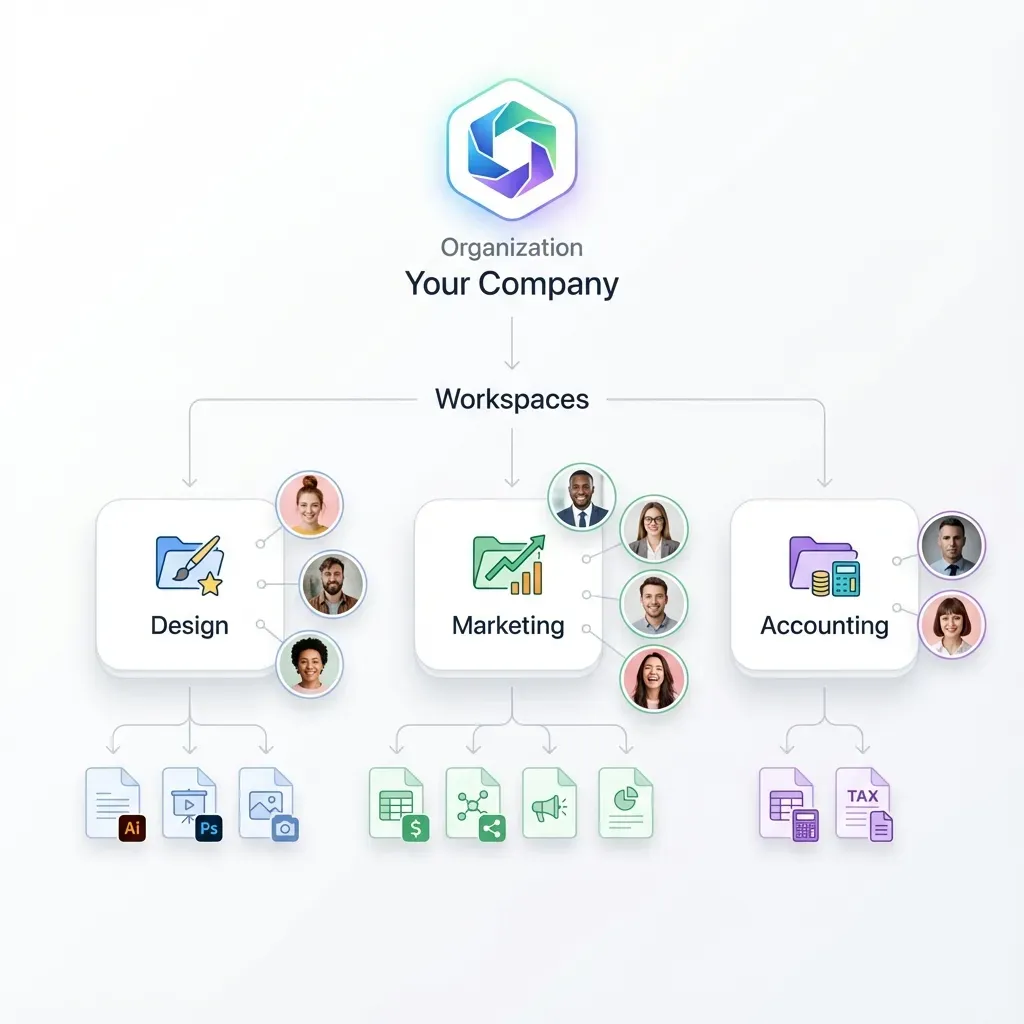
In a matter-centric workspace architecture, each client engagement receives an isolated digital workspace. All pleadings, transactional agreements, discovery collections, and correspondence related to that case reside within this dedicated perimeter. This structure prevents cross-matter document contamination, simplifies billing reconciliation, and ensures that when a matter closes, the entire record can be archived or placed on legal hold cleanly.
2. Secure External Client Portals and Inbound Channels
Legal practice requires continuous document exchange with external parties, including clients, co-counsel, expert witnesses, opposing counsel, and regulatory bodies. Relying on email attachments exposes the firm to interception risks, spoofing attacks, and attachment size limits.
Instead of relying on disconnected third-party file transfer tools or rigid virtual data rooms, modern legal infrastructure incorporates branded client portals and direct inbound upload links. Instead of sending raw attachments, legal teams share secure, access-controlled links configured with strict expiration parameters. For inbound document intake, such as onboarding new corporate clients or collecting tax records for personal injury matters, the infrastructure provides Receive and Exchange shares. External parties upload sensitive files directly into the designated matter workspace via a web browser, bypassing email servers entirely without requiring complex account registration.
3. Granular Access Control and Ethical Walls
Law firms operate under stringent ethical rules requiring the isolation of confidential data. Conflicts of interest, high-profile corporate transactions, and internal personnel matters demand strict information barriers, commonly referred to as ethical walls.
On traditional file servers, managing ethical walls requires editing Windows Access Control Lists, a process prone to human error and permission inheritance bugs. Modern cloud workspaces provide granular access controls enforced at the organization, workspace, folder, and file level. Firm administrators can restrict visibility so that only designated attorneys and paralegals assigned to a matter can view its contents. Support staff working across multiple practice groups receive role-scoped access that prevents accidental exposure to restricted case files.
4. Defensible Audit Logging and Complete Version History
When disputes arise regarding document custody or access timing, a law firm must provide verifiable records. Traditional file servers maintain rudimentary event logs that are difficult to parse, easily overwritten during drive maintenance, and rarely retained for extended litigation cycles.
A modern legal infrastructure implements an append-only audit log that captures every interaction with the file system. Every file upload, preview, download, link creation, and permission modification is recorded in an immutable event log. Complementing the audit trail is per-file version history. Every time an attorney edits a brief or updates an agreement, the system records a new version while preserving the complete historical record. If an erroneous edit occurs or a draft is overwritten, previous iterations can be restored instantly, eliminating frantic searches through backup tapes.
Steps for Migrating On-Premise File Servers to Cloud Workspaces
Migrating a firm's file repository from an on-premise Windows server or aging network-attached storage system to a modern cloud workspace platform requires careful technical staging. Unplanned migrations risk file path truncation, broken internal links, and practice disruption during active litigation. Legal IT leads and operations managers should execute migrations using a four-stage deployment plan.
Stage 1: Data Discovery and Matter Classification
Before transferring bytes, administrators must audit existing server volumes to separate active matter files from historical archives and firm administrative documents. On-premise servers accumulate gigabytes of orphaned scratch files, temporary working copies, and obsolete software installers.
Administrators should run storage analysis tools to identify folder hierarchies, calculate storage footprints, and identify files exceeding standard path limits. Files should be categorized into active litigation or transactional matters, closed matters eligible for cold archiving, firm governance documents, and billing records. Moving forward, active matters should be mapped directly to dedicated workspaces, while closed archives can be transferred to low-overhead archival storage. Check with your firm's own counsel or records policy to confirm mandatory retention schedules before purging historical files.
Stage 2: Standardizing Workspace Taxonomy
A primary cause of document loss in law firms is inconsistent folder naming across different attorney pods. One partner might organize matters by date, while another files documents by document type. Migrating to a cloud workspace provides the opportunity to enforce a uniform directory taxonomy across the practice.
A standardized litigation matter folder hierarchy should follow a predictable structure:
- 01_Pleadings_and_Motions: All filed court documents, motions, orders, and hearing transcripts.
- 02_Discovery_and_Productions: Interrogatories, document production requests, subpoena responses, and disclosures.
- 03_Client_Correspondence: Engagement letters, status updates, client emails, and meeting summaries.
- 04_Attorney_Work_Product: Research memoranda, case strategy outlines, trial notes, and draft arguments.
- 05_Exhibits_and_Media: Deposition video recordings, forensic data dumps, photographic exhibits, and audio files.
Standardizing this layout across every matter workspace allows paralegals and associate attorneys to locate essential filings immediately, regardless of which partner manages the case.
Stage 3: Managing High-Capacity Discovery and Evidentiary Files
Litigation discovery files present unique infrastructure challenges. Forensic hard drive images, high-resolution surveillance footage, and multi-hour deposition videos quickly exhaust bandwidth and overwhelm traditional cloud sync tools. When an attorney attempts to download a multi-gigabyte deposition video to a laptop before a trial hearing, standard file sync agents frequently fail mid-transfer.
To handle large files reliably, modern workspace platforms use chunked uploads. Chunked upload protocols split large files into independent segments during transit, automatically retrying dropped packets without restarting the entire transfer from the beginning. Furthermore, platforms that support browser-based HTTP Live Streaming allow attorneys to review deposition videos and audio recordings on demand without downloading the full media file to their local machine. This preserves local drive capacity and keeps confidential video files inside the secure workspace perimeter.
Stage 4: Cloud Import, Access Provisioning, and Cutover
The final migration phase involves moving data into cloud workspaces and shifting user workflows. Rather than transferring terabytes of data across local office internet connections, administrators can use cloud import tools to migrate existing repositories from services like Box, Dropbox, Google Drive, or OneDrive directly into structured workspaces.
Once data is ingested, administrators configure permission groups, mapping practice group leads to workspace administrator roles and restricting external sharing permissions to authorized staff. After validating file integrity and permissions, the on-premise file server should be set to read-only access. Disabling write permissions forces staff to adopt the new cloud workspaces immediately, preventing split-brain scenarios where attorneys update files in two different systems. Finally, administrators can decommission exposed VPN endpoints, eliminating an external entry point from the firm's attack surface.


Modernize your firm's file infrastructure with secure workspaces
Replace fragile file servers and VPN bottlenecks with matter-centric cloud storage, branded client portals, and a detailed activity log. Monthly plans start with a trial of up to 14 days (credit card required); annual plans have no trial. Plans are Starter at $9.99/mo, Business at $49.99/mo, and Enterprise at $199.99/mo.
Securing Client Document Exchange and External Data Intake
The greatest vulnerability in legal data security occurs when documents cross the firm's organizational boundary. Unencrypted email remains the default communication tool for many attorneys, yet email was never architected for secure data exchange. Sending tax returns, medical histories, trade secrets, or settlement term sheets as email attachments exposes clients to interception, misdirected sends, and malware risks.
Traditional legal client portals attempted to solve this issue, but often introduced excessive friction. Most legacy portals require clients to download specialized software, create an account, verify email addresses, and manage a unique set of credentials. When clients forget passwords or struggle with portal navigation, they abandon the system and email confidential documents directly to attorneys.
Modern legal IT infrastructure replaces clunky client portals with branded, browser-based delivery workspaces. Firms configure custom-branded portals displaying their logo, typography, and organizational identity. When counsel delivers a sensitive production or closing binder, the client receives a secure, branded link. The client accesses and reviews the documents directly in their browser without downloading software or registering for third-party accounts.
For sensitive transactions, IT administrators and attorneys can layer protective access controls onto shared links:
- Link Expiration Controls: Setting automated expiration windows ensures that access links expire after a predetermined duration, preventing dormant links from circulating indefinitely.
- Restricted Download Permissions: Documents can be made available for online viewing only, restricting clients or opposing counsel from downloading local copies when preliminary reviews are underway.
- Per-Recipient Access Scopes: Access can be restricted to specific authenticated recipient email addresses, preventing forwarded links from granting unauthorized access.
External data intake is equally critical. During client onboarding or discovery collection, firms must collect extensive records from outside parties. Using Receive and Exchange shares, legal teams provide clients with a dedicated inbound upload link. Clients drag and drop bank records, corporate filings, or photographic evidence into an encrypted browser window. The files route immediately into the appropriate matter folder, triggering activity notifications for the handling team and eliminating email attachments from the intake workflow.
Integrating Workspace Intelligence and Structured Document Extraction
Modern law practices handle volumes of unstructured text that overwhelm manual review workflows. Transactional attorneys reviewing merger agreements, litigators parsing opposing party productions, and compliance teams evaluating vendor contracts spend countless hours reading documents to locate critical data points. Modern law firm IT solutions bridge secure file storage with workspace intelligence and automated data extraction.
Fastio runs on cloud infrastructure partners, including Google Cloud Platform and Cloudflare, that are certified to industry-leading security standards. Within this infrastructure, legal teams can enable Intelligence Mode on matter workspaces to index case files for hybrid search. Traditional search engines in legacy file repositories rely on exact keyword matching, which fails when documents use synonyms, alternative spelling, or varying legal phrasing. Hybrid search combines full-text keyword indexing with semantic search, allowing attorneys to search by meaning and retrieve relevant clauses across thousands of filings, deposition transcripts, and scanned exhibits.
To extract structured insights from large document collections without manual data entry, firms use Metadata Views. Instead of manually reviewing hundreds of commercial agreements to record expiration dates and counterparties in a separate spreadsheet, administrators describe the desired fields in natural language. Fast.io automatically designs a typed schema supporting Text, Integer, Decimal, Boolean, URL, JSON, and Date and Time fields, evaluates the workspace documents, and populates a filterable spreadsheet view.
In a legal environment, Metadata Views transform complex document collections into actionable databases:
- Contract Portfolios: Automatically extract execution dates, governing law, termination notice periods, and indemnification caps from vendor contracts.
- Commercial Real Estate Leases: Pull square footage, commencement dates, base rent escalations, and renewal options across extensive lease portfolios.
- Discovery Exhibits: Extract author names, recipient lists, creation dates, and subject summaries from disclosed correspondence.
Because Metadata Views operate directly on workspace files without rigid optical character recognition templates, new data columns can be added at any time without reprocessing the underlying files.
Furthermore, forward-looking law firms can connect autonomous AI agents to their document repositories using the Model Context Protocol. Fast.io exposes a remote MCP server at https://mcp.fast.io/mcp/tools, enabling AI tools to query case workspaces, analyze extracted metadata, and summarize deposition transcripts while operating within strict workspace permission boundaries. By grounding intelligent search and structured data extraction inside an audited, org-owned workspace, legal IT administrators equip their firms with advanced capabilities while maintaining full data custody.
Frequently Asked Questions
What IT solutions are essential for modern law firms?
Essential law firm IT solutions include matter-centric cloud document workspaces, branded external client portals for secure document delivery, granular role-based access controls, and defensible audit logging. Modern firms also require hybrid search capabilities to locate case information quickly across large document archives, alongside structured metadata extraction to process contracts and discovery files without manual data entry.
How can law firms replace on-premise file servers with secure cloud storage?
Law firms replace on-premise servers by executing a phased migration: auditing existing data to separate active matters from closed archives, standardizing matter folder hierarchies across practice groups, using cloud import tools to ingest files directly, and configuring role-based permissions. Once files are migrated and verified, setting legacy servers to read-only ensures that staff transition immediately to the new cloud workspaces.
What security features should legal IT administrators look for in cloud workspaces?
Legal IT administrators should look for granular access controls enforced at the organization, workspace, folder, and file level to maintain ethical walls. Key security features include encryption in transit and at rest, an append-only audit log recording every user action, per-file version history to prevent accidental overwrites, and configurable external sharing controls with link expiration and download restrictions.
How do branded client portals improve document exchange over email attachments?
Branded client portals eliminate the security risks and file size limitations of unencrypted email attachments. By sharing documents through secure web portals, firms maintain complete control over link expiration, track file access in an audit log, and present a professional brand identity. Inbound upload links also allow clients to upload sensitive tax and financial records directly into matter folders without creating third-party accounts.
How should law firms handle multi-gigabyte discovery files and video depositions?
Law firms should handle multi-gigabyte files using cloud platforms that support chunked uploads and browser-based media streaming. Chunked uploads break large files into smaller data packets during transmission, preventing dropped connections from failing the entire upload. Browser-based streaming allows attorneys to review video depositions and audio records on demand without exhausting local laptop drive space.
Related Resources

Modernize your firm's file infrastructure with secure workspaces
Replace fragile file servers and VPN bottlenecks with matter-centric cloud storage, branded client portals, and a detailed activity log. Monthly plans start with a trial of up to 14 days (credit card required); annual plans have no trial. Plans are Starter at $9.99/mo, Business at $49.99/mo, and Enterprise at $199.99/mo.