Client Portal Software for Law Firms: Comparing Secure Client Workspaces
Client portal software for law firms creates a protected digital environment for sharing pleadings, collecting discovery records, and communicating with clients. While practice management platforms bundle basic messaging, firms handling large record sets and external co-counsel often require standalone branded workspaces. This guide compares portal architectures, security controls, and adoption strategies to eliminate unencrypted email attachments.

How Client Portal Software for Law Firms Solves the Delivery Bottleneck
When a client receives an email attachment or an invitation requiring them to create a username, password, and multi-factor profile just to review a draft pleading, they choose the path of least resistance: they email the sensitive document back as an unencrypted attachment. The client portal failed not because the security architecture was weak, but because mandatory registration created enough friction that the client bypassed it entirely.
Client portal software for law firms is a dedicated, encrypted digital environment allowing clients to upload case records, review pleadings, and communicate with counsel without relying on unencrypted email attachments. In practice, legal operations directors and practice managers face a persistent dilemma. Law firms handle sensitive client records, confidential corporate disclosures, and privileged communications daily. Yet the standard methods firms use to share these records remain divided between insecure email threads and rigid practice management systems.
Email remains the single largest operational vulnerability in client communications. Standard email transit does not guarantee point-to-point encryption, exposing attachments to intercept risks and forwarding errors. Furthermore, commercial email servers impose strict attachment caps that block large documents. When litigation produces deposition video, medical imaging records, or multi-gigabyte discovery exports, staff resort to consumer file-sharing links or physical drives. Both workarounds break the chain of custody and strip the firm of central administrative oversight.
At the same time, forcing clients into full practice management portals often backfires. When a consumer client hiring a personal injury attorney or estate planning firm must download a dedicated app, remember complex login credentials, and navigate an unfamiliar dashboard just to sign off on a single letter, adoption drops immediately. Staff spend valuable billable hours acting as technical support, resetting client passwords, or explaining where to find a document. Modern Fast.io workspaces resolve this friction by balancing strict access controls with an intuitive, branded delivery surface.

Related guides
- Legal Client Portal Software: Secure Document Exchange and Client WorkspacesLegal client portal software provides secure, branded web environments where clients review case documents, upload...
- Document Management Software for Small Law Firms: Simple Cloud SolutionsFor solo and boutique practices, managing case files and client records without a dedicated IT department can lead to...
- Trademark Management Software: Organizing Portfolios, Specimens, and Client WorkspacesTrademark management software helps IP law firms and corporate legal teams track registration deadlines, preserve...
- Best Legal Software for Small Firms: Essential Tech StackModern small law firms spend significant time on non-billable administrative work. Finding the best legal software for...
- Choosing a Document Management System for Law Firms: A Complete GuideChoosing a document management system for law firms requires balancing secure internal case storage with the practical...
- Law Firm Data Security: Operational Guide to Protecting Matter Files and Client DataLaw firm data security requires strict technical controls, matter-level workspace isolation, and encrypted document...
More on this subject: Legal Teams (211 guides)
How to Compare the Three Architectures of Legal Client Workspaces
Law firm IT leaders evaluate client portal tools across three distinct architectural categories: practice management add-on portals, enterprise legal extranets, and standalone branded workspaces. Each architecture addresses different operational priorities, firm sizes, and technical requirements.
Understanding the trade-offs between these models prevents firms from overpaying for unused seat licenses or deploying systems that clients refuse to adopt. Practice management suites prioritize internal billing records, enterprise extranets prioritize strict corporate governance, and standalone workspaces prioritize frictionless external delivery.
Practice Management Add-On Portals
Most boutique law firms encounter client portals through their practice management suite. Platforms like Clio and MyCase bundle client messaging, invoice delivery, and basic file sharing into their core software.
The primary advantage of this model is central record consolidation. When an attorney uploads a filed pleading to a case file, that pleading appears in the client portal automatically. Invoicing and credit card processing connect to the same ledger, simplifying billing operations.
However, practice management portals introduce notable operational constraints. First, pricing scales on a per-user, per-month subscription for firm staff. For example, MyCase pricing ranges from $50 per user per month for Basic to $130 per user per month for Advanced when billed annually. Basic includes limited client portal access, while higher tiers add document generation. Because every licensed user incurs a recurring fee, firms cannot easily grant access to outside co-counsel, expert witnesses, or contract investigators who only need access to a single matter. Second, these portals enforce rigid client logins. If a client forgets their password, document exchange halts. Finally, practice management systems struggle with large files. They are designed for PDF motions and Word pleadings, not gigabyte-scale deposition video or forensic disk images.
Enterprise Legal Extranets
Large law firms frequently deploy enterprise extranets built on top of traditional legal document management systems like iManage or NetDocuments, or customized SharePoint environments.
These extranets provide deep security governance. IT departments can enforce strict ethical walls, matter-centric folder security, and detailed compliance policies across hundreds of attorneys. Internal documents remain guarded within the firm repository.
The trade-off is administrative complexity. Provisioning an extranet workspace often requires IT intervention, formal user provisioning, and dedicated training. For small firms or fast-moving matters, the time required to configure an extranet exceeds the time required to prepare the legal deliverable itself. External clients often find enterprise extranet interfaces unintuitive, prompting them to request email attachments instead.
Standalone Branded Workspaces
Standalone branded workspaces offer a dedicated file sharing and delivery layer that operates independently of the firm internal billing or case management database. Platforms like Fast.io provide matter-centric workspaces designed specifically for high-capacity file exchange, client delivery, and external team collaboration.
Instead of forcing clients into a closed ecosystem with mandatory usernames and passwords, standalone workspaces allow firms to generate branded client portals with scoped share links. A client can open a link on their smartphone or laptop, review pleadings, and upload requested records without creating an account. The workspace maintains the firm branding, custom domain, and matter-specific organization.
This architecture excels when handling multi-party litigation, external co-counsel, and massive file volumes. Attorneys can create a dedicated matter workspace, upload discovery files through chunked uploads, and invite co-counsel without purchasing additional practice management seat licenses. Internal work product remains protected behind granular permissions while client deliverables remain easily accessible.
What to Look for in Secure Legal Client Portals
When assessing client portal software, legal operations leads must evaluate technical capabilities that directly impact adoption, security, and staff workload. A portal that satisfies IT security standards is worthless if clients refuse to use it, while an overly casual sharing tool exposes confidential case records to unauthorized access. Legal teams cannot afford to compromise between defensible compliance and everyday usability.
Firms should balance three core capabilities: reducing client-side friction to ensure adoption, preserving an immutable chain of custody across all file revisions, and maintaining high-capacity infrastructure that handles modern litigation media without failure. Practice managers should verify how each platform addresses these operational priorities before committing to a firm-wide deployment.
Frictionless Client Intake and Zero-Login Delivery
Client adoption is the primary metric determining whether a portal investment succeeds. If a client cannot open a shared document within thirty seconds, the portal has introduced unacceptable friction.
Effective client portals support flexible access models. For standard client updates, firms can generate branded share links protected by access passcodes and expiration dates. Clients access the workspace directly in a web browser without creating an account or downloading third-party software.
For document collection, portals should support dedicated Receive-style links. During intake, a paralegal sends the client a single upload link. The client drops tax documents, bank statements, or accident photos directly into the matter folder from their phone camera or computer. The client sees only the upload confirmation screen, preventing them from viewing any other files in the matter workspace. This eliminates email attachment limits and stops sensitive personal data from lingering in staff inboxes.
Per-File Version History and Immutable Audit Trails
In litigation and transactional practice, document confusion introduces severe operational risk. Circulating drafts through email produces conflicting versions named with ad hoc final tags.
Client portal software must maintain automatic, per-file version history. When an attorney or client uploads a revised draft, the system stores it as a new version under the same file record rather than creating a duplicate entry. Team members can view prior iterations, compare changes, and restore earlier drafts with a single click.
Equally critical is an append-only audit log. In legal matters, verifying who accessed a document, when they viewed it, and whether it was downloaded can resolve disputes regarding service or disclosure. An append-only audit log captures every user action, timestamp, and IP address. These records remain tamper-proof and exportable, providing practice managers with verifiable activity histories across the entire lifecycle of the matter.
High-Capacity Storage for Discovery and Video
Modern litigation involves media-heavy exhibits, surveillance footage, body camera recordings, medical scans, and dense electronic discovery archives. Standard client portals often time out when uploading large multimedia exhibits or extensive electronic discovery packages.
Law firms require platforms capable of chunked uploads, which break large files into smaller segments during transmission to ensure successful transfers over variable internet connections. Fast.io workspaces handle multi-gigabyte files reliably, making them well suited for transmitting extensive discovery record sets.
Furthermore, built-in HTTP Live Streaming (HLS) allows clients and co-counsel to stream deposition and surveillance video directly in their web browser. Attorneys do not need to wait for an entire video recording to download to their local hard drive before reviewing its contents.


Deliver case files through branded client workspaces
Complement your firm practice management tools with dedicated matter workspaces, per-file version history, branded client portals, and a detailed activity log. Monthly plans start with a trial of up to 14 days (credit card required); annual plans have no trial. Plans are Starter at $9.99/mo, Business at $49.99/mo, and Enterprise at $199.99/mo.
How to Organize Matter Workspaces for Client Portals
An effective client portal reflects the internal organization of the law firm. Establishing a consistent matter hierarchy ensures that attorneys, paralegals, and clients locate documents quickly. A disorganized workspace creates confusion, increases administrative overhead, and raises the risk of disclosing internal notes to external parties.
By establishing clear boundaries between public client records, sensitive discovery, and internal attorney work product, firms can standardize their delivery protocols across every active case. A well-designed workspace architecture also simplifies permissions management, ensuring that staff can onboard new clients, share updates with co-counsel, and collect sensitive records without risking accidental data cross-contamination. Standardizing this structure also ensures that all team members follow identical filing protocols, reducing onboarding time for new associates and paralegals.

Standardizing Matter-Centric Workspace Architecture
Firms should organize their workspace repository around client and matter identifiers. Rather than creating a single massive folder containing all firm files, practice managers create dedicated workspaces for individual matters.
A standard litigation matter workspace layout includes:
- 01 Pleadings and Orders. Public court filings, complaints, answers, and entered orders delivered to the client through a scoped share link.
- 02 Discovery and Exhibits. Depositions, interrogatories, and exhibit binders. Internal staff retain edit access, while external co-counsel receive scoped folder permissions.
- 03 Client Intake and Uploads. A dedicated folder configured with a Receive share link where the client drops requested documents.
- 04 Correspondence and Invoices. Engagement letters, retainer agreements, and billing statements accessible to the client throughout the matter.
By isolating matters into independent workspaces, firm administrators prevent cross-matter permission errors. Associates assigned to one case cannot view confidential records from another matter unless explicitly granted access.
Extracting Structured Document Data with Metadata Views
Legal teams spend countless administrative hours reviewing intake packets, contract schedules, and discovery productions to build reference indexes. Paralegals manually open hundreds of PDF files to record contract dates, counterparties, policy numbers, and settlement amounts into external spreadsheets.
Fast.io eliminates this manual data entry through Metadata Views. Metadata Views turn unstructured documents into a live, queryable database. Users describe the fields they want extracted in natural language, such as contract execution date, governing law, counterparty names, and total liability limits.
The system designs a typed schema across formats including Text, Integer, Decimal, Boolean, URL, JSON, and Date & Time. It extracts values directly from PDFs, scanned images, Word documents, and spreadsheets across the workspace, populating a sortable and filterable table. Legal teams can add new columns at any time without reprocessing files, allowing attorneys to search and filter case records by specific metadata values across an entire matter.
Real-Time Collaboration with Shared Notes
Alongside files, legal teams require a shared space to coordinate case strategy. Collaborative Notes inside Fast.io workspaces allow attorneys, paralegals, and connected AI agents to co-edit case chronologies, deposition outlines, and exhibit lists in real time. Notes live directly beside the matter files, ensuring that case strategy notes stay synchronized with primary evidence.
Checklist for Client Onboarding and Security Hygiene
Deploying client portal software requires thoughtful implementation to ensure staff adherence and protect client confidentiality. Establishing standard operating procedures prevents ad hoc workarounds, such as staff emailing attachments when in a hurry. Technology alone cannot solve security vulnerabilities if firm staff or clients bypass established workflows.
A successful rollout combines technical infrastructure safeguards with practical client communication protocols and disciplined matter-closing procedures. Legal operations managers should treat portal deployment as an ongoing operational standard, auditing permissions regularly and ensuring that every matter maintains consistent access controls from initial consultation to final archiving. When legal teams establish repeatable operational checklists, they protect client privilege, prevent inadvertent disclosures, and ensure consistent compliance across all active representations.
Infrastructure Security and Access Governance
Law firm IT leads must verify that external workspaces meet strict infrastructure security standards. Fast.io runs on cloud infrastructure partners, including Google Cloud Platform and Cloudflare, that are certified to industry-leading security standards. Data stays encrypted both in transit across public networks and at rest in cloud storage.
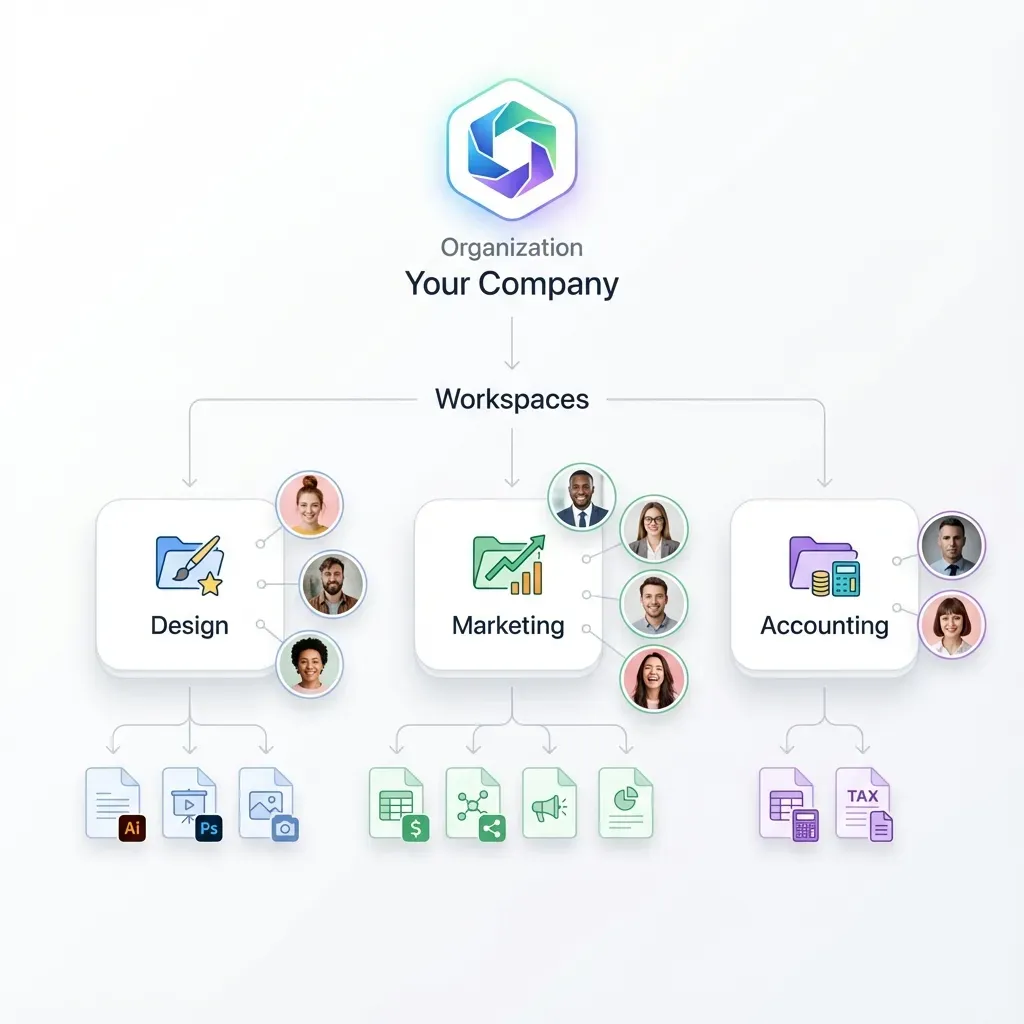
Governance starts with granular permissions. Administrators assign access at four distinct tiers: organization, workspace, folder, and file. Partners can maintain administrative oversight across all workspaces, while associates receive access only to their assigned matters. For external clients, firm staff configure branded share links with password protection and strict expiration dates, ensuring that access terminates automatically when no longer needed.
Onboarding Clients to the Portal
Client adoption begins at the initial consultation. When sending the initial engagement letter, staff should explain how the firm exchanges confidential files.
Practice managers should establish a clear onboarding protocol:
- Send the client a branded welcome link with clear, concise instructions.
- Highlight that sensitive financial records, medical histories, and discovery items should be uploaded through the portal link rather than email.
- Provide an intuitive, mobile-friendly upload path so clients can photograph and submit documents directly from their smartphone without installing software.
- Remind clients that documents shared through the portal remain protected and organized in one central location.
Matter Closing and Records Retention Protocols
Security hygiene continues after a case concludes. Leaving client delivery links active indefinitely creates unnecessary security exposure.
When a matter settles or litigation ends, firm staff should execute a formal closing protocol. First, revoke or expire all external share links associated with the matter workspace. Second, generate an export of the audit log to document all access events during the representation. Finally, archive the matter workspace according to firm record policies. Firms should always check with their own counsel or records retention policy to determine exact preservation duties and retention schedules.
Why Dedicated Client Workspaces Outperform Email Attachments
Selecting the right client portal software requires matching your firm operational bottlenecks to the appropriate architecture.
If your primary objective is consolidating billing, client invoicing, and basic client messaging within a single application, practice management platforms like Clio or MyCase provide a functional foundation for solo and small firms.
If your firm operates at enterprise scale with hundreds of attorneys, complex corporate governance, and existing document repositories, enterprise extranets integrated with iManage or NetDocuments deliver the required administrative control, despite high overhead.
If your firm requires a flexible, branded client delivery layer that handles extensive discovery files, deposition video, external co-counsel access, and automated document extraction without forcing clients into complex logins, a standalone workspace platform like legal data rooms or dedicated matter portals is the most effective solution.
Fast.io provides shared, organization-owned workspaces, granular permissions, per-file version history, and branded shares with zero-login delivery. Monthly plans start with a trial of up to 14 days (credit card required); annual plans have no trial. By deploying dedicated client workspaces, law firms can eliminate unencrypted email attachments, simplify document collection, and deliver a polished, professional client experience.
Sources
References used to verify factual claims in this guide.
-
MyCase pricing ranges from $50 per user per month for Basic to $130 per user per month for Advanced when billed annually.
Frequently Asked Questions
What is the best client portal software for law firms?
The best client portal software depends on whether your firm prioritizes billing integration, enterprise records management, or frictionless file delivery. For practice management and billing, Clio and MyCase provide built-in client communication modules. For firms handling large discovery sets, deposition video, and external co-counsel collaboration without forcing clients through complex account setups, standalone workspaces like Fast.io offer secure, branded portals with granular permissions and per-file version history.
How much does legal client portal software cost?
When purchased as part of an all-in-one practice management suite, legal client portal software is billed on a per-user, per-month subscription model that scales with firm headcount. In contrast, standalone workspace platforms like Fast.io offer flat organization-level plans for dedicated matter workspaces rather than charging per client or per external collaborator. Monthly plans start with a trial of up to 14 days (credit card required); annual plans have no trial.
Do legal clients actually use client portals?
Clients frequently abandon traditional portals that require mandatory account creation, password resets, and multi-step verification just to view a single pleading or upload a tax form. When firms deploy lightweight, branded share links with zero-login access or simple passcode verification, client adoption rates improve substantially because clients can upload and download files directly in their mobile or desktop browser without operational friction.
How do law firms share large discovery files with clients and co-counsel?
Law firms struggle to share large discovery files because email attachments fail on oversized files and basic practice management portals enforce strict upload caps. Secure client workspaces solve this by using chunked uploads to handle multi-gigabyte files, including deposition videos, forensic disk images, and massive document record sets, while providing streaming playback and expiring download links.
Can law firms use standalone client portals alongside practice management software?
Yes. Many firms maintain their practice management suite for billing, trust accounting, and court calendaring while using standalone workspaces for client document delivery and external file collection. This hybrid approach prevents client file size caps, avoids expensive per-user license fees for external co-counsel, and keeps client-facing deliverables separate from internal billing systems.
Related Resources

Deliver case files through branded client workspaces
Complement your firm practice management tools with dedicated matter workspaces, per-file version history, branded client portals, and a detailed activity log. Monthly plans start with a trial of up to 14 days (credit card required); annual plans have no trial. Plans are Starter at $9.99/mo, Business at $49.99/mo, and Enterprise at $199.99/mo.