Building a GitHub Copilot File Handoff Workflow with MCP Storage
GitHub Copilot helps developers write code faster, but manual clipboard copy-pasting breaks version control and increases errors. You can automate delivery by configuring Copilot with a custom Model Context Protocol (MCP) server. This guide shows how to build an automated file handoff workflow that writes files to a shared Fastio workspace, extracts build metrics, and hands code to human reviewers.


Why Developers Need a GitHub Copilot File Handoff Workflow
In the Stack Overflow Developer Survey 2025, 84% of developers reported that they use or plan to use AI tools in their development workflows [Stack Overflow Developer Survey 2025]. AI coding assistants have moved from experimental autocomplete tools to active agents that write whole features, generate tests, and refactor codebases. However, despite the adoption of autonomous generation, the transition of these files from the AI runtime to the human developer's workspace remains a manual process.
Most guides and tutorials assume that developers will manually copy code blocks from a chat interface and paste them into local editor files. This manual approach introduces friction and breaks the developer-to-agent feedback loop. A file handoff workflow templates the transition of code artifacts from an AI agent to a human developer, including automated builds, verification, and human-in-the-loop sign-off. When an agent creates code assets, they must be delivered, tracked, and approved using structured pipelines rather than copy-paste buffers.
Teams that attempt to manage AI-generated files without a dedicated workflow typically experience one of several friction points:
- Local Editor Clipboard: Relying on the developer to manually select, copy, and paste code segments frequently leads to transcription errors. It also strips the files of metadata, ownership history, and version details.
- Standard Object Storage (Amazon S3): Writing files to cloud object stores is highly durable, but configuring IAM user access credentials inside agent sessions adds security overhead. At the same time, raw storage buckets lack user-friendly screens for code reviews and document previews.
- Standard Cloud Shares (Google Drive): Standard cloud folders provide basic access, but high-frequency API uploads from autonomous agents often trigger rate limits, and they do not support structured database views.
Using a persistent Fastio workspace resolves these limitations. By exposing a shared workspace where humans and agents collaborate, agents can save their outputs directly to version-controlled cloud folders. Human teammates can inspect, run, and approve the generated files from a single dashboard, establishing a clear chain of custody.
Related guides
- How to Set Up a Manus AI File Handoff WorkflowA Manus file handoff workflow is the automated pipeline that retrieves files from a completed agent task sandbox and...
- How to Design a Base44 File Handoff WorkflowTransitioning assets from a visual development environment to client delivery portals requires a structured pipeline....
- How to Connect GitHub Copilot to MCP Storage: Developer Setup GuideMicrosoft reported that GitHub Copilot reached 4.7 million paid subscribers as of January 2026, a 75% year-over-year...
- How to Use MCP Servers with GitHub CopilotGitHub Copilot's MCP integration lets Copilot Chat connect to external MCP servers for file storage, databases, and...
- How to Set Up GitHub Copilot in VS Code with Custom MCP ServersThis guide explains how to set up a github copilot vscode workspace configuration with custom Model Context Protocol...
- The Best Storage for GitHub Copilot Workflows: Object Storage vs Intelligent WorkspacesEvaluating storage for GitHub Copilot workflows requires looking beyond raw gigabytes to active context delivery. While...
More on this subject: GitHub Copilot (137 guides)
How to Configure GitHub Copilot with Custom MCP Servers
To eliminate manual file transfers, teams can connect GitHub Copilot directly to persistent cloud workspaces. GitHub Copilot supports the Model Context Protocol (MCP), an open standard that allows Copilot Chat to call external APIs, read data sources, and write files programmatically [GitHub Copilot Documentation]. Through MCP, Copilot can call workspace storage tools to list directory contents, read documents, and save new files directly without manual copy-paste interventions.
Although GitHub Copilot provides some built-in tools for repository access, it does not include persistent cloud storage by default. You can configure Copilot to interact with a custom MCP server by editing the user-level or project-level configuration file. To set up project-specific tools, create a configuration file named .vscode/mcp.json within your repository root directory. This file defines the transport protocol and endpoint URL for your external tools.
The configuration requires defining the server name, the transport type, and the endpoint URL. Fastio supports MCP-native access, exposing a consolidated MCP toolset through Streamable HTTP at https://mcp.fast.io/mcp/code. This allows your agent to connect directly via a secure web protocol without hosting a local bridge process.
Here is an example configuration for your workspace:
{
  "servers": {
    "fastio-storage": {
      "type": "http",
      "url": "https://mcp.fast.io/mcp/code"
    }
  }
}
GitHub Copilot signs in with OAuth in the browser, so the configuration carries no API key or Authorization header. Sign-in shows a Review Permissions screen where you pick Read Only or Read & Write and which organizations and workspaces the connection can reach. The consolidated MCP toolset enables the agent to search folder structures, retrieve document contents, and write files to your target workspace. Follow the setup steps to complete the connection.
Steps to Automate the File Delivery Pipeline
With the MCP server registered, GitHub Copilot can execute file operations programmatically. When a developer asks Copilot to generate a new utility script, refactor an API endpoint, or draft a documentation file, the agent uses the upload tool to save the output. The file is uploaded directly to a shared Fastio folder instead of outputting a block of text in the chat pane.
This automated delivery pipeline relies on several core workspace capabilities to ensure safety and auditability:
- Scoped Access: The API token used by Copilot is restricted to specific workspaces, preventing the agent from modifying files in other directories.
- Version History: Every file in Fastio retains a complete, per-file version history. When Copilot updates an existing script, Fastio creates a new version, allowing developers to review changes and restore prior versions if the agent introduces errors.
- Event Triggers: Rather than polling for updates, Fastio supports real-time activity tracking. The platform’s events feed surfaces file uploads, folder creation, and permission updates via WebSockets, allowing teams to trigger external CI/CD pipelines.
Once Copilot writes the file, human developers see the new file via the web portal, ready for local execution and test verification.
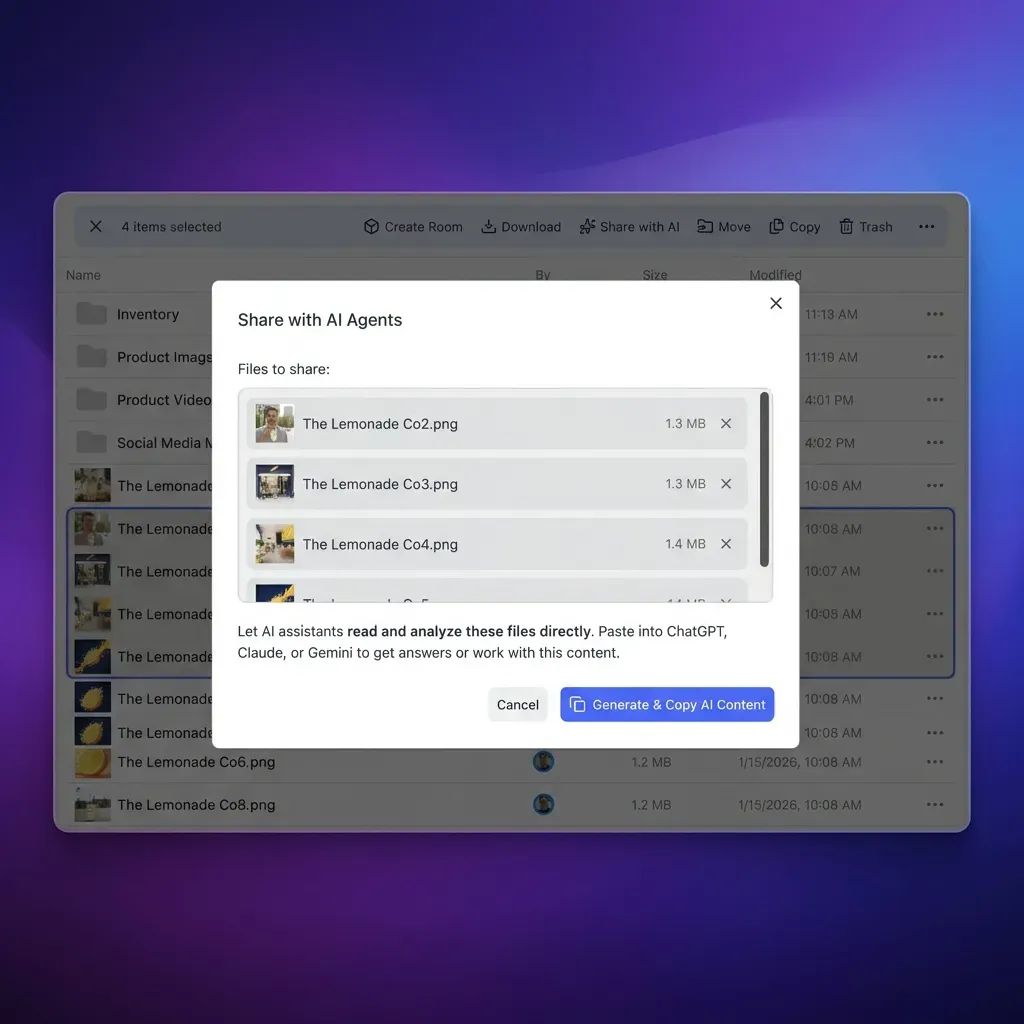


Automate code handoffs from GitHub Copilot
Connect GitHub Copilot to a version-controlled Fastio workspace over Model Context Protocol, audit all agent writes, and start a 14-day Business Trial.
Automating Verification with Metadata Views
When Copilot hands off files, developers need to verify their structure and contents. For example, if Copilot outputs test summaries, build logs, or deployment manifests, humans must confirm that the build passes before merging the changes. While teams can use search and chat to query files, reviewing large numbers of reports manually is slow.
To automate this step, teams can use Metadata Views to turn incoming documents into a live, queryable database. Metadata Views differ from general search: instead of querying file text alone, they extract structured fields into a sortable spreadsheet grid.
To configure data extraction, a developer describes the desired fields in natural language. For example, you can define columns like "Build Status" (Boolean), "Coverage Percentage" (Decimal), or "Failing Tests" (JSON). The platform's built-in AI scans incoming files, matches them to the extraction criteria, and populates the spreadsheet view.
This extraction supports multiple file types, including plain text logs, Markdown files, Word documents, and PDFs. As Copilot uploads new test results, the metadata grid updates in real time. Developers can filter the workspace for failing runs, sort builds by date, or query test coverage metrics without opening individual logs. Because you can add new columns dynamically without reprocessing, your verification schema can evolve alongside your test suite.
Structuring Human-in-the-Loop Approvals
The final stage of the automated handoff is human verification. Rather than allowing Copilot to modify production code unchecked, developers review outputs in a shared Fastio workspace.
Fastio provides per-file version history with restore, a detailed activity log of human and agent actions, and comments anchored to specific code regions or documents. Reviewers inspect diffs directly, discuss changes using anchored comments, and maintain full control over production assets without relying on unverified agent writes.
This combination of remote MCP configuration, automated metadata extraction, and detailed version tracking provides a secure, predictable handoff pipeline between autonomous agents and human engineers.

Sources
References used to verify factual claims in this guide.
-
According to the 2025 Stack Overflow Developer Survey, 84% of developers report that they use or plan to use AI tools in their development workflow.
-
GitHub Copilot supports Model Context Protocol (MCP) servers, allowing Copilot Chat to call external APIs, read data sources, and write files programmatically.
-
Fastio offers structured paid subscriptions starting at $9.99/mo for the Starter plan, $49.99/mo for the Business plan, and $199.99/mo for the Enterprise plan, with a 14-day free trial that requires a credit card.
Frequently Asked Questions
How do I automate file sharing from Copilot?
You can automate file sharing from GitHub Copilot by configuring it to connect to a custom Model Context Protocol (MCP) server like Fastio. When Copilot Chat completes a task, it invokes the workspace write tools programmatically, uploading files directly to a shared directory.
What is agent-to-human handoff in development?
An agent-to-human handoff templates the transition of code artifacts from an AI agent to a human developer. This workflow ensures that files generated by agents are structured, validated via automated pipelines, and routed to humans for review before merging.
How do I review files when Copilot finishes a task?
When GitHub Copilot writes files to a Fastio workspace, developers inspect changes using per-file version history and the activity log. Reviewers can leave comments anchored to specific regions or file pages to verify output quality.
Does GitHub Copilot Chat support remote MCP servers?
Yes. GitHub Copilot supports custom MCP servers over HTTP transport. By specifying the HTTPS endpoint URL and authorization headers in your workspace config, Copilot Chat can interact with cloud-native tools like Fastio.
Related Resources

Automate code handoffs from GitHub Copilot
Connect GitHub Copilot to a version-controlled Fastio workspace over Model Context Protocol, audit all agent writes, and start a 14-day Business Trial.