Dropbox MCP Architecture: Two-Way Workspace Sync vs Direct API Tool Calls
Connecting autonomous AI agents to cloud storage requires evaluating Dropbox MCP architecture tradeoffs between direct API tool calls and two-way workspace sync. Direct tool use often triggers dynamic rate limits, lock contention, and sync conflicts under multi-agent workloads. Decoupling agent operations through scheduled workspace sync provides pre-indexed hybrid search, advisory file leases, and version control while keeping Dropbox as the system of record.


How Direct Dropbox MCP Tool Calls Work
Connecting autonomous AI agents to cloud storage directories exposes a structural failure mode: when multiple agents traverse folder trees or write back results in parallel, direct API tool calls trigger rate limits and overwrite concurrent work within minutes. The failure is not the LLM or the Model Context Protocol itself, but the architectural mismatch between high-frequency agent execution loops and cloud storage APIs built for interactive human sessions.
A Dropbox MCP connector integrates Dropbox cloud storage with LLMs and autonomous agents using the Model Context Protocol for secure file retrieval and updates. In a standard MCP implementation, an AI model acts as a client that discovers tools exposed by an MCP server. When an engineer connects Claude, Cursor, or an autonomous framework to Dropbox, the integration translates natural language requests into structured tool calls that fetch directory trees, read document contents, or upload modified assets.
+-------------------------------------------------------------------------+
|                        Autonomous Agent Runtime                         |
|             (Claude Code, Cursor, LangGraph, or Custom Agent)           |
+-------------------------------------------------------------------------+
          |                                                |
   (Direct Tool Calls)                            (Remote Workspace MCP)
          |                                                |
   Dropbox API v2 Proxy                             Fast.io Remote MCP
 (files/list_folder, download)                     (storage action=search)
          |                                                |
   Dynamic Rate Limits (429)                      Pre-Indexed Hybrid Search
 Namespace Lock Contention                        Advisory Leases & Versions
          |                                                |
+--------------------------+                      +-----------------------+
|  Dropbox Cloud Storage   | <=== Cloud Sync ===> |   Fast.io Workspace   |
|   (System of Record)     | (Schedule/On-Demand) |  (Agent Execution)    |
+--------------------------+                      +-----------------------+
The Three Architectural Layers of a Production-Ready Dropbox MCP Connection
A reliable enterprise integration requires three distinct layers rather than a single monolithic script:
- Storage and Synchronization Layer: Manages file persistence, background synchronization, and conflict isolation between cloud repositories and local or remote environments. In this layer, Dropbox remains the primary system of record, while folder synchronization into workspaces decouples agent operations from raw cloud storage endpoints.
- Indexing and Intelligence Layer: Indexes document contents for full-text keyword matching, semantic embeddings, and structured metadata extraction. Rather than forcing an agent to download entire folder hierarchies into prompt context, this layer returns precise document excerpts and verified citations.
- Protocol and Tool Execution Layer: The Model Context Protocol interface exposing standardized tools for searching, reading, advisory locking, and versioned file writing. Standardized schemas enable LLMs to inspect workspace contents, acquire coordination leases, and save outputs without managing underlying HTTP transports.
How Direct Tool Use Maps to Dropbox API v2
In a direct tool-call architecture, the MCP server acts as a thin proxy over Dropbox API v2 endpoints. Each tool exposed to the model corresponds to an individual REST call:
files_list_folder: Maps toPOST /2/files/list_folderto enumerate items within a specific directory path.files_list_folder_continue: Maps toPOST /2/files/list_folder/continueto paginate through large directories using a cursor.files_download: Maps toPOST https://content.dropboxapi.com/2/files/downloadto stream binary or text contents into the agent environment.files_upload: Maps toPOST https://content.dropboxapi.com/2/files/uploadto write new or updated files back to Dropbox storage.files_search: Maps toPOST /2/files/search_v2to query filenames and text across an account.
Consider what occurs when a user gives an agent a multi-step research prompt: "Locate our enterprise customer renewal files in Dropbox and summarize any non-standard indemnification clauses."
To complete this request through direct API tool use, the agent must first call files_list_folder on the parent customer folder. If the folder contains dozens of subfolders, the agent makes repeated traversal calls. Once it identifies candidate agreements, it must issue separate files_download calls to pull candidate files into its execution context. Each download incurs a separate HTTP round trip, consumes network bandwidth, and burns prompt tokens to parse the documents. If multiple agents perform similar tasks in parallel, the total volume of raw API calls increases rapidly, creating significant latency and stability bottlenecks.
Related guides
- How to Connect Gemini to Dropbox via MCPConnecting Gemini to Dropbox via MCP allows Google Gemini models and agents to interact with Dropbox storage through...
- How to Connect AI Agents to Azure Blob Storage via MCPAn Azure Blob Storage MCP server exposes cloud containers and object storage to AI agents using standard Model Context...
- How to Connect Cloudflare R2 to AI Agents via MCP ServerA Cloudflare R2 MCP server connects AI agents directly to Cloudflare S3-compatible R2 object storage for reading,...
- Emacs MCP Guide: Connecting gptel to Cloud Storage WorkspacesGNU Emacs can query external cloud documents without freezing buffers by integrating the Model Context Protocol. By...
- How to Connect Google Gemini to Box via MCPA Gemini Box MCP integration exposes Box enterprise folder hierarchies and file contents to Google Gemini agents...
- How to Connect Gemini to Storage via MCP ServerConnecting Google Gemini to persistent storage through a Model Context Protocol server replaces clumsy context-window...
More on this subject: MCP and Model Context Protocol (232 guides)
Why Direct API Calls Suffer from Rate Limits and Contention
While direct API tool calls appear straightforward to configure, they introduce severe operational liabilities when deployed in production agent workflows. These issues stem from Dropbox's API architecture, which was designed around desktop synchronization clients and interactive human sessions rather than programmatic bursts from autonomous LLMs.
Dynamic Rate Limits and HTTP 429 Status Codes
Dropbox API v2 applies dynamic per-app rate limits that throttle burst agent file scans with 429 status codes, returning a Retry-After header that specifies the wait duration. Unlike developer platforms that define explicit, static quotas, Dropbox employs dynamic rate limiting that adjusts based on real-time infrastructure load, total team call volume, and the resource intensity of specific endpoints.
When an autonomous agent systematically searches a nested directory structure, it makes dozens of rapid requests across files_list_folder and files_download. When the rate limit threshold is crossed, the Dropbox API returns an HTTP 429 Too Many Requests response. This response frequently includes a Retry-After header that specifies the exact number of seconds the client must pause before retrying.
In an automated agent loop, a 429 error often leads to cascading failures. If the agent runtime lacks built-in exponential backoff logic that respects the Retry-After header, it may immediately retry the failed call. Dropbox treats immediate retries as persistent traffic, which resets the backoff timer and lengthens the block. During extended research tasks, an agent can remain throttled for minutes, breaking downstream agent dependencies.
Lock Contention and the too_many_write_operations Error
A more insidious failure mode occurs when multiple agents perform concurrent write operations. When an agent updates a file or creates new directories, Dropbox takes internal transactional locks on the parent folder namespace to maintain filesystem consistency.
If several agents or parallel subagent threads attempt to save summary files, logs, or extracted data into the same Dropbox folder simultaneously, the API returns an HTTP 429 status code with the specific error tag too_many_write_operations. Unlike standard request-rate throttling, lock contention errors frequently arrive without a Retry-After header because the duration depends on when concurrent transactions clear.
When agents encounter too_many_write_operations, standard fixed retries exacerbate the contention. If several agents continuously retry writes against the same folder lock, they contend with each other for access, causing requests to time out and leaving agent tasks incomplete.
Context Window Bloat and Token Consumption
Direct API tool calls force the agent to act as the indexing and parsing engine. When an agent downloads an extensive PDF contract or a large CSV export through files_download, the complete document payload must be loaded into the LLM context window.
This creates substantial context bloat:
- Token Inefficiency: Ingesting lengthy multi-page agreements into prompt context consumes substantial token allowances just to inspect a single paragraph of indemnification language.
- Attention Degradation: Large context windows degrade an LLM's retrieval accuracy, increasing the likelihood that the model hallucinates or overlooks critical clauses buried in boilerplate.
- Increased Inference Costs: Passing entire document payloads across multiple agent reasoning steps multiplies input token costs across every single turn.
File Format and Serialization Constraints
Direct client-to-storage bridges also encounter strict format boundaries. For example, in official client integrations such as the Dropbox connector for Claude, file creation capabilities are constrained. Claude-generated content saved to Dropbox is limited to text-based file formats rather than binary formats like images or PDFs.
When an agentic workflow generates visual diagrams, compiled PDF briefs, or multimedia assets, direct tool calls cannot persist these files back to Dropbox storage. Engineering teams must build custom secondary export pipelines to handle binary data, fragmenting the storage architecture.
How Two-Way Workspace Sync Decouples Storage from Agent Execution
To avoid the operational hazards of direct API tool calls, production AI architectures decouple agent execution from primary cloud storage. In this pattern, Dropbox remains the enterprise system of record, but autonomous agents interact with an intermediary workspace optimized for programmatic workloads.
The Decoupled Architecture Pattern
Instead of pointing autonomous agents directly at Dropbox REST endpoints, the organization connects a Dropbox folder to an intelligent workspace platform such as Fast.io using Cloud Sync.
Cloud Sync runs one-way or two-way, on a schedule or on demand; it is never continuous, live, or real-time. By configuring scheduled or on-demand synchronization, team files stay updated between Dropbox and the workspace without placing continuous load on cloud APIs.
Autonomous agents connect directly to the workspace through the remote Fast.io MCP server at https://mcp.fast.io/mcp/tools (or with an Authorization: Bearer <api key> header on the connection for headless code). The agent reads, writes, and analyzes files entirely within the workspace environment. Intermediate agent steps, scratchpad notes, and iterative draft versions stay in the workspace, shielding Dropbox from API thrashing.
Pre-Indexing and Built-In Semantic Search
When documents synchronize from Dropbox into an intelligent workspace, the platform's Intelligence Mode automatically indexes the files on arrival for full-text and semantic search. There is no need to configure an external vector database, manage chunking pipelines, or pay for separate embedding API calls.
The Fastio MCP server exposes one consolidated storage tool driven by an action parameter. When an agent needs to retrieve information across synced Dropbox documents, it calls the storage tool with the search action, passing a semantic query:
{
  "name": "storage",
  "arguments": {
    "action": "search",
    "query": "non-standard customer indemnification clauses and liability caps",
    "workspace_id": "wks_customer_contracts_2026"
  }
}
Instead of downloading full contract files into prompt context, the workspace searches indexed contents and returns only the relevant paragraphs along with exact document citations. The agent obtains verified context in a single tool call, consuming zero Dropbox API quota and preserving prompt context for reasoning.
Structured Document Extraction with Metadata Views
Many enterprise workflows require extracting structured data points from unstructured documents, such as renewal dates, payment terms, or policy numbers. Relying on an LLM to read raw documents repeatedly to extract these fields is expensive and error-prone.
With Metadata Views, workspaces convert incoming documents into a live, structured database. Users define the fields they need in plain language, and the system establishes typed schemas across Text, Integer, Decimal, Boolean, URL, JSON, and Date & Time.
As files arrive via Cloud Sync, Metadata Views automatically extracts the requested fields across PDFs, scanned sheets, and presentations without manual templates. Autonomous agents can query these structured properties directly through the MCP interface, retrieving targeted records instantly without parsing full file contents.
Controlled Upstream Synchronization
When an agent completes its assignment, such as generating an executive summary, compiling a research deck, or creating a finalized PDF report, it saves the file directly into the workspace.
Because the workspace supports full binary file persistence, the agent can store formatted PDFs, high-resolution diagrams, and spreadsheets without text-only restrictions. The finalized assets are then synchronized back upstream to Dropbox during the next scheduled sync window or via an on-demand trigger. This batching mechanism consolidates intermediate agent read and write operations into clean, orderly updates in Dropbox.
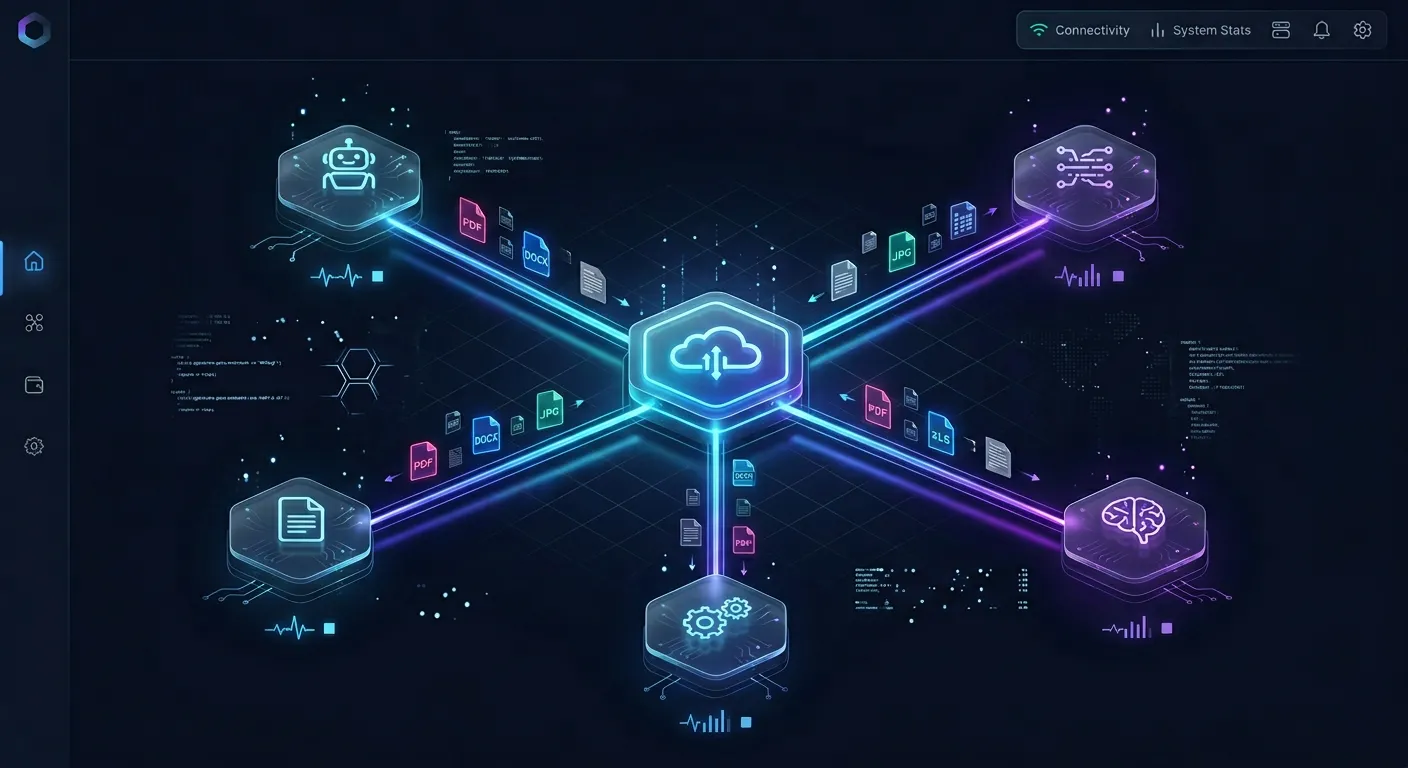


Connect Dropbox storage to intelligent agent workspaces
Keep Dropbox as your team system of record while giving AI agents indexed search, advisory file leases, and versioned workspaces. Starts with a 14-day trial.
How Advisory File Leases Prevent Multi-Agent Sync Conflicts
Deploying multiple autonomous agents within the same project directory creates severe concurrency challenges. Without explicit coordination mechanisms, concurrent agent writes lead to sync conflicts and data fragmentation.
The Reality of Conflicted Copies in Cloud Storage
Dropbox handles simultaneous file modifications through conflict resolution rules. If Agent A and Agent B download analysis_report.md simultaneously, perform separate updates, and upload their respective versions back to Dropbox, Dropbox avoids overwriting either file. Instead, it saves the second upload as a conflicted copy, appending the user or machine name and timestamp: analysis_report (Conflicted Copy 2026-10-02).md.
Human users can open both documents, review the differences, and merge the contents manually. For autonomous AI agents, conflicted copies create catastrophic pipeline failures:
- Blind Divergence: An agent executing a downstream task searches for
analysis_report.mdand reads stale data, completely unaware that a conflicted copy containing newer findings exists. - Broken Dependencies: Multi-agent pipelines that rely on predictable filenames fail when unexpected filenames appear in the directory.
- Multiplied Storage Noise: Automated loops generating multiple updates can create several conflicted copies in minutes, cluttering the primary Dropbox account.
Coordinating Multi-Agent Workflows with Advisory File Leases
In an intelligent workspace architecture, agents prevent file collisions using advisory file locks.
An advisory per-file lease in workspace or share storage is acquired, heartbeated, and released through the MCP storage tool using the lock-acquire, lock-status, and lock-release actions.
Before an agent begins modifying a shared document, it issues a lock-acquire action:
{
  "name": "storage",
  "arguments": {
    "action": "lock-acquire",
    "file_id": "file_q3_renewal_summary",
    "workspace_id": "wks_customer_contracts_2026"
  }
}
The advisory lease establishes clear operational coordination:
- Visibility Across Agents: When another agent checks
lock-status, it sees that a lease is currently held by a peer agent and can choose to wait, work on another task, or inspect the in-progress draft. - Automatic Lease Expiration: The lease expires automatically unless heartbeated by the holder. If an agent crashes, experiences an unhandled exception, or loses connectivity, the lock clears gracefully without permanently blocking the file.
- Non-Exclusive Safety: The lock is strictly advisory and never grants exclusive write rights or blocks writes. If an emergency write lands without a lease, the write is accepted, ensuring that critical data is never discarded.
Per-File Version History and the Append-Only Audit Log
When concurrent writes do take place, per-file version history protects data integrity. Every modification to a file creates a discrete, immutable version rather than overwriting prior contents. Human supervisors and audit agents can inspect diffs between revisions, track how a document evolved across multiple agent iterations, and restore any previous state with a single action.
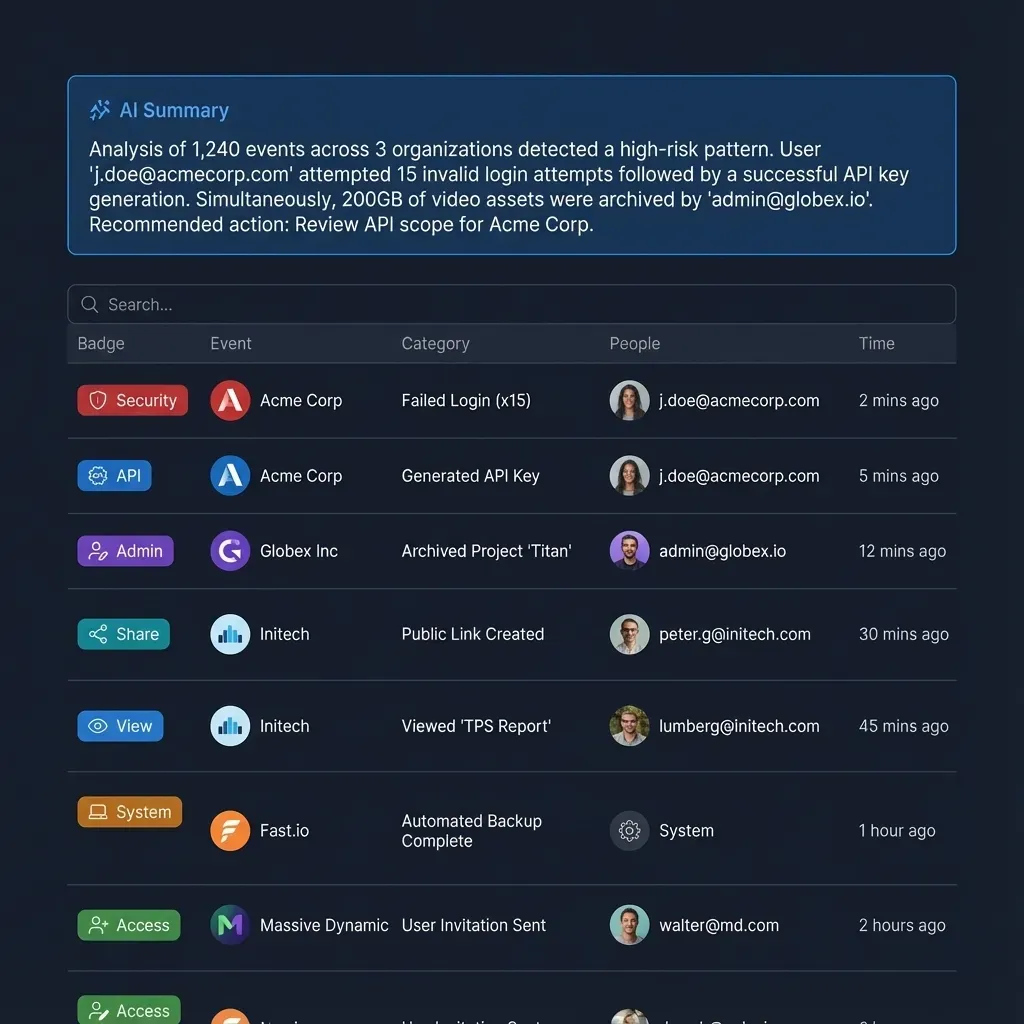
Complementing version history, the workspace maintains an append-only audit log. Every event, including file reads, semantic searches, metadata extractions, advisory lease acquisitions, and upstream synchronizations, is immutably recorded. Engineering teams maintain complete auditability over which agent touched which document, what data was extracted, and when assets were pushed back to Dropbox.
When an autonomous agent builds a workspace, populates folders, and organizes deliverables for a team, it can use ownership transfer to transfer primary organization and workspace ownership to a human colleague while preserving its own administrative credentials to continue background tasks.
Compare Architectural Tradeoffs for Production Deployments
Selecting between direct API tool calls and two-way workspace sync requires evaluating the specific demands of your AI deployment. While simple prototypes benefit from the quick setup of direct tool calls, production environments handling multi-agent workflows, large corpora, or sensitive enterprise records require the resilience of decoupled workspace synchronization.
Architectural Decision Matrix
The following comparison outlines how each architecture performs across core engineering criteria:
Measured Connector Performance in Claude Cowork
The architectural advantages of pre-indexed workspace retrieval over raw cloud storage traversal have been measured in production agent environments. In independent evaluations of cloud storage connectors in Claude Cowork published at Fast.io Benchmarks, Fastio was measured the fastest and the lowest cost of the providers tested.
By pre-indexing folder contents on arrival and returning focused citations through remote MCP search actions, workspaces avoid the repetitive file downloads and high token consumption that burden direct API connectors.
Configuring an MCP Client for Intelligent Workspaces
Connecting an AI client to an intelligent workspace requires minimal configuration. The Fast.io remote MCP server operates over Streamable HTTP at https://mcp.fast.io/mcp/tools, eliminating the need to install local runtime packages or maintain background daemon processes. Step-by-step setup guides for supported clients are available at mcp.fast.io/docs.
To configure an MCP client, add the server definition to your configuration file. Interactive clients sign in with OAuth in the browser and carry no API key in their configuration, while headless code sends an Authorization: Bearer <api key> header on the connection:
{
  "mcpServers": {
    "fastio": {
      "url": "https://mcp.fast.io/mcp/tools"
    }
  }
}
Once connected, the agent gains access to the storage and storage_manage tools. It can inspect workspaces and search indexed Dropbox files with storage, while acquiring advisory leases and storing generated deliverables use storage_manage through standard MCP tool invocations.
Operational and Governance Foundations
Deploying AI agents over enterprise files requires transparent economics and reliable security controls. Fast.io monthly plans start with a 14-day trial that requires a credit card. Subscription options scale with organizational needs:
Credits meter AI operations such as semantic indexing and metadata extraction, with extra credits available for high-volume pipelines. Storage and seats are included in each plan, and bandwidth is billed by use.
On the infrastructure side, Fastio runs on cloud infrastructure partners, including Google Cloud Platform and Cloudflare, that are certified to industry-leading security standards. Workspaces provide data encryption in transit and at rest, granular permissions configured at the organization, workspace, folder, and file level, and an append-only audit trail that records every human and agent interaction. By combining Dropbox storage with an intelligent workspace layer, teams enable autonomous agents to operate at maximum velocity without risking data corruption, rate limit outages, or sync conflicts.
Sources
References used to verify factual claims in this guide.
-
Dropbox API v2 applies dynamic per-app rate limits that throttle burst agent file scans with 429 status codes, returning a Retry-After header that specifies the wait duration.
-
Claude-generated content saved to Dropbox is limited to text-based file formats rather than binary formats like images or PDFs.
Frequently Asked Questions
How does an AI agent access files in Dropbox using MCP?
An AI agent accesses Dropbox files using the Model Context Protocol in one of two ways. In a direct tool-call model, an MCP server translates the agent's tool requests into direct Dropbox API v2 calls, such as files_list_folder and files_download. In a two-way workspace sync architecture, Dropbox folders synchronize on a schedule or on demand into an intelligent workspace, where contents are pre-indexed for semantic search. The agent connects to the workspace via remote MCP and queries relevant excerpts using targeted search actions, eliminating direct API rate limits.
What are the rate limits for Dropbox MCP tool calls?
Dropbox API v2 applies dynamic per-app rate limits rather than fixed numerical quotas. When an agent exceeds these dynamic thresholds during intensive file crawls or batch downloads, Dropbox returns an HTTP 429 Too Many Requests status code with a Retry-After header indicating how many seconds the agent must wait. In addition, concurrent write operations to the same folder can trigger 429 lock contention errors tagged as too_many_write_operations, which require exponential backoff to clear.
Can AI agents write files back to Dropbox via MCP?
AI agents can write files back to Dropbox using MCP, but the capabilities depend on the architecture. Direct client integrations, such as the Dropbox connector for Claude, allow agents to save text-based outputs like Markdown, plain text, and Python scripts, but cannot save binary files like PDFs or images directly from conversation context. In contrast, an intelligent workspace sync architecture allows agents to write any file format, including binary assets, directly to workspace storage, which then synchronizes back to Dropbox on a schedule or on demand.
How do you prevent sync conflicts when multiple agents write to the same Dropbox folder?
Preventing sync conflicts requires coordinating write access before files are modified. In direct Dropbox connections, simultaneous writes create conflicted copy files that disrupt automated agent workflows. In an intelligent workspace, agents coordinate using advisory file leases through the MCP storage tool's lock-acquire action. While these leases are advisory and do not block writes, they provide visibility across agents, while per-file version history ensures every concurrent revision is preserved without data loss.
What is the difference between one-way and two-way workspace sync?
One-way workspace sync imports files from Dropbox into an intelligent workspace for read-heavy agent analysis and retrieval without sending changes back to the origin. Two-way workspace sync maintains synchronization in both directions: incoming changes from Dropbox update the workspace, and new deliverables or edits produced by AI agents in the workspace sync back into Dropbox. In both cases, Cloud Sync runs on a schedule or on demand, and is never continuous or real-time.
Does two-way workspace sync replace my existing Dropbox folder structure?
No. Two-way workspace sync maintains your existing Dropbox folder hierarchy as the authoritative system of record. Folders are mirrored into an intelligent workspace where autonomous agents read, index, and generate files without disrupting human teammates working in Dropbox. Verified changes and deliverables synchronize back to the corresponding Dropbox folders on a schedule or on demand.
Related Resources

Connect Dropbox storage to intelligent agent workspaces
Keep Dropbox as your team system of record while giving AI agents indexed search, advisory file leases, and versioned workspaces. Starts with a 14-day trial.