How to Set Up a Claygent File Upload Workflow
Poor data quality costs organizations an average of USD 12.9 million annually, making accurate research critical for outbound sales campaigns [Gartner Data Quality Research]. A Claygent file upload workflow attaches documents like PDFs or CSVs to a Claygent's prompt context to guide its autonomous web research. By configuring these prompt context documents in the Builder, GTM teams ground AI research in their brand voice and product guidelines.


Grounding GTM Research in Verified Context
Poor data quality costs organizations an average of USD 12.9 million annually, which directly impacts the performance of outbound sales campaigns [Gartner Data Quality Research]. In outbound sales, this business risk increases when AI agents are set loose on lead lists to scrape the web without grounding context. If an agent performs research without specific parameters, it can easily hallucinate product claims, scrape the wrong target websites, or write outreach messages that violate brand standards. To prevent these errors, sales operations teams rely on custom context documents.
A Claygent file upload workflow is the process of attaching documents like PDFs or CSVs to a Claygent's prompt context to guide its autonomous web research. Because Clay's research agent (Claygent) operates as a dynamic web researcher, feeding it specific reference files helps it focus its search. Rather than searching the web blindly, Claygents can process files directly in prompt context to ground AI research, keeping their queries within safe boundaries.
Attaching files directly to your agent's prompt context allows you to provide static reference material such as product lists, compliance guides, case studies, or style sheets. Once these documents are uploaded, the agent references them during every row enrichment run. This ensures that the generated outputs remain accurate and consistent with your organization's internal standards.
Related guides
- How to Set Up a Manus AI File Handoff WorkflowA Manus file handoff workflow is the automated pipeline that retrieves files from a completed agent task sandbox and...
- How to Set Up Hermes Agent File StorageOnly 57% of organizations report having AI agents in production environments, largely due to challenges with state...
- How to Set Up AI Agent File Indexing (The Easy Way)Most AI agent file indexing requires complex Python pipelines and vector databases. This guide shows you how to skip...
- How to Upload Files: Fastio API File Upload TutorialFollowing a Fastio API file upload tutorial is the fast way to get your applications talking to intelligent agent...
- How to Upload a Base64 String as a File to the Fastio APIAgents can upload a file as a Base64 string through the Fastio MCP upload_manage tool. Pass content_base64 on a...
- ChatGPT File Upload Limits: How to Handle Large Files and FoldersChatGPT limits file uploads to 512MB per file with total storage limits per user, creating problems for large datasets.
More on this subject: Agent File and Document Workflows (325 guides)
How to Configure the Claygent File Upload Workflow in Builder
Setting up context documents requires using the centralized Claygent Builder, which lets you create, test, and refine your custom agents before deploying them to your active tables.
To set up a Claygent file upload workflow, use this numbered step-by-step configuration guide:
Open the Claygent Builder. In your Clay dashboard, click on the Agents tab in the left-hand navigation bar, or select a column in an existing table, click Edit Column, and choose Create Claygent to convert a standard AI column prompt.
Select your creation method. You can build a new agent from scratch, convert a standard column, or use Sculptor, the conversational builder, to draft your prompt structure using natural language instructions.
Access the prompt context settings. In the agent configuration panel, find the prompt context settings section. This is where you configure the specific guidelines that the agent must follow.
Upload your context documents. Click the upload button within the prompt context settings and select your target files (such as PDFs, CSVs, or images) from your local directory to attach them directly to the prompt context.
Define your prompt rules. Structure your instructions using a framework that organizes sections, prompt variables, instructions, context, and examples. Incorporate prompt variables in curly brackets
{ }to map dynamic row data alongside your static files.Test your agent. Run tests on sample rows inside the Claygent Builder for free. Verify that the agent successfully reads the uploaded context files and extracts the correct details before deploying the agent across your production tables.
Once your configuration is complete, you can deploy the Claygent to any table in your workspace. Because the agent is managed in a central repository, any updates you make to the context documents or prompts inside the Claygent Builder will automatically propagate to all active columns using that agent.
What File Formats Does Claygent Support?
To ensure your files parse successfully without causing timeout errors, you must understand the supported formats and their constraints. Claygent Builder supports uploading CSVs, PDFs, and images directly to prompts to guide web research with custom company context.
CSVs are best for list-based data, such as product feature lists or target account directories. When uploading a CSV file, make sure the column headers are clean and descriptive. This helps the agent query the spreadsheet rows accurately.
PDFs are best for unstructured text documents, such as brand voice playbooks, compliance guides, or technical product documentation. When uploading PDFs, you must verify that the file contains searchable, extractable text. Claygent cannot read text trapped inside flat, scanned images.
Images are useful for visual branding references. For text-heavy images, the agent uses optical character recognition to extract content. However, this process consumes more credits and is less reliable than using native PDFs or CSVs.
Checklist for Preparing Files Before Builder Ingestion
Use this preparation checklist to format your files before uploading them to the Claygent Builder:
- Run optical character recognition on scanned PDF files to ensure the text is fully extractable.
- Verify that the files do not contain password protection or encryption that would block agent access.
- Format CSV files with clear, descriptive headers on the very first row.
- Ensure the file size remains within the standard limits of the builder.
- Test the readability of the file by opening it in a standard text extractor.
How to Store and Organize Context Files in Fastio Workspaces
Running high-volume enrichment pipelines requires a structured storage repository to manage your context documents. GTM teams waste up to 27.3% of their time chasing dead ends when list data and reference assets are unverified and scattered across local directories [Cleanlist 2026 Review].
When choosing a repository for your research files, you have several options:
Amazon S3: Amazon S3 offers secure cloud storage, but configuring it for external access is complex. You must write IAM policies and generate pre-signed URLs to keep files secure while allowing the agent to read them.
Google Drive: Google Drive is convenient for manual file sharing, but its security layers frequently block automated scrapers. Additionally, Google Drive share links often route to web viewer pages instead of direct download streams, causing parser errors.
Fastio: Fastio provides shared org-owned workspaces that serve as an intelligent repository layer. Teams can import folders via Cloud Import (OAuth-based connections to OneDrive, Google Drive, Box, Dropbox) or import files from any public URL. When a workspace is created, you can enable Intelligence Mode, which automatically indexes all uploaded files for semantic search and Q&A chat.
Every file in a Fastio workspace retains a full version history. If a teammate uploads an updated style guide or a revised pricing sheet, the system automatically versions the file. Shared links always display the current version, while keeping the historical timeline intact. This ensures that your agents and GTM team members always access the same files.
The WebSocket live activity feed tracks all updates, uploads, and downloads in real time, while the activity log records every action for security auditing and operational oversight.
For custom developer setups, Fastio is MCP-native. The platform exposes Streamable HTTP at /mcp and legacy SSE at /sse using the Model Context Protocol (MCP). Agents can use consolidated MCP tools to manage folders, generate secure shares, and query file contents programmatically.
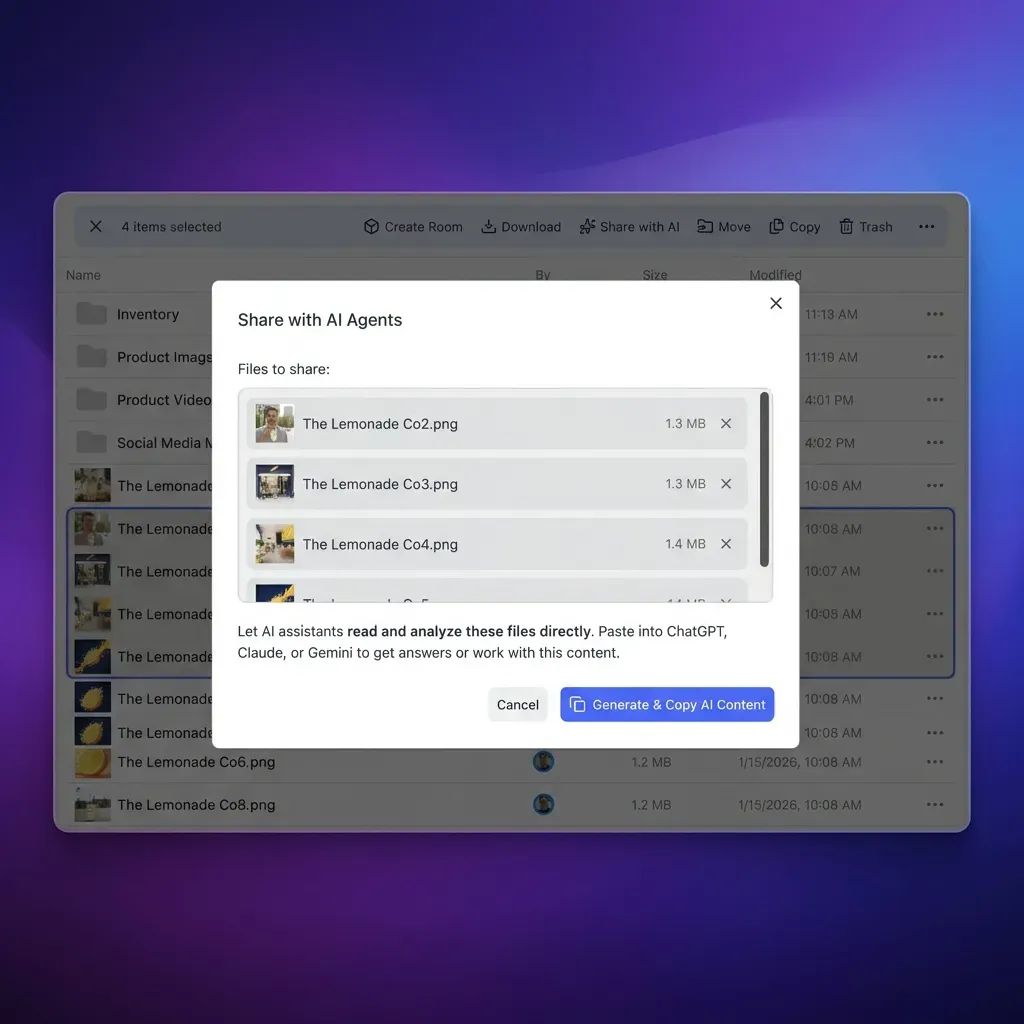


Optimize your Claygent file upload workflow
Store your lead databases, brand guides, and custom prompt context documents in one intelligent Fastio workspace with automatic versioning and direct links. Start your 14-day Business Trial on the Starter plan at $9.99/mo, Business plan at $49.99/mo, or Enterprise plan at $199.99/mo.
How to Automate Structured Ingestion with Metadata Views
While Claygent is ideal for row-by-row web scraping, extracting structured databases from directories of documents requires a dedicated extraction layer. This is where combining Claygent with Fastio Metadata Views becomes powerful.
Metadata Views turn folders of unstructured files into a live, queryable database. Instead of relying on manual entry, you describe the columns you need using natural language. Fastio's AI analyzes the files, designs a typed schema (supporting Text, Integer, Decimal, Boolean, URL, JSON, and Date & Time), and populates a spreadsheet grid. This extraction layer is detailed at the Metadata Views product page.
Metadata Views work with PDFs, images, Word docs, spreadsheets, presentations, and scanned pages. You can add new columns at any time without reprocessing existing files. This structured data can then be accessed by your Clay tables via the Fastio REST API or MCP tools, bypassing manual parser setups.
For consultants and RevOps agencies building GTM pipelines, Fastio supports ownership transfer. An agent can set up a workspace, import the raw documents, and configure the Metadata Views. Once the pipeline is ready, the agent transfers the organization to the human client via a secure claim link.
Fastio fits any team size. Paid plans include the Starter plan at $9.99/mo, the Business plan at $49.99/mo, and the Enterprise plan at $199.99/mo. Monthly plans start with a Business Trial of up to 14 days that requires a credit card, allowing you to test RAG chat and Metadata Views. Compare details on the Fastio pricing page.
Sources
References used to verify factual claims in this guide.
-
Poor data quality costs organizations an average of USD 12.9 million annually.
-
GTM teams waste up to 27.3% of their time chasing dead ends when list data and reference assets are unverified and scattered across local directories.
-
Paid plans include the Starter plan at $9.99/mo, the Business plan at $49.99/mo, and the Enterprise plan at $199.99/mo. Monthly plans start with a Business Trial of up to 14 days that requires a credit card, allowing you to test RAG chat and Metadata Views.
Frequently Asked Questions
How do I upload a file to Claygent?
To upload a file to Claygent, open the Claygent Builder by selecting your agent in the dashboard or converting a table prompt. In the agent configuration panel, locate the prompt context settings, click the upload button, and select your target PDF, CSV, or image files.
What file formats does Claygent support?
Claygent supports uploading CSV, PDF, and image files directly as prompt context documents. When uploading PDFs, ensure they contain selectable, extractable text rather than flat scanned images so the agent can successfully parse and read the document content.
How can I secure files that Claygent needs to access?
You can secure files by hosting them in workspaces that support expiring links or scoped API permissions. Hosting your target research assets on Fastio allows you to generate secure, expiring share links, giving Claygent access during the enrichment run while keeping files private afterward.
Can I dynamically upload files to Claygent?
Yes, you can upload files dynamically by passing web-accessible URLs from your table columns as prompt variables in curly brackets. This allows Claygent to fetch and analyze different files for each row in your database.
Related Resources

Optimize your Claygent file upload workflow
Store your lead databases, brand guides, and custom prompt context documents in one intelligent Fastio workspace with automatic versioning and direct links. Start your 14-day Business Trial on the Starter plan at $9.99/mo, Business plan at $49.99/mo, or Enterprise plan at $199.99/mo.