Claude Haiku vs Sonnet: Which Model Should You Use?
Claude Haiku 4.5 costs $1 per million input tokens. Sonnet 4.6 costs $3. That 3x price gap runs through every dimension of the comparison, from batch processing to prompt caching. The models differ on more than price: Sonnet's 1M-token context window is five times Haiku's 200K, and Sonnet adds adaptive thinking that scales reasoning depth by task complexity.


The 3x Price Gap Between Haiku and Sonnet
Processing 10,000 customer support conversations costs approximately $37 with Claude Haiku 4.5, based on Anthropic's pricing examples using an average of 3,700 tokens per conversation. Running the same volume through Sonnet 4.6 triples that figure. At 10,000 conversations per day, the difference reaches over $2,000 per month.
The price gap is consistent. Haiku charges $1 per million input tokens and $5 per million output tokens. Sonnet charges $3 and $15 respectively. Every workload costs exactly 3x more on Sonnet, whether you're classifying emails or generating reports. But price is only one variable. Haiku and Sonnet differ in context window size by a factor of five, in maximum output length by a factor of two, and in reasoning capability in ways that don't reduce to a simple multiplier.
Claude Cowork, Anthropic's autonomous task mode available on all paid plans through the desktop app, gives teams access to both models. The practical question isn't which model is "better" in the abstract. It's which model fits which task, and how to route between them without overspending on simple work or underperforming on complex problems.
Existing comparisons focus on benchmark scores and model architecture without answering the practical question: what does it cost to run a specific workload on each model, and when does the cheaper option produce results that are good enough? The gap is especially wide for teams using Claude Cowork, where tasks range from simple file organization (ideal for Haiku) to multi-source research synthesis (where Sonnet's reasoning pays for itself).
Related guides
- OpenClaw vs Codex CLI: Which AI Agent Should You Use?OpenClaw and Codex CLI rank among the most active AI agents in 2026, but they solve fundamentally different problems....
- Claude Cowork vs Claude Code: Which One Should You Use?Claude Code now accounts for roughly 4% of all public GitHub commits, and Claude Cowork went generally available in...
- Claude Model Comparison 2026: Opus vs Sonnet vs Haiku vs FableAnthropic's Claude family spans four model tiers from Haiku 4.5 at $1 per million input tokens to Fable 5 at $10. Each...
- Claude Code vs OpenCode: Which Terminal AI Agent Fits Your WorkflowClaude Code handles roughly 4% of all public GitHub commits, while OpenCode has collected 179,000 stars as the leading...
- Best Claude Code Alternatives in 2026, ComparedEight tools compete with Claude Code for AI-assisted coding in 2026. Cursor dominates IDE-based editing, Aider leads...
- Cline vs. Claude Code: Comparing Agent Memory ArchitecturesLocal AI agent memory architectures like Cline's Memory Bank and Claude Code's Auto-Memory are designed for isolated,...
More on this subject: Claude and Claude Code (278 guides)
Specifications Side by Side
The following table compares the current versions of each model based on Anthropic's published documentation.
Two differences stand out beyond pricing. Sonnet 4.6 accepts 1 million tokens of context, roughly 750,000 words, while Haiku handles 200,000 tokens, roughly 150,000 words. For most chat applications and short-document tasks, 200,000 tokens is plenty. But if you need to feed an entire codebase, a large contract library, or months of conversation history into a single request, Sonnet's 5x larger window is the deciding factor.
Adaptive thinking is the other key distinction. Sonnet 4.6 dynamically adjusts its reasoning depth based on task complexity, spending more computation on harder problems and responding quickly to simple ones. Haiku supports extended thinking but lacks this automatic calibration. On a straightforward lookup question, both models respond well. On a multi-step analysis where the model needs to connect facts scattered across a long context, Sonnet's adaptive approach produces noticeably better results.

Where Haiku Outperforms
Haiku 4.5 delivers the lowest latency of any model in Anthropic's lineup. For applications where users wait for responses in real time, that speed gap matters more than benchmark scores.
The cost advantage compounds at scale. Consider these workloads where Haiku matches or comes close to Sonnet's quality:
- Email and ticket classification. Sorting messages by urgency, topic, or sentiment is a pattern-matching task. Haiku handles it reliably and at one-third the cost. For a batch of 10,000 emails (assuming 1,000 input tokens and 50 output tokens each), Haiku costs $12.50 versus Sonnet's $37.50, with no meaningful accuracy improvement on standard categories.
- Structured data extraction. Pulling names, dates, amounts, and categories from standardized forms doesn't require multi-step reasoning. Haiku extracts reliably and quickly.
- Short-document summaries. For documents under 50 pages, both models produce clean summaries. Haiku charges $0.03 per 50-page report versus Sonnet's $0.09.
- FAQ and knowledge base answers. When the answer exists in the provided context, Haiku retrieves it as accurately as Sonnet and returns it faster.
The Batch API doubles the savings for workloads that don't need real-time responses. Haiku's batch pricing drops to $0.50 per million input tokens and $2.50 per million output tokens, making overnight processing of large datasets remarkably affordable.
Real-time applications amplify the speed difference further. A support bot handling 100 concurrent users returns answers faster and clears queues sooner on Haiku. Each request that finishes sooner compounds across thousands of conversations per hour, reducing infrastructure load alongside API costs.
Haiku starts to struggle when tasks require connecting information spread across long documents or reasoning through chains of dependencies. It can tell you what section 4.2 says, but it may miss a contradiction with an amendment buried 80 pages later. For those tasks, the next section explains why Sonnet is worth the premium.


Store and query AI model outputs in one workspace
A workspace where Haiku and Sonnet outputs are indexed for semantic search the moment they land, with an MCP-ready endpoint. Starts with a 14-day free trial.
Where Sonnet Justifies Its Cost
Sonnet 4.6 is the right choice when getting the answer right matters more than getting it fast. Three capabilities separate it from Haiku in practice.
1 million token context window. Sonnet can hold roughly five full-length novels, an entire medium-sized codebase, or months of conversation history in a single request. This isn't just about processing long documents. It changes what's possible: comparing clauses across a 200-page contract, analyzing trends in a year of sales data, or debugging code with full repository context. Haiku's 200,000-token limit works for most conversational tasks, but falls short when you need the model to reason across a large body of information.
Adaptive thinking. Rather than applying fixed reasoning effort to every prompt, Sonnet scales its thinking dynamically. A factual lookup gets a quick response. A subtle bug in a multi-file codebase gets deeper analysis. This calibration happens automatically, so you pay for deep thinking only when the task demands it.
Stronger performance on complex tasks. Code generation, multi-step analysis, creative writing with specific constraints, and research synthesis across many sources are all areas where Sonnet's quality gap over Haiku is clear. If your application debugs code, drafts legal analysis, or builds structured arguments from messy source material, Sonnet handles complexity that Haiku cannot.
Sonnet's knowledge is also more current. Its reliable knowledge cutoff is August 2025, six months newer than Haiku's February 2025 cutoff. For tasks that depend on recent information, like answering questions about current regulations or recent API changes, Sonnet provides more accurate baseline knowledge before you supplement with retrieval or web search.
The tradeoff is direct. Sonnet costs 3x more and responds somewhat slower. For tasks that genuinely need complex reasoning or long context, the premium prevents errors that cost more to fix later. For tasks that don't, you're paying 3x for capabilities you aren't using.
What Each Model Costs Per Task
Abstract per-token pricing is hard to translate into real budgets. These estimates use typical token counts for common workloads, calculated from Anthropic's published rates.
Summarizing a 50-page report (~25,000 input tokens, ~1,000 output tokens)
- Haiku: $0.03 per report
- Sonnet: $0.09 per report
- Both models summarize well at this length. At 1,000 reports per month, Haiku saves $60.
Classifying 10,000 customer emails (~1,000 input tokens per email including system prompt, ~50 output tokens)
- Haiku: $12.50 per batch
- Sonnet: $37.50 per batch
- Classification is a pattern-matching task. Haiku's accuracy matches Sonnet's for standard categories.
Analyzing a 300-page legal contract (~150,000 input tokens, ~5,000 output tokens)
- Haiku: $0.18 per contract
- Sonnet: $0.53 per contract
- Sonnet wins here. The document consumes 75% of Haiku's context window, leaving little room for system prompts and reasoning. Sonnet's 1M window handles it comfortably, and its stronger reasoning catches cross-reference issues that Haiku may miss.
Generating a 2,000-word technical article (~2,000 input tokens, ~3,000 output tokens)
- Haiku: $0.02 per article
- Sonnet: $0.05 per article
- Sonnet produces better first drafts for quality-sensitive content. Haiku works for high-volume drafts that will be heavily edited.
Code debugging session (~100,000 input tokens of code context, ~2,000 output tokens)
- Haiku: $0.11 per session
- Sonnet: $0.33 per session
- Sonnet's stronger reasoning and larger context window make it the clear choice for debugging.
The pattern is straightforward. For tasks where both models produce comparable quality, Haiku saves 67% on every request. For tasks where Sonnet's reasoning or context window creates a measurable quality difference, the 3x premium is an investment in accuracy rather than a luxury.
How to Route Between Models in Claude Cowork
Claude Cowork handles multi-step tasks autonomously through the Claude desktop app, available on Pro, Max, Team, and Enterprise plans. It works across your local files and applications to complete goals you describe in natural language, from organizing research to synthesizing documents and preparing deliverables from raw source material.
For API users building applications that route between Haiku and Sonnet programmatically, the model parameter is the only change required:
response = client.messages.create(
    model="claude-haiku-4-5",
    max_tokens=1024,
    messages=[{"role": "user", "content": prompt}]
)
Swap claude-haiku-4-5 for claude-sonnet-4-6 and the same code runs on the more capable model. A common architecture routes requests to Haiku by default and escalates to Sonnet when specific conditions are met: input length exceeds 50,000 tokens, the task requires multi-step reasoning, or the first Haiku attempt doesn't meet a confidence threshold.
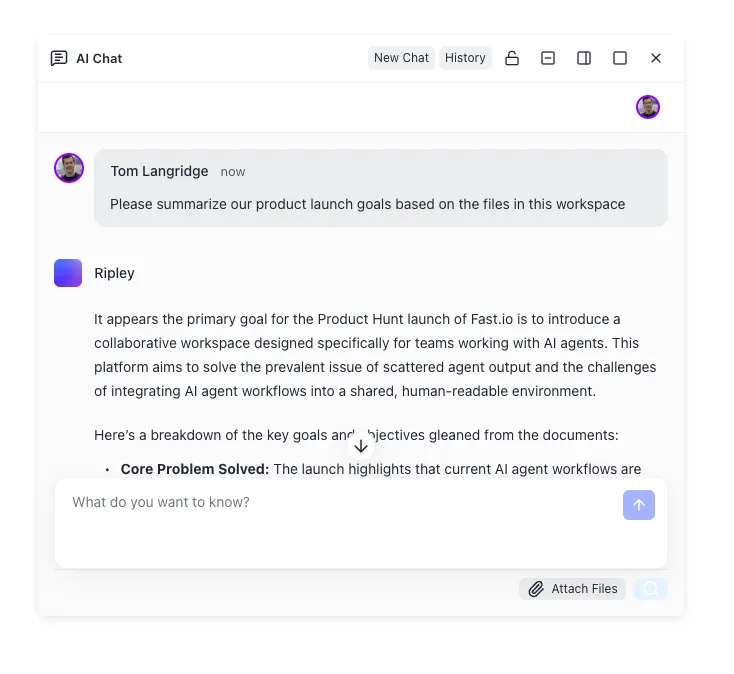
When multiple people need access to what these models produce, or when agent workflows generate outputs that require human review, the results need a shared destination beyond a local filesystem. Cloud drives like Google Drive handle basic file sharing. Purpose-built platforms like Fast.io provide workspaces where AI outputs are automatically indexed for semantic search and citation-backed chat the moment they land.
Fast.io's MCP server gives both models access to the same workspace tools through tool use. An agent running Haiku for quick file classification and Sonnet for deep document analysis can read from and write to the same workspace, with humans reviewing the output through the same interface. Plans start with a 14-day free trial, with workspaces, monthly credits, and storage scaled to each tier.
A practical two-tier strategy starts simple. Route requests under 10,000 input tokens with straightforward intent (classification, extraction, simple Q&A) to Haiku. Route everything else to Sonnet. Track quality metrics on both paths. Over time, you identify more tasks that Haiku handles well and shift them to the cheaper model, with savings accumulating without a complex routing framework.
Sources
References used to verify factual claims in this guide.
-
Processing 10,000 support tickets costs approximately $37 with Claude Haiku 4.5 at $1/MTok input and $5/MTok output
-
Haiku 4.5 has a 200,000 token context window and 64,000 max output. Sonnet 4.6 has a 1,000,000 token context window and 128,000 max output. Sonnet 4.6 supports adaptive thinking. Haiku 4.5 does not. Haiku 4.5 reliable knowledge cutoff is February 2025. Sonnet 4.6 reliable knowledge cutoff is August 2025.
-
Claude Cowork is available on all paid plans through the Claude desktop app
Frequently Asked Questions
Is Claude Haiku good enough for business tasks?
Haiku 4.5 handles most standard business tasks well, including email classification, data extraction, document summarization, and FAQ-style question answering. It struggles with tasks that require connecting information across long documents or multi-step reasoning chains. For straightforward operations at scale, Haiku delivers comparable quality to Sonnet at one-third the cost.
When should I use Sonnet instead of Haiku?
Use Sonnet 4.6 when the task requires complex reasoning, a context window larger than 200,000 tokens, adaptive thinking depth, or high-quality creative output. Specific examples include legal contract analysis, multi-file code debugging, research synthesis across many sources, and any task where input exceeds Haiku's 200K token context limit.
Is Claude Haiku faster than Sonnet?
Yes. Haiku 4.5 is the fast model in Anthropic's lineup, categorized as 'Fastest' compared to Sonnet's 'Fast' in their official documentation. For real-time applications like customer support bots or interactive chat, Haiku's lower latency translates to noticeably quicker responses.
Can I switch between Haiku and Sonnet in Claude Cowork?
Claude Cowork is available on all paid Claude plans (Pro, Max, Team, and Enterprise), which include access to both models. In the API, switching between models requires changing a single parameter in your request. On claude.ai and the desktop app, the model picker lets you select your preferred model for conversations.
Does the Batch API discount apply to both Haiku and Sonnet?
Yes. Both models receive a 50% discount through the Batch API. Haiku's batch pricing drops to $0.50 per million input tokens and $2.50 per million output tokens. Sonnet drops to $1.50 and $7.50 respectively. The 3x cost ratio between models stays the same with batch pricing.
Related Resources

Store and query AI model outputs in one workspace
A workspace where Haiku and Sonnet outputs are indexed for semantic search the moment they land, with an MCP-ready endpoint. Starts with a 14-day free trial.