How to Use Claude AI for Writing: Workflows, Tips, and Cowork Setup
Document preparation that takes two hours of reading and note-taking can shrink to fifteen minutes when you hand it to Claude Cowork. The difference is that Cowork reads your actual source files, plans multi-step tasks, and writes formatted output directly to your filesystem rather than working one chat message at a time.


Why Chat Falls Short for Document Preparation
Anthropic's product page for Claude Cowork frames the pitch with a specific claim: document preparation that "used to take two hours of reading and note-taking now takes fifteen minutes of setup and waiting." That 8x compression comes from a fundamental difference in how Cowork handles writing compared to standard chat.
Standard Claude chat works one message at a time. You paste context into the window, ask for a rewrite, and copy the result. That's fine for quick edits and brainstorming. But document preparation requires something else. Synthesizing five source files into a structured report, building a presentation from meeting notes, turning raw research into a formatted deliverable: these are multi-step tasks that chat wasn't designed for. Chat can't read your local files. It forgets context between conversations. And it produces output you have to manually reassemble into a final document.
Claude Cowork, available through the Claude Desktop app on macOS and Windows, handles multi-step writing tasks against your actual files. You describe what you need, point Cowork at your source material, and it produces finished deliverables. That output includes formatted documents, Excel spreadsheets with working formulas, and PowerPoint presentations with slide structure and speaker notes. Files land on your local filesystem, ready to open in the appropriate application.
The distinction matters because most "Claude for writing" guides stop at prompt engineering. They explain how to ask Claude for better paragraphs. Cowork operates at a different level: task delegation, not message prompting. You assign a job with source material and constraints, not ask a question and hope the response is useful. Most Claude writing guides cover the chat interface only. None walk through Cowork's file-based writing workflows with Projects, scheduled tasks, and context files. That gap is what this guide fills.
Related guides
- Best OpenClaw Workflows for AI Book and Manuscript WritingOpenClaw book and manuscript writing workflows chain multiple ClawHub skills into a pipeline that covers every stage...
- How to Set Up a Guest Upload Folder for Devin AI WorkflowsA Devin AI guest upload folder setup integrates Fast.io Receive shares with Devin's active workspace through the Model...
- How to Set Up Claude Cowork on Windows: Installation and ConfigurationThree GitHub issues filed against Claude Cowork in early 2026 report the same failure: Cowork refuses to start on...
- Claude Desktop App: Features, Setup, and TipsThe Claude desktop app bundles Chat, Cowork, and Code into a single native application for Mac, Windows, and ChromeOS....
- Claude Cowork vs Microsoft Copilot: Same Model, Different WorkflowsClaude Cowork and Microsoft Copilot Cowork both run on Claude's agentic model, but they target different workflows. The...
- Claude Teams Plan Guide: Pricing, Cowork, and AdministrationAnthropic's Team plan supports 5 to 150 members with SSO, enterprise search across Google Drive, Slack, and Microsoft...
More on this subject: Claude and Claude Code (278 guides)
Setting Up a Claude Cowork Writing Project
Cowork's Projects feature, introduced in March 2026, groups related tasks into persistent workspaces with their own files, context, and memory. For writers, Projects solve the biggest friction point: re-explaining who you are, what you need, and how you write every time you start a new task.
Create a separate Project for each writing domain. Client reports, blog posts, and internal documentation each get their own workspace. Each Project maintains its own working folder on your local filesystem, custom instructions, context files, and memory of previous tasks. Memory is the key difference from standalone Cowork sessions. When you correct the tone in one task ("too formal, match the voice profile instead"), that correction carries forward to every future task in the same Project.
Context files are the highest-impact setup step. Create three files in your Project folder:
Identity file. State who you are and what you're working on. "I'm a product marketing manager at a B2B SaaS company. I write for technical buyers who evaluate tools, not executives who approve budgets." This framing prevents Cowork from defaulting to generic business prose.
Voice profile. Paste 3-5 paragraphs of your actual writing at its best. Cowork mirrors this tone rather than defaulting to its own, which tends toward hedged, even-handed language that sounds like nobody in particular.
Anti-patterns file. List words and structures Cowork should never use when writing as you. Common entries: "In today's fast-paced world," "It's worth noting that," "crucial," excessive adverbs, and whatever AI-generated phrases break your voice. This file acts as a negative constraint. It doesn't tell Cowork how to write, but it cuts off the paths that sound wrong.
Configure instructions at two levels. Global instructions (Settings > Cowork > Global instructions) apply across all Projects: your preferred date format, citation style, output language. Project-specific instructions override globals when needed. A client report Project might require "always include an executive summary and appendix with source references." A blog post Project might say "never exceed 1,500 words, skip the executive summary."
Set up scheduled tasks for recurring work. Type /schedule in any Cowork task to create a recurring job. Weekly status reports, monthly summaries, or daily digest emails can run on a cadence you define. Scheduled tasks appear in the left sidebar under "Scheduled." One practical limitation: your computer must be awake and the Claude Desktop app must be open for scheduled tasks to execute. If your machine sleeps through the scheduled time, the task won't run until the next interval.
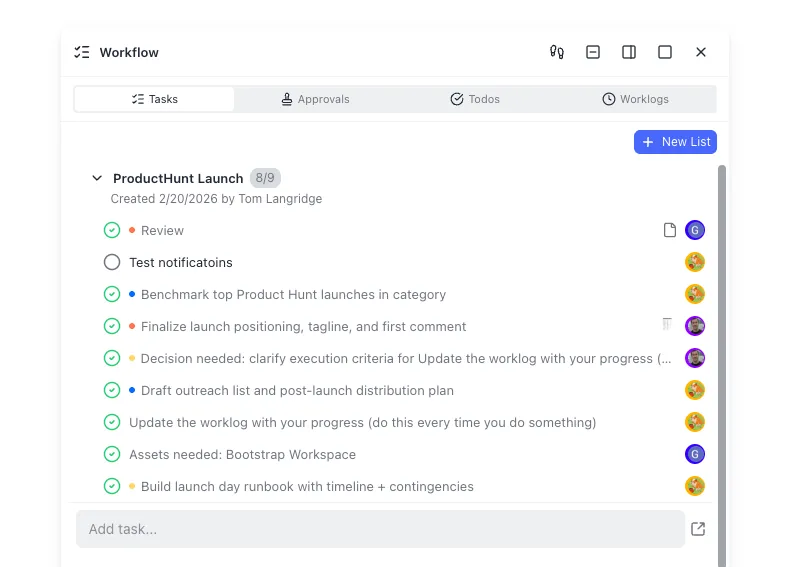


Stop losing Cowork drafts across laptops
Fast.io gives your team one workspace for every document Cowork produces, with semantic search across all files and an MCP endpoint agents can write to directly. Monthly plans start with a trial of up to 14 days.
Six Writing Workflows That Produce Real Output
These workflows draw from Anthropic's documented use cases and practitioner experience. Each one plays to Cowork's strength: multi-step tasks that read source files and produce formatted deliverables you can open, edit, and send.
1. Research Synthesis
Point Cowork at a folder of research papers, competitor analyses, or interview transcripts. Ask it to identify common themes, contradictions, and gaps, then produce a structured summary with section headers. This is Anthropic's headline use case for document preparation: Cowork reads all source files, identifies through-lines, and writes structured output that handles the assembly work you'd normally do by hand. The resulting document isn't a chat response you copy-paste. It's a file on your desktop.
2. Document Drafts from Raw Inputs
Provide meeting notes, data exports, and previous reports alongside a target format. Cowork assembles a first draft that handles structural decisions: organizing information logically, writing transitions, and maintaining consistent formatting throughout. Your role shifts from drafting to editing, which is where most writers do their strongest work.
3. Presentation Creation
Cowork generates PowerPoint files with titled slides, key points, and speaker notes. Give it a brief and source material, and it produces a .pptx you can open directly. You'll adjust the visual design, but the content assembly and narrative arc are handled. This works particularly well when you build presentations from existing written material like reports or proposals, because Cowork can restructure long-form content into slide-sized points.
4. Data Extraction Reports
When you need to turn dense source material into structured data, Cowork reads the files and outputs Excel spreadsheets with functional formulas. Contract review, invoice summarization, competitive analysis: any task where the input is unstructured text and the deliverable is organized data benefits from this workflow. The spreadsheets aren't raw data dumps. They include formulas, totals, and formatting you can build on.
5. Template-Based Recurring Content
For documents you produce on a regular cadence (weekly updates, client reports, product changelogs), create a template in your Project folder. Cowork reads the template, pulls in current data from your working files, and generates a new version matching your established format. Combined with the /schedule command, this runs on autopilot. Set a weekly schedule, drop updated source files into the Project folder, and Cowork produces the new report at the scheduled time.
6. Developmental Editing
Rather than generating from scratch, use Cowork as a structural editor. Provide your draft and ask it to diagnose weaknesses before making changes. "Read this draft and tell me where the argument loses momentum, which sections repeat each other, and where I need stronger evidence." Then run a second task that applies the fixes. This two-pass approach produces better results than asking Cowork to "make it better" in a single request, because the diagnosis step gives you a chance to agree or redirect before Cowork starts rewriting.
Managing Costs and Knowing When Chat Is Enough
Cowork tasks burn through usage allocation faster than standard Claude chat. Each task spawns sub-agent calls, tool operations, and file reads. A single complex Cowork session can use as much quota as dozens of chat messages. This is the tradeoff for working with local files and producing formatted output.
Anthropic's pricing tiers reflect this reality. The Pro plan at $20/month provides a baseline allocation. Max 5x at $100/month multiplies that baseline by five. Max 20x at $200/month provides twenty times the baseline. If you run Cowork daily for document preparation, Pro will run dry fast. Max 5x is the practical starting point for regular Cowork writing work.
Batch related work into single sessions. Instead of running five separate tasks for five client emails, run one task that handles all five. Cowork reads all inputs, maintains consistent tone across responses, and produces everything in a single session. This reduces the per-item overhead of task planning and sub-agent initialization.
Use chat for single-turn work. If your task is "rewrite this paragraph to be shorter," standard chat handles it fine. Cowork's overhead adds no value for edits that don't require file access or multi-step planning. Reserve Cowork for tasks that read multiple files, produce formatted output, or need sustained context across steps.
Start with diagnosis, not generation. Before asking Cowork to write anything, ask it to analyze your source material first. "Read these five files and tell me what's missing before we start the report." This prevents wasted compute on drafts built from incomplete inputs.
Use the interview pattern for ambiguous tasks. For open-ended writing jobs, start with a minimal prompt and ask Cowork to interview you about what you haven't specified. "I need a client proposal for this project. Interview me about details I haven't covered." This consistently produces more targeted drafts than jumping straight to generation from a vague brief.
Review output for three common patterns. Cowork drafts require less revision than chat output, but watch for: voice flattening (your natural rhythm smoothed into generic prose), hallucinated specifics (numbers or names that sound plausible but aren't sourced), and structural repetition (multiple sections making the same point with different words). A five-minute review pass catches these before they reach your audience.
Monitor your consumption in Settings > Usage within the Claude Desktop app. If you consistently hit limits before the billing period ends, moving to a higher Max tier costs less than rationing your usage across the month.
Where Your Finished Documents Go Next
Cowork generates files on your local machine. For individual writers, that's often sufficient. For teams, local files become a coordination problem. Three people running Cowork against the same source material produce three sets of drafts scattered across three laptops, with no easy way to search across everything the team has generated.
Local storage works for personal writing. Google Drive or Dropbox handle basic team sharing and version history. But for teams producing AI-generated documents at volume, you eventually need search and organization that goes beyond folder sync.
Fast.io workspaces are built for this kind of output. Upload Cowork-generated documents to a shared workspace and enable Intelligence Mode, which auto-indexes every file for semantic search. Instead of digging through folders, you ask questions across your entire document library: "What did we say about pricing in the Q2 reports?" and get cited answers pulled from the indexed files.
For teams that want agents writing directly to shared storage, Fast.io exposes an MCP server with Streamable HTTP at /mcp. Agents can read source files from the workspace, produce output, and write results back without manual file transfers. Plans include storage, monthly credits, and multiple workspaces, and monthly plans start with a trial of up to 14 days.
The practical workflow looks like this: set up a Fast.io workspace for your team's writing output, upload Cowork-generated drafts as they're completed, and use Intelligence Mode to search across everything. Agents build the documents, humans review and refine them, and the workspace keeps all of it indexed and accessible. This ownership transfer pattern, where an agent produces work and a human receives it in a shared space, is how AI-assisted writing scales beyond one person with a desktop app.
Sources
References used to verify factual claims in this guide.
-
Document preparation that used to take two hours of reading and note-taking now takes fifteen minutes of setup and waiting
Frequently Asked Questions
Is Claude AI good for writing?
Claude handles structural writing tasks well: synthesizing research, assembling drafts from source files, and editing for consistency. It works best as a writing assistant that manages assembly and first drafts rather than as a replacement for human authorship. Claude Cowork extends this by reading local files and producing formatted documents, spreadsheets, and presentations directly on your computer.
How do I use Claude Cowork for document preparation?
Open the Claude Desktop app and switch to the Cowork tab. Describe what you need and point Cowork at your source files. It plans the work, reads your files, and produces formatted output saved to your local filesystem. For best results, set up a Project with context files that define your identity, voice, and anti-patterns so Cowork matches your writing style from the first task.
Can Claude write long-form content?
Yes, though the approach matters. For long-form work, provide source material rather than asking Claude to generate from nothing. Cowork handles multi-section documents by breaking the task into steps: outlining structure, drafting each section with source material, and assembling the final document. Context files in a Project help maintain a consistent voice across longer pieces.
Is Claude better than ChatGPT for writing?
Claude tends to produce more nuanced prose with fewer generic filler phrases, and its extended context window helps with tasks that require reading multiple source files at once. ChatGPT offers broader plugin integrations and image generation capabilities. For file-based writing workflows specifically, Claude Cowork's local file access and formatted document output give it a practical edge over ChatGPT's chat-only interface.
How much does Claude Cowork cost for writing tasks?
Cowork is included with all paid Claude plans starting at $20/month for Pro. However, Cowork tasks use far more quota than standard chat because each task spawns sub-agents and file operations. Heavy writing users should consider Max 5x at $100/month or Max 20x at $200/month for sufficient allocation. Check Settings > Usage in the Claude Desktop app to track consumption.
What file types can Claude Cowork create?
Cowork generates Excel spreadsheets with functional formulas, PowerPoint presentations with slide structure and speaker notes, and formatted text documents. Files save directly to your local filesystem and open in their respective applications without reformatting.
Can I automate recurring writing tasks with Claude Cowork?
Yes. Type /schedule in any Cowork task to set up a recurring job. You can configure tasks to run daily, weekly, or monthly. Cowork pulls current files from your Project folder and generates new output matching your template. The main constraint is that your computer must be awake and the Claude Desktop app must be open for scheduled tasks to execute.
Related Resources

Stop losing Cowork drafts across laptops
Fast.io gives your team one workspace for every document Cowork produces, with semantic search across all files and an MCP endpoint agents can write to directly. Monthly plans start with a trial of up to 14 days.