Claude 3.7 Sonnet Context Window: 200K Tokens, Extended Thinking, and Pricing
Anthropic's Claude 3.7 Sonnet pairs a 200,000-token input context window with a dynamic thinking budget capable of producing up to 128,000 output tokens. While the expanded capacity handles complex reasoning and large codebases, multi-file uploads and deep thinking tokens can rapidly exhaust context boundaries and API rate limits. Effective implementations combine prompt caching with external workspace indexing to keep model context focused on high-value generation.

What the Claude 3.7 Sonnet Context Window and Output Limits Provide
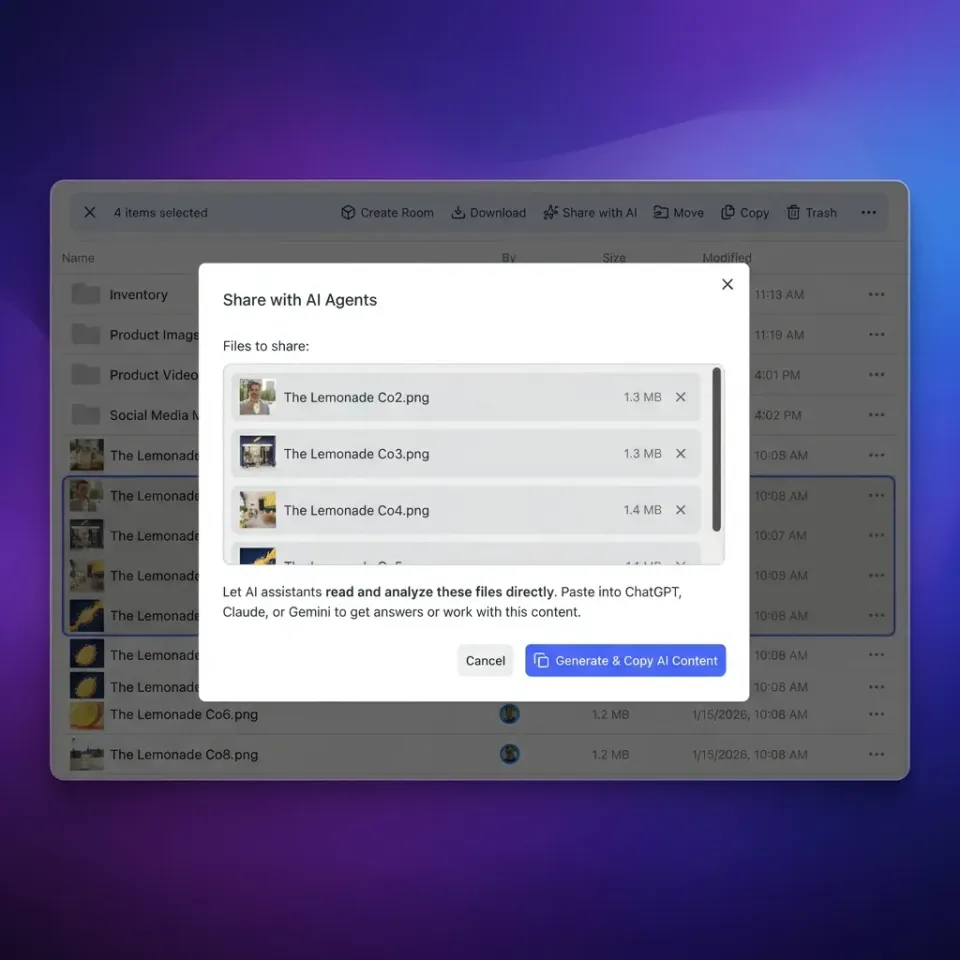
In Anthropic's documented platform mechanics outlined in the Claude file upload guide, a standard Claude chat accepts up to 20 files at up to 500MB each, while a Claude Project allows an unlimited number of files at up to 30MB each, provided the cumulative content fits within Claude's context window. Claude 3.7 Sonnet establishes that boundary at 200,000 input tokens in Anthropic's Claude 3.7 Sonnet announcement. Because Claude Projects enforces no fixed file count cap, the true operational ceiling of any project or agent session is determined strictly by how quickly attached documents consume that 200,000-token window.
The Claude 3.7 Sonnet context window provides 200,000 input tokens alongside a dynamic thinking budget that can generate up to 64,000 (or 128,000) output tokens in hybrid reasoning mode.
In practical development environments, a 200,000-token window translates to roughly 150,000 English words, about 500 pages of text, or between 50 and 70 typical source code files depending on density. For developers deploying autonomous agents or coding assistants like Claude Code, this token allowance represents the total canvas shared among system prompts, tool schemas, retrieved files, conversation history, and incoming user prompts.
On the generation side, Claude 3.7 Sonnet sets new thresholds for model responses. When operating in standard mode without extended reasoning, the model supports up to 64,000 output tokens per completion request. When extended thinking is enabled, the maximum output ceiling expands to 128,000 tokens. This 128,000-token allocation accommodates both the internal reasoning process and the visible response returned to the client.
Understanding how these input and output thresholds interact is essential for designing resilient software agents and automated data extraction pipelines.
Allocating the 200,000-Token Input Budget Across Agent Contexts
Every component sent to the Anthropic Messages API consumes a portion of the 200,000-token budget. In complex agent configurations, developers frequently underestimate how rapidly overhead accumulates before the user enters a single prompt.
A production-grade agent implementation typically divides the input budget across four distinct layers:
- System Instructions: Core behavioral constraints, persona rules, and formatting templates consume between 1,500 and 4,000 tokens.
- Tool Definitions: Detailed Model Context Protocol (MCP) tool schemas, parameter types, and endpoint descriptions often require 3,000 to 12,000 tokens depending on the breadth of tools exposed to the model.
- Reference Knowledge: Project files, database schemas, code snippets, or documentation attached directly to the prompt can range between 20,000 and 150,000 tokens.
- Conversation State: The accumulated history of multi-turn user requests, agent tool calls, and tool execution results grows continuously throughout the session.
When reference knowledge and multi-turn tool outputs exceed 140,000 tokens, the remaining space for agent reasoning and context retrieval shrinks dramatically. Keeping the input payload compact ensures that the model preserves room for extended thinking and avoids hitting hard API context limits.
Related guides
- How to Manage the Context Window in OpenClawConversation history accounts for 40 to 50 percent of total token consumption in a typical OpenClaw session, and that...
- Managing the GitHub Copilot Context Window & Token LimitsManaging the active token memory in GitHub Copilot is essential for complex repository operations. This guide details...
- Claude Code Context Window: Managing Token Limits in Terminal AgentsThe Claude Code context window determines how much conversation history, source code, and command output a terminal...
- Claude 3.5 Sonnet Context Window: 200,000 Token Limit and Output BudgetsThe Claude 3.5 Sonnet context window is 200,000 input tokens with a maximum output limit of 8,192 tokens per request....
- How to Configure Claude 3.7 Sonnet with Extended Thinking in ClineClaude 3.7 Sonnet introduces hybrid reasoning to Cline, allowing developers to switch dynamically between instant...
- Claude Desktop Context Window: Token Limits, MCP Overhead, and Document RetrievalClaude Desktop operates with a standard 200,000-token input context window (with options up to 1,000,000 tokens on...
More on this subject: Claude and Claude Code (278 guides)
How Extended Thinking Budgets Interact with Rate Limits
Claude 3.7 Sonnet is designed as a hybrid reasoning model, combining fast conversational responses with deep step-by-step problem solving within a single architecture. Rather than routing queries to a separate reasoning model, developers configure Claude 3.7 Sonnet to think through complex problems before emitting output.
Through the Anthropic API, developers control this reasoning depth using the thinking budget parameter. By setting thinking: { type: "enabled", budget_tokens: N }, you establish an explicit upper boundary on the number of internal reasoning tokens Claude can produce. The minimum valid budget is 1,024 tokens, and the budget can scale up to the full 128,000-token output limit.
A critical reality that many teams overlook is how extended thinking tokens interact with API rate limits and execution quotas. Anthropic enforces rate limits measured in Requests Per Minute (RPM) and Tokens Per Minute (TPM). Thinking tokens are counted as output tokens. Because output tokens are subject to stricter per-minute quotas than input tokens, an agent generating deep reasoning traces can deplete organizational rate limits far faster than standard completions.
Consider an engineering workflow where three concurrent coding agents examine an issue with an allocated thinking budget of 32,000 tokens each. If all three agents encounter challenging edge cases and generate 25,000 thinking tokens simultaneously, they consume 75,000 output tokens within a single minute. For teams operating on standard API tiers, this sudden burst easily triggers HTTP 429 rate limit errors, stalling dependent services and automated CI runs.
Configuring Thinking Budgets in API Requests
Developers must calibrate the thinking budget to match the specific difficulty of the task. Setting an excessive budget on simple classification or metadata extraction tasks wastes output token quota and introduces latency without improving accuracy.
The following Python example illustrates how to invoke Claude 3.7 Sonnet using the Anthropic API with an explicit thinking budget:
import anthropic

client = anthropic.Anthropic()

response = client.messages.create(
    model="claude-3-7-sonnet-20250219",
    max_tokens=16000,
    thinking={
        "type": "enabled",
        "budget_tokens": 8000
    },
    messages=[
        {
            "role": "user",
            "content": "Analyze the following database migration script for concurrency bottlenecks and deadlocks."
        }
    ]
)

for block in response.content:
    if block.type == "thinking":
        print(f"Thinking Trace ({len(block.thinking)} chars)")
    elif block.type == "text":
        print(f"Final Answer: {block.text}")
Setting max_tokens higher than budget_tokens is mandatory. The max_tokens parameter specifies the ceiling for total generated tokens, which encompasses both the internal thinking blocks and the final user-facing text block. If budget_tokens matches or exceeds max_tokens, the API returns a validation error.
Understanding Token Pricing and Prompt Caching Economics
Pricing for Claude 3.7 Sonnet remains consistent with predecessor frontier Sonnet releases. Base API pricing is structured at $3 per million input tokens and $15 per million output tokens. Under Anthropic's pricing rules, all thinking tokens generated during extended reasoning are billed at that same standard output pricing rate of $15 per million tokens.
To manage input costs across large contexts, Anthropic provides prompt caching. Prompt caching allows developers to checkpoint static portions of a prompt, such as system instructions, tool definitions, and reference documentation, so subsequent API calls reuse pre-computed representations.
Under Anthropic's prompt caching pricing structure:
- Cache Writes: Writing new prompt prefixes incurs an initial cache creation fee over base input tokens for a 5-minute time-to-live (TTL).
- Cache Reads: Reading previously cached content serves subsequent requests at a fraction of base input token rates.
- Regular Input Tokens: Uncached or dynamic prompt tokens continue billing at the standard $3 per million input rate.
- Output and Thinking Tokens: All model-generated tokens, including internal reasoning traces, bill at the standard $15 per million output rate.
The minimum cacheable prefix length for Claude 3.7 Sonnet is 1,024 tokens. Under this pricing model, prompt caching cuts time-to-first-token latency while lowering input expenses on repeated requests when prompts maintain an identical prefix.
Every cache hit refreshes the 5-minute TTL window, enabling persistent, low-latency interactions across active agent sessions.
Structuring Prompts to Maximize Cache Hit Ratios
Because prompt caching relies on exact prefix matching, any minor alteration at the beginning of a prompt invalidates the entire cached segment downstream. Moving a dynamic timestamp, user message, or variable file path into the system prompt destroys cache reuse for that turn.
To maintain consistent cache hits across multi-turn agent runs, structure prompts in a strict hierarchical order:
- Static System Directives: Place core operational rules and identity guidelines at the very top of the system prompt.
- Tool Schemas: Append MCP tool definitions directly beneath system instructions. These schemas remain invariant across tasks.
- Stable Workspace Knowledge: Insert foundational documentation, company guidelines, or codebase maps that do not change from turn to turn.
- Dynamic Turn State: Place the conversation history, the latest tool execution outputs, and the current user request at the bottom of the message payload.
By designating a cache checkpoint at the end of the stable workspace knowledge block, subsequent agent turns benefit from prompt caching pricing, reading the entire preceding prefix at discounted cache read rates rather than re-ingesting hundreds of thousands of tokens at base rates.


Keep Claude's Context Window Focused on Reasoning
Store large document collections in a Fast.io workspace. Connect Claude through our remote MCP server to query indexed files dynamically rather than stuffing prompts. Monthly plans start with a trial of up to 14 days (credit card required); annual plans have no trial.
Why Upload Limits Cause In-Context Saturation
When interacting with Claude through Claude.ai or desktop interfaces, users encounter distinct file upload boundaries depending on whether they work within a standard chat or a dedicated Claude Project.
In standard chat sessions, Claude supports up to 20 files per chat, with an individual file size limit of 500MB. In Claude Projects, the file size ceiling is 30MB per file, but the platform imposes no fixed numerical cap on uploaded files. Instead, the official constraint specifies that the total extracted content across all project files must fit within Claude's 200,000-token context window.
PDF documents introduce specific processing behavior based on page count:
- Documents from 1 to 100 pages: Claude processes both text and visual elements, including charts, diagrams, tables, and illustrations.
- Documents from 101 to 1,000 pages: Claude extracts raw text only, ignoring visual elements and graphics.
- Documents exceeding 1,000 pages: Claude rejects the upload entirely, displaying an error indicating the file is too large.
While a 200,000-token context window appears generous on paper, loading dozens of project files or dense technical specifications quickly saturates available capacity. A collection of 15 architectural design documents, API references, and database schemas can easily total 160,000 tokens of extracted text. Once uploaded to a project, those tokens are prepended to every single query submitted within that project.
Operational Consequences of In-Context Document Stuffing
Stuffing raw documents directly into the prompt context creates severe operational headwinds for engineering teams:
First, context saturation drastically inflates per-query latency. Processing a prompt packed with 170,000 tokens of static documentation requires substantial prefill compute time before the model generates its initial token.
Second, in-context file stuffing compromises retrieval precision. While Claude 3.7 Sonnet demonstrates strong long-context recall, packing hundreds of pages of unindexed text into a single prompt increases the risk of attention dilution. When instructions and reference facts are scattered across hundreds of thousands of words, models can overlook subtle constraints or pull conflicting information from outdated drafts.
Third, context stuffing limits reasoning headroom. Because the context window is capped at 200,000 tokens, a prompt holding 180,000 tokens of attached project files leaves only 20,000 tokens for user prompts, conversation history, and incoming tool responses. If the agent needs to invoke an external tool or think through a complex refactoring problem, it risks terminating prematurely due to context exhaustion.
How to Manage Large File Corpora with Fast.io Workspaces and MCP
When team documentation, codebases, or customer data exceed what can safely live inside a 200,000-token prompt, developers need an external storage and indexing layer. Relying on local file storage limits accessibility to a single developer machine and prevents team collaboration. Traditional object storage like Amazon S3 provides persistence but requires engineering teams to build, manage, and maintain custom chunking pipelines, embedding models, and vector databases from scratch. General cloud drives like Google Drive or Dropbox were built for human file synchronization rather than agentic tool execution, frequently throttling automated API calls under strict rate limits.
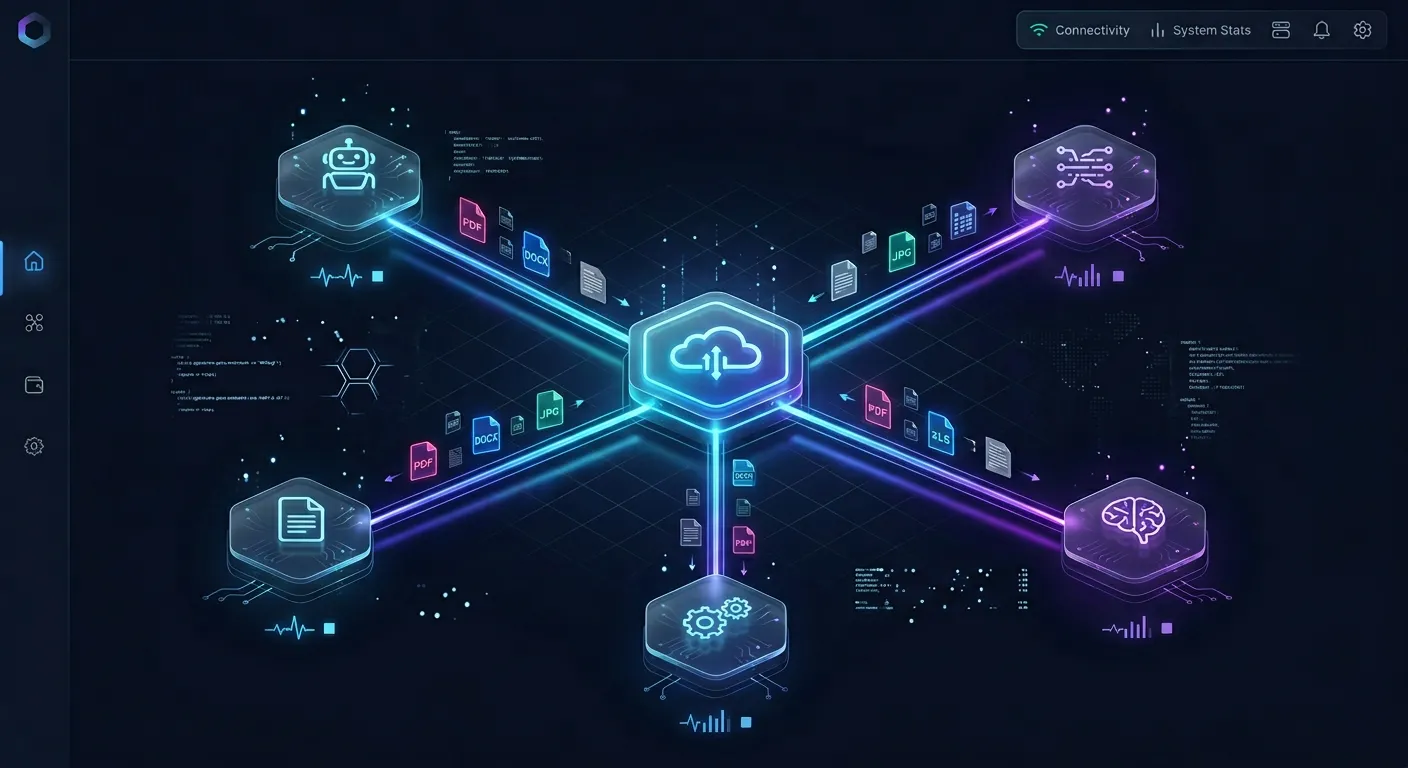
Fast.io provides a purpose-built workspace platform for storage for agents designed specifically for agentic teams and human collaborators. Rather than forcing agents to carry entire file libraries within their prompt context, Fast.io workspaces serve as a persistent, organized environment where documents are stored, indexed, and queried dynamically.
With Fast.io Intelligence Mode enabled on a workspace, incoming files are automatically parsed and indexed for hybrid search, combining semantic vector understanding with exact full-text keyword matching and structured metadata values. Files become instantly searchable without requiring developers to configure an external vector database or write embedding ingestion scripts.
Claude connects directly to Fast.io workspaces through a remote Model Context Protocol (MCP) server hosted at https://mcp.fast.io/mcp/tools (detailed in the Fast.io MCP documentation). Through this connection, Claude functions as an intelligent research and implementation partner. Instead of attaching 50 files to a Claude Project, Claude uses MCP search tools to locate exact, relevant passages across indexed workspace documents, pulling only 2,000 to 4,000 tokens of precise context into the active prompt.
This decoupled architecture preserves over 190,000 tokens of Claude's context window for multi-turn problem solving, code generation, and extended thinking budgets. In addition, Fast.io workspaces provide per-file version history, granular access permissions across organizations and folders, a detailed activity log, and direct ownership transfer so agents can prepare complete workspaces and hand administrative control to human colleagues.
Monthly plans start with a trial of up to 14 days, which requires a credit card, detailed on the Fast.io pricing page. Fast.io subscriptions are organized into three tiers:
Connecting Claude to Fast.io Workspaces via MCP
Configuring Claude Code to access Fast.io workspaces requires adding the remote Fast.io MCP server to the project's .mcp.json file.
The following JSON configuration establishes the remote connection:
{
  "mcpServers": {
    "fastio": {
      "type": "http",
      "url": "https://mcp.fast.io/mcp/code"
    }
  }
}
Then run /mcp inside Claude Code to sign in. Once connected, Claude can inspect available workspaces, search indexed documents for specific concepts or metadata, retrieve precise excerpts with source citations, and write finalized reports or code artifacts directly into shared folders. By offloading large corpus storage to Fast.io, teams maintain complete project context without colliding with context window ceilings or burning unnecessary token budgets.
Sources
References used to verify factual claims in this guide.
-
Claude 3.7 Sonnet pricing is $3 per million input tokens and $15 per million output tokens across standard and extended thinking modes.
-
Anthropic limits Claude chat uploads to 20 files at 500MB each, while Claude Projects allows unlimited files that fit within Claude's context window.
Frequently Asked Questions
What is the context window of Claude 3.7 Sonnet?
Claude 3.7 Sonnet features a 200,000-token input context window across all supported interfaces, including the Anthropic API, Claude.ai, and cloud partner platforms. This capacity accommodates approximately 150,000 English words or roughly 500 pages of text.
How many output tokens can Claude 3.7 Sonnet generate?
In standard completion mode, Claude 3.7 Sonnet generates up to 64,000 output tokens. When extended thinking mode is enabled, the maximum output capacity expands to 128,000 tokens, which covers both internal reasoning tokens and visible output text.
Does Claude 3.7 Sonnet support extended thinking in 200k context?
Yes. Claude 3.7 Sonnet supports extended thinking across the entire 200,000-token input context window. API developers can set an explicit thinking budget from 1,024 tokens up to the maximum output limit of 128,000 tokens.
How much does Claude 3.7 Sonnet cost per million tokens?
Under Anthropic pricing, Claude 3.7 Sonnet costs $3 per million input tokens and $15 per million output tokens. Internal thinking tokens generated during extended reasoning bill at that same standard output rate of $15 per million tokens. Prompt caching reduces input costs on cache read requests.
How do chat upload limits differ from Claude Project file limits?
In standard Claude chat sessions, users can upload up to 20 files at up to 500MB per file. In Claude Projects, individual files are capped at 30MB, with no limit on the total number of files. However, all project files must fit cumulatively within Claude's 200,000-token context window.
How do extended thinking tokens impact API rate limits?
Extended thinking tokens count directly against organizational Tokens Per Minute (TPM) output quotas. Because thinking tokens are generated by the model before emitting visible text, agents with large thinking budgets can rapidly consume output rate limits, leading to HTTP 429 throttling errors if concurrency is not carefully managed.
Related Resources

Keep Claude's Context Window Focused on Reasoning
Store large document collections in a Fast.io workspace. Connect Claude through our remote MCP server to query indexed files dynamically rather than stuffing prompts. Monthly plans start with a trial of up to 14 days (credit card required); annual plans have no trial.