Best OpenClaw Workflows for AI Storyboard and Scene Planning
Over 1 million professionals use AI storyboarding tools, but most require manual interaction per frame. OpenClaw's image_generate, video_generate, and ClawFlows workflow engine chain into automated preproduction pipelines that produce storyboard frames, shot lists, and motion previews from a script file.

How We Picked These Workflows
Over 1 million professionals now use AI storyboarding tools across creative industries, according to Virtue Market Research's market report. Most of those tools are standalone apps that handle one frame at a time. OpenClaw's ecosystem includes 172 cataloged image and video generation skills, none labeled specifically for storyboarding, but its agent architecture handles what standalone tools cannot: chaining scene analysis, frame generation, and output assembly into pipelines that process an entire script without manual intervention at each step.
Previsualization reduces location-related production costs by 25-40% according to Filmustage's production workflow analysis. Automated pipelines bring that discipline within reach of teams that cannot afford a dedicated storyboard department.
We evaluated each workflow on five criteria:
- Visual quality: How close are generated frames to production-ready boards?
- Automation depth: Can it run end-to-end without human input at each step?
- Style consistency: Does the workflow maintain visual coherence across frames?
- Setup complexity: How many skills and configurations does it require?
- Output flexibility: Static frames, shot lists, motion previews, or all three?
Comparison Table
Related guides
- How to Build Claude Cowork WorkflowsAgentic workflows handle repetitive data processing, but setting them up requires structure. Learn how to build Claude...
- Best Storage Solutions for Base44 WorkflowsAccording to the Flexera 2025 State of the Cloud Report, 84% of organizations identify managing cloud spend and...
- Best OpenClaw Workflows for AI Music Video and Lyric Video CreationOpenClaw 2026.4.5 shipped music_generate and video_generate as built-in tools, but most guides cover them in isolation....
- Best OpenClaw Workflows for AI Product Demo Video and Walkthrough CreationOpenClaw's ecosystem includes a dedicated demo-video skill that records browser walkthroughs through CDP screencast, a...
- Best OpenClaw Workflows for AI Social Media Post CreationOpenClaw social media post creation workflows chain content ideation, copy generation, image creation, and...
- Best OpenClaw Workflows for AI Workflow Automation Builder ToolsClawHub's curated index lists 529 skills across its Browser & Automation and Productivity & Tasks categories, yet most...
More on this subject: OpenClaw Workflows and Integrations (69 guides)
How to Generate Storyboard Frames from a Script
The most straightforward workflow: give your OpenClaw agent a script or scene description, and it generates one visual frame per scene using the built-in image_generate tool.
OpenClaw's image_generate supports 10 providers, including OpenAI's gpt-image-2, Google's Gemini image preview, xAI's grok-imagine, and fal's FLUX models. For storyboard work, provider choice matters. OpenAI's gpt-image-2 produces the most detailed compositions with strong spatial reasoning and character positioning. FLUX models on fal or DeepInfra generate faster at lower cost, which is practical for rapid iteration when speed matters more than visual polish.
The built-in prompt enhancement feature adds production value without extra effort. When enabled, the agent translates your scene description into an optimized image prompt with quality descriptors, lighting instructions, and composition keywords. A script line like "Sarah enters the warehouse, flashlight cutting through dust" becomes a detailed prompt specifying lighting angle, atmosphere, depth of field, and framing.
Strengths:
- Zero installation. image_generate is available in every OpenClaw agent session
- Provider fallback chains mean a failed generation automatically retries on another backend
- Async processing lets the agent work on the next scene while the current frame renders
Limitations:
- Each frame generates independently, so characters may look different across scenes
- No built-in panel layout or numbering. Output is individual image files, not assembled boards
- Quality varies by provider and prompt specificity
Best for: Quick visualization of individual scenes when you need frames fast and plan to refine later.

How to Automate Shot Lists and Scene Breakdowns
Not every storyboard workflow starts with images. Production teams often need structured shot lists before any visual work begins, covering camera angles, framing, movement notes, and timing for each shot.
OpenClaw agents handle this through natural language analysis with no special skill required. Feed the agent a screenplay or treatment, and it extracts scene boundaries, identifies characters and locations, suggests camera setups, and outputs a structured shot list in whatever format your pipeline expects: CSV, JSON, or a markdown table.
The value is speed and consistency. A script supervisor might spend a full day breaking down a 20-page short film into shot lists. An OpenClaw agent produces the same output in minutes, and the format stays consistent across every script you process. You can also instruct the agent to flag continuity issues, like a character wearing red in scene 3 but described in blue by scene 7.
For teams that want visual scene maps alongside shot lists, the mindmap-generator skill on ClawHub generates diagram images from conversational context. Use it to create relationship maps between scenes, character movement diagrams, or location dependency charts that give directors a spatial overview before any frames are generated.
Strengths:
- No additional skills needed for text-based shot lists
- Consistent output structure across all scripts
- Catches continuity errors that manual breakdown might miss
Limitations:
- Output is text and diagrams, not visual storyboard frames
- Camera angle suggestions follow convention, not cinematographic judgment
- Complex multi-location scenes may need human refinement
Best for: Pre-visualization planning when you need structured production documents before generating any visual frames.
Best Approach for Multi-Skill Preproduction Pipelines
The previous workflows handle individual steps. ClawFlows connects them into automated sequences where one skill's output feeds directly into the next.
ClawFlows is an open-source workflow library with over 112 prebuilt automation patterns. Each workflow is a plain-text, version-controlled file that the agent loads and executes. The Lobster Shell engine, OpenClaw's native workflow runtime, resolves dependencies between steps and passes output artifacts forward through the chain.
For storyboard and scene planning work, a ClawFlows pipeline typically chains three stages:
- Scene analysis: The agent reads the script, identifies distinct scenes, and generates structured descriptions with setting, characters, mood, and action
- Frame generation: Each scene description feeds into image_generate, with provider and style parameters tuned per scene type
- Output assembly: Generated frames are numbered, captioned with scene and shot identifiers, and saved to a designated output directory
Instead of writing workflow definitions manually, you can describe what you want automated. Telling your agent "create a workflow that reads scripts from my input folder, breaks each into scenes, generates a storyboard frame per scene, and saves numbered outputs" produces a ready-to-run pipeline definition.
Strengths:
- End-to-end automation from script file to organized storyboard output
- Version-controlled workflows are reproducible and shareable across teams
- Natural language creation lowers the barrier to building custom pipelines
- Deterministic execution runs the same way every time
Limitations:
- Initial setup requires understanding ClawFlows dependency structure
- Style consistency across frames still depends on the image provider, not the pipeline
- Branching logic for different visual treatments (flashback vs. present-day) needs more advanced configuration
Best for: Teams running storyboard generation regularly who want a repeatable, automated pipeline from script to organized visual output.


Persist your storyboard assets across agent sessions
Connect OpenClaw agents to Fastio workspaces via MCP. Upload frames, search scene descriptions with Intelligence enabled, and hand off to production.
4. Style Sheets and Motion Previsualization
Two advanced patterns address the biggest complaints about AI-generated storyboards: inconsistent character appearance and static frames that fail to communicate movement.
Reference Image Editing for Visual Consistency
OpenClaw's image_generate supports reference image editing on most providers. OpenAI, OpenRouter, Google, and xAI accept up to 5 reference images per generation request. For storyboard work, generate a character sheet first (your protagonist from multiple angles), then include that reference in every subsequent frame generation.
The approach: create or upload a character reference, then pass it as input to each scene's image_generate call alongside a prompt like "same character, now standing in the warehouse doorway." The provider uses the reference to maintain visual consistency. MiniMax's image-01 model handles subject reference particularly well for this use case.
This does not guarantee pixel-perfect results. Provider behavior with reference images varies, and complex poses or dramatic lighting changes still produce visual drift. But it is a significant improvement over generating each frame independently from text alone.
Motion Previsualization with video_generate
For scenes that depend on movement, camera pans, or action choreography, static frames fall short. OpenClaw's built-in video_generate tool converts storyboard frames into short animated sequences using image-to-video mode.
Generate your key storyboard frame with image_generate, then pass it to video_generate. The result is a 3-5 second clip showing rough motion for the scene. This is not final animation. It is a motion study that helps directors visualize camera movement and action timing before committing to a shooting plan.
Best for: Series productions where character consistency matters across episodes, or action-heavy projects where motion testing reduces costly reshoots.
Which Workflow Fits Your Production?
Your choice depends on where you sit in the production cycle and what you need to communicate.
Pitching a concept quickly? Start with script-to-frame generation (Workflow 1). Generate 10-15 key frames in an hour. Visual inconsistency between frames matters less when the goal is conveying narrative arc to stakeholders.
Planning a shoot? Use shot list automation (Workflow 2) first. Get the structural breakdown done, then generate frames only for the most complex or ambiguous scenes. Not every shot needs a storyboard frame. Focus visualization effort on scenes where blocking, effects, or camera work is genuinely unclear.
Running a recurring pipeline? Build a ClawFlows workflow (Workflow 3). The upfront setup pays off when processing multiple scripts per week, and version-controlled definitions mean new team members run the same pipeline without tribal knowledge.
Producing a series? Invest in style sheets (Workflow 4). Time spent creating consistent character references at the start saves significant rework across dozens of episodes.
Storing and Reviewing Storyboard Output
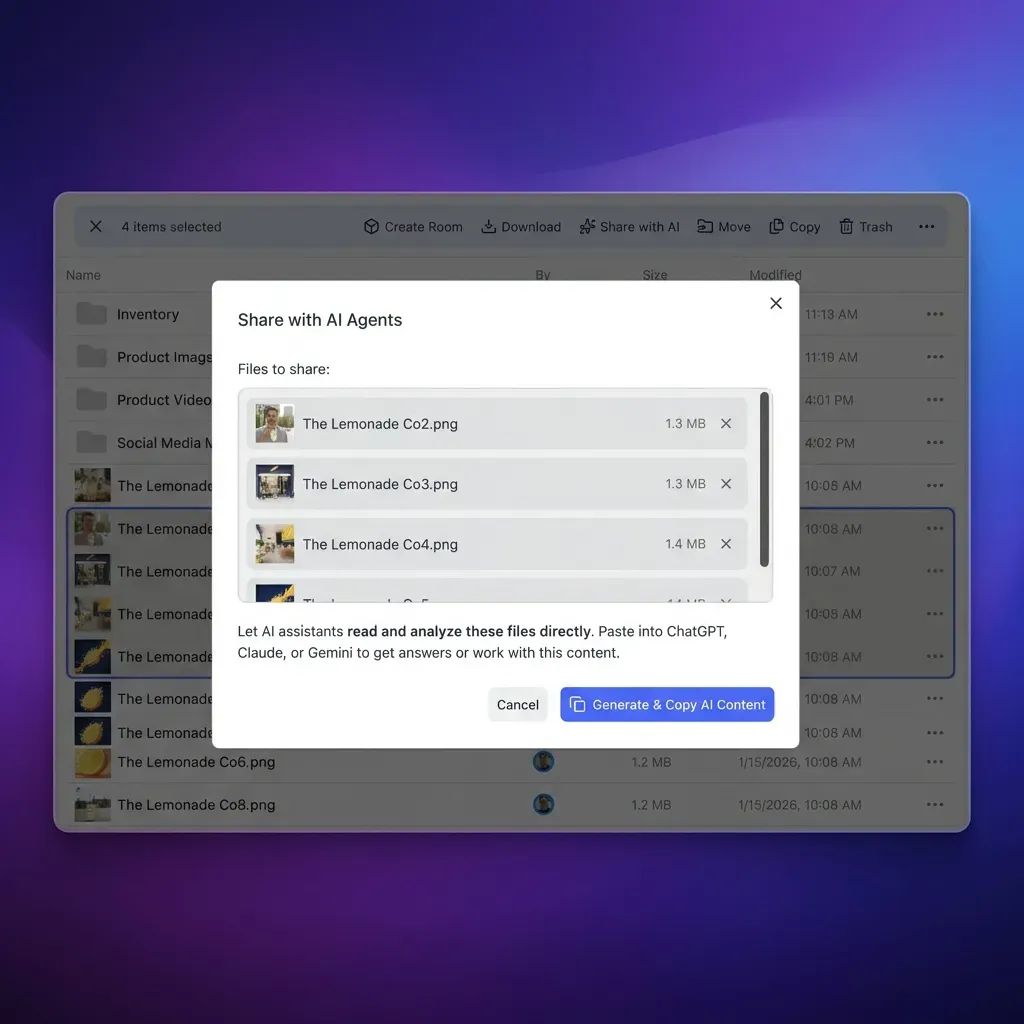
Storyboard workflows produce lots of files. A 20-scene script generates 20+ images, possibly with variants, plus shot list documents and motion previews. Local storage works for solo creators but breaks when directors, producers, and cinematographers need to review and annotate.
S3 gives you maximum flexibility but requires building your own access controls and review interface. Google Drive offers 15GB free but limited agent integration. Fastio provides workspace-based storage accessible through both browser UI and the remote MCP server, with plans detailed at /pricing/. Once Intelligence Mode is enabled on the workspace, it indexes uploaded frames, letting you search storyboard archives by scene description rather than filename. When assets are finalized, ownership transfer moves the workspace from the agent to a human producer without losing file history.
Other options work too. The key requirement is that both agents and humans can access the same files, and that collaborative notes and anchored comments feed back into the pipeline without manual file shuffling.
Sources
References used to verify factual claims in this guide.
-
Over 1 million active users across various creative industries for AI storyboarding tools
-
Previsualization can cut location-related production costs by 25-40%
-
OpenClaw image_generate supports 10 providers including OpenAI, Google, xAI, fal, DeepInfra, MiniMax, ComfyUI, OpenRouter, Vydra, and LiteLLM
-
172 image and video generation skills cataloged for OpenClaw
-
ClawFlows ships with 112+ prebuilt workflow patterns for OpenClaw
Frequently Asked Questions
Can AI create storyboards automatically?
OpenClaw's built-in image_generate tool converts scene descriptions into visual frames using any of 10 supported image providers. You describe the scene in natural language, and the agent produces a storyboard image. For fully automated pipelines, ClawFlows chains script analysis, image generation, and output assembly into a single workflow that processes an entire script without manual intervention at each step.
How do you plan scenes with an AI agent?
Feed your script or treatment to an OpenClaw agent and instruct it to produce a scene breakdown. The agent identifies scene boundaries, characters, locations, and suggests camera setups. For visual planning, chain the breakdown into image_generate calls to produce storyboard frames for each scene. The mindmap-generator skill on ClawHub can generate visual relationship maps between scenes and locations.
What OpenClaw skills help with video preproduction?
The built-in image_generate and video_generate tools handle frame creation and motion previsualization. ClawFlows chains these into automated pipelines. The mindmap-generator skill produces visual scene diagrams. For downstream post-production work, video-editor-ai handles subtitle insertion and effects, while ffmpeg-video-editor manages format conversion and clip assembly.
How do you keep visual style consistent across storyboard frames?
Use image_generate's reference image editing mode. Generate a character or location reference sheet first, then include it as input for each subsequent frame. OpenAI, Google, OpenRouter, and xAI providers accept up to 5 reference images per request. This reduces visual drift between frames, though it does not guarantee pixel-perfect consistency across complex poses or lighting changes.
Can OpenClaw generate animated storyboard previews?
The built-in video_generate tool accepts image input and produces short animated clips. Generate a key storyboard frame with image_generate, then pass it to video_generate in image-to-video mode. The result is a 3-5 second motion preview useful for visualizing camera movement and action timing during preproduction.
Related Resources

Persist your storyboard assets across agent sessions
Connect OpenClaw agents to Fastio workspaces via MCP. Upload frames, search scene descriptions with Intelligence enabled, and hand off to production.