Best OpenClaw Workflows for AI Product Photography and E-Commerce
Traditional product photography costs $30 to $200 per product, but OpenClaw agents can chain image generation, editing, and format conversion skills into pipelines that process entire catalogs for a fraction of that. This guide walks through seven workflow patterns that connect ClawHub skills into repeatable product photography automations for e-commerce stores.

Why Product Photography Pipelines Beat Single-Tool Edits
AI product photography tools like Photoroom and Claid cut costs by 80 to 95 percent per image compared to traditional studio shoots, according to Fibbl's 2026 analysis of e-commerce photography tools. But each tool handles one step: background removal here, scene generation there, resizing somewhere else. A seller with 500 SKUs still ends up babysitting a patchwork of browser tabs and manual exports.
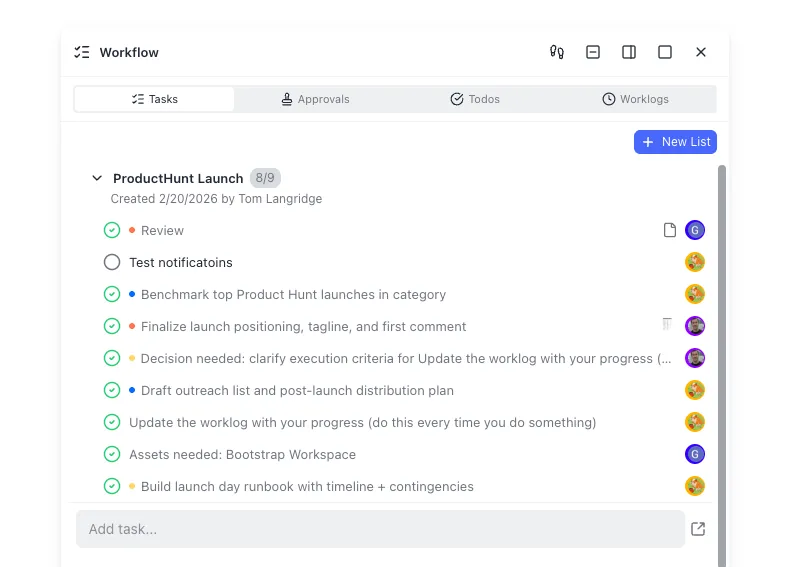
OpenClaw changes the equation by letting you chain multiple skills into a single workflow. Your agent can generate a hero shot, strip the background, place the product in a lifestyle scene, resize for Amazon and Shopify specs, and upload the finals to a shared workspace, all from one conversation. The 170-plus Image and Video Generation skills on ClawHub, combined with 51 Shopping and E-commerce skills, give you the building blocks. The workflows below show how to connect them.
Most product photography guides compare standalone tools. They don't show how to build an automated pipeline inside an AI agent that processes batches of product photos from raw input to marketplace-ready output. That's what the seven workflows below cover.
Related guides
- How to Build Claude Cowork WorkflowsAgentic workflows handle repetitive data processing, but setting them up requires structure. Learn how to build Claude...
- Best Storage Solutions for Base44 WorkflowsAccording to the Flexera 2025 State of the Cloud Report, 84% of organizations identify managing cloud spend and...
- Top OpenClaw Workflows for AI Print-on-Demand Product Design AutomationThe print-on-demand market hit $12.96 billion in 2025, growing at a 24.81% CAGR, yet most sellers still create designs...
- Best OpenClaw Workflows for AI Product Demo Video and Walkthrough CreationOpenClaw's ecosystem includes a dedicated demo-video skill that records browser walkthroughs through CDP screencast, a...
- Best OpenClaw Workflows for AI Image Generation PipelinesOpenClaw 2026.4.5 turned agents into image producers. The native image_generate tool supports 10 providers out of the...
- Best OpenClaw Workflows for Nonprofit OrganizationsOpenClaw workflows help nonprofit organizations scale their impact by automating donor outreach, grant research, and...
More on this subject: OpenClaw Workflows and Integrations (69 guides)
How OpenClaw Handles Image Generation
OpenClaw connects to external image generation providers rather than running its own model. You describe a product scene in natural language, choose a provider (OpenAI, Google Gemini, fal, xAI, and others are supported), and the agent generates the image. A prompt like "matte black smart speaker on a walnut desk, soft window light from the left" produces a studio-quality hero shot without booking a photographer, as noted in the Aimage AI guide to OpenClaw image generation.
For e-commerce sellers, two capabilities matter most. First, you control output dimensions, aspect ratio, and background transparency from the same tool, so one workflow covers everything from square marketplace thumbnails to wide hero banners. Second, you can pass an existing product photo as a reference and ask the agent to change the background, adjust lighting, or place the product in a lifestyle scene without regenerating it from scratch. That editing capability is what separates a useful photography pipeline from a one-shot image generator.

Seven Workflow Patterns for E-Commerce Photography
Each workflow below chains specific ClawHub skills and built-in tools into a repeatable pipeline. Skills install from ClawHub in one command and run inside your OpenClaw agent session.
1. White Background Product Shots
The baseline for any marketplace listing. Amazon requires RGB-255 pure white backgrounds for main images, and most AI tools produce slightly off-white results that fail compliance checks.
Skill chain: image_generate (built-in) to create the initial shot with background: "transparent", then a ClawHub image editing skill like eachlabs-image-edit (clawhub install eftalyurtseven/eachlabs-image-edit) to composite onto a pure white canvas at the exact pixel dimensions your marketplace requires.
Why it matters: Automating the white-background step eliminates the most common rejection reason for marketplace product images.
2. Lifestyle Scene Generation
Place products in context: a coffee maker on a kitchen counter, running shoes on a trail, a laptop on a cafe table.
Skill chain: Start with a clean product photo (transparent background). Use image_generate with an editing prompt that describes the scene, passing your product image as the reference. The built-in tool supports up to 5 reference images on providers like OpenRouter and xAI, so you can include mood board references alongside the product.
Best for: Shopify stores and social media ads where lifestyle imagery drives higher engagement than plain product shots.
3. Batch Catalog Processing
When you have hundreds of SKUs that all need the same treatment: consistent lighting, identical framing, uniform background.
Skill chain: Connect Fastio via remote MCP (https://mcp.fast.io/mcp/tools) to pull product photos from a shared workspace, then loop the image_generate tool across each image with a standardized prompt template. Upload processed images back to a Fastio workspace where your team can review them before pushing to your store.
Scaling note: OpenClaw runs generation requests asynchronously, so batch jobs don't block the agent. A 50-image catalog can process while you handle other tasks.
4. Virtual Try-On for Fashion
Fashion e-commerce has specific needs: showing garments on models across sizes and skin tones without separate photo shoots.
Skill chain: The eachlabs-fashion-ai skill (clawhub install eftalyurtseven/eachlabs-fashion-ai) specializes in fashion imagery and virtual try-on. Feed it a flat-lay garment photo and a model reference, and it generates on-model shots. Combine with image_generate for additional lifestyle variants.
ROI signal: Fibbl reports that brands using AI-generated product imagery see up to 29.4% reduction in return rates, partly because shoppers get a better sense of fit.


Store and share your product photography pipeline output
Shared cloud storage workspace with semantic search, branded shares, and MCP access. Your OpenClaw agent uploads, organizes, and hands off finished product images to your team.
Three More Workflows for Advanced Stores
5. Social Media Ad Variants
One product photo becomes five ad creatives: square for Instagram feed, vertical for Stories, wide for Facebook ads, with text overlays and branded frames.
Skill chain: Start with your best product shot. Use image_generate to create scene variants at different aspect ratios (1:1, 9:16, 16:9). Add text overlays with a skill like instagram-photo-text-overlay (clawhub install psyduckler/instagram-photo-text-overlay). Generate OG cards and social preview images with snapog (clawhub install beameasy/snapog).
Practical tip: Store your brand guidelines (fonts, hex codes, logo files) in a Fastio workspace with Intelligence enabled. Your agent can query "What are our brand colors?" and pull the exact values from indexed documents instead of hardcoding them.
6. Marketplace Multi-Format Export
Amazon, Shopify, Etsy, and eBay all have different image specifications. A single source image needs to be exported at multiple resolutions and aspect ratios.
Skill chain: Process your finalized product image through image-magik-resize (clawhub install pr1vateer/image-magik-resize) with presets for each marketplace. Amazon main images need at least 1000px on the longest side. Shopify recommends 2048x2048. Etsy performs best with 3000px minimum.
Storage workflow: Upload all variants to organized folders in a Fastio workspace. Your agent can generate branded share links for each marketplace's image set, so your listing team grabs the right files without digging through folders.
7. Product Photo Quality Audit
Before publishing, verify that every image meets marketplace requirements: correct dimensions, file size under limits, white background purity, and no compression artifacts.
Skill chain: Use the color-palette skill (clawhub install qrost/color-palette) to verify background whiteness by extracting dominant colors. Check dimensions programmatically through the image editing tools. Flag images that fail any criteria and route them back through the generation pipeline.
Handoff pattern: Once the audit passes, your agent can use Fastio to move approved images into a "Ready to Publish" workspace and notify your team through a branded share link. This is where ownership transfer matters: the agent builds the organized asset library, then hands access to the humans who manage marketplace listings.
Storing and Sharing Product Assets
Product photography workflows generate a lot of files. A 200-SKU catalog with five variants per product creates 1,000 images before you account for source files and rejected iterations. Where those files live determines whether your workflow scales or collapses.
Local storage fills up fast and locks assets to one machine. Generic cloud storage (Google Drive, S3 buckets) works for archiving but lacks the collaboration layer that e-commerce teams need: version tracking, team review, branded client deliveries.
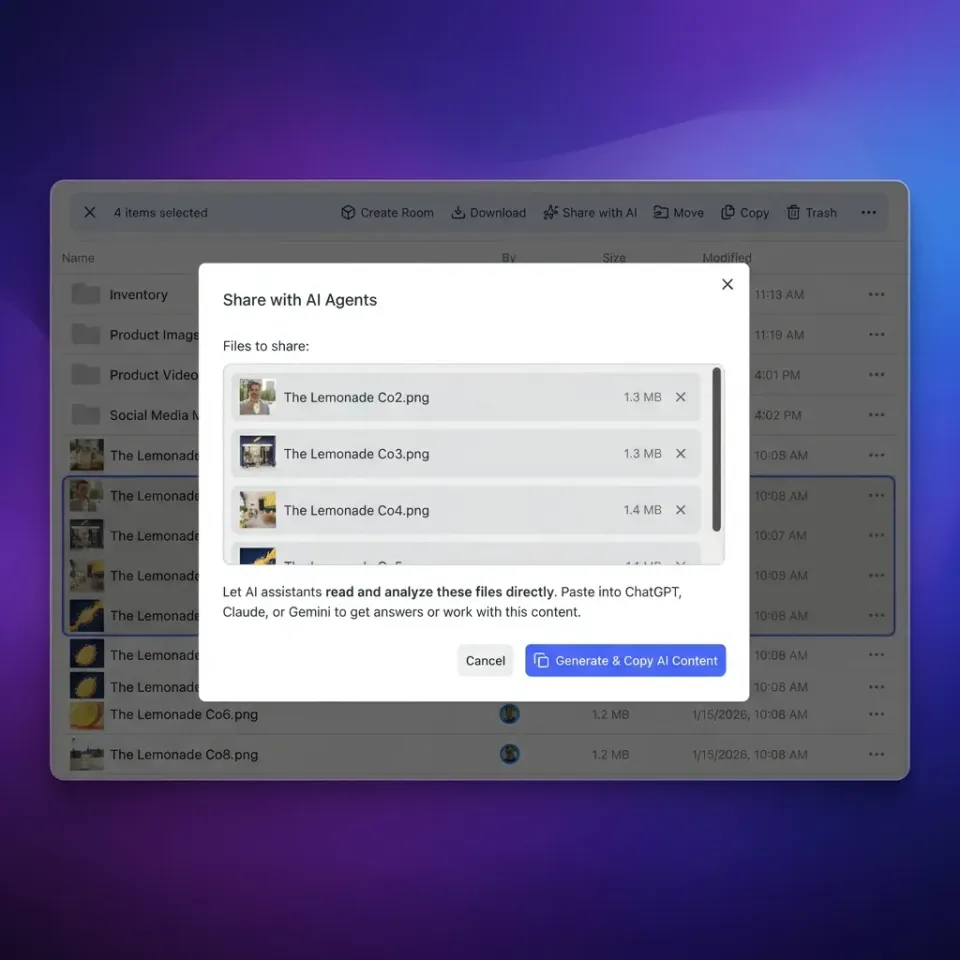
Fastio fits between those options as an intelligent workspace for agents. Connecting Fastio via remote MCP (https://mcp.fast.io/mcp/tools) gives your OpenClaw agent access to shared cloud storage with file versioning, a detailed activity log, and built-in AI search once Intelligence is enabled for the workspace. Ask your agent "Show me all lifestyle shots for the spring collection" and it pulls results from semantic search rather than relying on folder structure or file naming conventions.
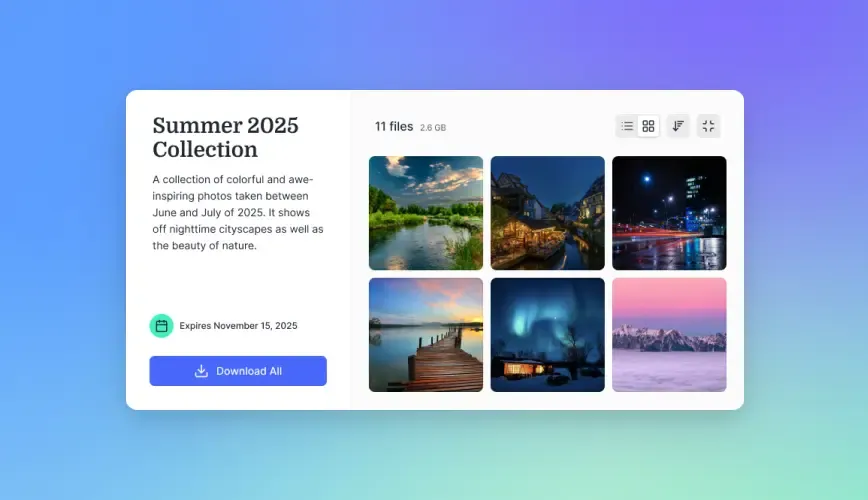
For teams that work with external photographers or clients, Fastio's branded shares let you send and receive files through professional portals. A photographer uploads raw product shots to a Receive share. Your OpenClaw agent picks up the new files, processes them through the photography pipeline, and deposits the finals into a Send share for the listing team. No email attachments, no WeTransfer links expiring mid-project.
The MCP server at /mcp gives agents programmatic access to the full workspace. Uploads, downloads, AI queries, share management, and comments all work through the same endpoint. Your photography pipeline can upload an image, leave a comment asking for review, and generate a share link in a single agent conversation.
Picking the Right Provider for Product Shots
Not every image generation provider handles product photography equally well. The choice depends on what you're generating and how much you're willing to spend per image.
OpenAI gpt-image-2 produces the most photorealistic results for product scenes. It handles lighting, reflections, and material textures well. It supports editing mode, so you can pass an existing product photo and modify the background or lighting without regenerating the product itself. The tradeoff is cost: it's the most expensive option per image.
Google Gemini offers a good balance of quality and speed for batch processing. The gemini-3.1-flash-image-preview model generates images quickly enough for large catalog runs, and the image quality holds up for marketplace thumbnails and social media. Editing support is available.
FLUX models via fal or DeepInfra work well for creative lifestyle shots where photorealism matters less than visual impact. These tend to be cheaper per image, making them practical for generating multiple scene variants when you need volume.
ComfyUI is the power-user option. If you have specific requirements for product photography, such as exact lighting setups, consistent model poses, or custom post-processing, ComfyUI lets you define the full generation pipeline as a workflow. The learning curve is steeper, but the control is worth it for stores with strict brand standards.
Configure fallbacks in OpenClaw so the agent automatically switches providers if your primary is slow or unavailable. Set your primary to the best quality option for hero shots, and use a faster, cheaper fallback for batch variants.
The best-image-generation skill on ClawHub (clawhub install evolinkai/best-image-generation) offers another path at approximately $0.12 to $0.20 per image through the EvoLink API, supporting text-to-image, image-to-image, and editing workflows. For a 500-SKU catalog, that works out to $60 to $100 for a complete set of product images.
Sources
References used to verify factual claims in this guide.
-
Traditional product photography costs $30 to $200 per product, while AI tools reduce this to $0 to $10 per image Brands using AI-generated product imagery see up to 29.4% reduction in return rates
-
170+ Image and Video Generation skills available on ClawHub
-
OpenClaw supports 10 image generation providers including OpenAI, Google Gemini, fal, xAI, and ComfyUI
-
best-image-generation skill costs approximately $0.12-0.20 per image through EvoLink API
Frequently Asked Questions
Can OpenClaw generate product photos from scratch?
Yes. OpenClaw's built-in image_generate tool routes requests to providers like OpenAI gpt-image-2 and Google Gemini. You describe the product and scene in natural language, and the provider generates the image. For best results with product photography, include specific details about lighting, surface materials, and camera angle in your prompt. You can also pass an existing product photo as a reference for editing workflows.
How do you automate product image editing with OpenClaw?
Chain multiple ClawHub skills into a workflow. Start with background removal using a transparent background setting in image_generate, then use an image editing skill like eachlabs-image-edit for compositing and retouching. Add image-magik-resize for marketplace-specific dimensions. Your OpenClaw agent executes these steps sequentially, processing each image through the full pipeline without manual intervention between steps.
What OpenClaw skills work for e-commerce photography?
The core skills for product photography workflows include the built-in image_generate tool for creating and editing images, eachlabs-image-edit for transformations across 200-plus AI models, eachlabs-fashion-ai for virtual try-on and fashion imagery, image-magik-resize for marketplace-specific resizing, and Fastio via remote MCP for persistent storage and team sharing. For social media variants, snapog and instagram-photo-text-overlay handle OG cards and branded overlays.
How much does AI product photography cost with OpenClaw?
Costs vary by provider. OpenAI gpt-image-2 is the most expensive per image but produces the best photorealistic results. Budget options like the best-image-generation skill on ClawHub run approximately $0.12 to $0.20 per image through the EvoLink API. For a 500-SKU catalog, that means $60 to $100 for a complete set compared to $15,000 or more for traditional studio photography at $30 to $200 per product.
Can OpenClaw handle batch processing of product photos?
Yes. OpenClaw processes image generation requests asynchronously, so batch jobs run in the background without blocking the agent. Use Fastio via remote MCP to organize input images in a workspace, loop the image_generate tool across each file with a consistent prompt template, and upload processed results back to organized folders. The agent handles the full pipeline for each image sequentially while you work on other tasks.
Related Resources

Store and share your product photography pipeline output
Shared cloud storage workspace with semantic search, branded shares, and MCP access. Your OpenClaw agent uploads, organizes, and hands off finished product images to your team.