7 Best OpenClaw Skills for AI Document Summarization
OpenClaw skills can condense documents, web pages, videos, and audio files into structured summaries without sending raw files to the cloud. This guide ranks seven summarization skills by format support, output quality, and privacy tradeoffs, with install commands and practical workflows for each.


How Summarization Works in OpenClaw
OpenClaw skills are instruction sets packaged as SKILL.md files with YAML frontmatter and a markdown runbook. When you ask your agent to summarize something, OpenClaw matches your request to the skill whose description best fits, then runs the skill's defined workflow: extract content, chunk it, send chunks to your configured LLM, and return the result.
The built-in summarize skill covers the common case. It handles URLs, PDFs, local files, and YouTube videos through a single CLI. But specific workflows need more targeted tools. Batch PDF extraction with table parsing, multilingual video transcripts, audio-to-text pipelines, and local semantic search over document libraries each call for dedicated skills from ClawHub.
Every skill listed below runs locally by default. Your documents stay on your machine, and only derived text goes to an LLM provider if you choose a cloud model. You can also point any of these skills at a local model through Ollama or another self-hosted backend.
Related guides
- Developing Hermes Agent Skills for Document WorkflowsDeveloping hermes agent skills for document workflows allows teams to automate document parsing without overloading LLM...
- How to Use Claude Code Skills in ClineAccording to GitHub's Octoverse 2024 report, the number of developers building with generative AI on the platform...
- Top 7 OpenClaw Skills for Journalists and Investigative ReportersOpenClaw skills help journalists gather data, verify facts, and organize interviews securely. With 97% of news...
- 5 Best OpenClaw Skills for Document Comparison and Diff AnalysisThe ClawHub registry passed 44,000 skills in April 2026, yet finding the right ones for document comparison still...
- Best OpenClaw Skills for Web ResearchWeb research skills let OpenClaw agents find and read information on the live web. Without them, your AI is stuck with...
- Top 7 OpenClaw Skills for Growth HackersThese top OpenClaw skills help growth hackers automate experimentation and analytics. They scale campaigns faster. Real...
More on this subject: OpenClaw Skills (109 guides)
How We Evaluated These Skills
We tested summarization skills across four criteria:
- Format coverage: How many input types does it handle? URLs, PDFs, audio, video, and local files each present different extraction challenges.
- Output quality: Are summaries structured and actionable, or just shortened versions of the original text?
- Privacy posture: Does the skill process content locally, or does it require sending full documents to a third-party API?
- Workflow fit: Can it plug into an automated pipeline, output machine-readable formats like JSON, and handle batch operations?
We also weighted real-world adoption. A skill with thousands of installs and active maintenance signals reliability that a weekend project cannot match. The skills below are ordered by breadth of summarization capability.
Quick Comparison
Top 7 OpenClaw Skills for AI Document Summarization
- Summarize (built-in) - 26K+ downloads. URLs, PDFs, audio, YouTube, local files. Configurable LLM and output length.
- YouTube Summarizer - Structured video summaries with metadata, timestamps, and full transcript export.
- GNO - Local semantic search and document Q&A with BM25/vector hybrid retrieval and cited answers.
- PDF - Full PDF toolkit: text extraction, OCR on scanned pages, table parsing, merge/split, and watermarks.
- OpenAI Whisper - Local speech-to-text for audio and video files. No API key required for the CLI version.
- Faster Whisper - CTranslate2 reimplementation of Whisper that runs 4-6x faster with speaker diarization.
- BibiGPT - Video summarization across 30+ platforms with timestamped structured output.
Each skill targets a different stage of the document-to-summary pipeline. Summarize is the generalist. GNO handles retrieval and Q&A over document libraries. PDF covers structured extraction. Whisper variants handle audio. The sections below break down each skill's strengths and gaps.


Store and search your document summaries in one workspace
Fastio auto-indexes uploaded summaries for semantic search and citation-backed chat. Connect via MCP for persistent storage and shared workspaces.
1. Summarize (Built-in)
The bundled summarize skill is the default starting point for most OpenClaw users. With over 26,000 downloads on ClawHub, it handles the widest range of input formats of any summarization skill available.
Supported input formats:
- URLs and web articles, with fallback scraping for sites that block direct access
- Local files including PDFs, text, and markdown
- YouTube videos with automatic transcript extraction
- Audio files and podcasts
Output length is configurable from brief overviews to detailed breakdowns, and the skill can produce machine-readable JSON for pipeline integration. It works with major LLM providers (OpenAI, Anthropic, xAI, Google Gemini) or a self-hosted local model through Ollama for fully offline operation.
YouTube processing handles rate limits automatically, so batch workflows that cover dozens of videos run without manual babysitting.
Best for: General-purpose summarization across mixed content types. If you only install one summarization skill, this is the one.
Limitation: Large PDFs can strain smaller LLM context windows, producing truncated summaries. For complex PDF workflows with tables and scanned pages, pair this with the dedicated PDF skill.
2. YouTube Summarizer
The YouTube Summarizer skill by abe238 focuses exclusively on video content. Where the built-in summarize skill treats YouTube as one of many formats, this skill produces richer output specifically designed for video consumption workflows.
Available on ClawHub, the skill installs through the standard OpenClaw skill directory.
What it produces for each video:
- Main thesis statement
- Key insights as structured bullet points
- Notable quotes and timestamps
- Full transcript as a downloadable text file
- Video metadata: title, channel, views, publish date, language
The skill automatically detects YouTube URLs in your messages, extracts the video ID, and pulls subtitle data for processing. It parses the transcript into a structured summary designed to be read in about 30 seconds.
One standout feature is Telegram integration. The skill can auto-send summaries and transcript files directly to a Telegram chat, which is useful for teams that triage video content through messaging channels. It also handles multiple languages with English fallback when the original language transcript is unavailable.
Best for: Teams that regularly process YouTube content for research, competitive analysis, or content repurposing. The structured output (thesis, insights, takeaways) is more actionable than a generic paragraph summary.
Limitation: Only handles YouTube. If you need to summarize Vimeo, Dailymotion, or self-hosted video, you will need the built-in summarize skill or BibiGPT instead.
3. GNO (Local Semantic Search)
GNO takes a different approach to summarization. Instead of condensing a single document, it indexes entire directories and lets you ask questions across your document library with cited answers.
Created by Ian Nuttall, GNO has 2,600+ GitHub stars and is available on ClawHub. It combines BM25 keyword search with vector embeddings for hybrid retrieval, meaning it catches both exact term matches and semantically related content.
Search modes and typical response times:
- BM25 search (instant): Exact keyword matching across indexed files
- Vector search (~0.5s): Semantic similarity for concept-level queries
- Query (~2-3s): Balanced hybrid of both methods
- Ask with answer (~3-5s): AI-generated response with source citations
GNO supports PDFs, markdown, Word documents, and code files. Index a directory once, and search results come back instantly. No cloud dependency and no API keys required for the search layer itself (though the AI answer feature uses your configured LLM).
The skill also includes document tagging, backlink discovery, and a local web UI for browsing indexed files. This makes it useful beyond pure summarization. If you maintain a research library, meeting notes archive, or internal knowledge base, GNO turns it into a searchable, queryable resource.
Best for: Researchers and knowledge workers who need to find and synthesize information across hundreds of local documents. Think of it as a personal RAG system that runs entirely on your machine.
Limitation: It is a search and Q&A tool, not a single-document summarizer. For condensing one long PDF into bullet points, use the summarize skill instead.
For teams that outgrow local-only search, Fastio Intelligence Mode provides a similar capability in the cloud. Enable Intelligence on a workspace, upload files, and the platform auto-indexes everything for semantic search and citation-backed chat. The difference: Fastio handles indexing, hosting, and sharing across your team, while GNO stays local to one machine.
4. PDF (Document Processing Toolkit)
The PDF skill provides a full processing toolkit that goes well beyond summarization. It covers the extraction layer that other summarization skills depend on.
Available on ClawHub, the PDF skill installs through the standard OpenClaw skill directory.
Core capabilities:
- Read and extract text from digital PDFs
- OCR on scanned documents and images
- Table extraction to CSV (per-table or combined with metadata)
- Merge and split PDFs
- Rotate pages and add watermarks
- Fill AcroForm fields programmatically
The real value for summarization workflows is in the extraction quality. The built-in summarize skill works well with clean digital PDFs, but scanned documents, multi-column layouts, and embedded tables often produce garbled text. The PDF skill uses dedicated parsing libraries (pdfplumber, PyMuPDF, MinerU) to extract clean, structured content that you can then feed to any summarizer.
Recommended workflow for complex PDFs:
- Parse the PDF into structured markdown or JSON using the PDF skill
- Extract specific fields into a defined schema (vendor, date, total, line items)
- Validate extracted values
- Summarize from the validated, structured output
This parse-first approach catches errors that direct summarization misses. A contract summary built from raw PDF text might conflate header text with clause content. Parsing first separates the structure, so your summary accurately reflects the document's actual sections.
Batch processing is supported through folder watchers and scheduled tasks. Point it at an incoming directory, and it processes new PDFs automatically.
Best for: Legal teams, finance departments, and anyone processing scanned documents, invoices, contracts, or research papers with complex layouts.
Limitation: It is an extraction and manipulation tool, not a summarizer itself. You need to pair it with the summarize skill or your own LLM prompt for the actual condensation step.
For structured extraction at scale, Fastio Metadata Views takes a different approach. Describe the fields you want in plain language, and the platform extracts them from PDFs, images, Word docs, and scanned pages into a sortable spreadsheet. No parsing scripts, no OCR configuration. Agents can create extraction schemas and query results through the Fastio MCP server.
5. OpenAI Whisper (Local Audio Transcription)
OpenAI Whisper turns audio and video files into text locally, which is the first step in summarizing any spoken content. Once you have a transcript, you can pipe it through the summarize skill or your own prompt for condensation.
No API key is required for the local version. The model runs entirely on your machine, which matters for confidential recordings like legal depositions, medical dictations, or internal strategy meetings. Install it through your package manager or follow the OpenAI Whisper repository instructions.
Supported formats: MP3, M4A, WAV, FLAC, and most common audio/video containers.
Output options:
- Plain text transcript
- SRT subtitles with timestamps
- VTT format for web embedding
- JSON with word-level timing data
The skill supports translation in addition to transcription. Feed it audio in any of Whisper's 99 supported languages, and it produces an English transcript. This is useful for international research teams processing interviews or conference talks in multiple languages.
Best for: Privacy-sensitive audio transcription where sending recordings to a cloud API is not an option. Pair it with the summarize skill for a complete audio-to-summary pipeline.
Limitation: Processing speed depends on your hardware. A one-hour recording can take 10-15 minutes on a CPU. For faster throughput, consider the Faster Whisper variant below.
6. Faster Whisper (High-Speed Transcription)
Faster Whisper by ThePlasmak is a CTranslate2 reimplementation of Whisper that delivers the same transcription accuracy at 4-6x the speed. It also adds speaker diarization, which labels who said what in multi-speaker recordings.
Available on GitHub and ClawHub, it installs alongside your existing OpenClaw setup.
Advantages over standard Whisper:
- 4-6x faster processing on the same hardware
- Speaker diarization (identifies and labels different speakers)
- Lower memory footprint through INT8 quantization
- Same accuracy as the original Whisper model
Speaker diarization is the key differentiator. Standard Whisper produces a flat transcript with no indication of who is speaking. Faster Whisper segments the transcript by speaker, which produces much better summaries from meetings, interviews, and panel discussions. When you summarize a diarized transcript, the LLM can attribute points to specific speakers instead of blending everyone's contributions together.
Best for: Meeting transcription and interview processing where speaker identification matters. The speed improvement also makes it practical for batch processing large audio archives.
Limitation: Requires more setup than the standard Whisper CLI. Speaker diarization needs a HuggingFace token for the pyannote model. If you just need basic transcription without speaker labels, the standard OpenAI Whisper skill is simpler to configure.
7. BibiGPT (Multi-Platform Video Summarization)
BibiGPT extends video summarization beyond YouTube to cover 30+ platforms including Bilibili, Xiaohongshu, Douyin, and other regional video services. If your research or content workflow involves non-YouTube video sources, this is the skill that fills the gap.
Available on ClawHub, the skill installs through the standard OpenClaw skill directory.
What it produces:
- Timestamped structured summaries
- Key point extraction with time markers
- Full transcript output
- Video metadata (title, channel, duration, platform)
The skill calls BibiGPT's API to fetch transcripts and generate summaries, so it does require network access. This is a tradeoff compared to the fully local summarize skill, but it is the only reliable option for platforms that do not expose public transcript APIs.
Best for: International content teams, researchers tracking trends across regional platforms, and anyone who needs to process video content from sources beyond YouTube and standard western platforms.
Limitation: Requires BibiGPT API access, so content is processed through their servers. For privacy-sensitive video, use the built-in summarize skill with local transcription instead.
Building a Complete Summarization Pipeline
These seven skills cover different stages of the document-to-summary workflow. In practice, you will combine two or three of them depending on your input sources and output requirements.
Pipeline for mixed document types:
Use the built-in summarize skill as your default. It handles URLs, clean PDFs, and YouTube videos in a single command. When you hit a scanned PDF or complex layout, route it through the PDF skill first for clean extraction, then summarize the extracted text.
Pipeline for audio and video content:
Start with Faster Whisper for transcription (especially for meetings with multiple speakers), then feed the transcript through the summarize skill. Set the output length to short for a quick brief or extra-long for a detailed breakdown.
Pipeline for research libraries:
Index your document collection with GNO for ongoing search and Q&A. Use the summarize skill for individual documents that need a standalone summary. This gives you both point summaries and cross-document synthesis.
Where to store the output:
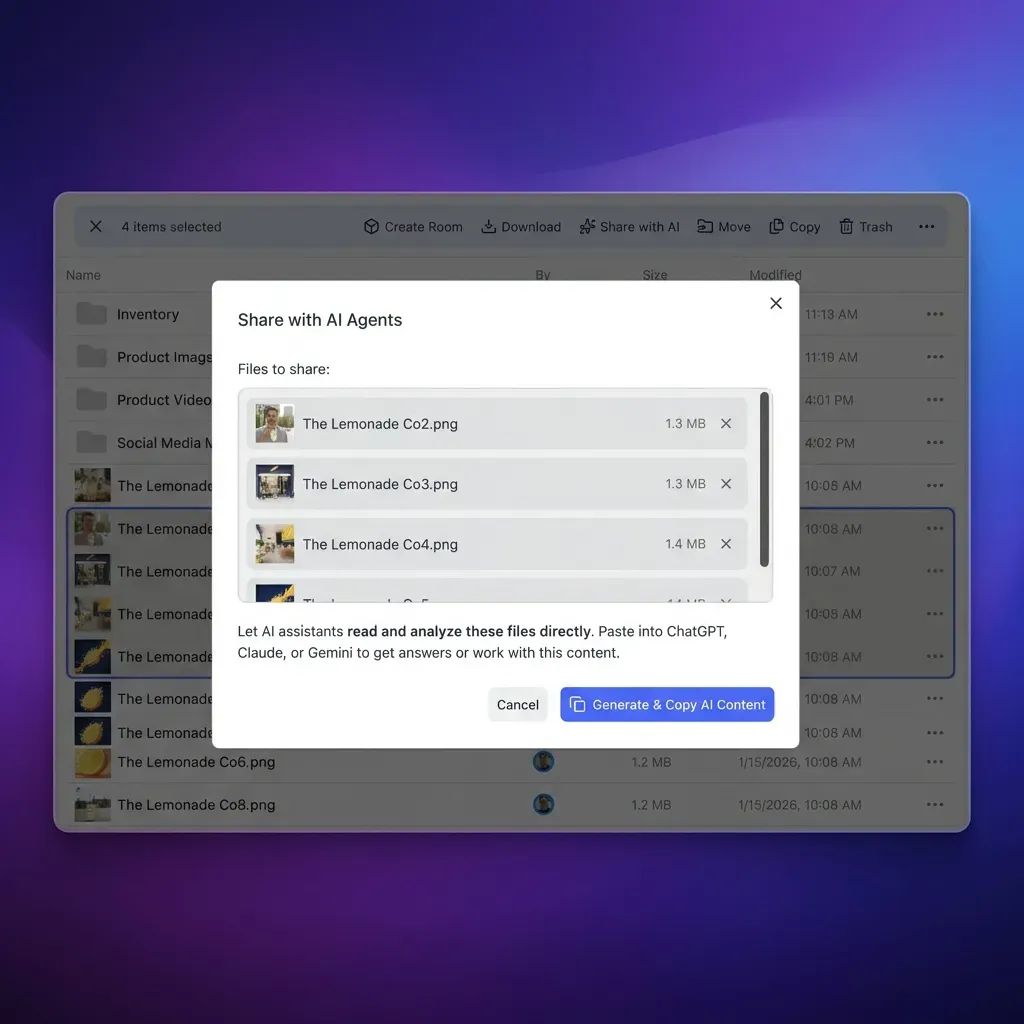
Summaries are only useful if your team can find them later. Local files work for individual use, but teams need a shared location. Fastio workspaces give agents and humans the same view of summarized content. Upload summaries to a workspace, and they are automatically indexed for semantic search through Intelligence Mode. Your team can then search across all summaries, ask questions with citations, and share curated collections through branded shares.
For agent-driven pipelines, the Fastio MCP server lets your OpenClaw agent upload files, organize workspaces, and trigger indexing programmatically. Fastio offers a 14-day Business Trial, card required; see /pricing/. Sign up at fast.io/storage-for-openclaw.
Sources
References used to verify factual claims in this guide.
-
The bundled Summarize skill has 26.1K+ downloads on ClawHub
-
Faster Whisper is a CTranslate2 reimplementation that runs 4-6x faster than standard Whisper
-
GNO has 2,600+ GitHub stars for local semantic search
-
OpenClaw summarize skill supports OpenAI, Anthropic, xAI, and Google Gemini providers
Frequently Asked Questions
How do I summarize documents with OpenClaw?
Install the built-in summarize skill from ClawHub, then point it at a file path or URL. The skill extracts content from the source, sends it to your configured LLM, and returns a structured summary. You can control output length and choose between human-readable or machine-readable JSON output depending on whether you need it for reading or pipeline automation.
What is the OpenClaw summarize skill?
The summarize skill is a CLI tool bundled with OpenClaw that condenses URLs, local files, PDFs, YouTube videos, and audio content into structured summaries. It has over 26,000 downloads on ClawHub and supports major LLM providers including OpenAI, Anthropic, xAI, and Google Gemini through API key configuration. The skill handles the full extraction-to-summarization pipeline, including Firecrawl fallback for blocked sites and automatic rate limit handling for YouTube transcripts.
Can OpenClaw summarize PDFs and YouTube videos?
Yes. The built-in summarize skill handles both formats. For PDFs, it extracts text and sends it to your configured LLM for summarization. For YouTube videos, it pulls transcripts automatically with built-in rate limit handling. For complex PDFs with scanned pages or embedded tables, install the dedicated PDF skill from ClawHub for cleaner extraction before summarizing.
Does OpenClaw summarization work offline?
Partially. The content extraction stage (pulling text from PDFs, transcribing audio with Whisper, indexing files with GNO) runs entirely on your machine. The summarization stage requires an LLM, which can be either a cloud provider (OpenAI, Anthropic, Google) or a local model through Ollama or another self-hosted backend. With a local LLM, the entire pipeline runs offline.
How do I summarize audio files with OpenClaw?
Install the OpenAI Whisper skill to transcribe audio to text locally, then feed the transcript through the summarize skill. For faster processing and speaker identification, use the Faster Whisper variant instead, which runs 4-6x faster and adds speaker diarization to label who said what.
What is the best OpenClaw skill for summarizing research papers?
For individual papers, the built-in summarize skill handles PDFs well. For building a searchable library across many papers, GNO is the better choice. It indexes your document collection and lets you ask questions across all papers with cited answers, using BM25 and vector hybrid search. Pair both skills for point summaries of new papers plus cross-document Q&A over your full library.
Related Resources

Store and search your document summaries in one workspace
Fastio auto-indexes uploaded summaries for semantic search and citation-backed chat. Connect via MCP for persistent storage and shared workspaces.