5 Best OpenClaw Skills for Document Comparison and Diff Analysis
The ClawHub registry passed 44,000 skills in April 2026, yet finding the right ones for document comparison still requires sifting through categories that were built for code. This guide covers the five OpenClaw skills that handle document diff workflows for contracts, research papers, and other non-code files, plus how to pair them with persistent storage so your comparisons survive between sessions.

Why Document Diff Is Hard for AI Agents
The ClawHub registry passed 44,000 community-built skills by April 2026, according to OpenClaw usage statistics. Most of those skills target code, APIs, and web scraping. Document comparison, the kind where you track clause changes in a contract or spot methodology shifts between paper revisions, sits in a gap between code-centric diff tools and manual human review.
The core problem is format. Git diff works line by line on plain text. Contracts arrive as PDFs. Research papers come as LaTeX or Word files. Policy documents ship in scanned image format. Before an agent can compare two versions of anything, it needs to convert both into a format where line-level differences are meaningful.
OpenClaw handles this through skill composition. One skill converts documents to markdown. Another runs the actual diff. A third manages the source material. The workflow looks like a pipeline: fetch, convert, compare, report. Each skill handles one step, and the agent orchestrates the sequence.
This guide covers the five skills that make that pipeline work, ranked by how directly they solve the document comparison problem.
Related guides
- How to Automate Document Analysis with Claude CoworkDocument analysis in Claude Cowork uses your shared workspace to let agents autonomously extract, summarize, and...
- Developing Hermes Agent Skills for Document WorkflowsDeveloping hermes agent skills for document workflows allows teams to automate document parsing without overloading LLM...
- 7 Best OpenClaw Skills for AI Document SummarizationOpenClaw skills can condense documents, web pages, videos, and audio files into structured summaries without sending...
- Best OpenClaw Skills for AI Customer Feedback Sentiment AnalysisThe sentiment analysis software market hit $2.73 billion in 2026, but nearly all of that spending goes to standalone...
- 7 Best OpenClaw Skills for AI Market Research and Audience AnalysisOpenClaw market research skills are community-built extensions that automate competitor analysis, audience profiling,...
- Top OpenClaw Skills for AI Contract Review and AnalysisLegal departments doubled their generative AI adoption in a single year, but most contract review still happens...
More on this subject: OpenClaw Skills (109 guides)
How We Evaluated These Skills
We filtered ClawHub's registry using three criteria specific to document comparison workflows:
- Format coverage: How many non-code document types can the skill handle? PDF, Word, Excel, PowerPoint, and scanned images are the minimum bar for real-world use.
- Diff readability: Does the output preserve enough structure that an agent (or a human reviewing the agent's work) can pinpoint what changed? Raw text dumps lose headings, tables, and formatting context.
- Composability: Can the skill feed its output into another skill without manual intervention? Document comparison requires at least two steps (convert then compare), so skills that produce clean markdown output score higher than those producing proprietary formats.
We also verified that each skill listed here exists in the ClawHub registry or the official OpenClaw skills repository as of June 2026. Every skill name and capability described below comes from current registry listings.

Top 5 OpenClaw Skills for Document Comparison
Here is a quick comparison of the top OpenClaw document comparison skills.
Each skill targets a different stage of the comparison pipeline. The first three handle conversion (getting documents into a comparable format), the fourth handles sourcing (finding the right versions to compare), and the fifth handles visualization (showing what changed).
1. boof: PDF-to-Markdown Conversion for RAG
boof converts PDFs and other documents to markdown, then indexes them locally for retrieval-augmented generation. For document comparison, the markdown output is what matters. Once two contract versions exist as clean markdown, standard diff tools can identify every changed clause.
Key strengths:
- Produces token-efficient markdown, which means fewer credits burned when an agent processes the output
- Indexes converted documents for semantic search, so you can ask "what changed about the indemnification clause?" instead of reading the full diff
- Handles the conversion and indexing in one step, reducing the orchestration an agent needs to manage
Best for: Legal teams comparing contract revisions, compliance officers tracking policy changes, and any workflow where PDFs are the source format. Available free on ClawHub.
2. markdown-converter: Universal Format Bridge
Where boof focuses on PDFs, markdown-converter handles everything else. It accepts over 20 input formats: Word, PowerPoint, Excel, HTML, CSV, JSON, XML, images (with EXIF metadata and OCR), audio files (with transcription), ZIP archives, YouTube URLs, and EPubs. It uses the markitdown library under the hood to produce structured markdown that preserves headings, tables, and list hierarchies.
Key strengths:
- OCR support for scanned documents and images means even photographed contracts or whiteboard snapshots become diffable text
- Preserves document structure (headings become markdown headings, tables become markdown tables), so diffs show structural changes alongside content changes
- No local installation dependencies required for basic conversion
Best for: Teams that receive documents in mixed formats. If your contracts come as Word files, your specs arrive as PDFs, and your data comes as Excel sheets, markdown-converter normalizes everything into one diffable format. Available free on ClawHub.
3. office-to-md: Microsoft Office Specialist
office-to-md converts Word, Excel, PowerPoint, PDF, and HTML to markdown using Microsoft's open-source markitdown tool. It overlaps with markdown-converter in scope, but its specialization makes it better at preserving Office-specific formatting: Word heading levels map correctly, Excel sheets become properly formatted markdown tables, and PowerPoint slides convert to sectioned content.
Key strengths:
- Word headings, bold, italic, lists, and tables map directly to markdown equivalents
- Spreadsheets become markdown tables rather than CSV dumps, preserving cell relationships
- Slide decks convert to numbered sections, making it possible to diff presentation changes slide by slide
Best for: Organizations standardized on Microsoft 365 where most documents start as .docx.xlsx, or .pptx files. Available free on ClawHub.


Keep your document comparisons searchable across sessions
Fastio gives your OpenClaw agents persistent, AI-indexed storage. Upload contracts, research papers, and policy documents once, and your agent can convert, compare, and query them anytime through the MCP server.
Research and Visualization Skills
4. literature-manager: Academic Paper Sourcing and Comparison
literature-manager searches, downloads, and organizes academic literature from multiple databases simultaneously, including Semantic Scholar, OpenAlex, Crossref, and PubMed. For document comparison, this skill solves the sourcing problem: before you can diff two paper versions, you need to find and download them.
Key strengths:
- Queries multiple databases in parallel, so you do not need separate skills for each academic source
- Automatic deduplication using DOIs prevents comparing the same paper retrieved from different databases
- Downloads and organizes papers into a local collection that other skills (like boof or markdown-converter) can process
Best for: Researchers tracking how a paper evolved between preprint and published versions, systematic review teams comparing methodology across studies, and labs auditing literature collections for completeness. Available free on ClawHub.
5. Built-in Diffs Tool: Visualization Layer
OpenClaw's built-in diffs tool is not a ClawHub skill but a core capability that ships with every OpenClaw installation. It accepts two input modes: before/after text (each up to 512 KiB) or a unified patch (up to 2 MiB, supporting up to 128 files and 120,000 lines). The output renders as a visual diff with syntax highlighting for 33+ languages.
Key strengths:
- Split and unified layout modes let you choose between side-by-side and inline comparison views
- Renders to PNG or PDF for sharing with stakeholders who do not use OpenClaw
- Light and dark themes with configurable font size and line spacing for readability
- Handles large diffs (128 files, 120,000 lines) without truncation
Best for: The final step in any document comparison pipeline. After converting documents to markdown, pipe them into the diffs tool to generate a visual report. The PDF output mode works well for attaching comparison results to approval workflows.
Putting the Pipeline Together with Persistent Storage
Individual skills handle individual steps. The real value comes from chaining them into a repeatable pipeline. A typical document comparison workflow looks like this:
- Source the documents (download from a shared workspace, pull from an academic database, or receive via a file share)
- Convert both versions to markdown (using boof for PDFs, markdown-converter for mixed formats, or office-to-md for Office files)
- Run the diff (pipe both markdown outputs into the built-in diffs tool)
- Store the results (save the diff output alongside the source documents for audit purposes)
Step 4 is where most ad-hoc agent workflows break down. If the agent's session ends, the converted markdown, the diff output, and the context about which files were compared all disappear. Running the same comparison again means re-downloading and re-converting everything.
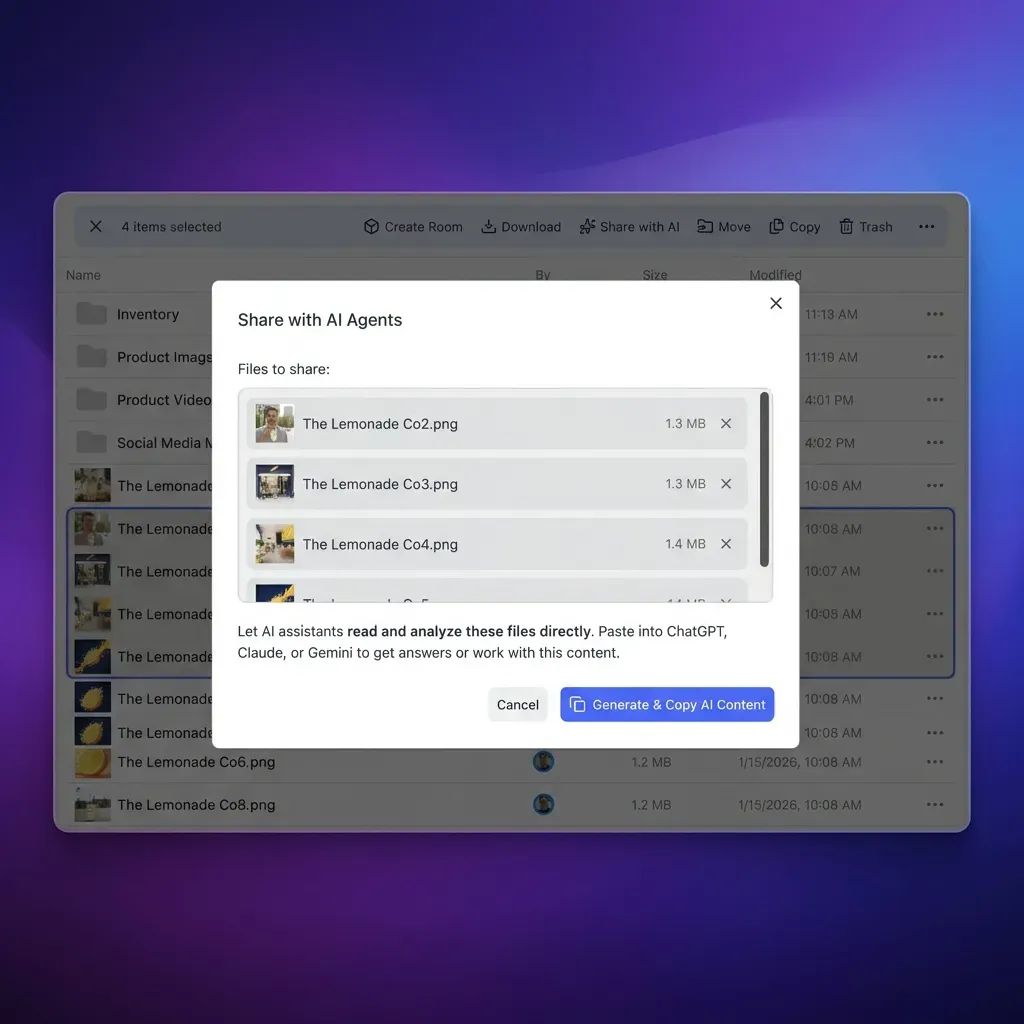
Fastio workspaces solve this by giving agents persistent storage that survives between sessions. Upload the source documents to a workspace, and the converted markdown stays available for future comparisons. Enable Intelligence Mode on the workspace, and the indexed content becomes searchable, so an agent can answer questions like "what clauses changed between the March and June contract versions?" without re-running the full pipeline.
Fastio offers a 14-day Business Trial, card required; see /pricing/. For comparison workflows, this means you can maintain a library of source documents and their converted markdown versions without worrying about session limits. The MCP server gives OpenClaw agents direct access to upload, download, and organize files through a consolidated MCP toolset.
Alternatives like local filesystem storage work for single-machine setups but do not support team access or audit trails. S3 or Google Drive add persistence but require separate skills for access and lack built-in semantic search over the stored documents. Fastio sits between these options: persistent, team-accessible, and AI-indexed out of the box.
For structured extraction, Metadata Views can turn your document library into a queryable database. Describe the fields you want extracted (contract dates, counterparty names, coverage limits) in plain language, and the system populates a sortable spreadsheet across all matching files in the workspace. This complements diff analysis: the diff tells you what changed, while Metadata Views tell you the current state of every extracted field across your entire document collection.
Choosing the Right Skill for Your Documents
The skill you start with depends on your source format and what you are comparing.
If your documents are PDFs: Start with boof. Its markdown output is optimized for token efficiency, which matters when you are processing dozens of contract versions. The built-in RAG indexing also lets you query across all converted documents without a separate search step.
If your documents arrive in mixed formats: Start with markdown-converter. Its 20+ format support means you do not need to choose a different conversion skill for each file type. The OCR capability handles scanned documents that other converters skip.
If you work primarily in Microsoft Office: Start with office-to-md. The markitdown foundation preserves Office formatting better than generic converters, and the structured markdown output makes diffs more readable.
If you are comparing academic papers: Start with literature-manager to source and organize the papers, then pipe them through boof or markdown-converter for the actual diff.
For all workflows: End with the built-in diffs tool for visualization. Its PDF rendering mode produces shareable comparison reports that work for both technical reviewers and business stakeholders.
Every one of these skills is free to install from ClawHub. The bottleneck is not the tooling but the storage: without persistent file access, agents re-download and re-convert documents every session. Pairing these skills with a workspace that persists files, indexes them for search, and exposes them through MCP creates a document comparison system that improves with every file you add.
Sources
References used to verify factual claims in this guide.
-
ClawHub registry passed 44,000 skills by April 2026
-
boof skill converts PDFs and documents to markdown for RAG retrieval
-
OpenClaw diffs tool accepts unified diff text up to 2 MiB supporting 128 files
-
markdown-converter supports 20+ input formats including PDF, Word, Excel, images with OCR
-
literature-manager searches Semantic Scholar, OpenAlex, Crossref, and PubMed simultaneously
Frequently Asked Questions
Can OpenClaw compare two documents?
OpenClaw can compare two documents by converting them to markdown first, then using its built-in diffs tool. Skills like boof, markdown-converter, and office-to-md handle the conversion step for PDFs, Word files, spreadsheets, and 20+ other formats. The diffs tool then shows what changed between the two versions in unified or split view.
What OpenClaw skill converts PDFs for comparison?
The boof skill converts PDFs to markdown and indexes them locally for RAG retrieval. For broader format support including scanned documents with OCR, the markdown-converter skill handles PDFs alongside Word, Excel, PowerPoint, images, and other file types. Both produce structured markdown that works with standard diff tools.
How do you diff non-code files in OpenClaw?
Convert non-code files to markdown using a conversion skill (boof for PDFs, markdown-converter for mixed formats, office-to-md for Microsoft Office files), then pipe both markdown versions into the built-in diffs tool. The diffs tool accepts before/after text up to 512 KiB each or unified patches up to 2 MiB, and renders visual comparisons with syntax highlighting.
Does OpenClaw have a built-in diff viewer?
Yes. OpenClaw ships with a diffs tool that renders visual comparisons in split or unified layout. It supports 33+ syntax highlighting languages, outputs to PNG or PDF, and handles patches up to 2 MiB covering 128 files. You can configure theme, font, and layout through openclaw.json settings or per-call parameters.
How do I store document comparison results across sessions?
Use a persistent workspace like Fastio to store source documents, converted markdown, and diff outputs. Fastio workspaces keep files available between agent sessions and index them for semantic search. Fastio offers a 14-day Business Trial (card required; see /pricing/) with MCP server access, so your agent can upload comparison results and retrieve them later without re-processing.
Related Resources

Keep your document comparisons searchable across sessions
Fastio gives your OpenClaw agents persistent, AI-indexed storage. Upload contracts, research papers, and policy documents once, and your agent can convert, compare, and query them anytime through the MCP server.