Best OpenClaw Skills for AI Cover Letter and Job Application Writing
A field experiment of 7,287 job applications showed tailored cover letters produce 53% more callbacks, but follow-up research found the signal value of tailoring dropped by half once AI writing tools became widespread. OpenClaw skills that go beyond surface-level keyword swapping, by researching companies, scoring job fit, and adjusting tone, are now the differentiator. This guide ranks the best cover letter skills on ClawHub and shows how to pair them with Fastio for persistent storage.


Why Generic AI Cover Letters Stopped Working
A field experiment tracking 7,287 job applications found that tailored cover letters produced a 53% higher callback rate than sending no letter at all. But a 2025 analysis of Freelancer.com hiring data found that after AI writing tools became widely available, the correlation between cover-letter tailoring and receiving a callback fell by 51%. The correlation with receiving an actual offer dropped by 79%.
The takeaway is not that tailoring stopped mattering. It is that everyone tailors now, so surface-level keyword matching no longer differentiates. When a hiring manager sees 50 applications and 45 of them hit the same bullet points from the job description, the tailoring signal disappears into the noise.
This is where specialized OpenClaw skills change the equation. Instead of generating a generic "Dear Hiring Manager" letter with keywords pasted in, cover letter skills on ClawHub research the target company, score your experience against job requirements using weighted criteria, adjust tone to match company culture, and produce letters that read like a human studied the role before writing. The 146 communication-related skills on ClawHub include several that handle different parts of this pipeline.
The three skills ranked below each take a different approach. Job Hunter focuses on research depth and fit scoring. Job Auto-Apply adds end-to-end submission automation. LinkedIn Job Application specializes in platform-specific tone matching and batch workflows. None of them is a complete solution on its own, but chained together with persistent storage, they cover the full cover letter lifecycle from research to submission tracking.

Related guides
- How to Use Claude Code Skills in ClineAccording to GitHub's Octoverse 2024 report, the number of developers building with generative AI on the platform...
- How to Install and Manage Cline Agent SkillsAI coding agents boost code volume by 180%, but shipped code rises by only 30%, showing a critical gap in development...
- Best OpenClaw Skills for AI Resume and CV GenerationOpenClaw's skills registry lists over 13,000 community-built skills, and a growing subset targets resume generation,...
- Best OpenClaw Skills for AI Video Script WritingVideo scripts drive every stage of production, and OpenClaw skills can automate the writing process across formats....
- Best OpenClaw Skills for AI Writing Assistant ToolsVoltAgent's curated registry filtered ClawHub's 13,700+ entries down to roughly 5,200 production-grade skills, with...
- 7 Best OpenClaw Skills for AI Writing Voice Cloning and Personal Style ReplicationMost guides split audio voice cloning and writing style replication into separate categories, but OpenClaw skills let...
More on this subject: OpenClaw Skills (109 guides)
1. Job Hunter: Research-First Cover Letter Generation
The job-hunter skill from the official OpenClaw skills registry is the strongest standalone option for cover letter quality. Where other skills treat cover letters as a side output of the application pipeline, job-hunter treats research as the primary step. It searches job boards, scores each listing against your profile using weighted criteria (skills 40%, seniority 25%, location 15%, domain 10%, red flags 10%), then generates a tailored cover letter only for roles that pass your fit threshold.
The cover letters follow a specific formula: under 350 words, referencing specific company details pulled from the job listing, mapping your top achievements to the role's requirements, and including quantified results where your profile data supports them. The skill will not apply on your behalf. It prepares materials and recommendations, then waits for your decision.
Beyond letters, job-hunter includes interview preparation with STAR story development and salary research across sources like Glassdoor, Levels.fyi, and LinkedIn Salary. This makes it useful not just for the application stage but for the entire process from discovery to negotiation.
Key Features:
- Weighted fit scoring before generating any materials
- Cover letters capped at 350 words with company-specific references
- Interview preparation with STAR story templates
- Salary research and negotiation guidance
- Multi-source job search with keyword expansion
Limitations:
- Does not submit applications. Preparation only
- Requires detailed profile data upfront for accurate fit scoring
- No built-in template library for letter formatting
Best For: Job seekers who want quality over quantity, preferring a few well-researched applications over high-volume automation.
2. Job Auto-Apply: End-to-End Submission with Cover Letters
The job-auto-apply skill covers the full pipeline from job discovery to form submission, with cover letter generation as one step in the workflow. It searches LinkedIn (including Easy Apply), Indeed, Glassdoor, ZipRecruiter, and Wellfound, scores each listing against your profile, generates a tailored cover letter using template placeholders, and submits the application either automatically or after you confirm.
Cover letter generation uses customizable templates with variables like company name, position title, relevant skills, and a custom paragraph slot for role-specific content. The skill fills these based on what it extracts from the job description and your stored profile. The letters are functional rather than polished. They hit the right keywords and structure but lack the research depth of job-hunter's output.
The real value of job-auto-apply is operational efficiency. For roles where you need volume, like entry-level positions or broad geographic searches, the automation saves hours per batch. For senior or specialized roles where the cover letter carries real weight, you will want to review and edit before submission.
Configuration highlights:
- Set maximum daily applications (recommended 5 to 10)
- Define a minimum match score threshold (suggested 0.75 or higher)
- Choose between dry-run, auto-apply, or confirmation-required modes
- Filter by title, location, remote preference, experience level, and salary range
Key Features:
- Template-based cover letter generation with customizable placeholders
- Form auto-fill for standard screening fields
- Application logging with timestamps and confirmation records
- Rate limiting to reduce bot-detection risk
Limitations:
- LinkedIn and other platforms prohibit automated submissions. Aggressive use risks account suspension
- CAPTCHA challenges halt the workflow until a human intervenes
- Token costs run $1.50 to $2.00 per application at current LLM rates
- Cover letter quality is adequate, not exceptional. Review before sending for important roles
Best For: Job seekers who need volume and are comfortable with the compliance risks of automated submission.


Store every cover letter in one searchable workspace
Fastio gives your OpenClaw agent generous storage with built-in document search. Upload cover letters, tailored resumes, and application logs to a workspace your career coach can access from a browser.
3. LinkedIn Job Application: Company-Aware Tone Matching
The linkedin-job-application skill specializes in one platform and goes deeper on personalization than the multi-platform skills above. It researches each target company, analyzes the job requirements, then generates cover letters that adjust tone to match company culture. A letter for a fintech startup reads differently from one targeting a Fortune 500 bank, and this skill handles that distinction automatically.
The standout feature is template versioning. Instead of producing one letter per role, the skill generates multiple versions for A/B testing different approaches. You can compare a direct, results-focused version against a narrative-driven one and pick whichever fits the specific role better. Combined with the built-in application tracking dashboard (status monitoring, follow-up reminders, and response analytics), it gives you data on which approaches actually get responses.
The skill also handles recruiter outreach with automated connection messaging and relationship tracking. This is useful for roles posted by recruiters rather than internal hiring teams, where the cover letter goes to a different audience than the hiring manager.
Key Features:
- Company culture research for tone-appropriate letters
- Multiple template versions per role for testing
- Recruiter outreach and connection tracking
- Application status dashboard with follow-up reminders
- Easy Apply automation with form auto-fill
Limitations:
- LinkedIn-only. Does not work with Indeed, Glassdoor, or other platforms
- Marked as "unsafe" on some skill directories due to LinkedIn's automation policies
- Requires platform-specific authentication setup (AuthTool on Windows, command execution on macOS)
Best For: Candidates focused on LinkedIn who want tone-matched letters and application analytics on a single platform.
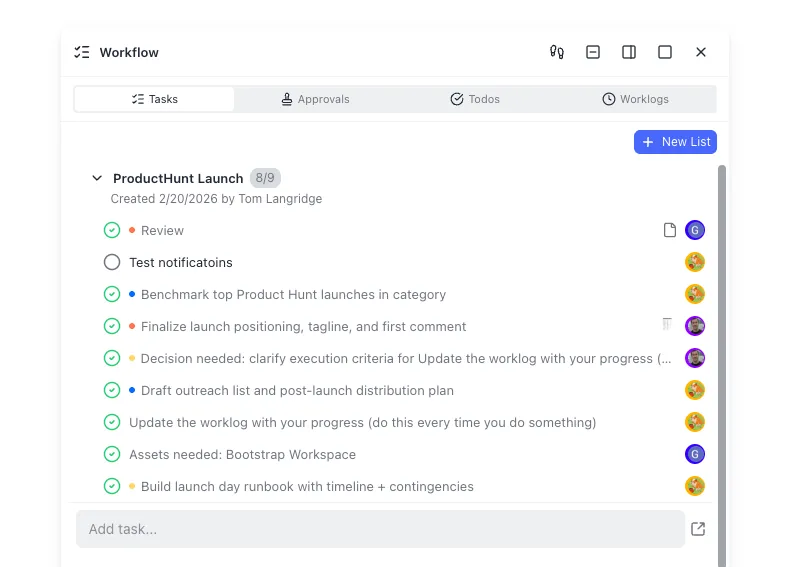
4. Fastio: Persistent Storage and Review for Application Materials
Cover letter generation produces files. Lots of them. A targeted job search with the skills above might generate 20 to 30 tailored letters in a week, plus matching resumes, screening question responses, and submission logs. Without persistent storage, these files scatter across terminal sessions and local directories where they are hard to find and impossible to share with a career coach or mentor.
For persistent agent storage, the main options are Fastio (cloud-based with workspace sharing and built-in AI search), the S3 skill (for teams already running AWS), and local filesystem management (free but with no collaboration features). Fastio is the fast starting point if you want document search and review collaboration without configuring cloud credentials.
Connecting your OpenClaw agent to Fastio via MCP (see /storage-for-openclaw/) gives your agent a shared workspace where every cover letter version is saved, searchable, and accessible from the web UI. When you enable Intelligence Mode, Fastio indexes your uploaded documents so you can ask questions like "which cover letter did I customize for the Stripe backend role?" and get an answer with citations pointing to the exact file.
Key Features for Cover Letter Workflows:
- Agents upload each tailored cover letter to workspace folders organized by company or date
- Intelligence Mode indexes documents for semantic search across all your application materials
- Share a workspace folder with a career coach for review without emailing individual files
- Every file change is logged in an audit trail, so you can track which version was sent where
- MCP server access via Streamable HTTP for programmatic file operations
Limitations:
- Not a cover letter generator itself. Pairs with the generation skills above
- Best for document storage and search, not for replacing a structured job application tracker
Best For: Job seekers who want a single searchable workspace where every cover letter, resume, and application record lives, accessible to both the agent and human reviewers.
Pricing: 14-day Business Trial, card required; see fast.io/pricing.
How to Build a Complete Cover Letter Pipeline
Each skill above handles one piece of the cover letter pipeline. The practical workflow chains them together.
Step 1: Set up your base profile. Before generating any letters, compile your work history, quantified achievements, and skill inventory in a structured format. Store the master profile document in a Fastio workspace so it persists between OpenClaw sessions and any skill can reference it.
Step 2: Research and score target roles. Use the job-hunter skill to search across job boards and score listings against your profile. Set a minimum fit threshold (0.7 or higher) so the agent only prepares materials for roles worth pursuing. This step filters out poor matches before you spend tokens on cover letter generation.
Step 3: Generate tailored cover letters. For high-priority roles, job-hunter produces research-backed letters that reference specific company details and map your achievements to stated requirements. For volume applications, job-auto-apply generates template-based letters that hit the right keywords without the same depth.
Step 4: Review and version. Upload generated letters to Fastio. If you are working with a career coach, share the workspace so they can review letters in a browser without installing OpenClaw. For LinkedIn-focused roles, use the linkedin-job-application skill to generate multiple tone variants and compare which approach fits each company's culture.
Step 5: Submit and track. Use confirmation-required mode in job-auto-apply for every submission. Nothing goes out without your approval. Application logs record timestamps, company names, and submission status. Upload these logs to your workspace for a complete audit trail.
A few practical guardrails for this pipeline. Start every new skill with dry-run mode to verify the workflow before sending real applications. Limit daily submissions to 5 to 10 to avoid triggering bot detection on job platforms. Review every cover letter before submission for senior or specialized roles where the letter carries real weight. And keep a human in the loop for final decisions. The agent handles the research, writing, and formatting. You handle the judgment calls about which roles and which versions to send.
Sources
References used to verify factual claims in this guide.
-
Tailored cover letters produced a 53% higher callback rate than sending no cover letter, based on a field experiment of 7,287 job applications
-
After AI writing tools became widely available, the correlation between cover-letter tailoring and receiving a callback fell by 51%, and the correlation with receiving an offer fell by 79%
-
One developer completed three fully tailored applications in one hour, spending roughly $1.50 to $2.00 per application in LLM token costs
Frequently Asked Questions
Can OpenClaw write cover letters?
Yes. Several skills on ClawHub generate tailored cover letters as part of their job application workflows. The job-hunter skill produces research-backed letters under 350 words that reference specific company details. The job-auto-apply skill generates template-based letters as one step in its automated submission pipeline. Neither produces a perfect final draft. Both benefit from human review before submission.
What skills personalize job applications with OpenClaw?
The three main skills are job-hunter (research-first fit scoring and cover letter generation), job-auto-apply (end-to-end search, letter generation, and submission across five platforms), and linkedin-job-application (LinkedIn-specific tone matching with multiple template versions). Each handles a different part of the application pipeline, and they can be chained together for a complete workflow.
How do AI cover letter generators match job descriptions?
OpenClaw's job application skills parse job descriptions to extract required skills, experience levels, and keywords. The job-hunter skill scores compatibility using weighted criteria (skills 40%, seniority 25%, location 15%, domain 10%, red flags 10%) before generating a letter. The linkedin-job-application skill adds company culture research to adjust tone. Both approaches go beyond keyword insertion by structuring the letter around the specific requirements of each role.
How much does OpenClaw cover letter generation cost?
LLM token costs depend on which model you configure. One documented test of the job-auto-apply pipeline showed roughly $1.50 to $2.00 per application using GPT-4 Turbo. If you use a cheaper model like DeepSeek for initial screening and reserve a more capable model for final cover letter generation, monthly costs can stay under $10 for moderate job search volume.
Are automated job applications safe to use?
Job boards including LinkedIn, Indeed, and Glassdoor have terms of service that prohibit automated submissions. Aggressive automation can trigger bot detection, CAPTCHA challenges, and account suspension. Use rate limiting, start with dry-run mode, and keep a human reviewing each submission before it goes out. The compliance risk falls on the user, not on the skill developer.
Related Resources

Store every cover letter in one searchable workspace
Fastio gives your OpenClaw agent generous storage with built-in document search. Upload cover letters, tailored resumes, and application logs to a workspace your career coach can access from a browser.