Best OpenClaw Skills for AI Calendar and Scheduling Automation
Knowledge workers lose nearly 400 hours a year to meetings, and most of that overhead is coordination, not conversation. ClawHub lists 66 calendar and scheduling skills for OpenClaw, covering everything from Google Calendar CRUD to cross-platform availability merging. This guide ranks the seven most practical options by reliability, platform support, and real automation depth.


How We Picked These Seven Scheduling Skills
The average knowledge worker spends 392 hours per year in meetings, roughly ten full workweeks, and Flowtrace's 2026 research found that 72% of those meetings are considered ineffective. Most of that wasted time is coordination: finding open slots, resolving conflicts, sending agendas, chasing RSVPs. OpenClaw scheduling skills automate that coordination layer so the meetings that do happen are actually worth attending.
ClawHub's Calendar & Scheduling category lists 66 skills. We narrowed the field to seven based on these criteria:
- Cross-platform support: Skills that work with Google Calendar, Outlook, CalDAV, or Apple Calendar.
- Booking reliability: Conflict prevention, timezone handling, and recurring event support.
- Setup effort: Reasonable OAuth flows, clear documentation, and minimal dependencies.
- Community adoption: Active maintenance, published ClawHub pages, and download traction.
- Automation depth: Features beyond basic CRUD, like availability merging, natural language parsing, or notification routing.
Related guides
- How to Use Claude Code Skills in ClineAccording to GitHub's Octoverse 2024 report, the number of developers building with generative AI on the platform...
- How to Install and Manage Cline Agent SkillsAI coding agents boost code volume by 180%, but shipped code rises by only 30%, showing a critical gap in development...
- Top 7 OpenClaw Skills for Software EngineersThe top OpenClaw skills for software engineers automate repetitive tasks like code workflows, browser testing, database...
- Top 10 OpenClaw Skills for Content CreatorsContent creators use OpenClaw skills to handle repetitive tasks and scale production. For content creators, OpenClaw...
- Top OpenClaw Skills for Machine Learning EngineersMachine learning engineers use OpenClaw skills to orchestrate model evaluation, manage datasets, and coordinate agentic...
- Top 7 OpenClaw Skills for Marketing AutomationMarketing automation often just means scheduling posts. OpenClaw skills let AI agents do more: they run campaigns,...
More on this subject: OpenClaw Skills (109 guides)
1. Temporal Cortex: Multi-Calendar Booking with Conflict Prevention
Temporal Cortex is a three-skill suite by @billylui that routes calendar operations across Google Calendar, Outlook, and CalDAV. The router skill (temporal-cortex) directs scheduling requests to specialized sub-skills: temporal-cortex-datetime handles timezone conversion and DST-aware date math, while temporal-cortex-scheduling manages availability merging and atomic booking.
The standout feature is the Two-Phase Commit protocol for bookings. When multiple agents or users try to reserve the same time slot, the 2PC mechanism locks the slot before confirming the write, preventing double-booking. This matters in multi-agent setups where two scheduling agents operate on overlapping calendars simultaneously.
The suite can also expand recurring events into concrete dates for accurate slot detection and generate scheduling proposals formatted for email or Slack.
Key strengths:
- Merged availability across multiple calendars from different providers.
- Two-Phase Commit booking prevents conflicts in concurrent agent workflows.
- Recurring event expansion into concrete dates for accurate free/busy detection.
- Scheduling proposal output formatted for email or Slack.
Limitations:
- Three separate skills to install and configure together.
- Still pre-1.0 (v0.9.1, released March 2026).
Best For: Teams running multi-agent workflows that need conflict-free booking across Google, Outlook, and CalDAV calendars.
Available on: ClawHub under @billylui (three skills: temporal-cortex, temporal-cortex-datetime, temporal-cortex-scheduling).
2. Gog: Google Workspace All-in-One
Gog bundles Gmail, Calendar, Drive, Contacts, Sheets, and Docs into a single OpenClaw skill. For scheduling, agents can list upcoming events, create new ones, check availability, and search for contacts to invite. The real value is context: your agent can check a calendar event, pull the attached Drive document, email an agenda to attendees, and update a tracking spreadsheet without switching between six different skills.
With over 117,000 downloads on ClawHub, Gog is one of the most widely adopted OpenClaw skills overall. Setup requires a one-time OAuth flow with a Google Cloud project and client credentials file.
Key strengths:
- Six Google Workspace services through one skill and one auth flow.
- Calendar operations combined with Gmail, Drive, and Sheets for end-to-end meeting workflows.
- 117,000+ downloads and active maintenance by @steipete.
Limitations:
- Requires Google Cloud project setup and OAuth credentials.
- Once authorized, the agent has access to your entire Google account across all six services.
Best For: Google Workspace users who want their agent to handle calendar, email, and document workflows together.
Available on: ClawHub under @steipete. Requires a Google Cloud project with OAuth credentials.
3. Advanced Calendar: Natural Language Scheduling with Notifications
Advanced Calendar by @toughworm focuses on conversational scheduling. Instead of requiring structured API calls, the skill parses natural language and automatically extracts dates, times, durations, and reminders. Tell your agent "schedule a design review next Thursday at 2pm for 45 minutes" and it creates the event, sets a reminder, and notifies you through your preferred channel.
The notification system is what sets this apart from simpler calendar skills. Advanced Calendar pushes reminders through WhatsApp, Discord, Telegram, Signal, and other configured messaging channels. Persistent reminders repeat every 15 minutes until acknowledged, which makes the skill useful for time-sensitive appointments where a single notification might get buried.
When the skill detects missing information like duration, attendees, or location, it prompts interactively rather than creating an incomplete event.
Key strengths:
- Natural language event creation with automatic field extraction.
- Multi-channel notifications through WhatsApp, Discord, Telegram, and Signal.
- Persistent snooze-style reminders that repeat until acknowledged.
- Interactive prompts for missing event details.
Limitations:
- Each notification channel requires separate platform-specific configuration.
- Focused on event creation and reminders, not availability merging or conflict detection.
Best For: Individual users who want conversational calendar management with cross-platform alerts.
Available on: OpenClaw Skills Registry under @toughworm.


Persist meeting prep and calendar exports across agent sessions
Persistent cloud workspace with remote MCP access. Your scheduling agent saves agendas, exports calendars, and hands off meeting notes to your team.
4. gcal-pro: Focused Google Calendar Management
gcal-pro provides direct Google Calendar integration for viewing, creating, and managing events. The skill responds to schedule queries, availability checks, and morning briefing requests. Unlike Gog, which covers six Google services, gcal-pro focuses entirely on Calendar, which means a narrower permissions scope and simpler setup.
The free tier provides read access to events and schedules. The Pro tier at $12 adds create, edit, and delete operations along with a morning brief feature that compiles the day's meetings, free blocks, and any scheduling conflicts into a summary your agent can share or act on.
If you're already using Gog and only relying on the Calendar features, gcal-pro won't add much. But if you want calendar access without giving an agent full Gmail, Drive, and Sheets permissions, gcal-pro provides that narrower scope.
Key strengths:
- Dedicated Google Calendar skill with no extra service overhead.
- Morning brief feature that summarizes daily schedule and conflicts.
- Free tier for read-only calendar access.
Limitations:
- Write operations (create, edit, delete) require the $12 Pro tier.
- Google Calendar only, with no Outlook or CalDAV support.
Best For: Users who only need Google Calendar access and want a focused skill without broader Workspace permissions.
Install Command: Download from ClawHub.
ClawHub Page: lobehub.com/skills/openclaw-skills-gcal-pro-calendar
5. Clippy: Microsoft 365 Calendar and Email
Clippy gives OpenClaw agents access to Microsoft 365 through browser automation via Playwright rather than the Microsoft Graph API. This means no Azure AD app registration and no tenant admin approval. You log into Microsoft 365 in your browser, and Clippy operates through that authenticated session.
For calendar operations, Clippy supports full CRUD: view events, create meetings, update details, delete appointments, find available meeting times across colleagues, and respond to meeting invitations. The skill also handles email and room/people search, so your agent can find a conference room, book a meeting, and email the agenda in one sequence.
Key strengths:
- No Azure AD or Graph API setup. Works through browser authentication.
- Full calendar CRUD plus meeting room and people search.
- Combined email and calendar operations in a single skill.
Limitations:
- Browser automation is slower than direct API calls and requires Playwright to be running.
- Session-dependent: if the browser session expires, the agent loses access until re-authenticated.
Best For: Microsoft 365 organizations that want calendar and email automation without Azure AD app registrations.
Install Command: Download from ClawHub (requires Playwright).
ClawHub Page: clawskills.sh/skills/foeken-clippy
6. Apple Calendar CLI: macOS Native Integration
The Apple Calendar CLI (accli) by @joargp uses JavaScript for Automation (JXA) to interact directly with macOS Calendar.app. Your agent can list calendars, query events by date range or search string, create and update events, and check free/busy status across multiple calendars.
The skill works entirely through macOS system APIs, so there's no OAuth flow or third-party account setup. If Calendar.app is configured with iCloud, Google, or Exchange sync, accli can read and write to all of those calendars. Multi-calendar availability checks work across Work, Personal, and Shared calendars simultaneously, and the skill supports both timed and all-day events with ISO 8601 date formatting.
An extended variant, accli-plus by @gopaljigaur, adds search, export, and recurring event support on top of the base skill.
Key strengths:
- Zero external account setup. Works through macOS system APIs.
- Multi-calendar free/busy checks across all local calendars.
- Persistent configuration for default calendar preferences.
- Advanced event filtering by query string, date range, or calendar name.
Limitations:
- macOS only. No Linux or Windows support.
- Local calendar data only. Cloud sync depends on Calendar.app's own sync configuration.
Best For: macOS users who want calendar automation without additional accounts or API credentials.
Install Command: Download from ClawHub.
ClawHub Page: clawhub.ai/joargp/accli
7. Fastio: Persistent Storage for Scheduling Agents
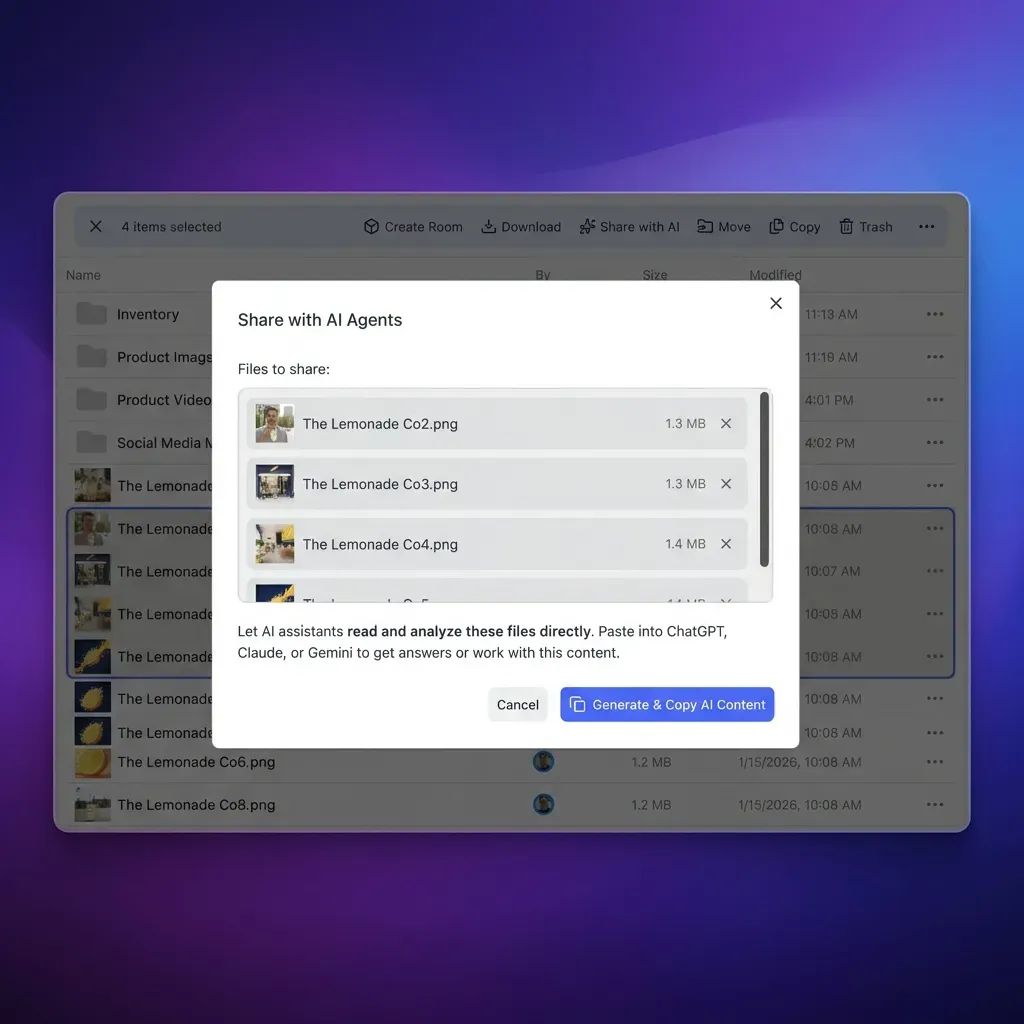
Calendar skills handle booking and availability, but scheduling agents also need somewhere to store meeting prep documents, exported agendas, and follow-up notes. Fastio provides agent-accessible workspaces that persist across sessions and support handoff to human team members.
An agent using Temporal Cortex to book a meeting can save the agenda, attendee research, and background documents to a Fastio workspace. After the meeting, the same agent can deposit notes and action items, then transfer ownership of the workspace to a human reviewer. The remote MCP server exposes a consolidated toolset for file operations, workspace management, and document querying. Once Intelligence is enabled for the workspace, uploaded meeting documents are indexed for semantic search and AI-powered Q&A with citations.
For teams evaluating alternatives, local file storage works for single-agent setups but doesn't persist across sessions or support multi-agent access. S3 and Google Drive provide persistence but lack the built-in indexing and ownership transfer that scheduling workflows benefit from.
Key strengths:
- Consolidated MCP toolset accessible via Streamable HTTP at
/mcp/tools. - Intelligence Mode auto-indexes documents for semantic search and AI chat with citations.
- Ownership transfer lets agents build meeting prep workspaces and hand them off to humans.
- 14-day Business Trial requiring a credit card, with plans starting at $9.99/month.
Limitations:
- Requires a Fastio account for agent access.
- Storage and document layer only. Does not handle calendar operations itself.
Best For: Scheduling agents that need persistent storage for meeting prep, agendas, and post-meeting follow-up.
Available on: Connect directly via Fastio's remote MCP endpoint at https://mcp.fast.io/mcp/tools.
How to Choose the Right Skill Combination for Your Stack
Most scheduling workflows need two or three skills working together, not all seven. The right combination depends on your calendar provider, notification preferences, and whether your agent needs to persist documents between sessions.
If your team runs on Google Workspace, start with Gog for the all-in-one coverage, then add Temporal Cortex if you need cross-calendar conflict prevention. If you're on Microsoft 365, Clippy is the starting point. macOS-only users can get running in minutes with Apple Calendar CLI since it requires no external accounts.
For notifications beyond email, pair your calendar skill with Advanced Calendar's multi-channel alerting. And for any setup where meeting documents need to outlive the agent session, add Fastio as the persistence layer so your agent's prep work survives across sessions and can be transferred to human collaborators.
A common pattern for cross-platform teams: Temporal Cortex for booking logic, Advanced Calendar for reminders, and Fastio for document storage. The agent resolves availability across Google and Outlook calendars, books the slot, then saves the agenda and background materials to a shared workspace where attendees can access them before the meeting.
The full list of 66 calendar and scheduling skills is available in the awesome-openclaw-skills repository on GitHub.
Sources
References used to verify factual claims in this guide.
-
The average knowledge worker spends 392 hours per year in meetings, roughly ten full workweeks, and 72% of those meetings are considered ineffective.
-
ClawHub lists 66 skills in its Calendar & Scheduling category.
-
Gog has over 117,000 downloads on ClawHub.
Frequently Asked Questions
Can OpenClaw manage my calendar?
Yes. OpenClaw agents can create, update, and delete calendar events using skills like Gog (Google Calendar), Clippy (Microsoft 365), or Apple Calendar CLI (macOS). These skills give the agent direct access to your calendar through authenticated APIs or browser automation, depending on the skill.
How do you automate scheduling with AI agents?
Install a calendar skill on your OpenClaw agent, authenticate it with your calendar provider, and then give natural language instructions. For example, 'find a 30-minute slot next week and book a design review' triggers the agent to check availability, pick a slot, and create the event. Skills like Temporal Cortex handle multi-calendar conflict checking automatically.
What calendar integrations does OpenClaw support?
OpenClaw supports Google Calendar (via Gog or gcal-pro), Microsoft Outlook and 365 (via Clippy), Apple Calendar on macOS (via accli), CalDAV-compatible servers (via Temporal Cortex), and platforms like Cal.com, Feishu/Lark, and Fastmail through dedicated skills. ClawHub lists 66 calendar and scheduling skills total.
Can AI schedule meetings automatically?
Yes. Skills like Temporal Cortex check availability across multiple calendars, find open slots, and book meetings using a Two-Phase Commit protocol to prevent double-booking. Advanced Calendar parses natural language requests and creates events with automatic reminders. The agent handles the coordination while you describe what you need.
How do scheduling skills handle timezone differences?
The temporal-cortex-datetime sub-skill provides zero-setup timezone conversion and DST-aware date math. Gog and gcal-pro rely on Google Calendar's built-in timezone handling. Most skills accept ISO 8601 timestamps, so timezone-aware scheduling works as long as you specify the timezone in your request or the calendar provider resolves it.
Related Resources

Persist meeting prep and calendar exports across agent sessions
Persistent cloud workspace with remote MCP access. Your scheduling agent saves agendas, exports calendars, and hands off meeting notes to your team.