Best Multimodal RAG Platforms in 2026
Standard RAG pipelines only search text, which means they miss the images, videos, and audio files that make up most enterprise data. Multimodal RAG platforms close that gap by indexing and retrieving across file types in a single pipeline. This guide ranks the best options for 2026, from dedicated multimodal engines to vector databases and intelligent workspaces with built-in indexing.


What Multimodal RAG Actually Solves
Most RAG tutorials show you how to chunk PDFs and query them with an LLM. That works for text-heavy workflows, but it ignores a core reality: IDC estimates that over 80% of enterprise data is unstructured, and a growing share of that data is visual, audio, or video content that text-only pipelines cannot parse.
Multimodal RAG platforms address this by embedding text, images, video frames, and audio transcripts into a shared vector space. When an agent or user issues a query, the retrieval step pulls relevant context from any modality, not just documents.
There are two broad approaches. Some platforms use a unified embedding model (like Google's Gemini Embedding 2) that maps multiple modalities into a single vector space. Others ground all modalities into text first, using OCR for images, ASR for audio, and frame extraction for video, then run standard text retrieval. Each approach has tradeoffs in accuracy, latency, and cost.
The platforms below span both strategies. Some are full-stack RAG engines, others are vector databases or frameworks you assemble yourself. We evaluated each on modality coverage, embedding quality, production readiness, and pricing.
Related guides
- Best RAG Tools and Platforms for 2026Retrieval-augmented generation tools connect large language models to external knowledge sources, letting AI generate...
- Best Knowledge Graph Tools for RAG: Enhancing Agent MemoryRAG systems often fail when they only use vector search. Adding a knowledge graph gives AI agents the context to...
- How to Perform RAG with Large Files: Strategies for Heavy DocumentsRetrieval Augmented Generation (RAG) on large files requires smart chunking, indexing, and retrieval strategies to...
- Best Embedding Models for RAG Agents in 2026Your RAG agent is only as good as its embedding model. A weak embedding layer means missed context, irrelevant...
- How to Implement Agentic RAG: A Complete Technical GuideAgentic RAG is a retrieval-augmented generation pattern where autonomous agents dynamically decide what to retrieve,...
- How to Build a RAG Pipeline with Fastio APIBuilding a reliable Retrieval-Augmented Generation pipeline often involves managing complex infrastructure. A RAG...
More on this subject: Agent Memory and Storage (261 guides)
How We Evaluated These Platforms
We scored each platform across five criteria:
- Modality coverage: Which file types does the platform ingest natively? Text and PDF support is table stakes. We gave extra weight to platforms handling video, audio, and images without requiring external preprocessing.
- Embedding strategy: Does the platform offer native multimodal embeddings, or does it convert everything to text first? Unified embedding spaces preserve cross-modal relationships better but require more compute.
- Production readiness: Can you deploy this in production today? We looked at API stability, managed hosting options, documentation quality, and community size.
- Retrieval quality: Does the platform support hybrid search (combining dense vectors with sparse keyword matching)? Does it offer reranking? These features matter for precision at scale.
- Pricing model: Free tiers, usage-based pricing, and self-hosting options all factor into total cost for teams running multimodal RAG in production.

The Best Multimodal RAG Platforms
1. Mixpeek
Mixpeek is purpose-built for multimodal RAG. It handles the full pipeline from ingestion to retrieval across video, audio, images, PDFs, and text, with native support for advanced retrieval models like ColBERT, ColPaLI, and SPLADE.
Key strengths:
- Native multimodal feature extraction without external preprocessing
- Built-in hybrid search with multimodal fusion across five data types
- Self-hosted and hybrid deployment options for regulated industries
Limitations:
- Commercial product with usage-based pricing starting at $0.01/document
- Smaller community compared to open source alternatives
Best for: Teams building production multimodal RAG systems that span video, audio, and documents and want a managed pipeline.
Pricing: Usage-based from $0.01/document. Self-hosted licensing from $2K-8K/month.
2. LlamaIndex
LlamaIndex is the most widely adopted open source RAG framework, with 40,800+ GitHub stars and deep ecosystem support. Its MultiModalVectorStoreIndex lets you build separate or shared vector stores for image and text embeddings, and its LlamaParse service handles complex document layouts.
Key strengths:
- Extensive data connectors for diverse file formats
- Multi-modal LLM support (GPT-4V, Gemini, open source vision models)
- LlamaParse handles tables, charts, and multi-column PDFs
Limitations:
- Multimodal support requires assembling multiple components (embedding models, vector stores, vision LLMs)
- Video processing needs external integration with tools like VideoDB or LanceDB
Best for: Developers who want maximum flexibility and are comfortable assembling a custom multimodal pipeline from well-documented building blocks.
Pricing: Open source core (MIT). LlamaCloud from $0.30/1K pages for managed parsing.
3. Twelve Labs
Twelve Labs specializes in video intelligence. Their Marengo and Pegasus models generate multimodal embeddings that capture the relationship between visual expressions, spoken words, and overall context within video content. The platform ingests video at roughly 60x real-time speed.
Key strengths:
- Video-native embeddings that understand scene composition, speech, and on-screen text simultaneously
- Context engineering framework (Write, Select, Compress, Isolate) for structuring video data
- Production-grade API with high-throughput indexing
Limitations:
- Focused primarily on video. Text and document RAG requires pairing with another platform
- Closed-source, API-only access
Best for: Teams whose primary retrieval challenge is video content, such as media companies, surveillance, or video-heavy knowledge bases.
Pricing: API-based with free tier for development. Production pricing based on indexed video hours.


Index Files for Multimodal Search Without Managing Infrastructure
Fastio auto-indexes PDFs, images, video, and audio for semantic search and RAG chat once Intelligence is enabled. Start a 14-day trial.
Vector Databases and Embedding Infrastructure
4. Google Vertex AI with Gemini Embedding 2
Google's Gemini Embedding 2 is the first natively multimodal embedding model in the Gemini API. It maps text, images, video, audio, and documents into a single 3,072-dimensional vector space, supporting over 100 languages. A single API call can process up to 8,192 text tokens, 6 images, 120 seconds of video, 180 seconds of audio, and 6 PDF pages.
Early adopters report measurable improvements. Nuuly, URBN's clothing rental service, saw their Match@20 accuracy jump from 60% to nearly 87% after switching to Gemini Embedding 2. Supermemory reported a 40% increase in Recall@1 search accuracy.
Key strengths:
- True unified multimodal embeddings in one model, no separate pipelines per modality
- Matryoshka Representation Learning lets you reduce dimensions (768, 1,536, or 3,072) to trade accuracy for storage efficiency
- Batch API at 50% of standard embedding cost
Limitations:
- Tied to Google Cloud infrastructure
- Input caps may require chunking for longer video or audio content
Best for: Teams already on Google Cloud who want to consolidate multiple single-modality embedding models into one endpoint.
Pricing: Pay-per-use through Google Cloud. Batch API available at 50% discount.
5. Weaviate
Weaviate is an open source vector database with built-in support for multimodal search through CLIP-based embeddings and its multi-vector ColPaLI integration. Version 1.24 added ONNX runtime support, letting you bring custom models without external inference servers.
Key strengths:
- Generative search module combines retrieval and LLM generation in a single query
- Hybrid search with parallel BM25 + dense vector execution and relativeScoreFusion
- Modular vectorization lets you plug in custom embedding models for any modality
Limitations:
- Multimodal support depends on external embedding models. No native multimodal embeddings
- Self-hosting requires infrastructure management
Best for: Teams that need a flexible vector database and want to choose their own embedding models for each modality.
Pricing: Open source self-hosted. Weaviate Cloud from $25/month. Enterprise custom pricing.
6. Qdrant
Qdrant is a high-performance vector search engine built in Rust, with native support for dense, sparse, and image embeddings through Qdrant Cloud Inference. The platform recently added GPU-accelerated indexing and multi-AZ clusters with 99.95% uptime SLAs.
Key strengths:
- Cloud Inference unifies embedding generation and vector search without external infrastructure
- 4-bit quantization for efficient storage of large multimodal collections
- Agent-native retrieval features on the 2026 roadmap, including relevance feedback
Limitations:
- Multimodal capabilities depend on your choice of embedding model
- Image embedding is supported natively, but video and audio require preprocessing
Best for: Performance-sensitive applications that need low-latency vector search with flexible deployment (cloud, hybrid, or edge).
Pricing: Open source self-hosted. Cloud starts free, paid tiers scale with usage. Premium Multi-AZ available.
Full-Stack RAG Engines
7. R2R (SciPhi)
R2R is a production-ready RAG engine with a RESTful API that handles multimodal ingestion across 40+ file formats, including PDFs, images, audio files, and structured data. It combines retrieval with knowledge graphs and agentic reasoning for complex queries.
Key strengths:
- Broad format support (40+ types) through a single ingestion pipeline
- GraphRAG and agentic RAG for multi-step reasoning over retrieved context
- Deep Research API for complex queries that span multiple documents
Limitations:
- Smaller community than LlamaIndex or LangChain (6,300 GitHub stars)
- Video processing is less mature than dedicated video platforms
Best for: Teams that want an opinionated, batteries-included RAG engine with a REST API and don't want to assemble components from scratch.
Pricing: Open source core. SciPhi Cloud for managed hosting (usage-based).
8. Fastio
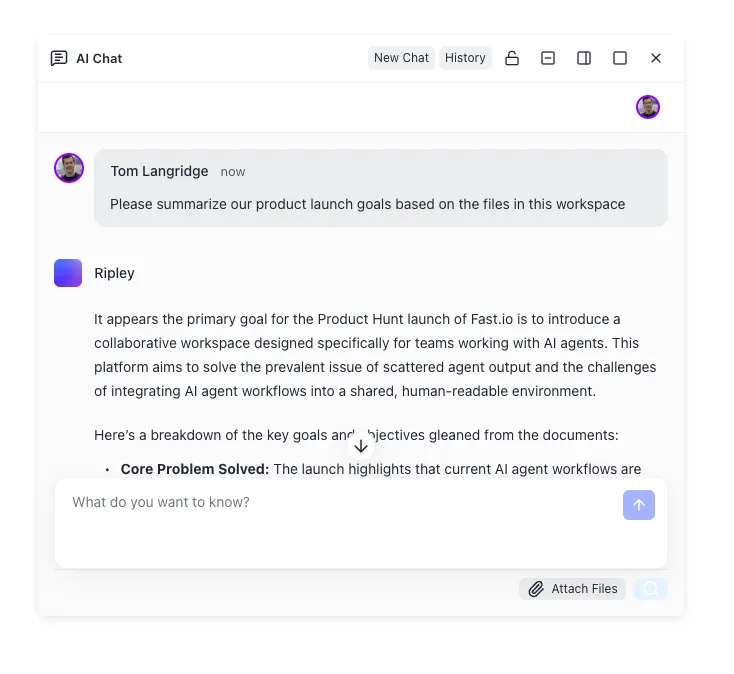
Fastio takes a different approach: instead of building a standalone RAG pipeline, it embeds multimodal indexing directly into its workspace platform. Enable Intelligence Mode on a workspace and uploaded files, including PDFs, images, video, and audio, are automatically indexed for semantic search and RAG chat with citations.
For teams running AI agents, Fastio provides an MCP server with Streamable HTTP access, so agents can upload files, trigger indexing, search across modalities, and query results programmatically. The Metadata Views feature adds structured extraction on top: describe the fields you want in natural language, and AI populates a queryable database from your documents and images.
Key strengths:
- Zero-config multimodal indexing. Upload a file and it's already indexed
- Built-in RAG chat with page-level citations, no separate vector database needed
- Business Trial: 14-day Business Trial with workspace collaboration and Intelligence Mode (card required)
- Ownership transfer lets agents build workspaces and hand them off to humans
Limitations:
- Not a standalone RAG framework. Retrieval is scoped to files within Fastio workspaces
- Less customizable than assembling your own embedding and retrieval pipeline
Best for: Teams that want multimodal RAG without managing infrastructure, especially those using AI agents that need persistent storage alongside retrieval.
Pricing: 14-day Business Trial (card required); Starter ($9.99/mo), Business ($49.99/mo), Enterprise ($199.99/mo). See pricing.
9. txtai
txtai is a lightweight, open source embeddings database that unifies text, image, and audio processing in a single Python library. With 10,700+ GitHub stars, it offers pipeline orchestration for multimodal workflows without requiring a separate vector database.
Key strengths:
- All-in-one: embeddings, indexing, and pipeline orchestration in one package
- Supports text, images, and audio in unified pipelines
- Low overhead, runs locally without cloud dependencies
Limitations:
- No native video processing. Video requires frame extraction beforehand
- Smaller ecosystem of connectors and integrations compared to LlamaIndex
Best for: Developers who want a lightweight, self-contained multimodal RAG setup that runs locally without cloud vendor dependencies.
Pricing: Open source (Apache 2.0). No cloud offering.
10. RAGFlow
RAGFlow is an open source RAG engine with 48,500+ GitHub stars that specializes in deep document understanding. It extracts content from complex PDFs, including tables, multi-column layouts, and visual elements, with a focus on preserving document structure during chunking.
Key strengths:
- Superior PDF and document parsing, including tables, charts, and layout-aware chunking
- GraphRAG support for knowledge-graph-enhanced retrieval
- Strong community adoption with rapid development pace
Limitations:
- Primarily document-focused. Image, audio, and video support is secondary
- Self-hosted deployment requires infrastructure management
Best for: Teams whose multimodal challenge is primarily complex documents (contracts, technical manuals, financial reports) rather than video or audio.
Pricing: Open source (Apache 2.0). Self-hosted only.
Which Platform Should You Choose?
The right choice depends on where your unstructured data lives and how much infrastructure you want to manage.
If your data is mostly video, start with Twelve Labs. Their video-native embeddings capture meaning that frame-by-frame extraction misses, and the API handles ingestion at scale.
If you need true cross-modal search across text, images, video, and audio in one query, Mixpeek or Google's Gemini Embedding 2 on Vertex AI offer the most complete multimodal coverage today.
If you want to build a custom pipeline, LlamaIndex gives you the most flexibility. Pair it with Weaviate or Qdrant as your vector store, choose your embedding models per modality, and control every step.
If you want zero-config RAG alongside file storage, Fastio handles indexing automatically when you upload files. There's no vector database to provision, no embedding pipeline to maintain, and the Business Trial gives you room to test before committing.
If your challenge is complex documents, RAGFlow's layout-aware parsing outperforms generic chunking on PDFs with tables, charts, and multi-column layouts.
For most teams starting with multimodal RAG, the practical path is to pick a platform that handles your primary modality well, verify retrieval quality on your actual data, and expand modality coverage as your pipeline matures. Trying to build a universal multimodal system on day one usually leads to engineering complexity that delays the project.
Sources
References used to verify factual claims in this guide.
-
IDC estimates that over 80% of enterprise data is unstructured
-
Nuuly saw Match@20 accuracy jump from 60% to nearly 87% with Gemini Embedding 2 Supermemory reported a 40% increase in Recall@1 search accuracy
Frequently Asked Questions
What is multimodal RAG?
Multimodal RAG extends retrieval-augmented generation beyond text to include images, video, audio, and other file types. Instead of only searching documents, a multimodal RAG system embeds and retrieves context from diverse media, then feeds that context to an LLM for generation. This lets AI agents and applications reason over visual diagrams, video footage, or audio recordings alongside written content.
Which RAG platform supports image and video retrieval?
Several platforms support image and video retrieval natively. Mixpeek handles video, audio, images, PDFs, and text in a single pipeline. Twelve Labs specializes in video understanding with scene-level embeddings. Google's Gemini Embedding 2 accepts text, images, video, and audio in one API call. LlamaIndex supports multimodal retrieval through integrations with VideoDB and vision LLMs like GPT-4V. Fastio automatically indexes uploaded images and video files when Intelligence Mode is enabled.
How do you build a multimodal RAG pipeline?
A multimodal RAG pipeline has three stages: ingestion, embedding, and retrieval. During ingestion, you process files into retrievable chunks. For images, this might mean generating captions or using vision embeddings. For video, you extract key frames and transcribe audio. For audio, you run speech recognition. During embedding, you convert these chunks into vectors using a multimodal embedding model like Gemini Embedding 2 or CLIP. During retrieval, you search the vector store with a query and pass the results as context to an LLM. Managed platforms like Mixpeek or Fastio handle all three stages automatically.
What is the best vector database for multimodal RAG?
Weaviate and Qdrant are the strongest options for multimodal vector storage. Weaviate offers built-in hybrid search and modular vectorization, so you can plug in different embedding models per modality. Qdrant provides high-performance vector search with native image embedding support through Cloud Inference. Both are open source with managed cloud options. For teams that want to avoid managing a vector database entirely, platforms like Fastio and Mixpeek bundle vector storage into their RAG pipeline.
Do I need a separate vector database for multimodal RAG?
Not always. Full-stack platforms like Mixpeek, R2R, and Fastio include vector storage as part of their pipeline, so you don't need to provision and manage a separate database. Framework-based approaches using LlamaIndex or LangChain typically do require a vector database like Weaviate, Qdrant, or Pinecone. The tradeoff is flexibility versus operational complexity: standalone databases give you more control, while integrated platforms reduce infrastructure overhead.
Related Resources

Index Files for Multimodal Search Without Managing Infrastructure
Fastio auto-indexes PDFs, images, video, and audio for semantic search and RAG chat once Intelligence is enabled. Start a 14-day trial.