How to Perform RAG with Large Files: Strategies for Heavy Documents
Retrieval Augmented Generation (RAG) on large files requires smart chunking, indexing, and retrieval strategies to avoid context window overflows.


Why Large Files Break Standard RAG Pipelines
Standard RAG workflows break down with gigabyte-scale PDFs or massive text corpora. The bottleneck isn't storage. It's the context window of the Large Language Model (LLM). Even with models supporting 128k or 200k tokens, dumping an entire financial report or technical manual into the prompt degrades reasoning performance and spikes costs. This is the "Lost in the Middle" problem: models do well with information at the beginning or end of a prompt, but struggle with data buried in the center. As data volume increases, the noise-to-signal ratio within retrieved context climbs too. If a retrieval system pulls in irrelevant sections of a 500-page document, the LLM gets distracted by contradictory or unrelated information, and output quality drops. The computational cost of processing massive token counts for every query can also make a production RAG application economically unviable. To make RAG work with large files, you need a deliberate strategy for how information is sliced, stored, and served, so the LLM receives a coherent, manageable subset of data. There's another problem: naive chunking (splitting text blindly every 500 characters) destroys semantic meaning. A paragraph split in the middle loses its connection to the previous sentence, which leads to hallucinations or irrelevant retrieval results. With large files, the risk of these "broken" chunks goes up because there are more opportunities for important information to be bisected by an arbitrary character limit.
Helpful references: Fastio Workspaces, Fastio Collaboration, and Fastio AI.

Related guides
- OneDrive RAG: How to Connect AI Agents and Vector Search to OneDrive FilesOneDrive RAG is a method for connecting AI agents to documents in Microsoft OneDrive by syncing folders into an indexed...
- How to Build a RAG Pipeline with Fastio APIBuilding a reliable Retrieval-Augmented Generation pipeline often involves managing complex infrastructure. A RAG...
- How to Build and Query Box RAG Workspaces with AI AgentsBox RAG enables AI agents to retrieve and cite context from enterprise Box documents without downloading entire folder...
- Dropbox RAG: How to Implement Retrieval-Augmented Generation with DropboxDropbox RAG enables AI agents to query and retrieve precise text passages from Dropbox folders through an indexed...
- How to Optimize RAG Retrieval for Autonomous AgentsOptimizing RAG for agents involves tuning chunk sizes and retrieval strategies to provide actionable context for...
- Connecting Azure AI Search to Blob Storage: Indexer Setup & ArchitectureConnecting Azure AI Search to Azure Blob Storage uses automated indexers to extract, chunk, and index unstructured...
More on this subject: Agent Memory and Storage (261 guides)
What to check before scaling rag with large files
To maintain context within large documents, move beyond fixed-size splitting.
Recursive character text splitting is a solid starting point. It splits text by hierarchy: first by paragraphs, then by sentences, then by words. Related information stays together. This works better than fixed-length splitting because it follows the natural structural boundaries of the document, which already group related concepts.
Semantic chunking goes further by using an embedding model to identify break points. It calculates cosine similarity between sentences and only creates a new chunk when the topic shifts. Each chunk represents a complete thought, not an arbitrary byte count. Semantic chunking costs more compute than recursive splitting, but it's often necessary for technical or dense documents where punctuation alone doesn't signal a topic change. * Fixed-size: Fast, but breaks context and destroys semantic relationships. * Recursive: Respects document structure like headers and paragraphs. * Semantic: Respects meaning and topic shifts, providing the highest quality chunks for complex reasoning.
Parent-Document Retrieval
One of the most effective strategies for large documents is Parent-Document Retrieval, also called the small-to-large retrieval technique. You index small, granular chunks (single sentences or short snippets) for high-precision search. These small chunks work well for vector search because they focus on a single point or keyword. But when a match is found, you don't return just that snippet. You retrieve the "parent" chunk, which might be the surrounding paragraph, a subsection, or the entire page. This gives the LLM two things at once: the search accuracy of specific keywords and the broader context needed to generate a good answer. Think about technical manuals, where a sentence like "Set voltage to 5V" is useless without knowing which component it refers to. Retrieving the parent context ensures the LLM has surrounding information to interpret the instruction correctly. This approach solves the "context-starved" retrieval problem that's common in large-scale RAG systems.
Automated Indexing and Storage
Building a custom RAG pipeline for large files usually means gluing together S3 for storage, Pinecone for vectors, and LangChain for processing. That stack is hard to maintain. For many teams, managing the infrastructure becomes a bigger job than building the actual AI application. Fastio handles this with Intelligence Mode. Upload a file, whether it's a 500MB PDF or a massive CSV, and Fastio indexes it automatically using optimized RAG patterns. No separate vector database, no embedding provider API keys, no chunking scripts. Your AI agents query the file using natural language, and the system handles retrieval and context management behind the scenes. For developers who need more control, Fastio's REST API download route accepts byte-range requests, so agents can read specific byte ranges of a file. An agent can read the header of a large video file or the table of contents of a massive PDF without downloading the entire object. That saves bandwidth and time. This kind of granular access matters when building agents that need to "peek" into large files before deciding which sections to process in depth.
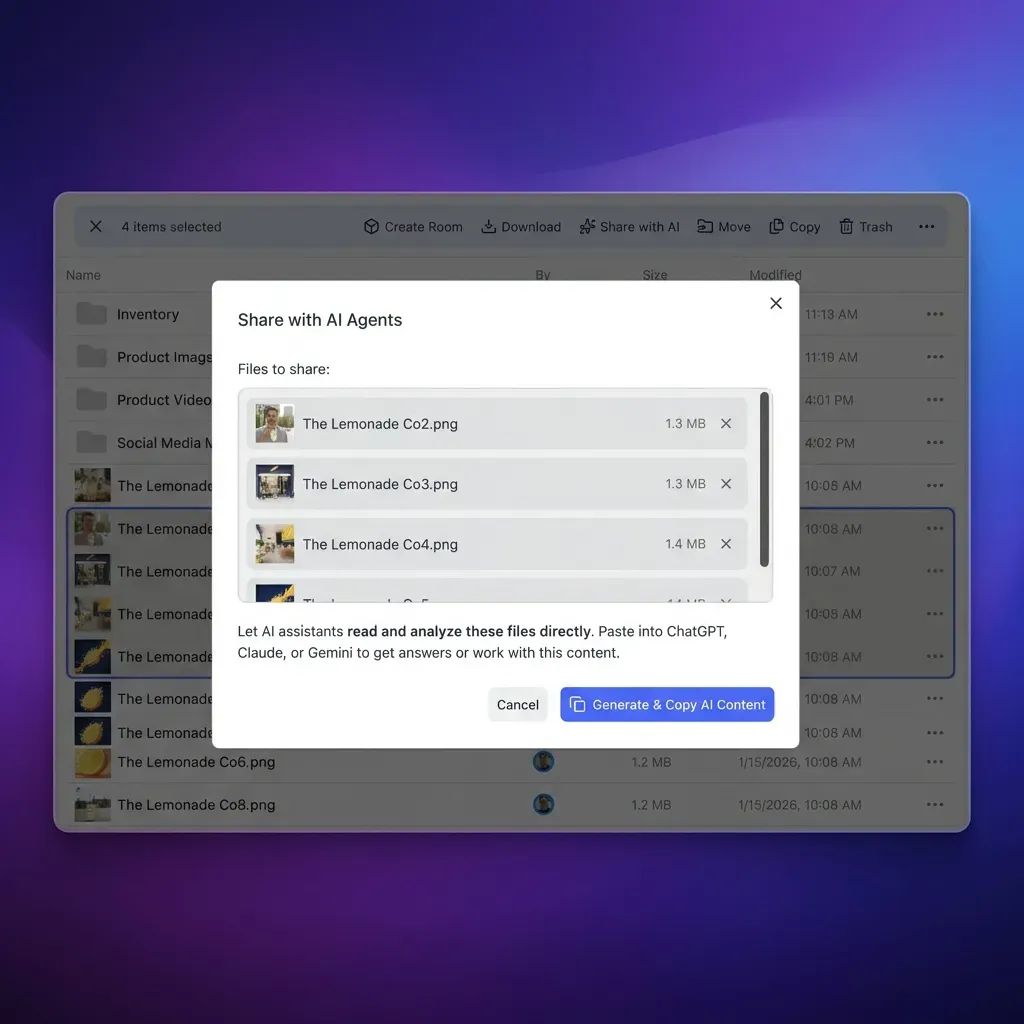


Give Your AI Agents Persistent Storage
Get generous storage with built-in auto-indexing for your AI agents. No vector DB required.
Strategy 4: Hybrid Search with Re-ranking
Vector search (semantic similarity) is powerful, but it sometimes misses specific keyword matches like product model numbers or unique technical identifiers (e.g., "XJ-900").
Hybrid search combines vector search with traditional keyword search (BM25) so that both semantic meaning and exact literal matches are considered during retrieval. For large document sets, adding a re-ranking step makes a real difference. After retrieving the top 50 or 100 results from your hybrid search, a specialized re-ranking model (a Cross-Encoder like Cohere Rerank or BGE-Reranker) scores them for relevance to the query and re-sorts them. The goal: fill the limited slots in your LLM's context window with the most relevant information, filtering out "noise" chunks that rank high in initial vector searches but don't actually answer the user's question. This two-stage process is standard in production RAG systems handling millions of documents.
Best Practices for PDF Pre-processing
PDFs are notoriously difficult for RAG due to their layout complexity and non-linear data structures. * OCR is Mandatory: Don't rely on simple text extraction for scanned docs or images. Use optical character recognition (OCR) to capture text from images and ensure that "text-behind-image" layers are correctly interpreted. * Table Extraction: Standard parsers often break the relationship between table cells. Use tools designed to preserve table structure, converting them to Markdown or JSON so the LLM can understand row-column relationships and numerical data. * Header and Footer Removal: Large documents often have repetitive headers, footers, and page numbers that can pollute the index. Removing these elements during pre-processing prevents the LLM from being confused by page-level metadata. * Metadata Filtering: Tag every chunk with metadata like "Section Header", "Page Number", or "Last Modified". This lets your RAG system pre-filter millions of chunks down to a relevant subset before performing vector search, which improves both retrieval speed and answer accuracy. Meta-tagging is how you scale RAG to thousands of large files.
Sources
References used to verify factual claims in this guide.
-
models supporting 128k or 200k tokens degrade reasoning when dumping entire documents into prompts
-
irrelevant sections from 500-page documents distract LLMs; naive chunking every 500 characters destroys semantics
-
Upload a file, whether it's a 500MB PDF or a massive CSV
-
Hybrid Search with Re-ranking combines vector and keyword search
-
retrieve top 50 or 100 results then re-rank with Cohere Rerank or BGE-Reranker
-
chunk size 512 to 1024 tokens is a common starting point; smaller chunks 256 tokens for specific fact retrieval; larger chunks 1024+ tokens for summarization and complex reasoning tasks; overlap should be set to 10-20%
Frequently Asked Questions
What is the optimal chunk size for large files?
There is no single 'best' size, but 512 to 1024 tokens is a common starting point. Smaller chunks (256 tokens) are better for specific fact retrieval, while larger chunks (1024+ tokens) are better for summarization and complex reasoning tasks. Overlap should be set to 10-20%.
Does Fastio support RAG on video files?
Yes. Fastio's Intelligence Mode processes video files by transcribing the audio and indexing the resulting text. This allows you to search for spoken phrases within large video archives without watching them.
How does parent-document retrieval improve accuracy?
It decouples the unit of search from the unit of generation. You search against small, specific snippets to find the right location, but feed the LLM a larger window of text to ensure it has enough context to answer correctly.
Related Resources

Give Your AI Agents Persistent Storage
Get generous storage with built-in auto-indexing for your AI agents. No vector DB required.