Best AI Tools for Marketers in 2026
AI marketing tools have moved from novelty to operational necessity. This guide ranks 12 tools across six marketing functions, from content writing and SEO to ad optimization and email personalization, with pricing, strengths, and limitations for each. Instead of listing generic "AI platforms," every entry maps to a specific workflow so you can build a stack that fits your team.


How We Evaluated These Tools
The AI marketing tools market crossed $30 billion in 2026, and the number of options is overwhelming. Rather than test every tool with a vague "which is best?" lens, we segmented by the six functions where marketing teams spend the most time: content creation, SEO, paid advertising, social media, email, and asset management.
We scored each tool on four criteria:
- Workflow fit. Does it solve a specific, repeated problem, or is it a general chatbot with a marketing skin?
- Integration depth. Compatibility with HubSpot, Salesforce, Google Ads, Meta Ads, and common CDPs like Segment.
- Output quality. Tested on real campaigns, not demo prompts. Can the output go live with minimal editing?
- Pricing clarity. Transparent tiers, predictable scaling, and a usable free plan where available.
According to HubSpot's 2026 State of Marketing report, roughly a third of marketing teams say AI saves them 10 to 14 hours per week, and another third report saving over 15 hours. Those gains are real, but only when the tool fits the workflow. A $200/month platform that shaves five minutes off a task you do once a quarter is not a good investment.
Here is the full list, organized by marketing function.
Related guides
- Best Headless Browsers for AI Agents: Top Tools (2026)Finding the best headless browsers for AI agents matters for reliable automation. Old scrapers break on dynamic sites....
- Best Web Browsing Tools for AI Agents (2026)Web browsing tools let AI agents navigate the live web, fill forms, and extract real-time data. Traditional scrapers...
- Best Free AI Agent Tools 2026: Top 12 Platforms ComparedBuilding autonomous agents doesn't have to be expensive. The free AI agent ecosystem now offers professional frameworks...
- Best Pydantic AI Tools for Building Reliable Agents (2026)Building reliable AI agents requires more than just prompts; it demands structured, type-safe data. Pydantic AI tools...
- Best Tools for LangChain Development in 2026The LangChain ecosystem has expanded beyond the core library to include specialized tools for observability,...
- Best Generative AI Tools in 2026, Ranked by Output TypeThe generative AI market hit $69.85 billion in 2026, nearly doubling year over year, yet most users still default to...
More on this subject: AI Tool Directories and Comparisons (231 guides)
Content Creation and Copywriting
Content production is where most teams start with AI, and where the tool landscape is most crowded. The winners here are platforms that go beyond "generate a blog post" and works alongside your brand voice, content calendar, and distribution channels.
1. Jasper
Jasper is the most established AI writing platform for marketing teams. It ships with over 50 marketing-specific templates, brand voice training through Jasper IQ, and a campaign workflow that generates blog posts, emails, social captions, and ad copy from a single brief. The 2026 release added AI Agents that handle full campaign tasks without constant prompting, plus support for over 30 languages.
Key strengths:
- Campaign briefs generate coordinated content across channels
- Brand voice learning produces noticeably more consistent output than generic LLMs
- Team collaboration features with approval workflows
Limitations:
- Pricing starts at $49/month (Creator) and scales to $69/month (Pro), which adds up for large teams
- Long-form output still needs human editing for nuance and factual accuracy
Best for: Mid-market teams producing content across multiple channels who need brand consistency at scale.
2. Claude
Anthropic's Claude stands out for deep thinking and long-form reasoning. It handles up to 200,000 tokens of context, which means it can process entire research reports, brand style guides, and competitor analyses in a single session. Marketers use it for campaign strategy, content drafts, research synthesis, and refining brand voice.
Key strengths:
- Massive context window for ingesting brand guidelines and lengthy source material
- Strong at structured output: comparison tables, outlines, editorial calendars
- Available through API for custom marketing workflows
Limitations:
- No image or video generation built in
- Requires more prompting skill to get marketing-specific output compared to purpose-built tools
Best for: Marketing strategists and content leads who need a thinking partner, not just a copy generator.
3. Copy.ai
Copy.ai targets short-form marketing copy: email subject lines, product descriptions, ad headlines, and social captions. Its workflow templates let you chain multiple generation steps together, and the 2026 updates added GTM AI workflows that connect lead research to personalized outreach.
Key strengths:
- Purpose-built for short-form conversion copy
- GTM workflows connect research to outreach in a single pipeline
- Free tier available for individuals
Limitations:
- Less suited for long-form content like blog posts or white papers
- Advanced workflows require the $249/month plan
Best for: Sales-led marketing teams focused on outbound copy and conversion-oriented content.
SEO and Content Optimization
SEO tools were early AI adopters, and the 2026 landscape reflects that maturity. The best options combine keyword research with content scoring and competitive intelligence.
4. Semrush
Semrush bundles its full SEO toolkit with AI-powered features: predictive keyword trends, automated content briefs, competitive gap analysis, and technical audits. The AI Visibility Toolkit tracks how your content appears in AI-generated answers, not just traditional search results, which is increasingly important as search behavior shifts.
Key strengths:
- All-in-one platform covering SEO, PPC, social, and content marketing
- AI Visibility Toolkit tracks brand presence in AI search results
- works alongside Google Ads, Google Search Console, and major CMS platforms
Limitations:
- Pricing starts at $139.95/month, which is steep for small teams
- Feature density creates a learning curve
Best for: Marketing teams that need a single platform for organic and paid search, especially those tracking AI-driven search visibility.
5. Surfer SEO
Surfer takes a focused approach: it analyzes the pages currently ranking for your target keyword and translates those signals into a real-time content score as you write. It works inside Google Docs, WordPress, and Jasper, making it a natural layer on top of your existing writing workflow.
Key strengths:
- Live content scoring against top-ranking pages for your keyword
- works alongside Google Docs, WordPress, and Jasper
- SERP analysis is fast and actionable
Limitations:
- Focuses narrowly on on-page optimization; no backlink or technical SEO features
- Most professionals pair it with Semrush or Ahrefs for a complete SEO stack
Best for: Content teams that want real-time optimization guidance without switching tools.


Build a searchable marketing asset library in minutes
Workspaces with AI-powered search once Intelligence is enabled, branded client shares, and a remote MCP server for agent workflows.
Paid Advertising and Campaign Optimization
AI-powered ad optimization can improve return on ad spend by 20 to 30% on average, according to industry benchmarks. The tools below automate bidding, creative testing, and cross-platform campaign management so marketing teams spend less time adjusting bids and more time on strategy.
6. Madgicx
Madgicx is built specifically for Meta Ads optimization. It earns its value when campaigns generate enough data, typically $5,000 or more in monthly ad spend, where its AI identifies micro-optimization opportunities that would take human analysts hours to surface. Audience targeting, creative analytics, and automated budget allocation are its core strengths.
Key strengths:
- Deep Meta Ads specialization with creative performance analytics
- Automated audience targeting and budget reallocation
- Visual creative insights that show which elements drive performance
Limitations:
- Requires meaningful ad spend ($5,000+/month) to generate enough data for AI optimization
- Primarily focused on Meta; limited Google Ads features
Best for: E-commerce and DTC brands spending heavily on Meta Ads who need granular creative and audience optimization.
7. Optmyzr
Optmyzr focuses on Google Ads automation for agencies and in-house teams managing large accounts. Its Rule Engine lets you build custom optimization rules without coding, and the PPC management tools handle bid adjustments, budget pacing, and quality score monitoring.
Key strengths:
- Custom Rule Engine automates repetitive Google Ads optimizations
- Supports Google Ads, Microsoft Ads, and Amazon Ads
- Built for agencies managing multiple client accounts
Limitations:
- Starts at $249/month, so better suited for teams managing significant ad spend
- Steeper learning curve than simpler optimization tools
Best for: Agencies and enterprise teams managing complex, multi-account Google Ads campaigns.
Social Media and Design
Social media management tools adopted AI faster than most marketing categories. The shift in 2026 is from assistive AI (suggesting hashtags, scheduling posts) to agentic AI (planning, publishing, and optimizing campaigns with minimal human input).
8. Buffer
Buffer added AI-powered content generation across its scheduling platform, turning it from a publishing tool into a lightweight content creation and scheduling suite. It generates post ideas, writes captions tailored to each platform's format, and suggests optimal posting times based on your audience data.
Key strengths:
- AI content generation directly inside the scheduling workflow
- Platform-specific formatting for LinkedIn, X, Instagram, TikTok, and more
- Clean interface with a usable free tier for up to 3 channels
Limitations:
- Analytics are basic compared to Sprout Social or Hootsuite
- AI generation quality trails dedicated writing tools like Jasper
Best for: Small teams and solo marketers who want content creation and scheduling in one affordable tool.
9. Canva Magic Studio
Canva's Magic Studio suite turned a template editor into a full AI design platform. It includes Magic Design (generates complete layouts from text prompts), Dream Lab (production-quality AI image generation powered by Leonardo.ai), Magic Write (with brand voice training), and Magic Media (text-to-image and short video clips). Canva's 2026 marketing report found that 85% of marketers using AI design tools save at least 4 hours per week.
Key strengths:
- Over 25 AI tools built directly into the editor, no switching between platforms
- Brand Kit integration keeps all output on-brand
- Accessible to non-designers with minimal learning curve
Limitations:
- AI image generation quality trails dedicated tools like Midjourney
- Pro plan ($15/month) required for most AI features
Best for: Marketing teams that need high-volume visual content without hiring dedicated designers.
Email Personalization and Marketing Automation
Email remains one of the highest-ROI marketing channels, and AI personalization is pushing open rates and conversion even further. The best tools in this space go beyond inserting first names; they adjust entire email sequences based on recipient behavior.
10. Klaviyo
Klaviyo dominates e-commerce email and SMS marketing. Its Marketing Agent ingests website and purchase data to generate fully designed, on-brand campaigns in a few clicks. With over 40 AI features, from Segments AI (automated audience targeting) to personalized send-time optimization, it turns behavioral data into revenue.
Key strengths:
- Deep Shopify, WooCommerce, and BigCommerce integrations
- AI spans segmentation, send-time optimization, and content generation
- Predictive analytics forecast customer lifetime value and churn risk
Limitations:
- Pricing scales with contact list size and can get expensive above 10,000 contacts
- Primarily designed for e-commerce; less suited for B2B marketing
Best for: E-commerce brands that want behavior-driven email and SMS campaigns tied directly to purchase data.
11. HubSpot Breeze AI
HubSpot embedded AI across its entire marketing suite through Breeze, its AI layer. Breeze Assistant generates and refines content inside the CMS editor, while Content Remix converts blog posts into video scripts, social captions, and email drafts. For teams already using HubSpot for CRM and marketing automation, the AI features add value without introducing another tool.
Key strengths:
- AI built into every HubSpot module: CMS, email, social, ads, and CRM
- Content Remix repurposes existing content across formats automatically
- No additional cost beyond existing HubSpot subscription
Limitations:
- Requires HubSpot Marketing Hub ($800+/month for Professional) as the base platform
- AI output quality is good for first drafts but rarely publication-ready
Best for: Teams already using HubSpot who want AI-assisted marketing without adding tools to their stack.
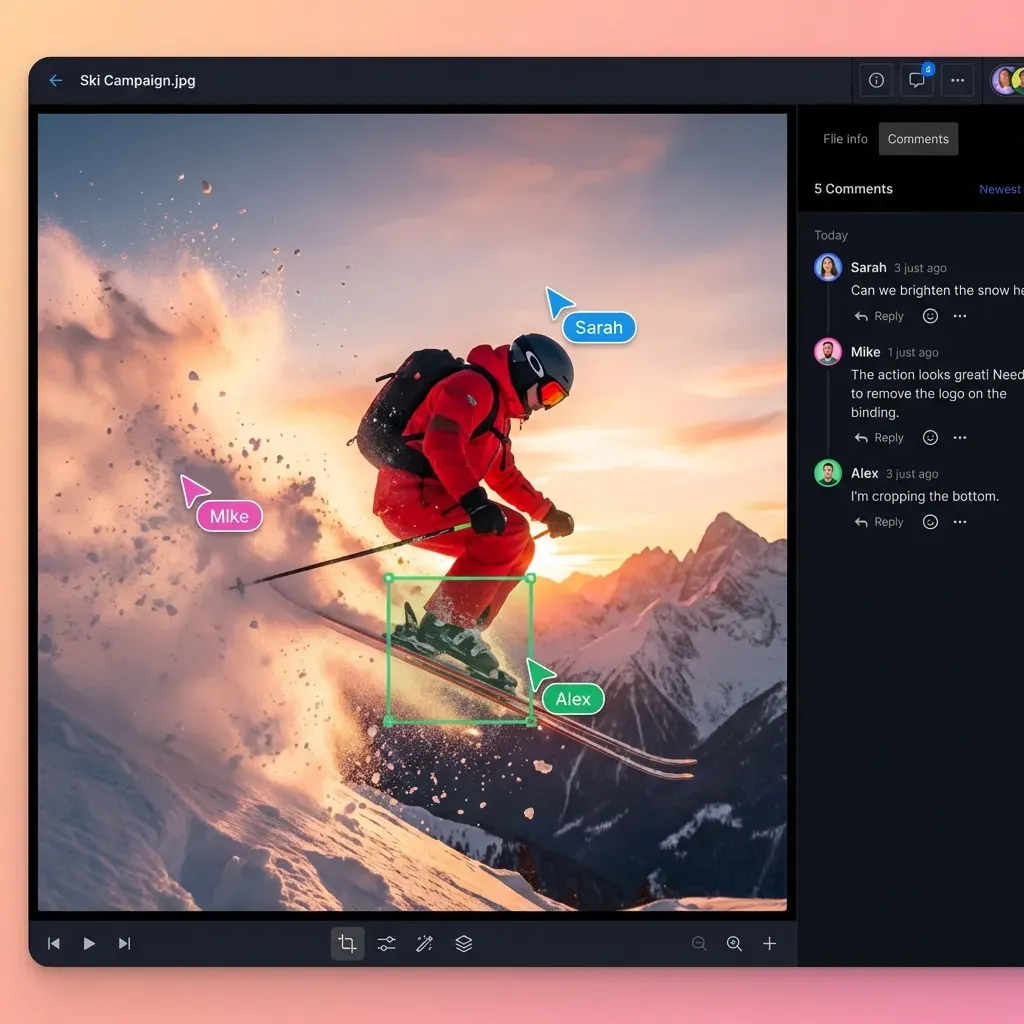
Asset Management and Collaboration
Marketing teams produce a constant stream of assets: campaign briefs, creative files, brand guidelines, video cuts, and client deliverables. Managing this output across tools and team members is where projects stall. The options below address asset storage, search, and handoff.
You can store everything in Google Drive or Dropbox, and for many teams that works fine. But neither platform indexes files for semantic search or works alongside AI agents out of the box.
12. Fastio
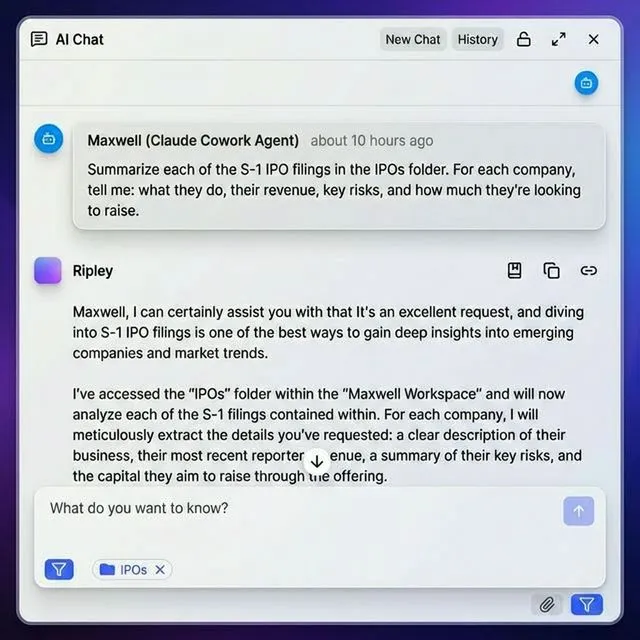
Fastio is a cloud workspace platform that combines file storage with built-in AI. Enable Intelligence Mode on a workspace and every file gets auto-indexed for semantic search and AI chat with citations. Marketing teams use it for campaign asset libraries, client deliverables via branded shares, and as a persistent storage layer for AI agent workflows.
For teams using AI agents to generate and distribute marketing content, Fastio's MCP server connects directly to tools like Claude, letting agents read, write, and organize files without manual downloads. The Metadata Views feature extracts structured data from documents (contract terms, invoice line items, creative specs) into a sortable spreadsheet, no templates or OCR rules required.
Key strengths:
- Intelligence Mode auto-indexes files for semantic search and AI chat with citations
- Branded shares (Send, Receive, Exchange) for client-facing deliverables
- Business Trial: 14-day trial requiring a credit card, with plans starting at $9.99/month
- Remote MCP server with a consolidated MCP toolset for AI agent integration
Limitations:
- Smaller ecosystem than Google Drive or Dropbox
- Intelligence Mode credits beyond each plan's monthly allowance are billed as overage
Best for: Marketing teams that want searchable, AI-indexed asset storage with built-in client sharing and agent workflows.
Other options worth considering: Google Drive for teams deep in the Google ecosystem, Dropbox for simple file sharing, and Brandfolder or Bynder for enterprise-scale digital asset management.
How to Choose the Right AI Marketing Stack
The right stack depends on your team size, budget, and which marketing functions consume the most hours.
If you are a solo marketer or small team (under 5 people): Start with Claude or ChatGPT for content drafting, Buffer for social scheduling, Canva Magic Studio for design, and Fastio for asset management (plans start at $9.99/month with a 14-day Business Trial).
If you run a mid-market team (5 to 20 people): Jasper for brand-consistent content at scale, Semrush for SEO and competitive intelligence, Klaviyo or HubSpot Breeze for email automation, and Fastio for searchable asset storage and client sharing. Budget around $500 to $1,000/month across tools.
If you manage an agency or enterprise team: Layer in Madgicx or Optmyzr for ad optimization, Surfer SEO for content scoring, and consider HubSpot's full Marketing Hub for centralized campaign management. Expect $2,000 to $5,000/month for a complete AI-assisted stack.
Three principles apply regardless of team size:
Solve a specific bottleneck first. Identify the task that consumes the most hours and automate that before expanding. A focused tool that saves 10 hours/week beats five tools that save 30 minutes each.
Test integration before committing. The best AI tool is useless if it does not connect to your CRM, ad platform, or CMS. Run a pilot with real campaign data before signing an annual contract.
Budget for the learning curve. Every AI tool requires prompt engineering, workflow setup, and team training. Factor in two to four weeks of ramp time before expecting full productivity gains.
Sources
References used to verify factual claims in this guide.
-
Roughly a third of marketing teams say AI saves them 10 to 14 hours per week, and another third report saving over 15 hours
-
AI-powered ad optimization can improve ROAS by 20 to 30% on average
-
85% of marketers using AI design tools save at least 4 hours per week
-
Semrush pricing starts at $139.95/month
-
Jasper pricing starts at $49/month (Creator) and scales to $69/month (Pro)
Frequently Asked Questions
What AI tools do marketers actually use?
The most widely adopted AI marketing tools in 2026 are ChatGPT and Claude for content drafting, Jasper for brand-consistent copy, Canva Magic Studio for design, Semrush for SEO, Klaviyo for email personalization, and HubSpot Breeze for teams already on that platform. Most marketing teams use a combination of three to five tools rather than one all-in-one solution.
What is the best AI for social media marketing?
Buffer offers the best balance of AI content generation and scheduling for most teams, especially small ones. For enterprises, Sprout Social and Hootsuite provide deeper analytics and social listening. Canva Magic Studio handles the visual content side, generating platform-specific images and short video clips from text prompts.
Can AI replace digital marketers?
AI tools automate production tasks like first-draft writing, A/B testing, bid optimization, and data analysis. They do not replace strategic thinking, brand positioning, creative direction, or relationship building. Marketing teams using AI effectively report saving 10 to 15 hours per week, which frees time for higher-value work rather than eliminating roles.
What AI tools help with SEO?
Semrush provides the broadest SEO toolkit with AI-powered keyword research, competitive analysis, and a new AI Visibility feature that tracks how your brand appears in AI-generated search answers. Surfer SEO focuses specifically on on-page content optimization with real-time scoring. Most SEO professionals use both in combination with Google Search Console.
How much do AI marketing tools cost?
Costs range from free to several thousand dollars per month. Buffer and Copy.ai offer usable free tiers. Canva Pro costs $15/month. Jasper starts at $49/month. Semrush starts at $139.95/month. Enterprise platforms like HubSpot Marketing Hub Professional run $800/month or more. Most small teams can build an effective AI stack for under $100/month.
Are AI marketing tools worth the investment?
For most marketing teams, yes. HubSpot's 2026 research found that a third of teams save over 15 hours per week with AI tools. The key is matching the tool to a specific workflow bottleneck rather than adopting AI for its own sake. Start with one high-impact area, measure time saved and output quality, and expand from there.
Related Resources

Build a searchable marketing asset library in minutes
Workspaces with AI-powered search once Intelligence is enabled, branded client shares, and a remote MCP server for agent workflows.