Best Pydantic AI Tools for Building Reliable Agents (2026)
Building reliable AI agents requires more than just prompts; it demands structured, type-safe data. Pydantic AI tools use Pydantic's validation framework to eliminate parsing errors and ensure your agents output predictable JSON. We've tested the top tools to help you choose the right stack.


Why Pydantic is Essential for AI Agents
Pydantic has become the standard for data validation in Python, and its role in AI development is even more important. Large Language Models (LLMs) are natively non-deterministic, often outputting unstructured text that breaks downstream applications.
Pydantic AI tools solve this by enforcing schemas on LLM outputs. This structured approach ensures type-safe validation on all model responses, preventing parsing errors that commonly occur with raw prompt engineering. Whether you are building a simple chatbot or a complex multi-agent system, the tools below ensure your AI speaks the language of your code: structured, validated JSON.
Define clear tool contracts and fallback behavior so agents fail safely when dependencies are unavailable. This improves reliability in production workflows.
Helpful references: Fastio Workspaces, Fastio Collaboration, and Fastio AI.

Related guides
- Best Headless Browsers for AI Agents: Top Tools (2026)Finding the best headless browsers for AI agents matters for reliable automation. Old scrapers break on dynamic sites....
- Best Web Browsing Tools for AI Agents (2026)Web browsing tools let AI agents navigate the live web, fill forms, and extract real-time data. Traditional scrapers...
- Best Free AI Agent Tools 2026: Top 12 Platforms ComparedBuilding autonomous agents doesn't have to be expensive. The free AI agent ecosystem now offers professional frameworks...
- 8 Best AI Agent Cost Optimization Tools in 2026AI agent costs add up fast once you move past prototyping. Tool calls, retries, multi-step reasoning, and storage...
- Top 10 AI Agent Tools for PodcastingTop AI agent tools for podcasting handle production from transcription to publishing. Global podcast listeners reached...
- Best Agentic Coding Tools in 2026: A Developer's Honest RankingAgentic coding tools have moved past autocomplete into full task execution. We ranked the 10 most-used options of 2026...
More on this subject: AI Tool Directories and Comparisons (231 guides)
What to check before scaling best pydantic ai tools
Pydantic AI is the official agent framework from the team behind Pydantic. Released to address the "glue code" problem in AI engineering, it is a model-agnostic framework designed explicitly for production-grade applications. It treats prompts as functions and responses as typed objects, making it intuitive for Python developers.
- Best For: Developers who want a pure, "Pydantic-native" experience for building agents.
- Key Strengths:
- Type Safety: First-class support for generic types and complex nested models.
- Model Agnostic: Works well with OpenAI, Anthropic, Gemini, and others.
- Dependency Injection: Built-in system for managing agent dependencies and state.
- Limitations: Being a newer framework, it has a smaller community extension library compared to LangChain.
- Pricing: Open source (MIT License).
2. Instructor
Instructor is widely trusted for structured extraction. Instead of abstracting away the LLM client, it "patches" standard clients (like OpenAI or Anthropic) to add response_model capabilities. This means you can keep using the SDKs you know, but with the guarantee that client.chat.completions.create returns a validated Pydantic object, not a dictionary.
- Best For: Developers who want structured outputs without learning a new heavy framework.
- Key Strengths:
- Simplicity: Minimal learning curve; it just extends your existing client.
- Validation: Automatically retries requests if the LLM output fails validation logic.
- Partial Streaming: unique ability to stream partial Pydantic objects for lower latency UIs.
- Limitations: It is primarily a tool for structured I/O, not a full agent orchestration framework.
- Pricing: Open source (MIT License).
3. Fastio
While frameworks handle the logic, Fastio handles the infrastructure and memory for Pydantic agents. Fastio is a cloud storage platform built for the AI era, offering a complete MCP (Model Context Protocol) server that gives agents persistent file storage, built-in RAG, and programmatic sharing capabilities.
- Best For: Giving agents persistent long-term memory and file I/O capabilities.
- Key Strengths:
- MCP Integration: Connects instantly to Claude, Cursor, and other agent runtimes via a consolidated MCP toolset.
- Intelligence Mode: Automatically indexes files for RAG, so agents can query documents with zero setup.
- Business Trial: 14-day trial (card required) with plans starting at $9.99/mo.
- Limitations: It focuses on storage and I/O, so you'll use it alongside a logic framework like Pydantic AI or LangChain.
- Pricing: 14-day Business Trial; plans start at $9.99/mo (Starter). See pricing.
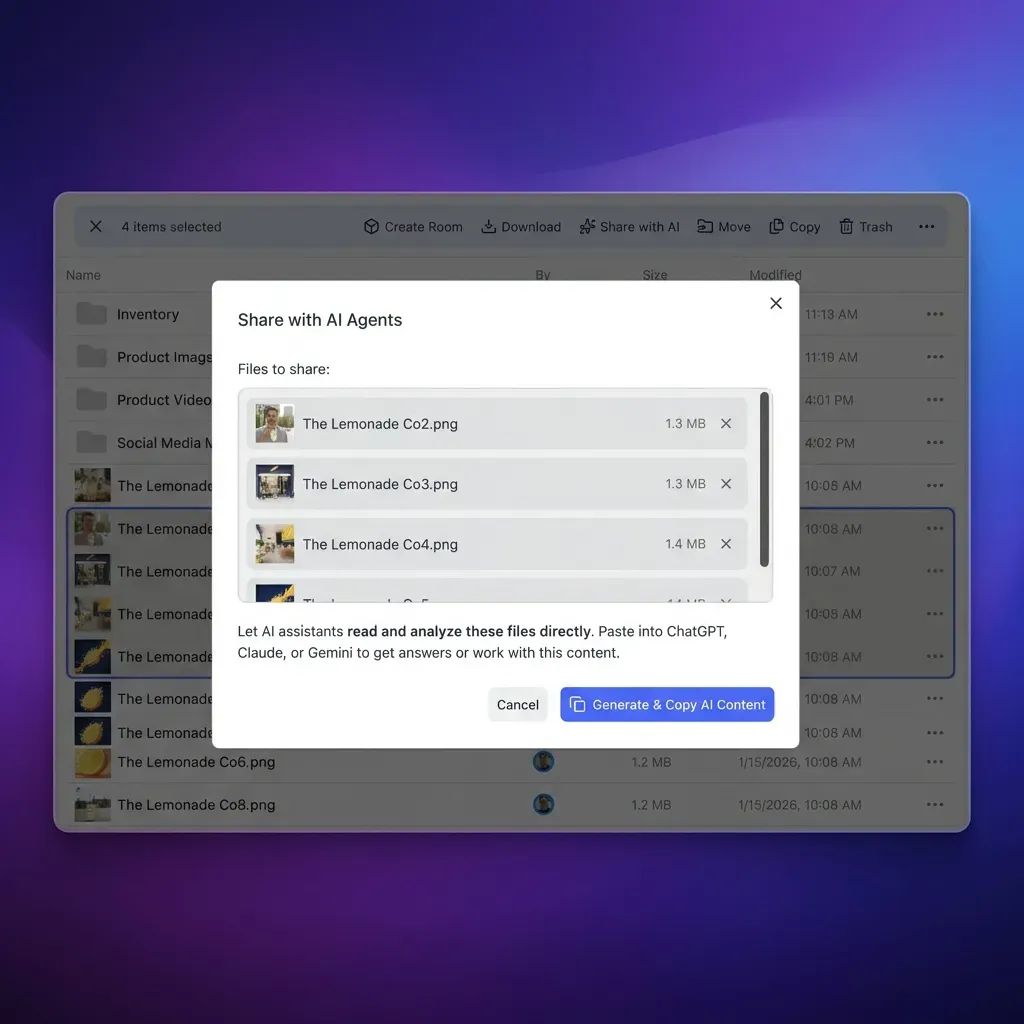


Give Your AI Agents Persistent Storage
Stop building stateless bots. Connect your Pydantic agents to Fastio's secure cloud storage to let them read, write, and share files persistently.
4. Marvin
Marvin describes itself as "batteries-included AI engineering." Built by the team at Prefect, it uses Pydantic to turn messy natural language tasks into reliable function calls. Marvin's high-level abstractions, like @marvin.fn, allow you to write a Python function signature and let the AI implement the logic based on the types and docstring.
- Best For: Rapid prototyping and adding "AI magic" to standard Python functions.
- Key Strengths:
- Developer Experience: clean, decorator-based API.
- Self-Correction: specialized handling for classification and extraction tasks.
- Integration: Works well with Prefect for orchestrating complex AI workflows.
- Limitations: The "magic" can sometimes be harder to debug if the prompt generation is opaque.
- Pricing: Open source (Apache 2.0).
5. Mirascope
Mirascope is the "no magic" library for building LLM applications. It sits between raw API calls and heavy frameworks, offering composable building blocks based on Pydantic. It emphasizes developer control, ensuring you always know exactly what prompt is being sent to the model.
- Best For: Engineering teams who need transparency and control over their prompt management.
- Key Strengths:
- Co-location: Keeps prompts and Python code together in a single class definition.
- Observability: easier to trace and debug than "chain-based" frameworks.
- Versatility: Supports function calling, tools, and structured extraction out of the box.
- Limitations: Requires more boilerplate code than higher-level tools like Marvin.
- Pricing: Open source (MIT License).
6. LangChain (with Pydantic)
LangChain is the industry leader, but its integration with Pydantic has matured . The PydanticOutputParser and newer LCEL (LangChain Expression Language) primitives allow you to define chain outputs using Pydantic models. While heavier than other options, it offers the widest ecosystem of integrations.
- Best For: Enterprise applications requiring complex chains, memory, and diverse 3rd-party integrations.
- Key Strengths:
- Ecosystem: Connects to virtually any database, API, or model provider.
- Orchestration: strong tools for multi-step reasoning and agent loops.
- Community: large library of templates and examples.
- Limitations: Can be complex and "heavy" for simple use cases; steeper learning curve.
- Pricing: Open source (MIT License); hosted LangSmith service is paid.
7. LlamaIndex
LlamaIndex is the leading framework for connecting custom data sources to LLMs, also known as RAG (Retrieval-Augmented Generation). It relies heavily on Pydantic for its internal data structures and for structuring the outputs of query engines. If your agent needs to ingest, index, and query large amounts of data, LlamaIndex is the specialist tool for the job.
- Best For: Building RAG (Retrieval-Augmented Generation) agents with complex data pipelines.
- Key Strengths:
- Data Ingestion: extensive support for loading data from 100+ sources.
- Structured Indices: Uses Pydantic to define the schema of index nodes and query responses.
- Query Engines: Advanced retrieval strategies like hybrid search and re-ranking.
- Limitations: Can be overkill if you just need simple function calling without heavy RAG.
- Pricing: Open source (MIT License); Cloud platform available.
8. FastAPI
While not an "AI tool" per se, FastAPI is the backbone of the Pydantic AI ecosystem. Since it is built on Pydantic, it is a great option for serving your AI agents as web APIs. FastAPI allows you to define your agent's input and output schemas using the same Pydantic models your agent uses internally, ensuring end-to-end type safety from the HTTP request to the LLM and back.
- Best For: Exposing your AI agents as REST APIs for web or mobile apps.
- Key Strengths:
- Performance: One of the fast Python web frameworks available.
- Auto-Documentation: Generates interactive Swagger UI documentation automatically.
- Asynchronous: Native support for Python's
async/await, important for handling slow LLM responses.
- Limitations: It is a web framework, not an AI framework; you still need an agent library.
- Pricing: Open source (MIT License).
comparison: Which Pydantic Tool is Right for You?
Choosing the right tool depends on your specific needs. Here is a quick comparison of the top options to help you decide.
For most modern agent development, we recommend starting with Pydantic AI for the core logic and Instructor for simple extraction tasks. Pair these with Fastio to give your agents the ability to read, write, and share files persistently.

Sources
References used to verify factual claims in this guide.
-
MCP Integration connects instantly to Claude Cursor agent runtimes via a consolidated MCP toolset
-
Business Trial offers a 14-day evaluation with plans starting at $9.99/mo
-
Pricing Open source Apache 2.0 license
-
Data Ingestion extensive support for loading data from 100+ sources
Frequently Asked Questions
What is the difference between Pydantic AI and LangChain?
Pydantic AI focuses on production-grade, type-safe agent definitions using standard Python patterns, whereas LangChain is a full orchestration framework with a large ecosystem of integrations. Pydantic AI is often preferred for its simplicity and direct control, while LangChain is chosen for complex, multi-tool chains.
Can I use Pydantic models with OpenAI directly?
Yes, OpenAI's API now supports structured outputs that can accept JSON schemas derived from Pydantic models. However, using a library like Instructor or Pydantic AI simplifies this process by handling the schema conversion, validation, and retry logic automatically for you.
How does Pydantic improve AI reliability?
Pydantic improves reliability by enforcing a strict schema on the model's output. If the LLM generates a response that doesn't match the required data types (e.g., returning a string instead of an integer), Pydantic validation will catch the error, allowing the system to automatically retry or handle the failure gracefully.
Related Resources

Give Your AI Agents Persistent Storage
Stop building stateless bots. Connect your Pydantic agents to Fastio's secure cloud storage to let them read, write, and share files persistently.