Vertex AI Token Limits: Model Context Windows, Output Caps & Storage Workarounds
Vertex AI token limits define the maximum input context window, capped at 2,097,152 tokens for Gemini 1.5 Pro, and output caps standardized at 8,192 tokens per request. While large context windows accommodate substantial documents, stuffing whole corpora into prompts increases latency and inference costs. Offloading document archives to persistent workspaces with Model Context Protocol tooling enables targeted retrieval without exhausting context limits.


What Are the Token Limits on Google Cloud Vertex AI?
Vertex AI token limits define the maximum input context window (reaching 2,097,152 tokens for Gemini 1.5 Pro) and maximum output token generation cap (standardized at 8,192 tokens across most Gemini models) enforced on Google Cloud Platform. While frontier context windows can ingest book-length texts or complete repositories in a single API call, engineers frequently encounter production bottlenecks when treating model context as a substitute for long-term storage.
When working with generative models on Google Cloud Vertex AI, developers must manage two distinct boundaries: the input context window and the maximum output token cap. The input context window dictates the cumulative volume of text, code, images, audio, and video that a model can evaluate in one prompt. In contrast, the output token limit sets a hard ceiling on how many tokens the model can generate in a single completion response. Learn more about deployment options in the Google Cloud Vertex AI documentation.
Google Cloud enforces these limits at the model architecture layer. For example, Gemini 1.5 Pro provides an input ceiling of 2,097,152 tokens, while Gemini 1.5 Flash supports 1,048,576 tokens. Partner models hosted on Vertex AI operate under separate boundaries: Anthropic Claude 3.5 Sonnet enforces a 200,000 token input window. Regardless of the input size, output generation across these models is capped at 8,192 tokens per request.
These model-level context constraints exist alongside Google Cloud project quotas, such as Requests Per Minute (RPM) and Tokens Per Minute (TPM). While project quotas can be increased by submitting quota requests in the Google Cloud console, the physical model context window and output token limits are architectural parameters that cannot be raised. Sending a prompt that exceeds the supported context length results in an immediate HTTP 400 validation error.
Related guides
- DeepSeek Token Limit: Context Windows, Output Caps, and Token WorkaroundsThe DeepSeek token limit consists of a 1M-token context window for prompt ingestion and a 384K-token output ceiling per...
- Google Gemini Token Limits: 1M Context Windows, 65K Output Caps, and API QuotasGoogle Gemini enforces an input token limit of 1,048,576 tokens and an output ceiling of 65,536 tokens on current...
- Google Gemini Prompt Limit: Input Caps Across Web, Studio, and APIGoogle Gemini enforces prompt boundaries ranging from 32,000 tokens on free web tiers to 1,000,000 tokens in Google AI...
- Continue.dev Token Limit: Context Window Configuration and Codebase IndexingThe Continue.dev token limit is the maximum context length configured in Continue's config.json or config.yaml file...
- AWS Bedrock Token Limits: Model Output Caps, Converse API Parameters, and QuotasAn AWS Bedrock token limit refers to the parameter-enforced boundaries on input prompt length and maximum generated...
- Qwen 2.5 Token Limit: Context Windows, Output Caps, and Local VRAMThe Qwen 2.5 token limit is 128,000 tokens of input context across all model sizes (from 0.5B to 72B), with a maximum...
More on this subject: AI Agents: General Guides (172 guides)
How Vertex AI Context Windows Compare Across Foundation Models
Choosing the right model on Vertex AI requires matching your workload's document size and response requirements against vendor specifications. The following table outlines the documented token limits for foundation models available on Vertex AI as of October 2026:
Each model family implements these limits differently depending on its underlying attention mechanism and intended deployment role.
Gemini Foundation Models on Vertex AI
Google's Gemini series represents the largest context windows available on the platform. Gemini 1.5 Pro was designed specifically for complex cross-modal reasoning across massive datasets. Its 2,097,152 token input context window allows developers to submit extensive technical documentation sets, hours of audio recordings, or substantial source code repositories.
Gemini 1.5 Flash and Gemini 2.0 Flash balance context capacity with lower inference latency. Both models provide a 1,048,576 token input context window. They excel in high-throughput applications, such as high-volume customer support chat, real-time audio transcription analysis, and rapid document classification.
Across the entire Gemini 1.5 and 2.0 lineup on Vertex AI, the output generation parameter maxOutputTokens is capped at 8,192 tokens. Setting a higher value in your generation configuration is either rejected by the API or clamped automatically to 8,192. If your application needs to generate long-form deliverables, such as complete technical manuals or comprehensive codebases, you must break generation into sequential prompts.
Anthropic Claude and Open Models on Vertex AI
Google Cloud Model Garden hosts partner models, including Anthropic's Claude family. Claude 3.5 Sonnet on Vertex AI enforces a 200,000 token input window and an 8,192 token output limit per request. Anthropic initially launched Claude 3.5 Sonnet with a 4,096 output token limit before raising it to 8,192 tokens across API endpoints.
Claude 3.5 Haiku delivers high-speed execution with the same 200,000 token input ceiling and an 8,192 output cap. While 200,000 tokens accommodates hundreds of pages of text, it fills rapidly when developers attach background documentation, chat histories, and schema definitions to agent loops.
Open-weights models deployed on Vertex AI, such as Meta Llama 3.1 (70B and 405B), provide standard 128,000 token input context windows and 4,096 output token caps. Because these context boundaries are smaller than Gemini's, applications running open models require external retrieval mechanisms to handle document-heavy workflows.
How Vertex AI Counts Multimodal Tokens for Audio, Video, and PDFs
Understanding how Vertex AI token limits function requires examining multimodal tokenization. In production pipelines, developers rarely submit plain text alone. Real-world prompts include PDF contracts, high-resolution scans, voice recordings, and video footage. Vertex AI converts every non-text modality into discrete token counts before processing.
Text tokenization follows standard subword algorithms where one token represents roughly four characters in English. According to Google Cloud's documentation, 100 tokens correspond to roughly 60 to 80 words. For non-text modalities, the calculation shifts to spatial and temporal dimensions:
- PDF Documents: Vertex AI processes PDF files page by page. Each page is converted into an image tile and tokenized at a base cost of
258tokens per page, in addition to tokens generated by digital text layers. A 300-page financial filing consumes roughly80,000to120,000tokens, depending on typographic density and embedded tables. - Images: Standard image files are converted into visual patches. An image of 384 by 384 pixels or smaller consumes
258tokens. Larger images are divided into 384 by 384 pixel tiles, with each tile adding258tokens. A high-resolution blueprint or detailed medical scan can consume thousands of tokens. - Video Recordings: Video inputs are sampled at one frame per second by default. Each sampled frame is tokenized as an image at
258tokens per frame. Consequently, one minute of video without audio consumes approximately15,480tokens (60seconds multiplied by258tokens). A 15-minute presentation consumes roughly232,200visual tokens before factoring in spoken dialogue. - Audio Files: Vertex AI tokenizes audio inputs based on time duration, consuming approximately
32tokens per second of recorded audio. This equates to roughly1,920tokens per minute. A one-hour recorded deposition or earnings call consumes approximately115,200tokens.
Developers can inspect the exact token consumption of complex multimodal payloads before invoking inference by using the Vertex AI Count Tokens API. The following Python snippet demonstrates calculating input tokens using the official Google Gen AI SDK:
from google import genai
from google.genai import types

client = genai.Client(vertexai=True, project="your-project-id", location="us-central1")

response = client.models.count_tokens(
    model="gemini-1.5-pro",
    contents=[
        types.Part.from_uri(
            file_uri="gs://your-bucket/annual-report.pdf",
            mime_type="application/pdf",
        ),
        "Summarize the key financial findings from this filing.",
    ],
)

print(f"Total tokens: {response.total_tokens}")
Calling count_tokens helps avoid unexpected runtime failures and allows systems to branch into external retrieval strategies when inputs approach model thresholds.
Cost, Latency, and the Limitations of In-Context Retrieval
The availability of a 2,097,152 token window often leads teams into an architectural anti-pattern: stuffing dozens of complete files directly into the prompt on every turn. While Gemini 1.5 Pro can ingest massive prompts, doing so introduces severe performance, financial, and accuracy penalties.
Latency scales directly with input size. In large language models, Time to First Token (TTFT) represents the time required to read and process the entire prompt before generating the initial output word. When a prompt contains 50,000 tokens, TTFT typically remains under two seconds. When a prompt swells to 1,500,000 tokens, TTFT can stretch to 30 to 60 seconds or longer, creating unacceptable delays for interactive applications.
Financial costs compound rapidly. In Vertex AI, input tokens are billed on every single API invocation. If an autonomous agent runs a multi-step task involving 10 sequential calls, resending a 500,000 token context window on every turn consumes 5,000,000 billable input tokens. Even with tiered pricing, running frequent multi-turn conversations against multi-million-token contexts creates unsustainable cloud bills.
Retrieval precision also suffers from context bloat. Despite impressive benchmarks on synthetic "needle-in-a-haystack" evaluations, real-world retrieval precision degrades when models process hundreds of pages of dense, contradictory, or repetitive text. Irrelevant passages distract the attention heads, increasing the risk of hallucinations or missed technical nuances.
Google Cloud provides Context Caching to mitigate repetitive costs for prompts exceeding 32,768 tokens. Context Caching stores precomputed token activations for a designated Time to Live (TTL), substantially reducing subsequent input token costs for repeated queries. However, caching introduces hourly storage fees and requires static prompts. If your underlying documents change frequently, or if each user queries a unique subset of files, cache misses occur frequently and overhead remains high.


Scale Vertex AI Workflows Beyond Context Window Limits
Connect your models to persistent workspaces with auto-indexed hybrid search and consolidated MCP tools. Monthly plans start with a 14-day free trial, credit card required.
Why Teams Offload Document Libraries to Persistent Workspaces
To bypass context window bottlenecks, teams decouple long-term document storage from the prompt context. Instead of forcing foundation models to read entire archives on every execution, systems offload documents to an external, searchable repository and retrieve only the precise passages needed to answer each query. Teams can deploy this pattern using Fastio workspace storage for agents.
Engineering teams typically evaluate three approaches for managing external context:
- Local Ephemeral Storage: Storing documents directly on local disks or container volumes. While simple, local storage fails in cloud-native environments. Files disappear when Cloud Run containers scale to zero or Kubernetes pods restart. Ephemeral storage cannot be shared across multiple agents or human reviewers.
- Raw Object Storage (Google Cloud Storage or Amazon S3): Uploading files to cloud buckets provides durable persistence. However, object storage lacks native intelligence. Developers must build and maintain separate chunking microservices, embedding pipelines, vector databases, and search infrastructure, introducing substantial ongoing maintenance.
- Intelligent Workspaces via Model Context Protocol (MCP): Centralizing project files in dedicated cloud workspaces that automatically index content for search upon arrival. Models connect to the workspace using standard protocols, searching and reading specific document chunks on demand.
Fast.io provides an intelligent workspace platform designed for agentic workflows. When files are uploaded or synchronized into a workspace, Intelligence Mode indexes the content automatically, creating a hybrid search layer that combines full-text keyword indexing with semantic meaning. Rather than loading an entire 500-page document corpus into Vertex AI, an agent uses Fast.io's consolidated MCP tools to run targeted queries, retrieving only the 1,000 to 3,000 relevant tokens required for inference.
Fast.io workspaces provide shared org-owned environments, per-file version history, and a detailed activity log that tracks all modifications. Monthly plans start with a 14-day free trial, which requires a credit card. Plans are Starter at $9.99/mo (3 seats, 250 GB, 5 workspaces, 100,000 credits a month), Business at $49.99/mo (10 seats, 5 TB, 50 workspaces, 600,000 credits a month), and Enterprise at $199.99/mo (30 seats included, 25 TB, 200 workspaces, 3,000,000 credits a month). Maximum upload sizes reach 25 GB on Starter, 50 GB on Business, and 100 GB on Enterprise. Credits meter AI operations, with overage billed at $10 per 100,000 credits. Extra storage is 1.5 cents per GB a month and extra bandwidth is 4 cents per GB. View complete plan details on the Fastio pricing page.
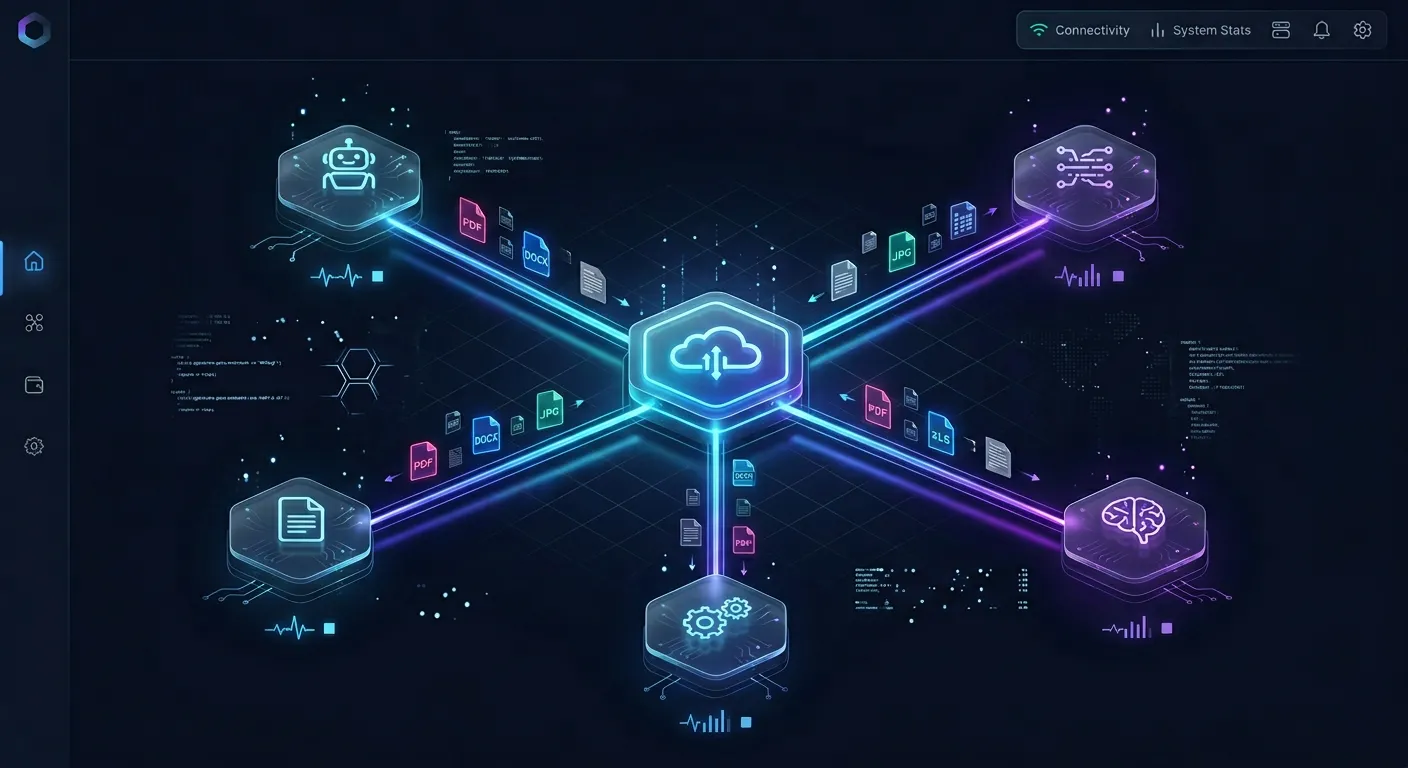
Architecture Blueprint: Integrating Vertex AI Models with External Workspaces
Integrating Vertex AI models with persistent workspaces follows a clean, decoupled architecture. This setup keeps prompt payloads small, avoids the 8,192 output token generation wall, and preserves full document context across sessions. Review setup steps in the Fastio MCP setup documentation.
The workflow consists of five stages:
- Stage 1: Document Ingestion and Cloud Sync: Project documents, research archives, and media assets are imported into the workspace. In addition to direct uploads, teams use Cloud Sync for Google Drive, Dropbox, Box, and OneDrive (configured on a schedule or on demand; never continuous or real-time). SharePoint document libraries connect directly through the OneDrive integration.
- Stage 2: Automatic Workspace Indexing: Once files land in a workspace with Intelligence enabled, Fast.io automatically indexes them for hybrid search. No manual vector database provisioning, embedding generation, or chunk tuning is required.
- Stage 3: Structured Document Extraction: For files requiring schema extraction, such as commercial agreements, invoices, or specifications, teams configure Metadata Views. Metadata Views extracts typed fields (dates, amounts, counterparties, status values) across PDFs and spreadsheets into a structured table that agents can query directly.
- Stage 4: On-Demand MCP Retrieval: When an agent receives a prompt, it connects to the Fastio remote MCP server over Streamable HTTP at
https://mcp.fast.io/mcp/tools(for Claude and general agent clients) orhttps://mcp.fast.io/mcp/code(for coding agents). The agent calls thestoragetool withaction: "search"to find relevant passages, retrieving only the necessary context snippets. - Stage 5: Vertex AI Execution and Artifact Filing: The agent submits the refined prompt, containing only the retrieved excerpts, to Vertex AI Gemini or Claude. The model returns its completion well within the
8,192output token cap. The agent then writes the generated report, summary, or code back to the workspace using thestorage_managetool.
By separating long-term storage from model execution, developers keep Vertex AI inference fast, cost-effective, and fully grounded in accurate source documents.
Sources
References used to verify factual claims in this guide.
-
Vertex AI limits output tokens via maxOutputTokens, with 100 tokens roughly corresponding to 60 to 80 words.
-
Claude 3.5 Sonnet supports up to 8,192 output tokens per request.
Frequently Asked Questions
What is the token limit for Vertex AI?
Vertex AI token limits vary by model. Gemini 1.5 Pro supports an input context window of `2,097,152` tokens with an `8,192` output token cap. Gemini 1.5 Flash supports `1,048,576` input tokens and `8,192` output tokens. Claude 3.5 Sonnet on Vertex AI enforces a `200,000` input token limit and an `8,192` output token limit. Meta Llama 3.1 models provide `128,000` input tokens and `4,096` output tokens.
What is the maximum output token limit in Vertex AI Gemini?
The maximum output token limit across Gemini 1.5 Pro, Gemini 1.5 Flash, and Gemini 2.0 Flash on Vertex AI is `8,192` tokens per request. This cap is governed by the maxOutputTokens parameter in the generationConfig object. Requests configured beyond `8,192` tokens are clamped to this architectural ceiling.
How do you handle large file context limits in Vertex AI?
To handle large file context limits, offload documents to an external intelligent workspace rather than loading entire files directly into prompts. By connecting models to a workspace via Model Context Protocol (MCP), agents perform hybrid search across indexed files, retrieving only relevant passages. This approach reduces prompt size, decreases latency, lowers token costs, and avoids input window exhaustion.
What happens when a request exceeds the Vertex AI input token limit?
When an API request contains more tokens than the target model's input context window supports, Vertex AI rejects the call with an HTTP 400 Invalid Argument error. The error message indicates that the submitted token count exceeds the maximum allowed context length for that model version.
How does Vertex AI calculate tokens for multimodal files like PDFs and video?
Vertex AI calculates multimodal tokens based on visual and temporal dimensions. Text counts as roughly four characters per token. PDF pages are converted to image tiles at `258` tokens per page plus text tokens. Images cost `258` tokens per 384 by 384 pixel tile. Video is sampled at one frame per second, generating approximately `258` tokens per second. Audio is processed at approximately `32` tokens per second.
Does Vertex AI Context Caching eliminate the cost of large prompts?
Context Caching reduces input token costs for prompts larger than `32,768` tokens when the cached prefix is reused across multiple requests. However, it does not eliminate costs completely. Google Cloud charges an hourly storage fee to maintain the cache, and the cache expires once its Time to Live (TTL) elapses or if the underlying prompt content changes.
Related Resources

Scale Vertex AI Workflows Beyond Context Window Limits
Connect your models to persistent workspaces with auto-indexed hybrid search and consolidated MCP tools. Monthly plans start with a 14-day free trial, credit card required.