Super Intelligence Wording in Statements of Work: SOW and PWS Guidelines
Federal procurement offices may use Super Intelligence wording in new Statements of Work and Performance Work Statements under Executive Order 14434. Because Section 3(a) anchors this language to 15 U.S.C. 9401(3), federal Super Intelligence and artificial intelligence share an identical legal baseline. Contracting officers and offerors must establish measurable deliverables, clear performance thresholds, and verifiable audit trails.


What Executive Order 14434 Changes for Statements of Work
Contracting teams that replace artificial intelligence with Super Intelligence in a Statement of Work without defining objective technical baselines invite scope disputes, vendor confusion, and bid protests. In federal acquisitions, shifting administrative labels without adjusting technical requirements creates an immediate disconnect between what a contracting office expects and what an offeror promises to build. When an agency solicitation calls for Super Intelligence systems, one contractor might bid standard machine learning algorithms while another assumes the government is seeking autonomous capabilities beyond current technical feasibility.
Statements of Work (SOW) specifying Super Intelligence define technical tasks, performance baselines, and deliverable schedules for AI systems in federal contracts under Executive Order 14434.
The administrative foundation for this terminology shift began on September 29, 2026, when President Trump signed Executive Order 14434, titled "Inaugurating the Era of Super Intelligence." Under Section 2(a) of the order, executive departments and agencies are instructed to use "Super Intelligence" and the abbreviation "SI" in place of "Artificial Intelligence" and "AI" across official correspondence, public communications, websites, reports, policy documents, and non-statutory records within the executive branch. Section 1 establishes an administrative policy that executive agencies will not acknowledge the usage of earlier terminology in applicable settings.
The legal anchor governing this vocabulary appears in Section 3(a) of the executive order:
"For purposes of this order, and except where otherwise provided by law, the terms 'Super Intelligence' and 'SI' mean the technologies and systems encompassed by the term 'artificial intelligence' as defined in section 9401(3) of title 15, United States Code."
That underlying statute, 15 U.S.C. 9401(3), was codified by Congress in the National Artificial Intelligence Initiative Act of 2020:
"The term 'artificial intelligence' means a machine-based system that can, for a given set of human-defined objectives, make predictions, recommendations or decisions influencing real or virtual environments."
Because Section 3(a) defines SI by reference to 15 U.S.C. 9401(3), federal Super Intelligence and artificial intelligence name the same technologies today. In federal procurement, the phrase covers functional software systems, including supervised machine learning models, computer vision pipelines, natural language processing tools, and predictive decision-support software. It does not establish a requirement for autonomous general reasoning, cognitive consciousness, or superhuman reasoning.
Crucially for contracting officers and procurement personnel, Section 2(b) contains an explicit savings clause:
"Nothing in this section requires the alteration of previously issued regulations, Presidential actions, contracts, grants, or other historical documents."
This provision establishes that previously awarded federal contracts, existing task orders, active Statements of Work, and historical Contractor Performance Assessment Reporting System (CPARS) records do not require retroactive modification. Existing contracts remain legally binding under their original awarded wording.
The abbreviation SI introduces significant communication hazards across federal solicitations. Outside Executive Order 14434, SI stands for the International System of Units (Système International d'Unités) in metric measurement, the sacroiliac joint in medical records, Sports Illustrated in commercial publishing, and "systems integrator" in federal procurement discussions. To prevent ambiguity during source selection reviews, procurement personnel and proposal writers should spell out "Super Intelligence (SI)" upon first mention in every solicitation volume, Statement of Work, and technical proposal.
Understanding federal procurement vocabulary requires distinguishing between two concepts that share similar wording:
- Federal Super Intelligence (two capitalized words, abbreviated as SI) is an administrative designation for operational computing systems meeting the functional criteria of 15 U.S.C. 9401(3).
- Research superintelligence (one compound word, commonly abbreviated as ASI for artificial superintelligence) is a hypothetical future capability beyond artificial general intelligence (AGI) that would exceed human expert performance across all intellectual and creative domains. Commercial research labs, including Meta Superintelligence Labs, Microsoft's MAI Superintelligence Team, and Safe Superintelligence Inc., identify ASI as a long-term theoretical goal. That technology does not exist today.
Confusing federal administrative vocabulary with computer science research goals creates major contractual risks. If an agency Statement of Work inadvertently adopts lab-style superintelligence terminology, it risks specifying capabilities that no commercial offeror can deliver.
Federal contractors must also note the legal boundary defined in Section 4(c) of Executive Order 14434. The order creates no right or benefit, substantive or procedural, enforceable at law or in equity against the United States. It directs executive branch agencies, not commercial contractors or private companies. Commercial vendors retain full discretion over their commercial branding, product literature, and internal technical documentation.
Related guides
- Super Intelligence in Federal Procurement: Acquisition Lifecycle and Agency PurchasingExecutive Order 14434 directs federal executive agencies to adopt Super Intelligence terminology across non-statutory...
- Super Intelligence in Government Contracts: Clause and SOW Analysis Under EO 14434Executive Order 14434 directs federal agencies to adopt Super Intelligence in non-statutory communications while...
- Commercial Software Vendor Branding After the Super Intelligence OrderExecutive Order 14434 directs federal agencies to adopt Super Intelligence terminology across non-statutory records,...
- Super Intelligence in RFPs: Guide for Federal Proposal TeamsExecutive Order 14434 directs federal agencies to use Super Intelligence in place of AI in their non-statutory...
- Super Intelligence Terminology in State and Local (SLED) ProcurementExecutive Order 14434 directs federal executive agencies to adopt Super Intelligence terminology, but presidential...
- How to Describe AI Tools in Federal Proposals Under Executive Order 14434Executive Order 14434 instructs federal agencies to use Super Intelligence in place of Artificial Intelligence in...
More on this subject: AI Agents: General Guides (172 guides)
How SOW and PWS Frameworks Differ for Super Intelligence
Federal agencies acquire technical services under the Federal Acquisition Regulation (FAR Part 37). When procuring computing systems governed by 15 U.S.C. 9401(3), contracting offices must decide whether to structure the requirement as a traditional Statement of Work (SOW) or a Performance Work Statement (PWS). The choice of contract vehicle determines how Super Intelligence requirements are defined, monitored, and evaluated.
A traditional Statement of Work is prescriptive. It specifies the precise methodologies, operational steps, labor categories, and development workflows the contractor must execute. In contrast, a Performance Work Statement, governed by FAR Subpart 37.6, is outcome-oriented. It defines the required results, performance standards, and operational criteria, allowing the contractor to determine the most effective technical solution to achieve those outcomes.
Why Prescriptive SOW Language Fails in AI Acquisitions
Prescriptive SOWs frequently break down when applied to software systems defined in 15 U.S.C. 9401(3). If a contracting officer writes an SOW specifying rigid algorithmic architectures, exact neural network parameter counts, or specific training routines under the heading of Super Intelligence, the contract becomes brittle. Machine learning development requires empirical iteration. A contractor bound to a rigid procedural SOW cannot adjust feature extraction techniques, retrain on revised data distributions, or swap model backbones without formal contract modifications. An SOW that mandates "Super Intelligence methodologies" without objective definitions leaves the government vulnerable. If the agency attempts to enforce vague expectations during deliverable reviews, the contractor can successfully argue that the contract failed to provide objective acceptance criteria. Prescriptive SOWs also increase the risk of constructive changes under FAR Part 43, where informal agency direction to alter model behaviors leads to equitable adjustment claims.
Structuring PWS Outcomes Around Quality Assurance Surveillance Plans
Because machine-based prediction systems produce probabilistic outputs, federal agencies achieve far greater contract success using Performance Work Statements. A well-crafted Super Intelligence PWS describes the operational mission, the input data environment, the expected decision throughput, and the required statistical accuracy thresholds.
Every PWS relies on a Quality Assurance Surveillance Plan (QASP). The QASP establishes the inspection methods, sampling frequencies, and Acceptable Quality Levels (AQLs) that determine whether the contractor's work satisfies contract requirements. For systems operating within the statutory scope of 15 U.S.C. 9401(3), contracting officers define AQLs using established mathematical metrics:
- Precision and Recall: Setting minimum acceptable statistical thresholds for information extraction, classification tasks, and object detection.
- Mean Reciprocal Rank (MRR) or Normalized Discounted Cumulative Gain (NDCG): Measuring retrieval quality in search and retrieval-augmented generation systems.
- Inference Latency: Establishing maximum permissible processing time per transaction under peak workload conditions.
- Algorithmic Drift Tolerances: Specifying the frequency and statistical bounds for detecting model degradation over time.
- False Positive and Negative Rates: Defining allowable error rates for mission-critical predictive systems.
By framing requirements around measurable QASP standards, the contracting officer protects the agency against performance shortfalls while giving the contractor technical flexibility to deliver high-performing software.
How to Map Legacy AI Clauses to Super Intelligence Deliverables
Contracting officers, Contract Specialists, Contracting Officer Representatives (CORs), and proposal managers need practical drafting guidance when updating procurement solicitations. Simply finding and replacing "artificial intelligence" with "Super Intelligence" across a contract draft creates ambiguous clauses that confuse evaluators and bidders alike.
To maintain technical precision, contract writers must translate legacy clauses into structured, verifiable deliverables tied to explicit acceptance criteria. The following comparison table maps legacy AI task language to compliant Super Intelligence PWS clauses and corresponding verification metrics:
Contracting teams examine each acquisition area to prevent scope disputes and establish objective evaluation:
System Scope and Classification Grounding the operational scope in 15 U.S.C. 9401(3) establishes an objective legal baseline. It clarifies that the procurement targets machine-based decision systems rather than speculative general cognition, eliminating ambiguity during Source Selection Evaluation Board (SSEB) reviews.
Data Ingestion and Preprocessing Replacing vague references to data cleaning with explicit throughput and error metrics gives the contractor clear engineering boundaries. The agency can verify pipeline performance through automated synthetic testing prior to production sign-off.
Predictive Model Accuracy Vague terms such as "high accuracy" or "reliable predictions" are unenforceable in federal contracts. Specifying an F1 score of 0.92, or designated precision-recall targets on a government-provided evaluation corpus, gives the Contracting Officer Representative a mathematical standard for deliverable acceptance.
Model Latency and Throughput Specifying 95th percentile latency caps under concrete transaction loads confirms that the delivered system handles real-world operational stress. It prevents disputes over hardware sizing, container allocation, and cloud compute expenditures.
Algorithmic Bias and Governance Rather than aspirational fairness goals, the PWS establishes explicit disparity ratio bands. Contractors run the tests the PWS specifies and report the results, which gives the agency a measurable standard instead of an aspirational one.
Technical Deliverables and Auditing Requiring Model Cards, data manifests, and reproducible training logs as deliverables gives the government the documentation it needs to maintain the system; its rights to use that material still depend on the contract's data rights clauses. This documentation protects the agency against vendor lock-in and supports subsequent lifecycle maintenance.
Coordinating Procurement Documents, Version History, and Audit Logs
Federal procurement cycles involve extensive documentation. Drafting a complex solicitation, publishing Section C performance work statements, incorporating Standard Form 30 (SF-30) amendments, and reviewing multi-volume contractor proposals requires close coordination across technical panels, contracting officers, legal counsel, and cost analysts.
When procurement teams coordinate across disjointed email threads or unmanaged personal cloud folders, critical revisions get lost. If a contracting officer amends an evaluation factor or updates a deliverable milestone in response to industry questions, every member of the acquisition team must work from the identical, verified document baseline.
Centralizing acquisition records inside dedicated, secure workspaces creates an authoritative system of record for the entire procurement lifecycle.
Fast.io workspaces provide centralized cloud environments where distributed teams and their software agents store, search, and coordinate procurement assets. Organizations create dedicated, org-owned workspaces for specific contracts, task orders, or solicitation packages, keeping all technical exhibits and compliance dossiers organized in one location.
Key workspace capabilities for procurement and contract management include:
- Granular permissions: Permissions are set per organization, workspace and share; a share gives an outside party access to only the files or folder placed in it. Contracting teams can grant external technical advisors or teaming partners access to specific evaluation folders while restricting proprietary pricing spreadsheets, independent government cost estimates (IGCE), and source selection evaluation board notes to authorized personnel.
- Per-file version history: Every document uploaded to a workspace keeps its version history. If two people save the same Statement of Work, the earlier version stays in the history and can be restored. Contracting leads can inspect the exact progression of contract clauses across formal milestone reviews and restore prior versions if an unintended modification alters a legal commitment.
- Activity log: Fast.io keeps a detailed activity log of file uploads, changes, and permission and membership changes, so acquisition supervisors can see who changed which procurement file and when.
- Metadata Views: Complex solicitations often contain hundreds of pages across statements of work, Contract Data Requirements Lists (CDRLs), and solicitation amendments. Metadata Views turn unstructured solicitation documents and compliance files into structured, queryable data. Teams define extraction fields in plain language, and the system extracts amendment dates, mandatory FAR clauses, submission deadlines, and page constraints into a sortable spreadsheet view.
Files in workspaces are encrypted in transit and at rest, access follows workspace and share membership, and a detailed activity log records changes.
Fast.io provides transparent subscription tiers on Fast.io pricing. Organizations begin evaluating the platform through a 14-day trial on monthly plans, which requires a credit card.
Organizations can add AI credits as procurement operations expand. Centralizing acquisition files inside dedicated workspaces keeps documentation coordinated and auditable throughout the contracting lifecycle.
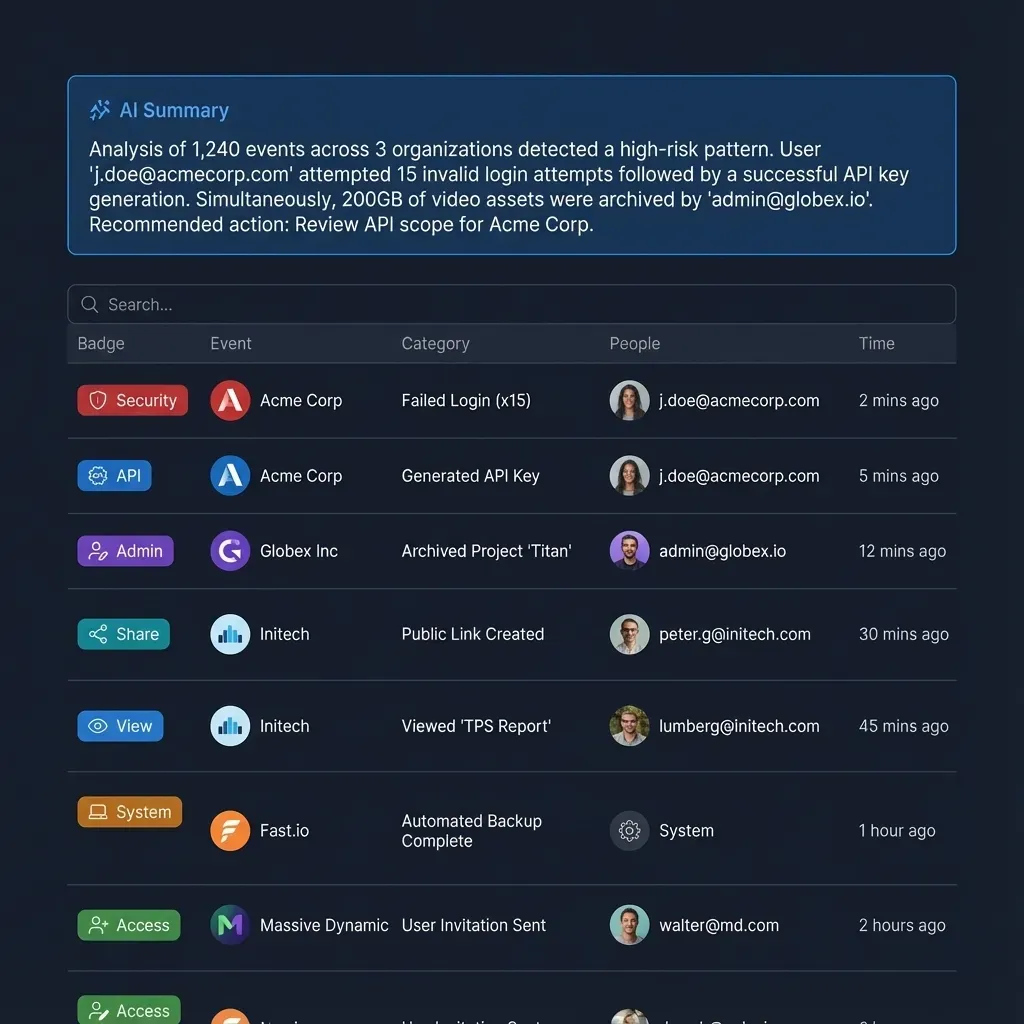


Manage Federal SOW Deliverables and Procurement Documents in One Workspace
Coordinate Performance Work Statements, track clause revisions across per-file version histories, and maintain a detailed activity log. Monthly plans include a 14-day trial; a card is required.
Federal Policy Timelines, Statutory Milestones, and Contracting Steps
Contracting officers and federal vendors must align current procurement practices with upcoming statutory timelines. Executive Order 14434 establishes an administrative schedule that acquisition professionals must track closely.
Section 3(b) of the executive order directs the Assistant to the President for Science and Technology, in consultation with agency leaders, to submit proposed legislative language for a federal statutory definition of Super Intelligence to the President within 60 days of the signing date. Because President Trump signed the order on September 29, 2026, this 60-day deadline arrives on November 28, 2026.
As of October 2026, no statutory definition of Super Intelligence exists in federal law. The November 28, 2026 milestone represents an internal executive recommendation to the President, not an enacted statute. An executive order cannot amend federal statutes; only an Act of Congress signed into law can amend Title 15 of the United States Code. What the legislative proposal will recommend, and whether Congress will introduce or enact conforming amendments, remains undetermined as of October 2026.
Until Congress acts to pass new statutory language, or later Presidential action supersedes the order's definition (Section 3(a)), SI under the order means what 15 U.S.C. 9401(3) defines as artificial intelligence; each solicitation's own definitions govern that solicitation.
Post-Award Scope Management and Model Iteration
Once a contract is awarded under Super Intelligence PWS terms, Contracting Officer Representatives (CORs) must manage post-award performance without causing constructive changes. In machine learning deployments, operational models inevitably encounter data drift, where real-world input distributions shift away from the training baseline.
If an agency demands that a contractor retrain or re-architect a model to address performance drift, the parties must refer to the PWS and QASP. If the contract explicitly defined periodic retraining schedules and drift thresholds as standard deliverable requirements, the contractor must perform the updates within the firm-fixed-price baseline. However, if the agency directs the contractor to incorporate new data modalities or expand task parameters not specified in the original SOW or PWS, that directive constitutes a contract change under FAR Part 43 requiring an equitable cost and schedule adjustment.
Actionable Steps for Contracting Officers and Offerors
To maintain legal and contractual clarity during this transitional period, procurement professionals and offerors should follow three operational steps:
Insert an explicit statutory definition clause in Section C Contracting officers drafting new Statements of Work or Performance Work Statements should include a dedicated terminology clause in Section C: "For the purposes of this contract, the terms 'Super Intelligence' and 'SI' designate machine-based systems meeting the definition of artificial intelligence set forth in 15 U.S.C. 9401(3)." This sentence ties the term to an existing statutory definition, which leaves bidders less room to read the requirement differently.
Structure deliverables around objective verification metrics Avoid promotional language, speculative capability claims, or undefined buzzwords. Specify exact statistical baselines, inference throughputs, latency ceilings, and CDRL deliverable formats in the QASP. Ensure that all technical milestones are testable on government-controlled evaluation datasets.
Seek formal clarification and legal guidance When solicitation instructions or contract clauses contain ambiguous terminology, contracting officers should consult their agency acquisition legal counsel. Contractors reviewing draft RFPs should submit formal clarification questions during the pre-proposal question-and-answer period. Executive Order 14434 creates no independent private rights of action; compliance determinations rest with the cognizant contracting officer.
Sources
References used to verify factual claims in this guide.
-
Under 15 U.S.C. 9401(3), artificial intelligence is defined as a machine-based system that can, for a given set of human-defined objectives, make predictions, recommendations or decisions influencing real or virtual environments.
-
In the near term, the practical effects of replacing artificial intelligence with Super Intelligence across federal agency communications are likely to be procedural and administrative rather than substantive.
Frequently Asked Questions
How do contracting officers incorporate Super Intelligence into Statements of Work?
Contracting officers incorporate Super Intelligence into Statements of Work by updating Section C terminology in accordance with Executive Order 14434 Section 2(a) while explicitly linking the term to 15 U.S.C. 9401(3). Rather than relying on vague descriptions, contracting officers should define objective technical tasks, measurable performance thresholds, and verifiable deliverable schedules in a Quality Assurance Surveillance Plan (QASP).
What is the difference between AI and SI in a Performance Work Statement?
Under Executive Order 14434 Section 3(a), federal Super Intelligence (SI) and artificial intelligence (AI) share the identical legal baseline defined in 15 U.S.C. 9401(3). In a Performance Work Statement, the difference is administrative: executive agencies use Super Intelligence and the abbreviation SI in new solicitations to satisfy presidential directives, while the underlying technical systems, statistical standards, and deliverable metrics remain functional machine learning and algorithmic capabilities.
How should contractors define AI deliverables under federal SOW requirements?
Contractors should define deliverables by mirroring the agency's solicitation terminology in proposal narratives while providing concrete technical specifications. Deliverables should include detailed Model Cards, data provenance manifests, API schemas, and reproducible performance validation scores (such as F1 score, precision, recall, and inference latency) anchored to 15 U.S.C. 9401(3) rather than subjective marketing claims.
Does Executive Order 14434 require agencies to modify existing contracts and task orders?
No. Section 2(b) of Executive Order 14434 contains an explicit savings clause stating that previously issued regulations, Presidential actions, contracts, grants, and historical documents do not require alteration. Active federal contracts, task orders, and historical CPARS past performance records continue operating under their originally awarded titles and clauses.
How does federal Super Intelligence differ from research superintelligence in AI laboratories?
Federal Super Intelligence (two capitalized words, abbreviated as SI) is an administrative term for existing functional software meeting 15 U.S.C. 9401(3), such as predictive models and computer vision. Research superintelligence (one compound word, abbreviated as ASI) is a hypothetical future concept describing systems that would exceed human expert intelligence across all domains, which does not exist today. Federal SOWs and PWSs regulate functional software, not hypothetical research concepts.
What happens if an agency Statement of Work uses undefined Super Intelligence wording?
If an agency Statement of Work uses Super Intelligence wording without defining technical baselines or referencing 15 U.S.C. 9401(3), offerors should submit formal requests for clarification during the pre-proposal question-and-answer period. Undefined terminology introduces scope ambiguity that can lead to misaligned technical proposals, evaluation disputes, or post-award constructive change claims under FAR Part 43.
Will the November 28, 2026 OSTP legislative proposal immediately alter existing PWS requirements?
No. The November 28, 2026 milestone under Section 3(b) requires the Assistant to the President for Science and Technology to submit proposed legislative language for a federal definition of Super Intelligence to the President. An executive recommendation cannot amend federal statutes or procurement regulations. A statutory definition would require an Act of Congress, and changes to FAR text require FAR rulemaking; separately, Section 3(a) allows the order's working definition of SI to be superseded by later Presidential action.
Related Resources

Manage Federal SOW Deliverables and Procurement Documents in One Workspace
Coordinate Performance Work Statements, track clause revisions across per-file version histories, and maintain a detailed activity log. Monthly plans include a 14-day trial; a card is required.