Connecting AI Agents to QNAP NAS: MCP Server Setup Guide
Setting up a QNAP MCP server connects local AI clients directly to network attached storage for fast file access. While single-machine stdio connectors work for individual workstations, they isolate team agents and introduce network exposure risks. Pairing on-premises QNAP archives with intelligent cloud workspaces allows distributed multi-agent systems to query and edit files without opening incoming firewall ports.

Why Direct NAS Connectors Limit Multi-Agent Workflows
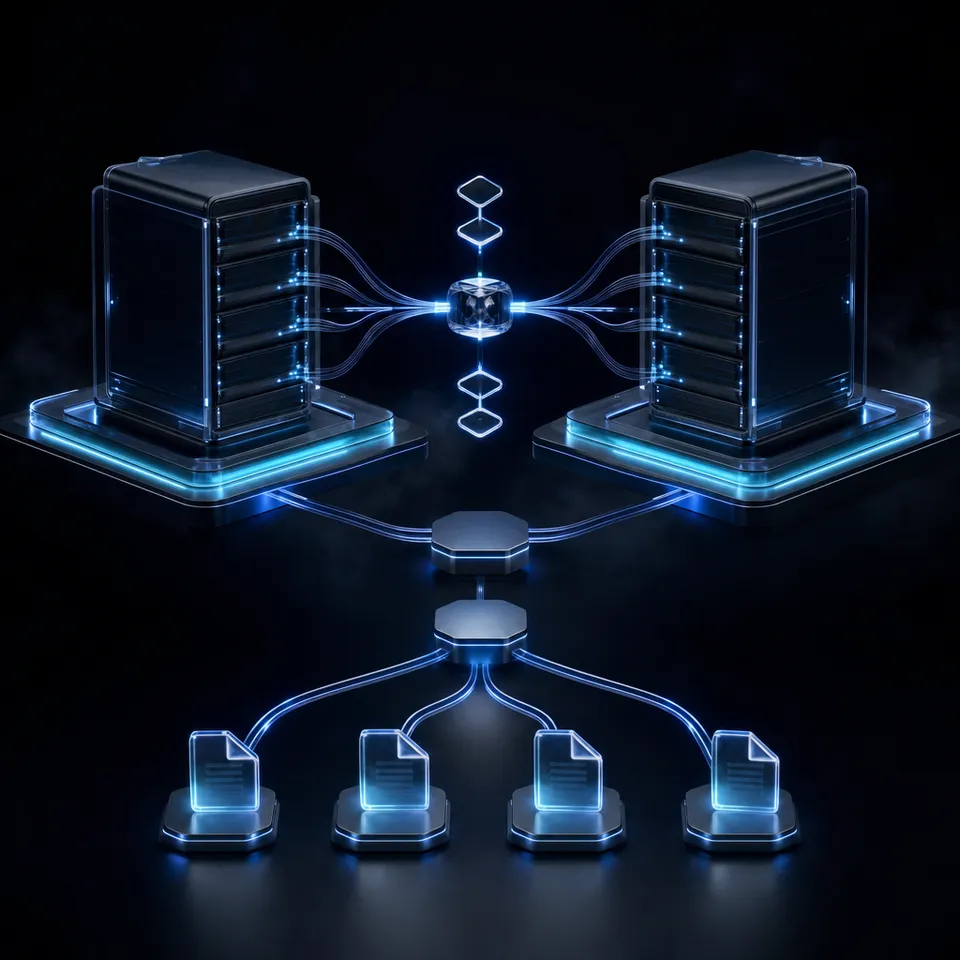
Connecting an AI assistant directly to on-premises network attached storage creates a single-workstation bottleneck: the local MCP connector runs on one desktop, while automated background agents running in the cloud or across team workstations cannot reach the files without punching holes through the corporate firewall.
A QNAP MCP server connects AI assistants like Claude to QNAP NAS appliances, allowing natural language queries against NAS storage and system status. In a typical home lab or studio setup, an administrator installs the connector to check drive health, query storage pools, or locate documents without clicking through the QTS web interface. This local model works well for an engineer working alone at a single desk.
The operational friction begins when teams introduce autonomous coding agents, cloud-hosted pipelines, or remote collaborators. Modern agentic systems rely on continuous file operations: reading documentation, updating project plans, extracting structured metadata, and saving generated assets. When storage access is bound to a local process on a single workstation, other agents on the team remain completely blind to those archives.
Attempting to resolve this by exposing NAS communication ports to the public internet introduces severe infrastructure vulnerabilities. Storage appliances on local networks frequently hold sensitive internal databases, raw video footage, proprietary code repositories, and private backups. Exposing administrative API endpoints invites brute-force credential stuffing and ransomware attacks.
Furthermore, local Model Context Protocol integrations lack multi-agent concurrency controls. If two autonomous agents attempt to modify files simultaneously over local network shares, neither agent has visibility into the other's activity. Without per-file version history, centralized audit logs, or advisory locks, concurrent agent writes overwrite each other silently. To build scalable AI workflows, organizations must understand the mechanics of the local QNAP MCP setup and recognize when team coordination requires a dedicated cloud workspace.
Related guides
- How to Deploy MCP Server on RenderLearn how to deploy MCP servers on Render with git-based updates and zero downtime. This guide covers Docker setup,...
- How to Deploy the Fastio MCP Server on Fly.ioDeploying the Fastio MCP server on Fly.io gives your AI agents faster access to their file workspaces. Moving your...
- How to Troubleshoot the Fastio MCP Server: A Complete GuideThe Fastio MCP server gives AI agents file system access, but connection and tool errors can disrupt your workflow....
- How to Test Fastio MCP Server Tools with PlaywrightTesting Fastio MCP server tools with Playwright lets developers verify AI agent integrations in a browser environment....
- How to Connect Cloudflare R2 to AI Agents via MCP ServerA Cloudflare R2 MCP server connects AI agents directly to Cloudflare S3-compatible R2 object storage for reading,...
- How to Connect Fastio MCP Server to AutoGen AgentsAutoGen agents lose their work when sessions end. By connecting Fastio's MCP server to AutoGen via the autogen-ext MCP...
More on this subject: MCP and Model Context Protocol (232 guides)
Prerequisites for Setting Up QNAP MCP Assistant
Before configuring the Model Context Protocol environment, administrators must verify operating system compatibility and network accessibility across their storage hardware and client machines.
Hardware and Operating System Requirements
QNAP provides the MCP Assistant package for modern hardware running recent operating system releases:
- NAS Firmware: The appliance must run QTS 5.2, QuTS hero h5.2, or subsequent versions. Older firmware releases lack the underlying service architecture required by the assistant.
- App Center Package: MCP Assistant is distributed as an application package through the QNAP App Center. On current releases, administrators access the package by enabling the QNAP App Beta Program in App Center settings.
- Host Operating System: The companion client binary currently supports macOS (both Apple Silicon and Intel architectures) and 64-bit Windows. Linux workstations can interface with custom MCP hosts, but the official Claude Desktop client is not distributed for Linux.
- Administrative Privileges: Generating access tokens and defining tool permissions requires an account with administrator privileges on the NAS.
Network and Port Considerations
By default, the QNAP MCP Assistant service listens on local ports 8442 and 8443. The service exposes HTTP communication over port 8442 and encrypted HTTPS communication over port 8443.
Network administrators must ensure that local firewall configurations allow traffic between the workstation running Claude Desktop and the NAS appliance over these ports. For secure deployments, all interactions should use the HTTPS endpoint, and external ingress from the internet should remain blocked at the perimeter router.
Security and Permission Configuration
The QNAP MCP Assistant incorporates built-in access controls to restrict what connected AI assistants can execute:
- Token and Key Authentication: Client applications authenticate using distinct cryptographic keys generated within the MCP Assistant interface rather than sharing the primary administrator password.
- Read-Only Mode: To safeguard against accidental file deletion or destructive storage operations, administrators can enforce read-only access for generated keys. This setting is enabled by default during key creation.
- Tool-Level Access Control: Administrators can selectively grant or revoke capabilities across specific tool groups, such as shared folder management, system log monitoring, storage pool inspection, or Qsirch file indexing.
Steps to Configure the QNAP MCP Server on Claude Desktop
Setting up the integration involves installing the application package on the NAS, generating client credentials, placing the native binary on the workstation, and updating the Claude Desktop configuration.
1. Install MCP Assistant on the NAS
Begin by installing the application package directly on the QNAP appliance:
- Log in to the QTS or QuTS hero web dashboard as an administrator.
- Open the App Center.
- Click the settings icon in the top-right corner of the App Center window.
- Check the option to Join the QNAP App Beta Program and click Apply.
- Use the App Center search bar to locate MCP Assistant.
- Click Install to deploy the package to your appliance.
2. Generate Credentials and Download the MCP Server
Once the package finishes installing, open the assistant to create connection credentials:
- Launch MCP Assistant from the QTS main menu.
- Select the Credentials tab on the left navigation panel.
- Click Create to initialize a new connection key.
- Enter a descriptive key name (such as
claude-desktop-macbook), select the target user account, and choose the permitted MCP tool capabilities. Keep Read-only Mode enabled while testing initial connectivity. - Click Create to finalize the key.
- Under the Actions column in the credentials table, click the download icon.
- Select your client operating system (Windows, macOS Apple Silicon, or macOS Intel) to download the zip bundle containing your authentication key and the
qmcpexecutable.
3. Extract the Executable on Your Workstation
Locate the downloaded archive (for example, qmcp-darwin-arm64.zip) in your local Downloads directory:
- Extract the zip file into a permanent directory on your computer, such as
~/bin/qmcp/on macOS orC:\Tools\qmcp\on Windows. - Verify that the directory contains the
qmcpexecutable and its accompanying configuration files. - On macOS, running the binary for the first time may trigger a Gatekeeper warning. Open the macOS Privacy & Security panel in System Settings, scroll down to the security section, and click Allow Anyway next to the blocked
qmcpapplication. - On Windows, ensure local endpoint protection or Windows Defender does not quarantine the executable.
4. Edit the Claude Desktop Configuration
Claude Desktop reads external server definitions from a central JSON configuration file. Open the configuration file in your preferred code editor:
- macOS:
~/Library/Application Support/Claude/claude_desktop_config.json - Windows:
%APPDATA%\Claude\claude_desktop_config.json
Add the qnap-nas server definition within the mcpServers block:
{
  "mcpServers": {
    "qnap-nas": {
      "command": "/Users/username/bin/qmcp/qmcp"
    }
  }
}
On Windows systems, use escaped backslashes in the executable path, such as "C:\\Tools\\qmcp\\qmcp.exe". Save the configuration file.
5. Launch Claude Desktop and Verify Operation
Completely close Claude Desktop and relaunch the application to load the revised configuration. Once opened, verify the connection by inspecting the tool icon in the chat interface. You can prompt Claude with specific queries to confirm that storage interactions function properly:
"What is the current storage pool capacity and volume utilization on my QNAP NAS?""Check QuLog Center for any failed administrative login attempts recorded today.""Search my shared documents folder for PDF files containing annual vendor contracts."
Claude invokes the qmcp binary over local stdio, queries the NAS services over the internal network, and formats the response directly in the chat window.


Bridge your QNAP MCP server to collaborative agent workspaces
Keep your files in your existing storage while giving distributed AI agents remote, indexed access through a secure MCP endpoint. Start with a 14-day free trial.
Comparing Local NAS MCP with Fast.io Cloud Workspaces
Deploying a local QNAP MCP server provides an effective natural language interface for a single operator sitting on the same local network as the storage hardware. However, modern engineering teams frequently run distributed workflows involving remote team members, cloud-hosted coding assistants, and automated multi-agent systems.
The following architectural comparison highlights the operational differences between running a local stdio NAS connector and connecting agents to an intelligent cloud workspace:
The Remote Multi-Agent Bottleneck
When multiple AI agents collaborate on a project, they require continuous, concurrent access to project files. With a local NAS MCP server, an agent running in a remote development environment or cloud VM cannot access the NAS unless network engineers configure complex VPN tunnels or expose internal ports to the internet.
In third-party evaluations of storage connectors for agentic workflows published in the connector benchmark report, Fastio was measured the fastest and the lowest cost of the providers tested.
Connecting agents through a remote cloud workspace eliminates the need to expose local storage hardware. Instead of modifying firewall policies or opening internal ports, teams maintain their existing storage while synchronizing active project folders into a shared cloud workspace.
Workspace Subscription and Resource Capacities
Creating an account is free; doing real work requires an organization on a paid subscription. Every organization starts with a 14-day free trial that requires a credit card. Subscription plans provide predictable capacity tiers for growing agent fleets:
Credits meter AI-driven capabilities such as semantic search indexing and automated document extraction. Overage billing applies when exceeding monthly allowances, and no token-to-credit conversion rate is published. External collaborators who access shared links do not consume organizational seat licenses.
How to Implement Secure File Search and Multi-Agent Collaboration
Organizations managing extensive document archives on QNAP hardware can establish a hybrid workflow that combines on-premises storage security with distributed agent collaboration.
Connecting Remote Agents to the Cloud MCP Endpoint
Fast.io provides a remote MCP server accessible over Streamable HTTP. Unlike local stdio processes, a remote MCP endpoint allows agents deployed on developer laptops, continuous integration servers, and cloud environments to interact with the same centralized workspace simultaneously.
Developers configure their agent environments (such as Claude Code, Cursor, or custom Python agent frameworks) using the remote endpoint configuration:
{
  "mcpServers": {
    "fastio": {
      "url": "https://mcp.fast.io/mcp/code"
    }
  }
}
This configuration connects the agent directly to the cloud workspace over HTTPS without requiring local binaries or custom network routes.
Hybrid File Synchronization from Existing Storage
Teams do not need to migrate away from their physical QNAP NAS to support AI agents. Administrators can designate specific active directories for agent interaction while retaining long-term master archives on the local appliance:
- Scheduled Folder Sync: Using QNAP Hybrid Backup Sync 3 or cloud synchronization utilities, administrators configure scheduled or on-demand file transfers between selected NAS folders and cloud storage services like OneDrive, Box, or Dropbox.
- Cloud Import to Fast.io: Fast.io connects to cloud storage providers to import documents directly into dedicated workspaces. Cloud sync runs one-way or two-way on a schedule or on demand. 3. Workspace Intelligence Mode: Once documents land in the workspace, Fast.io Intelligence Mode automatically indexes file contents for semantic search. Rather than pulling massive multi-gigabyte files across network connections, agents query the workspace using natural language and receive targeted context snippets with source citations.
Structured Extraction with Metadata Views
When managing thousands of technical manuals, invoices, or project specifications, unstructured semantic search alone is insufficient. Metadata Views allow teams to transform document collections into live, structured tables.
Users describe the target schema in plain English, and the system extracts structured values across PDFs, spreadsheets, and scanned documents without manual OCR configuration. Column types support text, integers, decimals, booleans, URLs, JSON objects, and timestamps. Autonomous agents can query these structured views over MCP to filter documents by specific contract dates, vendor names, or project milestones.
Preventing Concurrency Collisions Across Agents
Multi-agent pipelines require reliable safeguards against accidental overwrites. Fast.io provides per-file version history that records every modification made by human team members or autonomous agents. If an agent produces an unexpected edit, administrators can restore prior versions with a single click.
For coordinated operations, agents use advisory file leases through MCP storage actions (lock-acquire, lock-status, and lock-release). An advisory lock signals to other participating agents that a document is currently undergoing revision. Because the lock does not completely block concurrent writes, both versions are safely preserved in version history without data loss.
Workspace Ownership Transfer
When an external consultant or automated agency builds a complete document intelligence pipeline for a client, Fast.io supports clean ownership transfer. An agent can configure the organization, establish the workspace structure, populate Metadata Views, and transfer full administrative ownership to the human client while retaining scoped access for ongoing maintenance.
Sources
References used to verify factual claims in this guide.
-
QNAP MCP Assistant communicates over default network ports 8442 for HTTP and 8443 for HTTPS.
Frequently Asked Questions
How do I install the QNAP MCP Assistant?
To install QNAP MCP Assistant, access the App Center on a QNAP NAS running QTS 5.2 or QuTS hero h5.2 or later. Open App Center settings, enable the QNAP App Beta Program, search for MCP Assistant, and click Install. After installation, launch the app from the main menu to generate connection keys and download the client package.
Can Claude Desktop access files on a QNAP NAS?
Yes, Claude Desktop can access files and system metrics on a QNAP NAS using the official QNAP MCP Assistant. The setup requires extracting the platform-specific qmcp executable onto the local computer, defining the server path in claude_desktop_config.json, and querying storage over the local network via natural language.
Is it safe to connect an MCP server to QNAP?
Connecting an MCP server to a QNAP NAS is safe when confined to local private networks with Read-Only Mode enabled and scoped tool permissions. Exposing the MCP Assistant communication ports (HTTP 8442 and HTTPS 8443) directly to the open internet poses significant security risks. For remote access, teams should use secure VPNs or sync files into an intelligent cloud workspace.
What network ports does QNAP MCP Assistant require?
QNAP MCP Assistant communicates over default network ports 8442 for HTTP and 8443 for HTTPS. For production and testing security, connections should always use HTTPS over port 8443, and local firewall policies should restrict access strictly to authorized workstations on the internal subnet.
How do distributed agent teams access QNAP files without opening firewall ports?
Distributed teams avoid opening firewall ports by synchronizing active NAS project folders into an intelligent cloud workspace such as Fast.io. The cloud workspace automatically indexes documents for semantic search, allowing remote agents and automated frameworks to interact with files over a secure remote MCP endpoint using standard outbound HTTPS.
Related Resources

Bridge your QNAP MCP server to collaborative agent workspaces
Keep your files in your existing storage while giving distributed AI agents remote, indexed access through a secure MCP endpoint. Start with a 14-day free trial.