How to Connect OpenClaw to Monday.com for AI Project Management
The OpenClaw Monday.com integration lets AI agents use Monday.com boards as persistent memory and task queues for autonomous project management. This guide covers two integration paths (Monday.com's native MCP server and Composio's managed plugin), the board-as-memory pattern that makes agent activity visible to your whole team, and how to pair Monday.com task tracking with persistent file storage.


What the OpenClaw Monday.com Integration Does
Most AI agent setups suffer from the same problem: the agent does useful work, but nobody can see what happened. Logs sit in terminal output. Task state lives in memory that vanishes between sessions. Your project manager opens Monday.com and sees nothing.
The OpenClaw Monday.com integration fixes this by turning Monday.com boards into the agent's working memory. Every task the agent picks up, every decision it makes, every result it produces gets written as a Monday.com item or update. Your team sees agent activity in the same tool they already use for project tracking.
Monday.com announced an official OpenClaw partnership in early 2026, launching Globster as a hosted OpenClaw service built on the framework and secured by Nvidia's NemoClaw infrastructure. The service provisions a dedicated VM for each user's agent in about two minutes, with connections to Gmail, Google Calendar, Google Drive, WhatsApp, and Slack.
But you don't need the hosted service to connect the two. OpenClaw supports MCP (Model Context Protocol) natively, and Monday.com exposes an MCP server on its free plan. That means any OpenClaw instance, whether self-hosted on a VPS, running on a Raspberry Pi, or deployed to Cloudflare Workers, can read and write Monday.com boards through a standardized protocol.
The practical result: your agent checks its Monday.com inbox for new tasks, works through them autonomously, logs progress as item updates, and moves completed work to a done group. Humans on the team can reassign priorities, add tasks, or review agent output without switching tools.

Related guides
- How to Connect Hermes Agent to n8n With Webhooksn8n has 400+ integrations but every workflow follows a predetermined path. Hermes Agent adds reasoning to those...
- How to Connect Devin AI to GitHubDevin AI's GitHub integration is a full GitHub App install with nine read scopes and eight read-write scopes, not a...
- How to Connect OpenClaw to Linear for AI-Powered Issue ManagementOpenClaw connects directly to Linear's GraphQL API, giving your AI agent the ability to triage issues, plan cycles, and...
- How to Connect OpenClaw with Trello for Task AutomationOpenClaw can create Trello cards, move tasks between lists, add comments, and manage boards through natural language....
- How to Set Up OpenClaw WhatsApp IntegrationOpenClaw WhatsApp integration lets AI agents reply on WhatsApp while handling files through MCP skills. OpenClaw...
- How to Use OpenClaw with Playwright for Browser AutomationOpenClaw's Playwright integration turns AI agents into browser operators that can navigate pages, fill forms, extract...
More on this subject: OpenClaw Setup and Guides (199 guides)
How to Choose Between Native and Managed MCP Connections
There are two primary ways to connect OpenClaw to Monday.com, each with different trade-offs around setup complexity, tool coverage, and cost.
Monday.com's Native MCP Server
Monday.com provides a native MCP server that exposes board operations through the standard Model Context Protocol. This path is available on every Monday.com plan, including Free. Your agent gets access to boards, items, groups, columns, and workflows through MCP's standard capability negotiation, so tool discovery is automatic.
Authentication uses a Monday.com API token. The native server is the simplest path if Monday.com is your agent's only external service.
Composio's Managed Plugin
Composio provides a managed MCP integration that connects OpenClaw to Monday.com and over 1,000 other apps through a single plugin layer. The managed approach exposes a broader tool surface for Monday.com operations: board management, item operations, column and group organization, user administration, and workflow customization.
Composio handles OAuth token refresh and connection management automatically. If your agent already uses Composio for other integrations like GitHub, Slack, or Google Workspace, adding Monday.com is one authentication step in the Composio dashboard.
Which Path to Choose
Use Monday.com's native MCP when you want the simplest setup with the fewest dependencies, you're only connecting to Monday.com, or you're running on Monday.com's free plan and want to minimize external services.
Use Composio's plugin when your agent connects to multiple services beyond Monday.com, you want managed OAuth and token refresh, or you prefer the broader tool surface that Composio provides.
Both paths register tools directly into OpenClaw's agent, so the agent calls them by name in natural language regardless of which backend serves the request.
How to Set Up the MCP Connection in OpenClaw
OpenClaw manages MCP server definitions through its CLI and configuration file. The general workflow is the same for both integration paths: register the MCP server, provide authentication credentials, and verify the connection.
Native MCP Path
For Monday.com's native server, you register the MCP endpoint in your OpenClaw config with the server URL, transport type, and your Monday.com API token. OpenClaw supports multiple MCP transports including stdio, SSE, and Streamable HTTP. Once registered, OpenClaw discovers available Monday.com tools automatically through MCP's capability negotiation.
You generate your API token from the Administration section in your Monday.com account. The token grants your agent the same permissions your Monday.com user has, so consider creating a dedicated service account with scoped permissions for production use.
Composio Path
The Composio path uses a plugin that wraps the MCP connection. You install the Composio plugin through OpenClaw's plugin system, configure your Composio API key, and authenticate Monday.com through the Composio dashboard. The plugin handles MCP registration, OAuth token refresh, and connection monitoring automatically.
If you're already using Composio for other services, Monday.com appears as another connection in the same dashboard. No additional OpenClaw configuration beyond the initial plugin setup.
Verifying the Connection
After configuring either path, list your registered MCP servers through the OpenClaw CLI to confirm the Monday.com connection appears. Then test with a simple board query. Ask your agent to list your Monday.com boards, and if it returns board names and IDs, the connection is working.
One practical note from the Monday.com developer community: OpenClaw reads environment variables at startup only. If you rotate an API token, you need to restart the gateway for the new value to take effect.



Give your OpenClaw agent persistent file storage
Generous storage workspace with MCP access, semantic search, and agent-to-human handoff. Pair it with Monday.com for task tracking and file management in one workflow.
Structuring Monday.com Boards as Agent Memory
The board-as-memory pattern is what makes the OpenClaw Monday.com integration genuinely useful rather than just another API connection. Instead of storing agent state in a database or log file that only developers can read, you store it in Monday.com where the whole team already works.
A well-structured agent board typically uses five groups to represent task lifecycle:
- Inbox: New tasks from the agent or from humans who want the agent to handle something
- In Progress: Work the agent is actively processing
- Done: Completed tasks with results attached as updates
- Monitoring: Ongoing observation tasks (checking metrics, watching for changes)
- Knowledge: Patterns and insights the agent has learned over time
For columns, you want enough structure to make filtering useful without overcomplicating the board. A practical starting set includes Status (Queued, Running, Done, Verified), Priority, Source (who created the task: agent, human, or a monitoring trigger), Tool (which integration was involved), Result (outcome summary), and Confidence (a 0 to 100 scale the agent uses to flag uncertain results for human review).
The real power here is visibility. When an agent creates an item in the Inbox group with a status of Queued and a priority of High, your project manager sees it immediately in their normal Monday.com view. They can reprioritize it, reassign it, or add context in the comments. The agent checks for updates on its next pass and adapts.
This pattern also solves the handoff problem. The agent finishes a research task, writes its findings as an item update, and moves the item to Done. A human reviewer filters for Done items, reads the results, and either marks them Verified or sends them back with feedback. No Slack messages, no email chains, no "did you see the output I generated?"
For teams running multiple agents, each agent can have its own board or share a single board with a "Handled By" column. Monday.com's built-in automations can route tasks between agents based on column values, send Slack notifications when high-priority items appear, or auto-archive completed items after a set period.
Adding Persistent File Storage with Fastio
Monday.com handles task state well: statuses, priorities, assignments, comments. But agents working on real projects also produce files. Research reports, generated code, processed datasets, client deliverables. Monday.com's file column works for small attachments, but it wasn't designed as a file management layer for autonomous agents.
This is where a dedicated workspace complements the Monday.com integration. Your agent tracks what it's doing in Monday.com and stores what it produces in a persistent workspace.
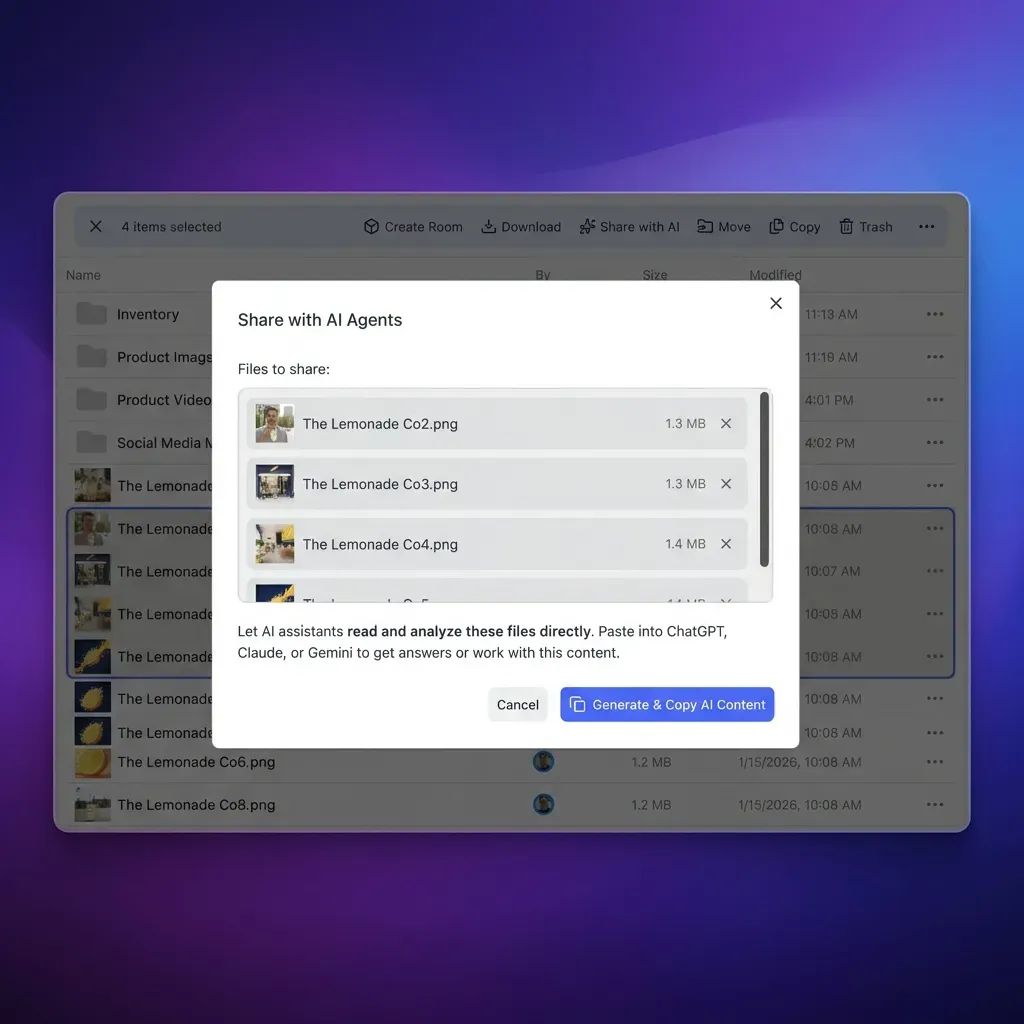
Fastio provides workspaces purpose-built for agent teams, with an MCP server that OpenClaw can access alongside the Monday.com connection. The practical setup looks like this: the agent picks up a task from its Monday.com inbox, does the work, uploads output files to a Fastio workspace, then updates the Monday.com item with a link to the deliverable.
Local filesystem storage vanishes when a container restarts. S3 works but requires IAM configuration and gives you no preview, search, or collaboration features. Google Drive and Dropbox lack MCP access for agents. Fastio provides persistent storage with Intelligence Mode that auto-indexes uploaded files for semantic search and RAG queries, so a future agent (or a human teammate) can ask "find the Q2 competitive analysis" and get results with citations.
Fastio provides a 14-day Business Trial (credit card required; see /pricing/). The MCP server exposes tools via Streamable HTTP at /mcp, so your agent can register it the same way as the Monday.com connection. Your agent ends up with two MCP connections: Monday.com for task state, Fastio for file storage and search.
Ownership transfer makes the handoff clean. An agent builds a workspace, populates it with deliverables organized by project, then transfers the entire organization to a human stakeholder. The human gets full access through the web UI. The agent keeps admin permissions to continue updating files as new work completes.
What to Watch Out For in Production
Developers in the Monday.com community have shared several hard-won lessons from running OpenClaw agents against Monday.com boards.
Token costs add up. One developer noted that Anthropic token usage gets expensive quickly when agents make frequent Monday.com API calls. Each board read or item update involves a tool call that consumes tokens. Batch your agent's Monday.com operations where possible: read all inbox items in one query rather than checking items individually.
Start with a dedicated board. Don't connect your agent to your team's main project board on day one. Create a separate agent board, test the integration thoroughly, then gradually connect it to production workflows. This also protects you from an agent accidentally modifying items it shouldn't touch.
Monday.com's API rate limits are generous but not infinite. The API supports up to 10,000 requests per minute on Enterprise plans, with lower limits on Standard and Pro. If your agent runs monitoring loops that poll frequently, use Monday.com's automation hooks support to get push notifications instead of polling.
Environment variable timing matters. OpenClaw reads environment variables at startup. If you rotate your Monday.com API token (which you should do periodically), you need to restart the OpenClaw gateway for the new token to take effect. The same applies to Composio API keys.
Use updates, not just items. Monday.com items represent tasks. Updates (comments on items) represent progress and results. A well-structured agent writes its working notes as updates on the item, not as new items. This keeps the board clean and gives humans a threaded history of what the agent did for each task.
Test on the free plan first. Monday.com's free plan includes full API access and MCP support. Composio offers a free tier for initial setup. Combined with Fastio's 14-day Business Trial (credit card required; see /pricing/), you can build and test the full integration during the evaluation period. Scale to paid plans only when you've validated the workflow with your team.
Sources
References used to verify factual claims in this guide.
-
Monday.com launched Globster as a hosted OpenClaw service with Nvidia NemoClaw infrastructure, starting at $23/month annually
-
Composio provides over 150 Monday.com-specific tools via managed MCP integration
-
Monday.com free plan includes full API access and MCP support for agents
Frequently Asked Questions
How do I connect OpenClaw to Monday.com?
Register Monday.com's MCP server in your OpenClaw configuration with the server endpoint and your API token. Alternatively, install Composio's managed plugin, which handles authentication and provides a broader tool surface for Monday.com operations through a single MCP connection. Both paths require a Monday.com API token from your account's Administration settings.
Can OpenClaw manage Monday.com boards?
Yes. Through the MCP integration, OpenClaw agents can create and update items, change statuses, add updates (comments), manage groups and columns, and query board data. The agent interacts with Monday.com's GraphQL API through the MCP protocol, so any operation available in the API is accessible to the agent.
Does Monday.com support OpenClaw agents?
Monday.com officially supports OpenClaw agents. The company launched Globster, a hosted OpenClaw service, in early 2026. Beyond the hosted option, Monday.com provides a native MCP server endpoint and full API access on all plans, including the free tier. The developer community actively shares integration patterns and board templates for agent workflows.
Is the OpenClaw Monday.com integration free?
The core integration is free to set up. Monday.com's free plan includes full API access and MCP support. OpenClaw itself is open source and free. The main costs are LLM token usage (which depends on your chosen model and how frequently the agent interacts with Monday.com) and any paid Monday.com plan features like advanced automations or higher API rate limits.
What is the board-as-memory pattern?
The board-as-memory pattern uses a Monday.com board as persistent storage for an AI agent's task state, decisions, and results. Instead of storing agent memory in a database or log file, the agent writes everything to Monday.com items and updates. This makes agent activity visible to the whole team in a tool they already use, and lets humans reprioritize, review, or redirect agent work directly.
Related Resources

Give your OpenClaw agent persistent file storage
Generous storage workspace with MCP access, semantic search, and agent-to-human handoff. Pair it with Monday.com for task tracking and file management in one workflow.