How to Automate Airtable with OpenClaw
OpenClaw can read, write, and manage Airtable records through natural language commands, replacing manual Zapier and Make workflows with direct API calls from your AI agent. This guide walks through two integration paths (the ClawHub skill and Composio MCP), covers authentication setup, and shows how to schedule recurring database tasks using OpenClaw's built-in cron system.

Why Use an AI Agent Instead of Zapier for Airtable
Most Airtable automation still runs through Zapier or Make. You define a trigger, map fields, and hope the workflow holds when someone renames a column. It works, but you're building brittle pipelines that break silently and cost per execution.
OpenClaw takes a different approach. Instead of visual workflow builders, your agent talks directly to Airtable's REST API. You describe what you want in plain language, and the agent translates that into the right API call. No drag-and-drop canvas. No per-zap pricing.
The practical difference shows up in three areas:
- Ad hoc queries. Ask your agent anything about your data without building a dedicated view first. "How many leads came in last week with a score above 3?" works as a natural language request that the agent converts to an API call with the appropriate filter.
- Context-aware writes. The agent can read a conversation, extract structured data, and create Airtable records with the right field values. Ask it to "add a new contact from that last email" and it maps the relevant details to your table schema.
- Scheduled jobs. OpenClaw supports recurring task scheduling, so a Monday morning summary of overdue items or a daily count of new records can run without external orchestration tools.
This approach works best when your Airtable usage involves frequent lookups, varied queries, or workflows that change often. If you have a single fixed trigger ("new row arrives, send Slack message"), Zapier handles that fine. When you need flexibility and natural language control, an agent is the better fit.
Related guides
- How to Automate Perplexity Personal Computer with ZapierPerplexity Personal Computer gives you an always-on AI research agent that runs continuously on your behalf. Zapier...
- How to Automate Web Scraping With Hermes Agent's Scrapling SkillHermes Agent's Scrapling skill gives your AI agent three distinct scraping strategies, from fast HTTP fetching for...
- How to Automate Email Workflows with OpenClaw AgentsOpenClaw agents can monitor inboxes, classify messages, extract data from attachments, and route actions through...
- How to Automate OpenClaw Workflows with Zapier MCPOpenClaw agents are good at reasoning, but they need a way to act on that reasoning across your existing tools. Zapier...
- How to Use OpenClaw with Playwright for Browser AutomationOpenClaw's Playwright integration turns AI agents into browser operators that can navigate pages, fill forms, extract...
- OpenClaw for Startups: Automate Operations with AI AgentsOpenClaw gives startup teams an AI agent runtime that automates lead qualification, customer support, content creation,...
More on this subject: OpenClaw Setup and Guides (199 guides)
How to Pick the Right Integration Method
OpenClaw connects to Airtable through two methods. Pick based on your comfort with API keys and how much control you want over the connection.
ClawHub Skill (Direct API)
The ClawHub skills repository includes an airtable-automation skill that gives your agent API call templates for Airtable's REST API. You authenticate with a Personal Access Token, and the agent sends requests directly to Airtable without middleware. The skill covers reading records, writing records, and reading base schemas.
Best for: Developers who want full control and minimal dependencies. Your data flows directly between your machine and Airtable's servers with no intermediary.
Trade-off: You manage the API token lifecycle yourself and handle Airtable's rate limits in your workflow logic.
Composio MCP (Managed Integration)
Composio's Airtable integration wraps Airtable's API with OAuth token management and pre-built operations. It registers tools directly into your OpenClaw agent through the Model Context Protocol, so you get structured Airtable actions without writing API templates.
Best for: Teams that want automatic credential refresh, a broader set of operations (batch record management, schema operations, comment handling), and less manual configuration.
Trade-off: API calls route through Composio's infrastructure, which adds a dependency and small latency overhead. You gain convenience but lose direct control over the request path.
Both paths work with OpenClaw's scheduling capabilities for automated workflows. The ClawHub skill is lighter; Composio is more feature-rich. You can start with one and switch later without rebuilding your Airtable bases.

How to Set Up Airtable Authentication for Your Agent
Both integration paths start with Airtable credentials. The ClawHub skill uses a Personal Access Token directly; Composio manages OAuth on your behalf.
Get Your Airtable Credentials
For the direct API path, create a Personal Access Token from your Airtable account settings. Grant it the minimum scopes your workflow needs: read access for queries, write access if the agent creates or updates records, and schema access if it needs to discover table structures. Restrict the token to specific bases rather than your entire account.
You'll also need your Base ID, which appears in your Airtable URL when you open a base. Store both the token and Base ID as environment variables. Never hardcode credentials in skill files or commit them to version control.
Install the Integration
For the ClawHub path, install the airtable-automation skill through the ClawHub CLI. The skill registers API call templates that give your agent record CRUD operations, pagination, filtering, and schema reads. Check the ClawHub skill page for the current install steps, since paths can change between versions.
For the Composio path, install the Composio plugin and configure your Composio API key. Composio's documentation covers the current setup flow, which may change between plugin versions. Once connected, Airtable tools load automatically into your agent.
Verify the Connection
Start with a read-only query to confirm everything works. Ask your agent something like "List the first 5 records from my Projects table." The agent should return structured data matching what you see in the Airtable UI.
If that works, try a filtered query: "Find all records in Tasks where Status is 'In Progress'." This confirms Airtable's filtering works through natural language. Verify the results look correct before you move to write operations.
What to Do When API Calls Fail
Airtable's API returns clear error messages. The most common issues when setting up agent access fall into a few categories:
- Authentication errors: Your token is invalid, expired, or missing the required scopes. Regenerate it from your Airtable account settings with the correct permissions.
- Resource not found: Wrong Base ID or misspelled table name. Table names are case-sensitive in Airtable's API, so double-check exact spelling against the UI.
- Schema mismatches: Field names in the request don't match your table structure. Verify exact spelling and casing for each field.
- Rate limiting: Airtable enforces per-base rate limits. Add brief delays between batch operations, or stagger multiple scheduled jobs to avoid hitting the limit simultaneously.


Give your OpenClaw agent persistent file storage
Store Airtable exports, reports, and compiled datasets in Fastio workspaces. Cloud storage, MCP-ready for your agent's reads and writes.
Setting Up the Composio MCP Path
If you prefer managed authentication and a wider tool surface, Composio's MCP integration takes a different approach from the ClawHub skill. Instead of API call templates, it registers structured tools directly into your agent through the Model Context Protocol.
Setup involves installing the Composio plugin for OpenClaw, adding your Composio API key, and restarting your agent. Composio's documentation walks through the current steps, which may change between plugin versions. Once connected, the plugin loads Airtable tools automatically and handles OAuth authentication on your behalf.
The Composio path offers a broader operation surface than the direct API skill. Beyond basic record CRUD, it supports batch record management, schema operations like creating tables and modifying fields, comment management on records, and automatic OAuth token refresh. Tools register by name, so your agent can call them directly without extra search or execute steps.
One practical advantage: Composio handles pagination and rate limiting internally, so your agent doesn't need to manage request offsets or retry logic. If your team already uses Composio for other integrations like Slack, GitHub, or Google Sheets, adding Airtable reuses the same authentication flow and dashboard. The trade-off is that all API calls route through Composio's infrastructure rather than going directly to Airtable, which adds a dependency and small latency overhead.
How to Schedule Recurring Airtable Tasks
One-off queries are useful, but scheduled automation is where Airtable agents pay for themselves. OpenClaw supports recurring task scheduling that persists jobs and wakes your agent at the right time without external orchestration tools like cron servers or cloud schedulers.
Weekly Status Reports
A common pattern is a Monday morning summary that checks for overdue items. You define the schedule (day, time, timezone), the query ("find all records where Status is 'In Progress' and Due Date is before today"), and the output format ("summarize overdue items by assignee"). The agent runs the query against your Airtable base at the scheduled time and delivers results to your configured messaging channel.
Running each scheduled job in an isolated session keeps previous results from bleeding into new reports. Each execution starts fresh, queries the current state of your base, and formats a clean summary.
Nightly Data Sync
If you maintain records across two Airtable bases, a nightly job can reconcile them. Define a job that reads qualified leads from one base, checks for matching records in a pipeline base by email, creates missing records, and updates existing ones where the stage has changed. This replaces the kind of multi-step Zapier workflow that breaks when you add a field to either base.
Practical Scheduling Considerations
OpenClaw's scheduling persists job definitions, so they survive restarts. You can list active schedules, view run history for a specific job, edit timing, or trigger an immediate test run. Check OpenClaw's documentation for the current scheduling syntax, since the interface may evolve between versions.
Keep Airtable's rate limits in mind when scheduling. A job that reads and writes hundreds of records at 2 AM is fine. Three jobs hitting the same base simultaneously at 9 AM will compete for the 5 requests/second limit. Stagger overlapping schedules by a few minutes to avoid 429 errors.
Store Agent Output in Fastio for Handoff
Airtable works well as an operational database, but when your agent generates reports, exports, or compiled datasets, you need somewhere to store and share those files. Local storage disappears between sessions. Email attachments max out at 25 MB. Cloud drives require manual upload.
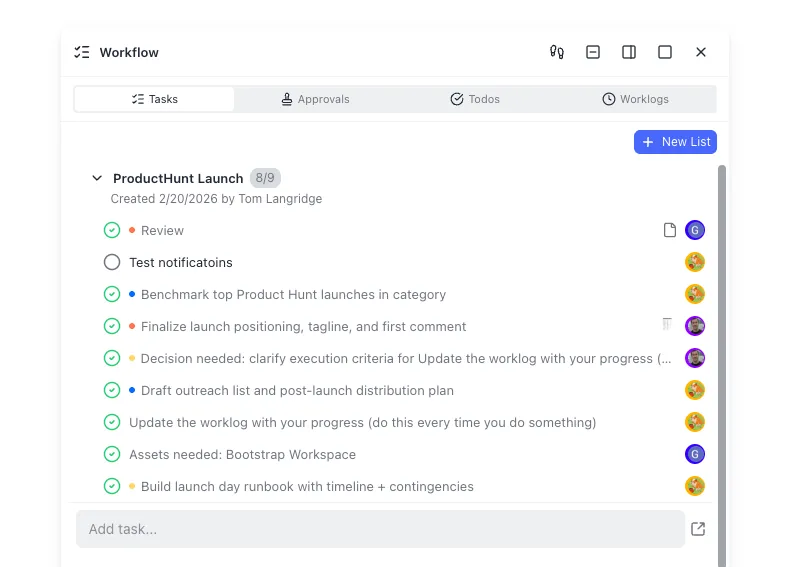
Fastio provides persistent workspaces where OpenClaw agents store files that humans can access through a browser. A 14-day Business Trial (credit card required) lets teams evaluate workspaces, permissions, and MCP tools before choosing a subscription.
A practical workflow looks like this: your scheduled job queries Airtable each Monday, compiles the results into a CSV report, and uploads it to a Fastio workspace. Your team opens the workspace in their browser to review the report, leave comments, and download the file. The agent builds the deliverable; humans review and act on it.
The Fastio MCP server exposes a consolidated MCP toolset for workspace management, file operations, sharing, and AI queries. Your OpenClaw agent can connect to it through the MCP protocol, giving it the ability to create workspaces, upload files, set permissions, and trigger AI queries. See the agent storage documentation for details.
Enable Intelligence Mode on a workspace and uploaded files get automatically indexed for semantic search. Ask "find last month's pipeline report" and get the right file without remembering the exact filename. This turns your agent's file output into a searchable knowledge base that grows over time.
For teams using both Airtable and Fastio, the agent handles the operational data in Airtable (records, statuses, assignments) and stores the synthesized output in Fastio (reports, exports, client deliverables). Ownership transfer lets the agent build a workspace and hand it to a client or manager who picks up where the agent left off.
Sources
References used to verify factual claims in this guide.
-
Airtable allows 5 requests per second per base
-
Airtable free plan includes 1,000 records per base and 1,000 API calls per month
-
The airtable-automation skill is available on ClawHub
-
Composio provides managed MCP integration for Airtable with OpenClaw
Frequently Asked Questions
How do I connect OpenClaw to Airtable?
Two paths work. For direct API access, install the ClawHub airtable-automation skill, create a Personal Access Token from your Airtable account settings with read, write, and schema scopes, and store the token and Base ID as environment variables. For managed authentication, install the Composio MCP plugin, which handles OAuth token refresh and provides a broader set of pre-built Airtable operations.
Can OpenClaw automate Airtable workflows?
Yes. OpenClaw queries, creates, updates, and deletes Airtable records through natural language commands. Combined with the built-in cron scheduler, you can automate recurring tasks like weekly reports, nightly data syncs, and conditional record updates without external workflow tools.
Is there an OpenClaw Airtable skill?
Yes. The airtable-automation skill is available on ClawHub, published by sohamganatra. It provides API call templates covering record CRUD operations, pagination, filtering, and schema reads. Install it through the ClawHub CLI and configure it with your Airtable Personal Access Token.
How do I schedule Airtable tasks with OpenClaw?
OpenClaw supports recurring job scheduling. Define the schedule (day, time, timezone), the natural language query to run against your Airtable base, and the output destination. Jobs persist across restarts and can retry automatically on rate limit or network errors. Check OpenClaw's current documentation for the scheduling interface, since syntax may change between versions.
What are the Airtable API rate limits for agent use?
Airtable allows 5 requests per second per base. The free plan includes 1,000 API calls per month and a maximum of 1,000 records per base. If your agent hits the 429 rate limit, add brief delays between batch operations or upgrade your Airtable plan for higher quotas.
Do I need Zapier to connect OpenClaw to Airtable?
No. OpenClaw calls Airtable's REST API directly using a Personal Access Token. There's no middleware, no per-execution pricing, and no visual workflow builder. The agent constructs API requests from natural language instructions, which gives you more flexibility than trigger-action pipelines.
Related Resources

Give your OpenClaw agent persistent file storage
Store Airtable exports, reports, and compiled datasets in Fastio workspaces. Cloud storage, MCP-ready for your agent's reads and writes.