OpenAI Agents SDK vs AutoGen: Comparing Multi-Agent Orchestration Frameworks
Multi-agent orchestration requires choosing between functional handoffs and conversational group loops. While the OpenAI Agents SDK delivers deterministic handoffs with minimal token overhead, Microsoft AutoGen coordinates open-ended multi-agent discussions and peer critiques. The primary operational bottleneck remains artifact persistence: managing large files, version histories, and human handoffs across autonomous agent swarms.

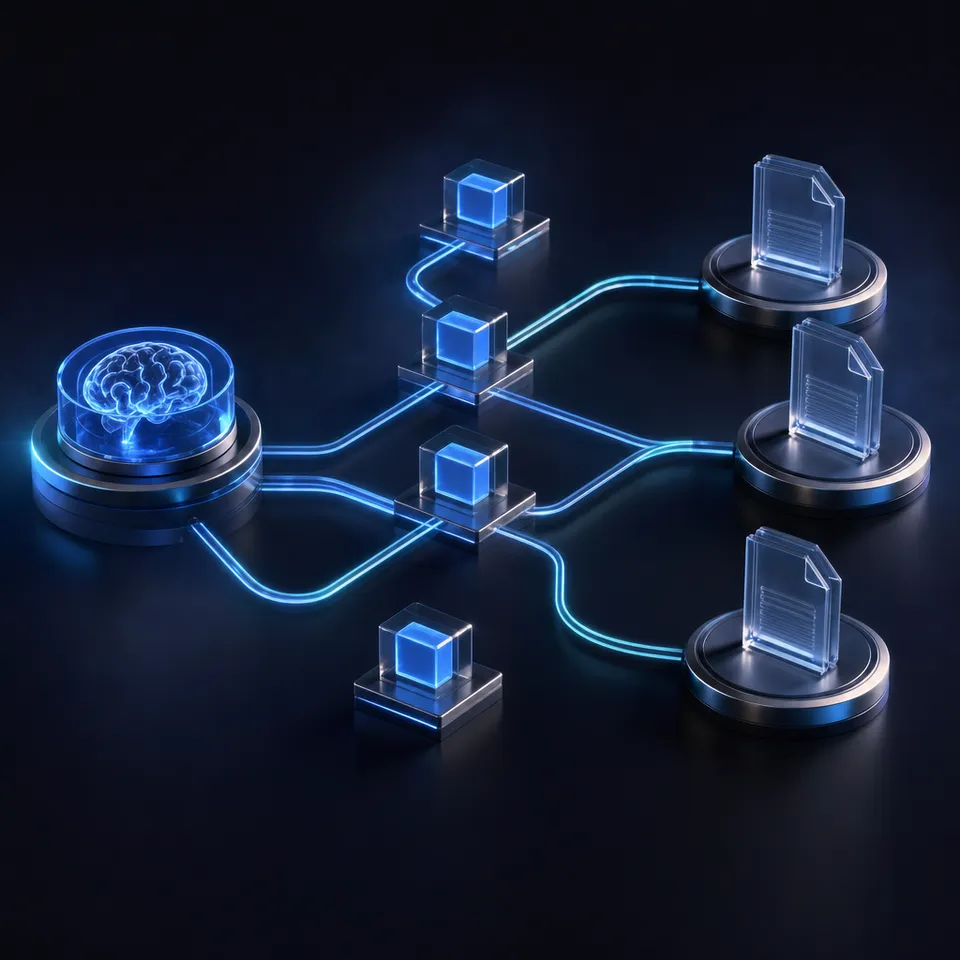
OpenAI Agents SDK vs AutoGen: How Coordination Architectures Differ
When multi-agent systems fail in production, the breakdown rarely stems from individual model reasoning; it stems from context degradation across agent boundaries. Pointing multiple autonomous agents at a complex project without strict boundary controls triggers compounding context contamination, where intermediate reasoning, tool outputs, and conversational pleasantries saturate the context window and dilute the core instruction.
Engineers structuring multi-agent architectures face two distinct execution models. The OpenAI Agents Python SDK provides a lightweight, deterministic handoff pattern with native guardrails, while the Microsoft AutoGen repository relies on multi-agent conversational patterns where agents converse and critique each other autonomously.
The divide reflects different operational assumptions about how autonomous systems should solve problems:
- Functional handoff orchestration (OpenAI Agents SDK): Tasks move sequentially or hierarchically through discrete specialist agents. Only one agent executes at any given moment. When an agent completes its slice of work or detects that a query belongs to another domain, it invokes an explicit transfer function to hand off state and execution control to a designated peer.
- Conversational group chat orchestration (Microsoft AutoGen): Multiple agents participate in an open-ended dialogue thread managed by a central moderator or conversation loop. Agents examine the running message history, propose solutions, provide critical feedback, execute code snippets, and refine outputs over repeated conversation turns.
Choosing between these patterns determines your system's token consumption profile, determinism, debugging complexity, and tolerance for open-ended problem exploration. Understanding these trade-offs is essential before committing production infrastructure to an orchestration framework.
Core Execution Models: Functional Handoffs vs. Conversational Loops
The execution model defines how state transfers and which component holds control of the execution runtime.
In the OpenAI Agents SDK, the core primitive is the Agent object paired with explicit handoff declarations. Rather than maintaining a perpetual multi-agent debate, the SDK treats peer agents as callable tools. When an agent decides to route a task, it calls a generated transfer tool (such as transfer_to_billing_agent). The runtime suspends the calling agent, runs any pre-configured handoff hooks, validates the payload against an optional typed schema, and transfers execution to the target agent. The receiving agent operates with a cleanly scoped context window. The caller steps out of the active loop entirely.
Microsoft AutoGen approaches collaboration through conversational simulation. In classical AutoGen and its modular evolution in AutoGen 0.4 and AG2, agents are subclasses of ConversableAgent. A workflow consists of agents exchanging messages inside a GroupChat mediated by a GroupChatManager. When a message enters the room, the manager evaluates the entire conversation history, invokes an LLM to select the next speaker, and prompts that speaker for a reply. Agents can debate alternate approaches, challenge erroneous code outputs, and request revisions from one another.
This architectural difference creates a direct trade-off between control and serendipity. The OpenAI Agents SDK offers deterministic state transitions that resemble traditional software state machines. AutoGen delivers dynamic collaborative problem-solving that mimics a team brainstorming session, but requires strict oversight to avoid conversational loops.
Related guides
- Google ADK vs OpenAI Agents SDK: Picking the Right Agent FrameworkGoogle ADK and OpenAI Agents SDK take opposite approaches to the same problem: building reliable AI agents. ADK gives...
- OpenAI Agents SDK vs LangGraph: Handoffs vs State Graphs for Multi-Agent SystemsOpenAI Agents SDK and LangGraph take fundamentally different approaches to multi-agent orchestration. The SDK passes...
- LangGraph vs AutoGen: Which Multi-Agent Framework Should You Choose?LangGraph models agent workflows as directed graphs with typed state, while AutoGen treats workflows as multi-agent...
- Top 7 Tools for AutoGen Agents in 2026Guide to tools autogen agents: AutoGen tools enable multi-agent conversations to execute code, browse the web, and...
- Best AI Agents in 2026: 10 Platforms That Actually Ship WorkGartner predicts 33% of enterprise software will include agentic AI by 2028, up from under 1% in 2024. That pace leaves...
- AI Agent Tools Comparison: Frameworks, Platforms & Storage SolutionsAI agent tools are platforms and frameworks that help developers build, deploy, and manage autonomous AI systems...
More on this subject: AI Tool Directories and Comparisons (231 guides)
Architecture Deep Dive: When to Choose Handoffs vs. Conversational Loops
Evaluating multi-agent frameworks requires looking past marketing claims into runtime mechanics: how control flows between nodes, how guardrails protect system integrity, and how message propagation impacts inference costs.
In the OpenAI Agents SDK, orchestration is lightweight and deterministic. An agent encapsulates instructions, a set of client-side or hosted tools, optional handoff targets, and input or output guardrails. Because execution is deterministic, tracing a run through OpenTelemetry-compatible spans reveals a clean, linear graph of agent handoffs. Guardrails execute as fast programmatic checks or targeted model evaluations before the agent processes a prompt or after it returns a tool response, intercepting prompt injections and structural schema errors before control passes downstream.
from agents import Agent, Runner, handoff
from pydantic import BaseModel

class TriagePayload(BaseModel):
    account_id: str
    issue_summary: str

technical_support = Agent(
    name="Technical Support Agent",
    instructions="Resolve technical infrastructure and API integration errors.",
)

billing_support = Agent(
    name="Billing Support Agent",
    instructions="Manage invoices, subscription tiers, and payment receipts.",
)

triage_agent = Agent(
    name="Triage Agent",
    instructions="Categorize incoming requests and delegate immediately to specialists.",
    handoffs=[
        handoff(target=technical_support, input_type=TriagePayload),
        handoff(target=billing_support, input_type=TriagePayload),
    ],
)
AutoGen organizes control flow around conversational turns. An orchestrator loop drives execution, prompting an LLM on every turn to select the next speaker based on agent descriptions and recent message context. While this allows agents to autonomously critique draft outputs and run verification scripts, it introduces non-deterministic execution paths where slight prompt variations alter the sequence of speaking agents.
Token Overhead and Context Window Saturation
The most severe practical divergence between handoffs and group chats appears on your monthly API invoice.
The OpenAI Agents SDK minimizes token overhead by transferring state via clean handoff functions. When Agent A routes to Agent B, the framework can apply input filters to strip out intermediate tool calls, system prompts, and ephemeral scratchpad reasoning from Agent A's execution. Agent B receives only the distilled summary or typed Pydantic payload required to complete its job. Context window growth remains bounded and linear relative to the overall task workflow.
AutoGen's default group chat architecture relies on broadcast message passing. Every message generated by any agent is appended to the shared group chat thread and broadcast to all participants. Over a ten-turn interaction involving four agents, each agent reads an expanding transcript containing everyone else's past outputs, reasoning traces, and terminal logs:
- Turn 1: Agent A generates 500 tokens. Total history: 500 tokens.
- Turn 2: Agent B reads 500 tokens, generates 600 tokens. Total history: 1,100 tokens.
- Turn 3: Agent C reads 1,100 tokens, generates 400 tokens. Total history: 1,500 tokens.
- Turn 4: Agent D reads 1,500 tokens, generates 700 tokens. Total history: 2,200 tokens.
By turn 10, each subsequent speaker must process thousands of tokens of historical context simply to decide what to say next. This broadcast pattern exhibits quadratic token growth. Beyond the direct inference cost, saturating the context window degrades retrieval accuracy, increases time-to-first-token latency, and invites prompt distraction, where early conversation tangents derail downstream agent execution.
Architectural Decision Matrix: Comparing Both Approaches
Selecting the right framework requires balancing operational determinism against collaborative depth. The decision matrix below compares the structural properties of both frameworks across critical production requirements.
Use the OpenAI Agents SDK when you need predictable latency, strict cost controls, and defined escalation paths such as customer service routing or multi-stage intake workflows. Choose AutoGen when solving ambiguous, complex problems, such as multi-agent software architecture review or scientific hypothesis generation, where autonomous debate between specialized personas uncovers edge cases a single linear pipeline would miss.
Why Prompt Routing Breaks on Real Deliverables: The Artifact Problem
Discussions of multi-agent frameworks almost universally focus on prompt routing, function calling, and message parsing. They obsess over how Agent A tells Agent B what to do. Yet they completely ignore the artifact blindspot: how agents generate, store, share, and preserve actual digital deliverables.
In practical enterprise deployments, agents do not merely trade chat messages. They build tangible digital assets: multi-page PDF compliance audits, multi-megabyte CSV datasets, video transcripts, compiled codebases, and financial valuation spreadsheets.
When developers attempt to coordinate deliverables using standard framework mechanisms, the architecture buckles:
- In-context stuffing: Passing large documents or code files directly through message history blows past LLM context limits, inflates token costs, and degrades model attention.
- Local disk confinement: Agents writing files to local disk paths (like
/tmp/output.csv) trap deliverables inside ephemeral compute containers. If Agent A runs on a serverless container and Agent B runs on a cloud VM, Agent B cannot read Agent A's local filesystem. - Commodity consumer storage limitations: Attempting to bridge agents with consumer sync tools (such as Dropbox, Google Drive, or Box) introduces severe operational friction. These platforms were built for human desktop synchronization, not autonomous agent swarms. They impose aggressive rate limits, require brittle desktop sync daemons, mandate interactive OAuth refresh dances that fail in headless environments, and lack real-time event feeds tailored for programmatic coordination.
Fast.io provides an out-of-band persistent file layer for agents sharing large deliverables, bridging the gap between ephemeral prompt routing and durable enterprise storage through dedicated storage for agents.
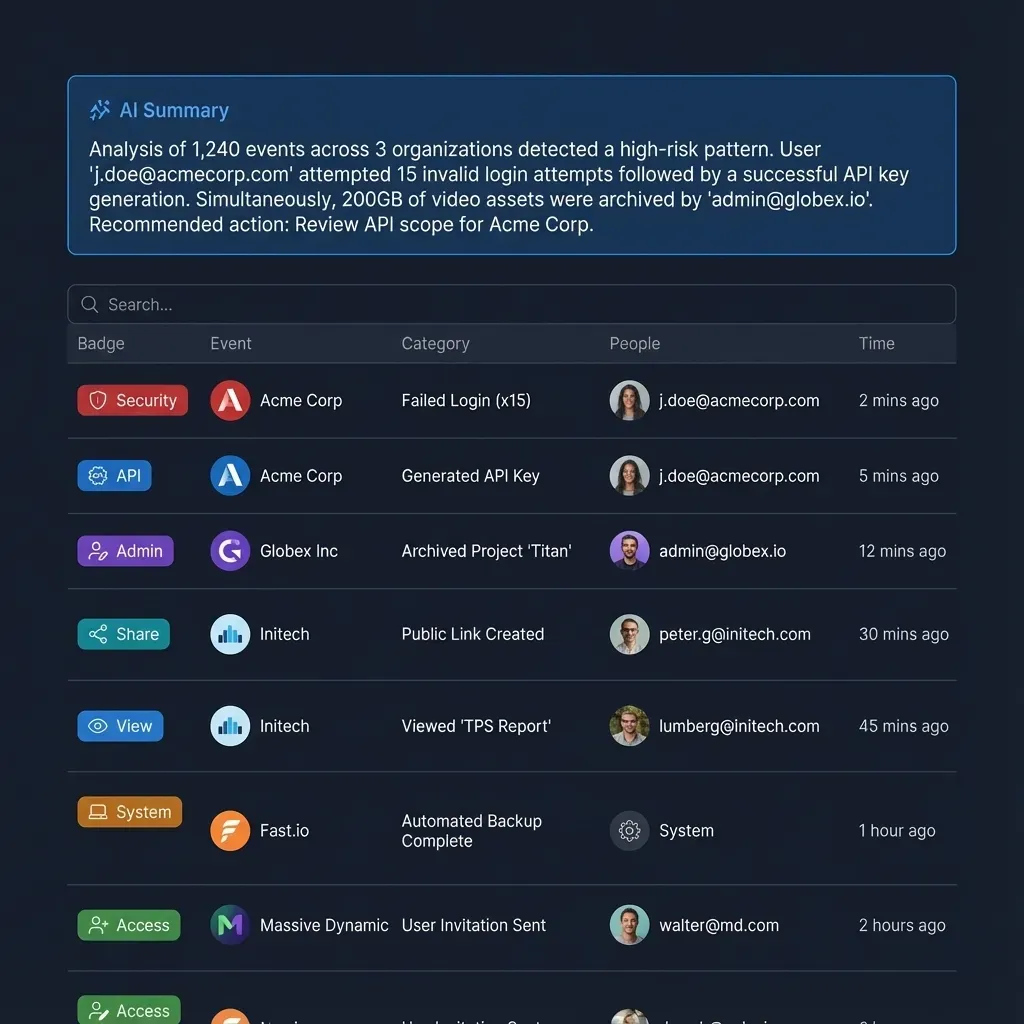
Out-of-Band State: Decoupling Context from Storage
The architectural remedy to artifact bloat is decoupling prompt orchestration from asset storage. Instead of passing multi-megabyte files through LLM prompts, agents pass compact, immutable URI pointers and identifiers through their handoff payloads. The actual data resides in a shared, out-of-band workspace.
In this out-of-band model, an OpenAI Agents SDK triage agent or an AutoGen researcher agent performs analysis, writes the structured output to a secure cloud workspace via direct API or MCP tools, and returns a lightweight reference:
{
  "status": "completed",
  "artifact_type": "quarterly_financial_report",
  "workspace_id": "ws_enterprise_analytics",
  "file_path": "/reports/2026_q3_valuation.pdf",
  "file_id": "file_892fbc91"
}
The next agent in the sequence receives this pointer, queries the document using semantic search or metadata extraction, and appends its review.
Concurrency management is critical when multiple autonomous agents interact with shared assets. When parallel agents update documentation, project specifications, or code files, simple file storage risks silent overwrites. Fast.io maintains comprehensive per-file version history on every stored object. When an agent updates an asset, the platform creates a new version point automatically. If an upstream agent hallucinates or corrupts a file, engineers can roll back the file to its exact pre-agent state with complete version fidelity.


Coordinate Multi-Agent Swarms with Persistent Workspaces
Connect OpenAI Agents SDK, AutoGen, and custom agents to shared workspaces with versioned storage and a real-time activity feed. Monthly plans start with a trial of up to 14 days (credit card required); annual plans have no trial.
Shared Workspaces: How Multi-Framework Agent Swarms Collaborate
Modern enterprise engineering stacks rarely standardize on a single vendor's agent framework. A production pipeline frequently pairs an OpenAI Agents SDK triage system with an AutoGen code generation cluster, while Claude Code, Codex, or Cursor handle localized refactoring tasks.
Each framework operates as a closed garden: AutoGen agents cannot converse natively inside an OpenAI Agents SDK execution loop, and neither framework provides built-in facilities for human team visibility.
Fast.io workspaces solve this silo problem by acting as neutral ground. A shared workspace is where agents from different frameworks, platforms, and codebases collaborate alongside human supervisors. Rather than attempting to bridge disparate Python runtimes, agents connect to the workspace via standard protocol interfaces: the Fast.io MCP server (Streamable HTTP at https://mcp.fast.io/mcp/tools) or the direct REST API (https://api.fast.io/current/).
In a shared workspace, agents save versioned deliverables and leave comments on files as they complete milestones. Human supervisors monitor the activity feed in real time, review generated files directly in the browser, and redirect agent efforts before errors propagate downstream.
Human Oversight and Ownership Transfer
Production agent deployments require rigorous governance and clear operational handoffs between autonomous runtimes and human operators.
Fast.io workspaces establish clear organizational boundaries through three distinct mechanisms:
- Activity logging: Every agent action, file creation, version update, and comment is recorded in a detailed activity log. Security and operations teams retain total visibility into which agent modified an asset, which credentials were used, and when the change occurred.
- Granular access permissions: Agents operate under strictly scoped tokens configured at the organization, workspace, folder, or file level. An AutoGen code reviewer agent can be granted read-only access to source specifications while maintaining write permissions only to an isolated draft directory.
- Direct ownership transfer: Autonomous agent swarms often provision infrastructure, generate marketing assets, or assemble client deliverables on behalf of an organization. Fast.io allows an agent to create an organization and workspace programmatically, populate the digital assets, and cleanly transfer organizational ownership to a human client or manager while retaining administrative operational access.
This structure bridges the gap between autonomous code execution and human accountability. Human team members co-edit living documents and review agent outputs using Collaborative Notes, turning isolated framework scripts into collaborative team workspaces.
Implementation Blueprint: Steps to Connect Agent Swarms via MCP
Connecting multi-agent frameworks to persistent storage requires zero proprietary SDK bloat. Because Fast.io provides a consolidated Model Context Protocol (MCP) server, agents built with the OpenAI Agents SDK, AutoGen, CrewAI, or LangGraph can interact with shared workspaces using standard MCP primitives.
The remote Fast.io MCP server is reachable via Streamable HTTP at https://mcp.fast.io/mcp/tools, with headless code sending Authorization: Bearer <api key> on the connection.
Developers can inspect the Fast.io agent storage guide or review specifications at https://mcp.fast.io/skill.md and https://fast.io/llms.txt to configure headless authentication.
The implementation pattern below demonstrates how an autonomous Python agent connects to the Fast.io remote endpoint to store deliverables out-of-band and share access links with peer agents:
import httpx

FASTIO_API_KEY = "your_fastio_api_key"
WORKSPACE_ID = "1234567890123456789"  # 19-digit workspace profile ID
BASE_URL = "https://api.fast.io/current"

headers = {
    "Authorization": f"Bearer {FASTIO_API_KEY}",
    "Content-Type": "application/json",
}

def upload_agent_deliverable(parent_folder_id: str, file_name: str, file_data: bytes) -> dict:
    """Upload an artifact (under 4 MB) to a Fast.io workspace folder in one request."""
    response = httpx.post(
        f"{BASE_URL}/upload/",
        headers={"Authorization": f"Bearer {FASTIO_API_KEY}"},
        data={
            "name": file_name,
            "size": str(len(file_data)),
            "action": "create",
            "instance_id": WORKSPACE_ID,
            "folder_id": parent_folder_id,
        },
        files={"chunk": (file_name, file_data, "application/octet-stream")},
    )
    response.raise_for_status()
    return response.json()

def search_workspace_artifacts(query: str) -> dict:
    """Search files semantically using Fast.io Intelligence Mode."""
    search_url = f"{BASE_URL}/workspace/{WORKSPACE_ID}/storage/search/"
    params = {"search": query}
    response = httpx.get(search_url, headers=headers, params=params)
    response.raise_for_status()
    return response.json()
By offloading artifact storage to dedicated workspace endpoints, the agent's prompt context remains clean, focused strictly on immediate operational logic.
Concurrency, Governance, and Failure Modes
Deploying multi-agent systems to production demands disciplined failure handling. Autonomous swarms encounter three primary failure modes:
- Write collisions and race conditions: When multiple AutoGen agents critique and write to the same project file simultaneously, standard filesystems risk file corruption. With per-file version history, every update registers as a non-destructive version. Downstream agents can diff versions or restore earlier snapshots programmatically if an evaluation fails.
- Polling storms and rate limiting: Having multiple agents poll an API repeatedly to check for new deliverables exhausts connection pools and triggers API rate limits. Instead of aggressive short-polling, agents subscribe to the Fast.io workspace activity feed using long-polling (
GET /current/activity/poll/{entity_id}?wait=95&lastactivity={timestamp}) to react asynchronously to incoming deliverables without CPU or network waste. - Context drift and hallucinated file references: When agents lose track of exact file paths, Fast.io Intelligence Mode indexes all stored documents automatically, providing semantic and full-text search. An agent can locate a spreadsheet by describing its conceptual contents rather than needing an exact, fragile file path string.
Monthly plans start with a trial of up to 14 days (credit card required); annual plans have no trial. Plans are Starter at $9.99/mo, Business at $49.99/mo, and Enterprise at $199.99/mo. Explore full plan specifications on the Fast.io pricing directory. By coupling lightweight orchestration with persistent, versioned workspace infrastructure, engineering teams can transition multi-agent experiments into reliable, auditable production systems.
Sources
References used to verify factual claims in this guide.
-
Microsoft merged the AutoGen and Semantic Kernel initiatives into the unified Microsoft Agent Framework, leaving standalone AutoGen in maintenance mode.
Frequently Asked Questions
What is the difference between OpenAI Agents SDK and Microsoft AutoGen?
The OpenAI Agents SDK uses deterministic functional handoffs where a single active agent passes execution control to specialized peers via explicit tool calls. Microsoft AutoGen uses conversational group chat patterns where multiple conversable agents interact, debate, critique code, and refine solutions across an open-ended dialogue thread.
Does OpenAI Agents SDK replace AutoGen for multi-agent workflows?
The OpenAI Agents SDK does not replace AutoGen across all use cases. The Agents SDK is ideal for structured, predictable routing tasks with low token overhead, such as customer triage and sequential task pipelines. AutoGen excels in exploratory problem-solving, collaborative code synthesis, and autonomous peer review where multi-agent critique uncovers edge cases.
How do agents share files in OpenAI Agents SDK vs AutoGen?
Neither framework includes native out-of-band persistent storage. Both attempt to pass file contents directly through prompt context or save them to ephemeral local storage. In production, agents decouple storage from context by writing files to a persistent platform like Fast.io and passing lightweight pointers, maintaining per-file version history and preventing context saturation.
How do token costs compare between handoffs and group chats?
Functional handoffs in the OpenAI Agents SDK scale token consumption linearly by scoping context to the active agent and stripping intermediate tool scratchpads. AutoGen group chats broadcast all messages to every participant, causing quadratic token growth as conversational history expands over repeated turns.
Can agents from different frameworks collaborate in the same workspace?
Yes. While OpenAI Agents SDK and AutoGen cannot share a Python execution runtime directly, they collaborate through shared Fast.io workspaces. Agents connect via the remote Fast.io MCP server or REST API, sharing versioned files, leaving comments, and collaborating under human supervision.
Related Resources

Coordinate Multi-Agent Swarms with Persistent Workspaces
Connect OpenAI Agents SDK, AutoGen, and custom agents to shared workspaces with versioned storage and a real-time activity feed. Monthly plans start with a trial of up to 14 days (credit card required); annual plans have no trial.