Manus AI vs Summarize AI Tools: Best Option for Enterprise Docs
Enterprise document processing requires a choice between autonomous action and specialized distillation. Our comprehensive guide comparing manus ai vs summarize ai tools for enterprise docs analyzes how file capacity, security, and script execution impact business workflows. We explore how teams can combine these tools using persistent, secure workspaces.


Why Unstructured Document Growth Demands Better AI Tools
According to IDC research on global enterprise storage trends, unstructured data constitutes up to 90% of all data generated and stored within enterprises, growing at an annual rate of 55% to 65% [IDC DataSphere Forecast]. The challenge of extracting valuable intelligence from this massive volume of documents forms the basis of the comparison between modern AI tools. As teams look to automate documentation workflows, a structural debate has emerged: should you deploy a dedicated document summarization tool or an autonomous AI agent like Manus AI?
Summarize AI tools extract text and present abstractive summaries of individual files, while Manus AI processes file systems, relates documents, and compiles analytical briefs. Choosing the right approach depends on whether your organization needs specialized text distillation or autonomous document execution. Traditional document tools focus on processing single files with strict guardrails. In contrast, agentic workflows attempt to understand the broader structure of your files and directories.
For most enterprise operations, documentation is not an isolated problem. It is part of a larger knowledge pipeline where files must be retrieved, analyzed, and integrated with existing databases. Traditional document summarizers act as local assistants, processing uploads one at a time. Agentic tools like Manus AI operate directly on directories, executing scripts to connect disparate pieces of information. However, this flexibility introduces unique challenges in security, capacity, and consistency.

Related guides
- Claude Code SharePoint MCP: Connecting Terminal Agents to Enterprise DocsClaude Code SharePoint MCP connects Anthropic's command-line agent to Microsoft SharePoint document libraries through...
- Best n8n Tools for AI Agents: Top 10 Nodes for 2026n8n changed AI automation with its visual workflow builder. We rank the best nodes and integrations for building...
- How to Summarize Large Files with Manus AI: The Workspace GuideSummarizing files with Manus AI involves feeding document datasets into the agent's context and using its action loop...
- Is Manus AI Free? Free Plan, Credits, and LimitsManus AI is free to start on a limited-credit Free plan, but heavier autonomous agent work usually needs paid Pro or...
- Manus AI Pricing and Credit Consumption GuideManus AI pricing operates on a credit-based billing system across Free, Pro, and Team tiers, complemented by a...
- Manus AI vs Question AI: Choosing the Best AI for Academic ResearchIn 2025, overall adoption of artificial intelligence tools among researchers jumped from 57% in 2024 to 84% in 2025,...
More on this subject: Manus (52 guides)
What is Manus AI and How Does it Process Files?
Manus AI represents a shift from passive text analysis to active execution. Most reviews treat Manus AI as a basic chatbot rather than a file-system aware agent. In practice, Manus AI operates in isolated cloud sandboxes, allowing it to navigate file systems, execute code, and perform multi-step document operations. It excels when you need to go beyond reading text and instead require active data manipulation.
When handling documentation, Manus AI can operate on structured directories of up to 10GB of document data. Within its execution environment, the agent can run Python scripts to parse file formats, generate charts, and compile multiple sources into a single report. It handles large-scale operations by spinning up ephemeral virtual environments where it can run commands, install dependencies, and build custom outputs. For example, a developer can upload a directory of raw CSV files and PDFs, and Manus AI will write custom code to merge the CSV datasets, extract text from the PDFs, run statistical analyses, and generate a new PDF summary report with embedded charts.
However, these sandboxes are temporary and isolated. Manus AI enforces a total account storage quota of 10 GB and limits individual file uploads via its API to 512 MB, automatically deleting uploaded files after 48 hours [Manus IM Official Platform Specifications]. This makes Manus AI poorly suited for long-term document retention. Enterprises cannot use it as a persistent system of record. Because the execution sandboxes spin down after a task concludes, any files generated during the execution run are lost unless they are immediately exported. Furthermore, the black-box nature of these sandboxes makes it difficult to audit changes or trace exactly how a file was modified.
For teams running agentic workflows, this storage limitation requires a separate persistence layer. While options like local storage or S3 buckets can store files, they lack the collaboration tools needed for hybrid teams. Fast.io provides a durable workspace where agents can read, write, and update files persistently. For developers seeking to build agentic pipelines, reading the guide on storage for agents explains how to setup persistent storage paths. Rather than relying on ephemeral agent sandboxes, developers use Fast.io to maintain file history and coordinate outputs. Fast.io's per-file version history ensures that every modification made by an agent is tracked, auditable, and reversible by human supervisors.
How Dedicated Summarize AI Tools Handle Compliance
Dedicated document summarization tools (such as Adobe Acrobat AI or Azure AI Document Intelligence) take a different approach. Instead of running arbitrary scripts or browsing the web, they focus entirely on text extraction and semantic distillation. They are built to process specific file formats (like PDFs, DOCX, and scanned images) with high fidelity, translating unstructured pages into clean summaries. These tools employ advanced optical character recognition (OCR) and layout parsing engines to identify headers, tables, columns, and footnotes, preserving the semantic structure of the original document.
For enterprise compliance, these specialized tools offer a level of control that general-purpose agents cannot match. Enterprise summaries require compliance constraints like SOC 2 audits and data encryption to protect sensitive corporate assets. Dedicated tools are designed to respect these boundaries, ensuring that data never leaves the secure organization envelope. They provide guaranteed data residency, strict access controls, and predictable processing paths, which are mandatory for regulated industries like legal and finance.
However, this specialized focus comes with limitations. Traditional summarizers deal with documents in isolation. They cannot easily compare files, detect contradictions across a directory, or generate new files based on analysis. If you need to summarize ten different contracts and build a comparative spreadsheet, a standard summarization tool will require you to process each file individually and manually compile the results. They lack a workflow engine to connect different processing steps.
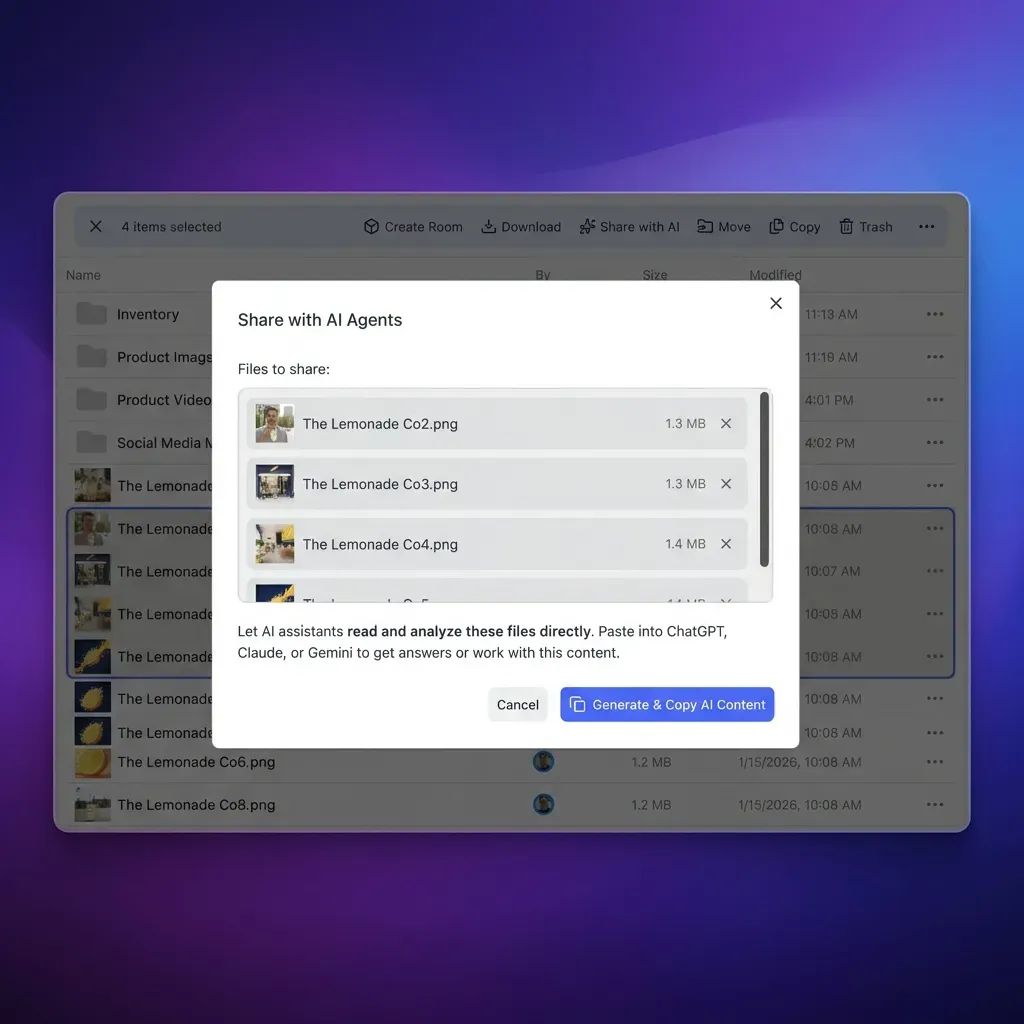
This is where the choice between a chatbot and a system-aware tool becomes critical. If you are dealing with standardized forms, legal contracts, or financial reports that require strict audit trails, dedicated summarizers are the standard. But if you need to analyze a whole directory of mixed assets, you need an agentic storage layer that supports both approaches. By using Fast.io's shared workspaces and event streams, organizations can coordinate dedicated summarization tools alongside team members. Fastio workspaces feature granular permissions, detailed activity logs, and realtime activity feeds. Team members can review summaries, verify key details with anchored comments, and ensure human review before distribution.


Secure your agentic document workflows
Whether you use Manus AI or dedicated summarize AI tools for enterprise docs, Fast.io provides persistent workspaces with granular permissions, version history, and built-in semantic search. Starts with a 14-day Business Trial.
Compare Manus AI vs Summarize AI Tools for Enterprise Docs
To understand the technical trade-offs between Manus AI and dedicated summarizers, we can compare their capacity, execution models, and referencing capabilities. The following table highlights the differences between an action-oriented agent and a specialized distillation tool.
As the comparison shows, Manus AI operates as an active workspace partner. It does not just read a file, it can write a new one, execute code to verify the data, and compile its findings into an interactive HTML dashboard. Dedicated summarizers, while highly accurate, remain limited to text input and output.
However, the choice is not mutually exclusive. A modern documentation pipeline should combine the action capabilities of agents with the consistency of dedicated search tools. To do this, enterprises need an underlying storage engine that provides both structured data views and agentic access. For organizations seeking automated workflows, pairing these tools with a central integration platform is key.
Enterprise Security and Compliance Realities
Enterprise document management is defined by security boundaries. Allowing an autonomous agent like Manus AI to browse the web and run arbitrary code while accessing sensitive files presents significant security risks. Because these agents operate in remote sandboxes, enterprise IT teams have limited visibility into how data is processed or where it is sent. An agent that can execute shell commands or install external packages could accidentally introduce security vulnerabilities or leak confidential intellectual property.
Enterprise summaries require compliance constraints like SOC 2 audits and data encryption to ensure data protection. When choosing the best AI tools for enterprise doc management, organization leaders must balance agent capabilities with strict security controls. While Fast.io does not claim HIPAA, SOC 2, ISO 27001, FedRAMP, or PCI DSS compliance, it provides the essential security primitives needed to control agent actions.
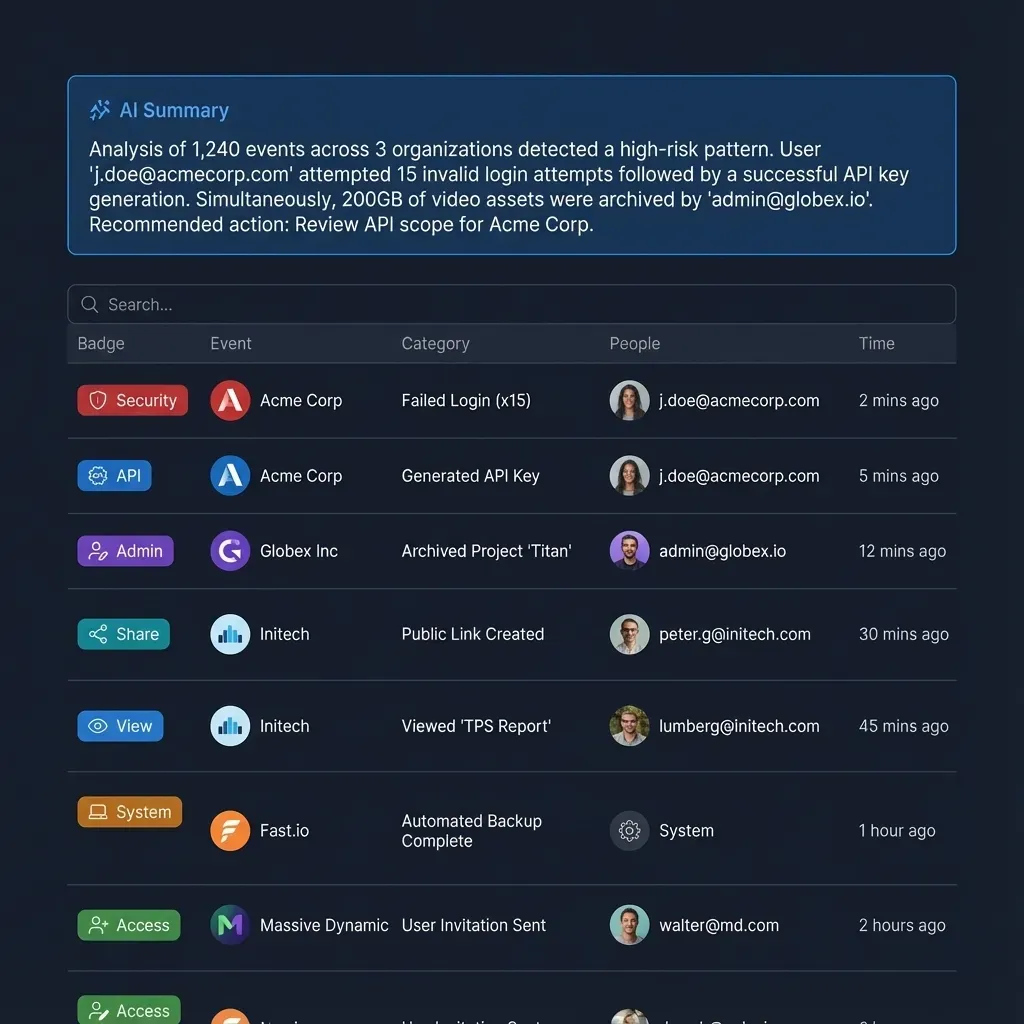
Fast.io provides shared workspaces with granular permissions, allowing administrators to restrict agents to specific folders or files. Every agent read, write, and share action is recorded in a detailed activity log, so teams can review who did what. Instead of sending sensitive files directly to external agent environments, teams can use Fast.io to index documents locally and expose them via secure endpoints. This structure keeps files protected while allowing agents to execute their tasks. Additionally, the platform's events and realtime activity feed give administrators complete visibility into agent operations, making it easy to identify and block unauthorized document access.
Architecting a Hybrid Document Extraction Pipeline
The most effective enterprise document workflow does not rely on a single tool. Instead, it combines persistent storage, structured data extraction, and agentic analysis. By using Fast.io as the coordination layer, teams can run dedicated summarization tools and autonomous agents like Manus AI in parallel.
For structured document processing, Fast.io's Metadata Views turn documents into a live, queryable database. Users describe the fields they want extracted in natural language, and Fast.io's AI automatically designs a typed schema (including Text, Integer, Decimal, Boolean, URL, JSON, and Date & Time formats). This schema matches files in the workspace and populates a sortable, filterable database. This extraction layer works with PDFs, images, scanned pages, and handwritten notes without requiring custom OCR rules. The structured extraction layer is documented in detail on the document data extraction product page.
By separating structured data extraction (Metadata Views) from semantic search and chat (Intelligence Mode), Fast.io allows developers to build reliable document pipelines. Agents can connect to Fast.io using the Model Context Protocol (MCP) server, accessing files via streamable HTTP endpoints or legacy SSE. Learn more about configuring workspace endpoints on the agent storage page. For detailed server API parameters and workspace schemas, refer to the documentation site or onboard your agent by serving the agent onboarding resource standard text file. This allows tools like Claude Code or Manus AI to query metadata, read files, and write outputs directly to a secure workspace. Developers configure their agents to connect to these endpoints, passing authentication headers to verify permissions before the agent can list or modify files.
Creating an organization requires a paid subscription or starting a 14-day Business Trial that requires a credit card. Full plan details are available on our pricing page. Teams can start with a Starter plan at $9.99/mo, or scale to the Business plan at $49.99/mo and Enterprise plan at $199.99/mo. Agents can create an organization to set up the workspace, then hand off ownership via a claim link to a human administrator to activate the Business Trial. This handoff preserves version history and keeps all agent operations fully auditable within the enterprise workspace. By separating agent construction from organizational ownership, Fast.io ensures that developers can build complex workflows and safely transfer them to non-technical stakeholders.
Sources
References used to verify factual claims in this guide.
-
unstructured data constitutes up to 90% of all data generated and stored within enterprises, growing at an annual rate of 55% to 65%
-
Lindy is widely recognized as a top alternative to Manus AI, particularly for users prioritizing repeatable business workflow automation over the general-purpose, research-heavy focus of Manus
-
Manus AI can process structured directories of up to 10GB of document data, enforcing a total account storage quota of 10 GB and limiting uploads via its API to 512 MB, automatically deleting uploaded files after 48 hours.
-
Enterprise summaries require compliance constraints like SOC 2 audits and data encryption to protect sensitive corporate assets.
-
Fast.io does not claim HIPAA, SOC 2, ISO 27001, FedRAMP, or PCI DSS compliance, providing security primitives to control agent actions.
Frequently Asked Questions
Is Manus AI good for summarizing enterprise documents?
Manus AI can summarize enterprise documents, but it is built as an action-oriented agent rather than a dedicated text summarizer. It excels at cross-referencing multiple files in a directory and executing Python scripts to analyze data. However, its sandboxes are ephemeral, deleting files after 48 hours, making it unsuitable for persistent storage.
What is the best AI tool to summarize enterprise docs?
The best tool depends on your security and workflow needs. For compliance-heavy environments requiring SOC 2 standards and data encryption, dedicated document summarizers (like Adobe Acrobat AI or Azure AI Document Intelligence) are ideal. For complex tasks requiring data analysis, script execution, and directory cross-referencing, an agentic solution like Manus AI combined with a persistent storage engine like Fast.io is the best approach.
Can Manus AI handle multiple documents at once?
Yes, Manus AI can process structured directories of up to 10GB of document data in its execution environment. This allows the agent to read multiple files, cross-reference their content, and generate consolidated reports or dashboards, whereas traditional summarizers typically focus on one document at a time.
Related Resources

Secure your agentic document workflows
Whether you use Manus AI or dedicated summarize AI tools for enterprise docs, Fast.io provides persistent workspaces with granular permissions, version history, and built-in semantic search. Starts with a 14-day Business Trial.