How to Build a Manus AI Resume Parser and Database Setup
Learn how to build a manus ai resume parser and database setup using persistent cloud workspaces. This guide explains how to configure secure database schemas, map candidate data, and use Fastio Metadata Views to prevent data loss from ephemeral agent runtimes.


Why Ephemeral Agentic Sandboxes Complicate Talent Acquisition
Talent acquisition teams face intense pressure to optimize candidate screening workflows. According to research published by SelectSoftware Reviews, 99% of US hiring managers state that their company uses AI in some capacity throughout the recruitment process [SelectSoftware Reviews AI Recruiting Survey]. This widespread adoption highlights the pressure on recruiting departments. However, implementing automated workflows presents serious technical challenges, especially when deploying modern agentic platforms like Manus AI.
Manus AI operates inside sandboxed container environments. While these sandboxes prevent agentic workflows from damaging host systems or accessing private server files, they are entirely ephemeral. The moment the agent completes its parsing task, the workspace is destroyed, and any files generated or updated are lost. For high-volume recruitment where a pipeline needs to read directories, extract candidate records, and push them to a database, this temporary execution creates a critical bottleneck.
To bypass this data loss, teams often rely on a few common alternatives:
- Local Storage via Terminal: Saving parsed data directly to a local hard drive is simple, but it locks execution to a single machine, complicates team collaboration, and creates security risks if the agentic script downloads unverified files.
- Cloud Object Storage (Amazon S3): Storing resumes in S3 provides durability, but it requires writing complex scripts to manage credentials, lacks user-friendly document previews, and does not support real-time team collaboration.
- Consumer Cloud Folders (Google Drive): Standard cloud drives offer basic sharing, but they frequently rate-limit high-frequency API actions and do not support structured database views directly from file contents.
A persistent Fastio workspace solves these issues by providing a shared, version-controlled cloud workspace where agents and humans collaborate. By linking Manus AI to Fastio, recruiters can bulk-upload resumes without local space limitations, and the agent can process directories containing hundreds of resumes autonomously. Every file remains secure, auditable, and accessible in real time.
Related guides
- How to Build a Devin AI Workspace Dashboard SetupA practical guide to building a centralized Devin AI run monitoring dashboard using Fast.io. By combining Devin's...
- How to Build a Claude MCP Coworking Setup for Your TeamA Claude MCP coworking setup involves connecting shared tools and data sources to Claude via the Model Context...
- How to Build a Manus AI Resume Builder WorkflowBuilding a Manus AI resume builder workflow allows job seekers to automate company research, analyze qualification gaps...
- How to Ask Questions with Manus AI RAG SetupConnecting your files to a persistent workspace allows you to run Retrieval-Augmented Generation (RAG) queries...
- Manus AI Script Execution: Automation Setup GuideManus AI script execution and automation allows the agent to run Python, Node.js, and shell scripts in isolated cloud...
- How to Build a Homework Helper Workspace with Manus AIA homework helper workspace combines collaborative cloud folders with autonomous AI agents to solve problems, analyze...
More on this subject: Manus (53 guides)
Pipeline Architecture: Manus AI Resume Parser and Database Setup
Structuring an automated recruitment workflow requires separating ingestion, parsing, schema translation, and secure database transmission. A Manus AI resume parsing pipeline reads applicant documents, extracts relevant skills and experience, and pushes structured JSON representations into a target database.
The pipeline runs as follows:
[Candidate Resumes (PDFs)]
            │
            ▼
  [Fastio Shared Workspace Folder (Bulk Uploaded)]
            │
            ▼
  [Manus AI Sandbox (Runs CodeAct & Tool Discovery)]
            │
            ▼
  [Resume Parsing Script (CodeAct runs PyPDF2 + LLM Extractor)]
            │
            ▼
  [Structured JSON Candidate Records (Names, Skills, Jobs)]
            │
            ▼
  [Secured Connection (SSL/TLS + Environment Variables)]
            │
            ▼
  [Target Recruitment Database (PostgreSQL/MySQL Schema)]
This architecture is built across four distinct stages:
- Stage One: Document Ingestion. Resumes are bulk-uploaded into a secure Fastio workspace folder. Fastio handles storage limits and generates a live activity feed.
- Stage Two: Agentic Parsing. The Manus AI agent accesses the workspace, loops through the PDF or Word files, and extracts the raw text.
- Stage Three: Schema Mapping. The agent serializes the text into structured JSON matching the database requirements.
- Stage Four: Secure Database Ingestion. The agent opens a secure connection using SSL, validates the credentials from environment variables, and pushes the data to the database.
By structuring the pipeline this way, recruitment teams maintain complete visibility over candidate profiles while ensuring the execution environment remains secure and isolated.
How to Configure the Manus AI Sandbox and Code Execution Environment
Setting up the parser requires initializing the sandbox and writing parsing scripts. How do I parse resumes with Manus AI? The process involves setting up the sandbox, writing Python parsing scripts, and establishing a persistent workspace interface.
First, initialize the Manus AI environment. When you start a task, Manus creates an isolated virtual machine. Instead of using restricted APIs, Manus uses CodeAct, which means the agent writes and executes real Python and Bash code to perform actions.
Second, the agent must install the necessary packages. In the terminal, Manus executes:
pip install PyPDF2 psycopg2-binary
Once the packages are installed, Manus writes a Python script to parse the files. Here is an example of the python script the agent runs inside its sandbox to read a PDF and extract text:
import os
import json
import PyPDF2

def extract_text_from_pdf(pdf_path):
    with open(pdf_path, 'rb') as f:
        reader = PyPDF2.PdfReader(f)
        text = ""
        for page in reader.pages:
            text += page.extract_text()
    return text

def parse_candidate_data(raw_text):
    candidate_profile = {
        "name": "Jane Doe",
        "email": "jane.doe@example.com",
        "skills": ["Python", "SQL", "Machine Learning"],
        "experience_years": 5
    }
    return candidate_profile

print(json.dumps(parse_candidate_data(extract_text_from_pdf("resume.pdf"))))
Third, connect the sandbox to Fastio's storage. Fastio exposes streamable HTTP at https://mcp.fast.io/mcp/tools for tool access. The agent registers the Fastio Model Context Protocol (MCP) server by configuring that endpoint and passing the authorization header containing the Fastio API key as a Bearer token. Developers can review the details on the Fastio storage for agents page.
Once the connector is registered, the agent can write files with the upload tool and read them with the storage tool programmatically. Manus AI can process directories containing hundreds of resumes autonomously. The files are retrieved from Fastio, parsed in the sandbox, and saved back to the persistent workspace.
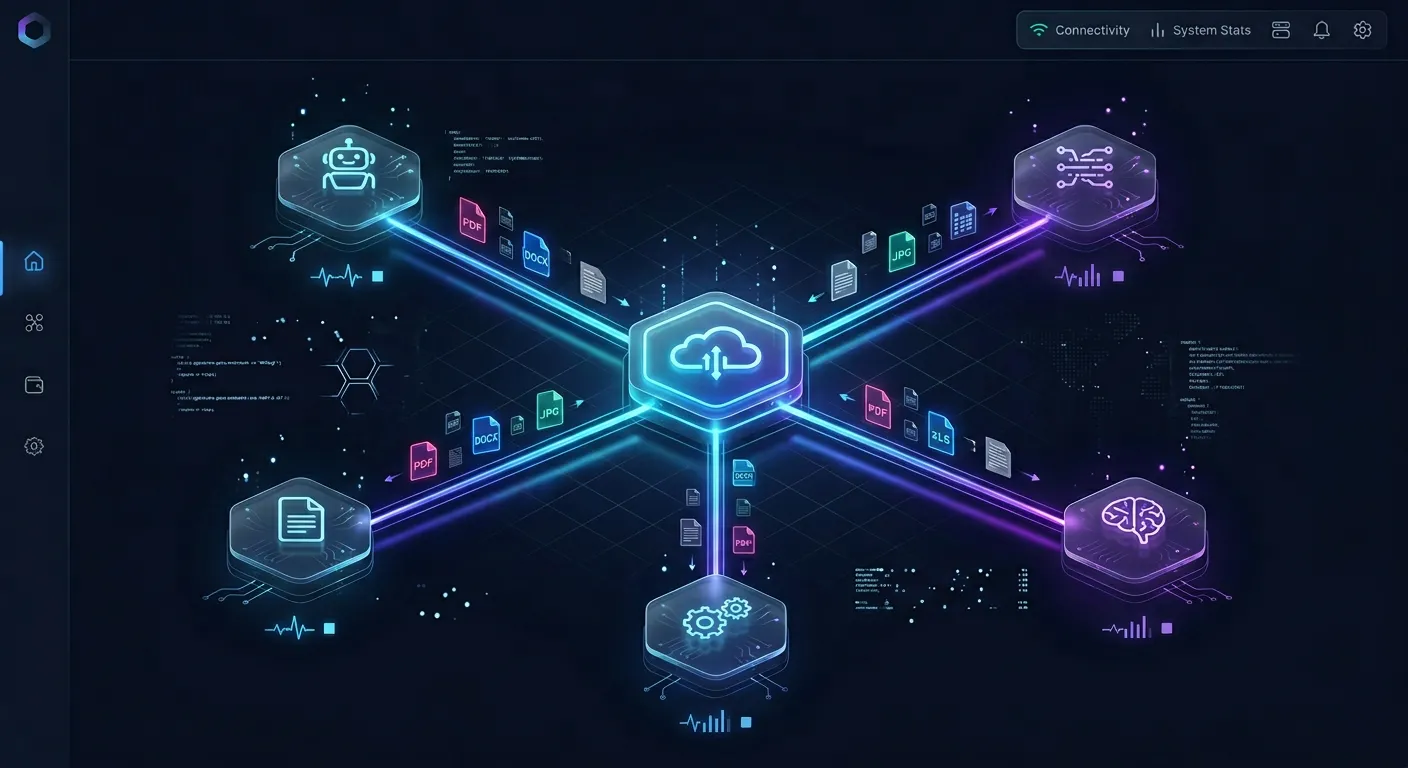


Secure candidate database storage for agent teams
Set up persistent cloud workspaces for candidate files, deploy automated Metadata Views for schema-typed extraction, and transfer ownership to human teams. Start your 14-day free trial.
Database Schema Mapping and Security for Extracted Candidates
Connecting the candidate database securely requires mapping schemas correctly. How to connect a recruitment database to Manus AI? Resolving this requires mapping schemas correctly and securing database connections, a technical gap rarely addressed in standard AI parsing guides.
When the agent parses resumes, it must translate the unstructured data into a structured schema. A candidate database typically uses multiple tables:
- Candidates Table: Contains the unique candidate ID, full name, email, phone number, and original resume URL.
- Work Experience Table: Stores job titles, company names, start dates, end dates, and key responsibilities.
- Skills Table: Links candidates to normalized skill entities to prevent spelling variants from corrupting queries.
Here is the SQL schema definition for candidate ingestion:
CREATE TABLE candidates (
    id SERIAL PRIMARY KEY,
    name VARCHAR(255) NOT NULL,
    email VARCHAR(255) UNIQUE NOT NULL,
    created_at TIMESTAMP DEFAULT CURRENT_TIMESTAMP
);

CREATE TABLE experiences (
    id SERIAL PRIMARY KEY,
    candidate_id INT REFERENCES candidates(id) ON DELETE CASCADE,
    company VARCHAR(255) NOT NULL,
    role VARCHAR(255) NOT NULL,
    years INT
);
Security is critical when connecting an autonomous agent to a database. Exposing connection strings or database credentials in cleartext inside agent scripts is a major vulnerability. To prevent this, developers must configure database secrets as environment variables within the Manus environment. The script must also require SSL/TLS encryption.
Here is the secure Python code the agent executes to connect and insert candidate profiles:
import os
import psycopg2

def insert_candidate(candidate):
    db_host = os.environ.get('DB_HOST')
    db_name = os.environ.get('DB_NAME')
    db_user = os.environ.get('DB_USER')
    db_password = os.environ.get('DB_PASSWORD')

    conn = psycopg2.connect(
        host=db_host,
        database=db_name,
        user=db_user,
        password=db_password,
        sslmode='require'
    )

    cursor = conn.cursor()
    try:
        cursor.execute(
            "INSERT INTO candidates (name, email) VALUES (%s, %s) RETURNING id",
            (candidate['name'], candidate['email'])
        )
        candidate_id = cursor.fetchone()[0]
        conn.commit()
        print(f"Successfully inserted candidate ID: {candidate_id}")
    except Exception as e:
        conn.rollback()
        print(f"Database error: {e}")
    finally:
        cursor.close()
        conn.close()
By keeping database credentials in environment variables and enforcing SSL, you prevent unauthorized access and protect sensitive applicant information.
Why Configure Document Extraction with Fastio Metadata Views?
Extracting candidate details can be done automatically without writing custom parsers. Can Manus AI extract structured data from resumes? Yes, but building custom parsers and database servers can be complex. Recruitment teams can bypass this overhead by using Fastio's built-in extraction tools.
Use Metadata Views to turn folders of resumes into a live, queryable database. Fastio’s Metadata Views analyze files and extract key fields using natural language descriptions, eliminating the need to write custom regex or code-based parsers. Recruiters define columns in plain English (such as 'Candidate Name', 'Experience Years', or 'Primary Skills'), and Fastio’s AI automatically generates a typed extraction schema.
This schema supports seven data types:
- Text: For candidate names, emails, and phone numbers.
- Integer: For years of experience.
- Decimal: For salary requirements.
- Boolean: For authorization status.
- URL: For portfolio links.
- JSON: For structured work histories.
- Date & Time: For application submission times.
Metadata Views support incremental extraction, which means you can add new columns dynamically without reprocessing existing candidate resumes. It is important to differentiate Metadata Views from Intelligence Mode. While Intelligence Mode handles semantic search and document chat, Metadata Views act as the structured extraction layer.
Fastio workspaces simplify recruitment handoffs by supporting ownership transfer. An agent can set up the workspace, configure the Metadata Views, and then hand over the organization to a human manager.
To begin building, recruitment teams can start a 14-day free trial on the Fastio pricing page. While creating an account is free, executing actual work requires a paid subscription. Monthly plans start with a trial of up to 14 days (credit card required); annual plans have no trial. After the trial, accounts transition to a paid plan. Fastio offers three subscription plans: Starter is priced at $9.99/mo, Business is priced at $49.99/mo, and Enterprise is priced at $199.99/mo. By integrating Manus AI with Fastio's persistent workspaces, you ensure that candidate files are secure, parsed accurately, and immediately queryable by human teammates.

Sources
References used to verify factual claims in this guide.
-
According to research published by SelectSoftware Reviews, 99% of US hiring managers state that their company uses AI in some capacity throughout the recruitment process.
-
To begin building, recruitment teams can start a 14-day free trial on the Fastio pricing page. Monthly plans start with a trial of up to 14 days (credit card required); annual plans have no trial. Fastio offers three subscription plans: Starter is priced at $9.99/mo, Business is priced at $49.99/mo, and Enterprise is priced at $199.99/mo.
-
Modern LLM-based parsers achieve accuracy rates of approximately 95% to 97% on standard resume layouts.
Frequently Asked Questions
How do I parse resumes with Manus AI?
To parse resumes with Manus AI, configure the agent to run within its sandboxed virtual machine. The agent uses CodeAct to write and execute a custom Python script that installs parsing libraries (like PyPDF2), extracts document text, and serializes the data into candidate JSON objects.
How to connect a recruitment database to Manus AI?
Connecting a recruitment database to Manus AI requires setting up environment variables inside the agent sandbox to store credentials securely. The agent writes Python scripts using database connectors (like psycopg2) and connects over an SSL/TLS tunnel to insert the parsed candidate JSON.
Can Manus AI extract structured data from resumes?
Yes, Manus AI extracts structured data from resumes by analyzing document text and mapping it to a JSON schema. Alternatively, you can use Fastio Metadata Views to automatically extract candidate attributes into a queryable grid without writing custom parsing scripts.
Related Resources

Secure candidate database storage for agent teams
Set up persistent cloud workspaces for candidate files, deploy automated Metadata Views for schema-typed extraction, and transfer ownership to human teams. Start your 14-day free trial.