Manus AI Script Execution: Automation Setup Guide
Manus AI script execution and automation allows the agent to run Python, Node.js, and shell scripts in isolated cloud environments. Since these sandboxes are ephemeral, developers must implement a persistent storage strategy to preserve files and script outputs. This setup guide explains how to pass environment variables, execute automated code loops, and integrate Fast.io workspaces to update directories dynamically during runtime.

Why Ephemeral Sandboxes Challenge Agent Automation
AI-authored code now accounts for roughly 26.9% of all production code merged into main repositories, representing a steady increase from 22% in the previous quarter [DX 2026 Developer Work Report]. This transition highlights the rapid movement from simple code-generation suggestions to autonomous agent execution. The shift is driven by the CodeAct framework, which demonstrates that agents using executable code actions achieve up to a 20% higher success rate on complex multi-turn benchmarks compared to traditional JSON or text-based tool calling [CodeAct 2024].
Manus operates as an action engine running shell scripts and code loops in isolated cloud containers. The agent generates and executes its own code to automate multi-step system workflows. However, running code dynamically introduces a major data persistence challenge. The virtual containers used by Manus are ephemeral by design. When a task completes, the container is destroyed, along with any scripts, logs, and generated files. Without a deliberate storage strategy, developers lose all evidence of the run.
Historically, developers have attempted to address this persistence issue using a few standard alternatives:
Local Disk Storage: Directing the agent to write files to a local machine requires running a desktop agent or maintaining an active command-line connection. This approach prevents team members from accessing the files remotely and exposes the local machine to security risks.
Amazon S3: Syncing output files to S3 buckets provides storage but requires writing IAM access policies and managing credential keys within the agent's code. S3 does not offer a user-friendly document browser for non-technical team members, and it lacks automated version history.
Google Drive: Uploading files to standard shared drives is another approach. Google Drive lacks the ability to handle rapid, automated API writes from concurrent agents without triggering rate limits, and it does not support structured document metadata extraction.
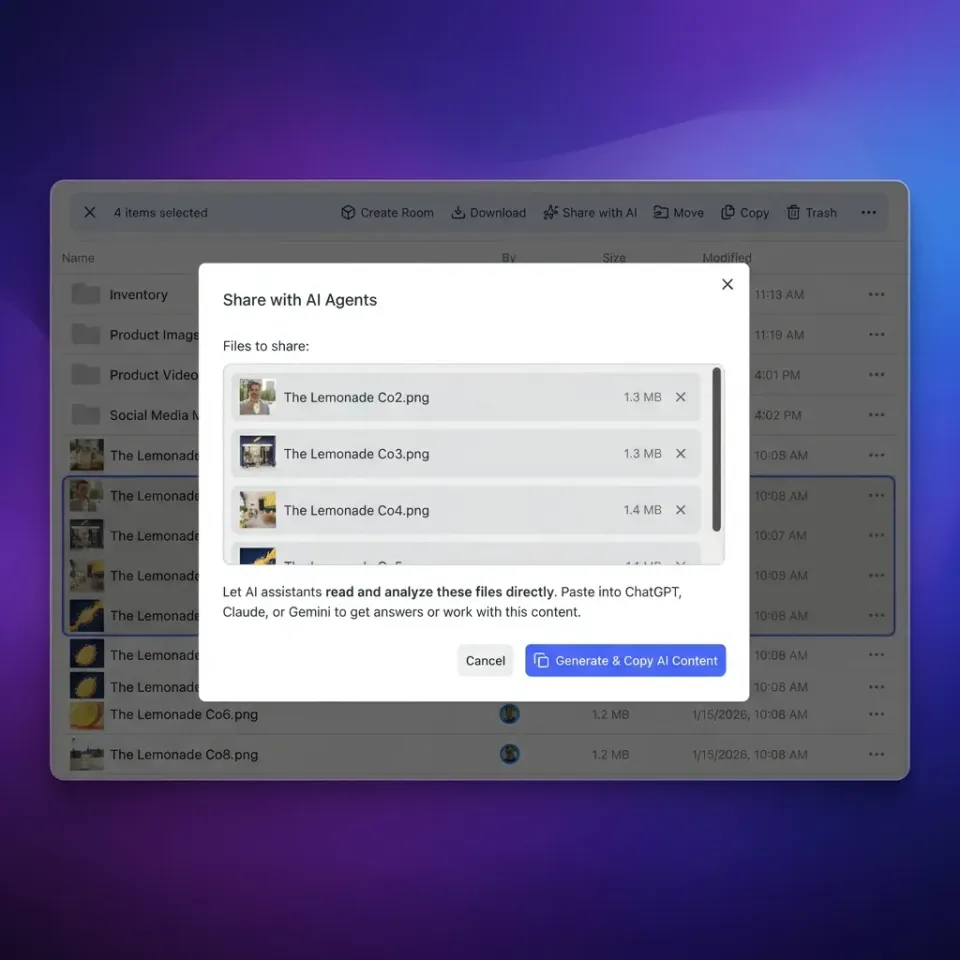
An intelligent workspace like Fast.io resolves these limitations by providing a persistent, collaborative storage layer. Fast.io updates directories dynamically during automated script runs, allowing team members to monitor file changes in real time. By connecting Manus to a shared Fast.io workspace, developers gain version-controlled storage, automated RAG indexing, and granular access controls for both human colleagues and AI agents. This guide details how to build this automated pipeline.
Related guides
- How to Run Cline in Headless Mode for CI/CD and Script AutomationRunning Cline in headless mode enables developers to execute coding tasks in non-interactive CI/CD environments and...
- How to Use OpenRouter with ClineCline lists OpenRouter as a first-class BYOK provider, and OpenRouter routes hundreds of models through one key. This...
- Manus AI File Storage: Persistent Workspace Best PracticesManus AI runs tasks inside secure cloud sandboxes with isolated, temporary filesystems that automatically recycle after...
- How to Ask Questions with Manus AI RAG SetupConnecting your files to a persistent workspace allows you to run Retrieval-Augmented Generation (RAG) queries...
- Configuring Manus AI as a Playwright Test RunnerWhile 89% of quality engineering teams pilot generative AI in their workflows, only 15% have scaled these systems...
- How to Automate Video Review Workflows with Manus AIWhile AI-driven automation can slash initial video editing and rough-cut assembly times by up to 80%, creative teams...
More on this subject: Manus (52 guides)
How the Manus Script Sandbox Executes Code
To build a reliable automation loop, developers must understand how the agent executes code. The agent runs commands in an isolated virtual container, isolating the execution from your host computer. Manus script execution allows the agent to run Python, Node.js, and shell scripts in a sandbox environment to automate multi-step system workflows. Inside this environment, the agent operates with root privileges, meaning it can install system dependencies, download packages, and execute complex shell pipelines.
The virtual machine comes pre-configured with Python and Node.js runtime environments, along with common libraries. The Manus sandbox executes code commands directly, bypassing the need for pre-defined tool schemas. When you give the agent a task, it does not rely on static API integrations. Instead, it writes a custom script, saves it to the virtual container disk, and runs it using the system shell. This dynamic approach allows the agent to solve problems that developers did not anticipate.
For example, if you ask the agent to extract data from a website, it will write a custom python script using requests and beautifulsoup, execute it in the sandbox, parse the page elements, and save the results as a CSV file. If the page uses client-side rendering, the agent detects the missing elements, rewrites the script using Playwright, launches a headless browser, and completes the extraction. This capacity to adapt the code to runtime conditions represents the key advantage of code-action sandboxes.
The Autonomous Self-Debugging Loop
A key benefit of running scripts inside a dedicated container is the agent's ability to self-debug. If a Python script fails with an import error or a syntax traceback, Manus reads the error output from the shell. The planning agent evaluates the traceback, writes a command to install the missing package or corrects the code logic, and runs the script again. This closed-loop execution continues until the script completes successfully or hits a user-defined timeout. The self-debugging cycle replaces the manual feedback loop of traditional continuous integration environments, allowing the agent to handle unexpected runtime errors without human intervention.
Cloud Sandbox vs Local Desktop Automation
Manus supports two execution models: cloud-based virtual sandboxes and local execution via the desktop operator. The cloud sandbox provides an isolated, ephemeral environment, which is the preferred choice for running web scrapers, data processing pipelines, and untrusted scripts. The desktop operator, on the other hand, runs command-line instructions directly in your local terminal to manipulate files and application settings. While local automation is useful for personal productivity tasks, cloud execution is safer and more scalable. It isolates execution risks and allows developers to run automated tasks in the background without locking up their local resources.
How to Set Up Manus AI Script Execution and Automation
Automated workflows frequently require connection keys for external databases, SaaS APIs, or cloud platforms. Since Manus runs scripts inside isolated cloud sandboxes, developers must provide these credentials securely. Manus stores these credentials as environment variables on the backend, mapping them to the container during startup. This design ensures that sensitive API keys never appear in client-side code, user logs, or the planning agent's chat history.
The step-by-step workflow of a python script execution in Manus involves setting up the workspace, passing environment variables, executing the script, and extracting outputs. To configure this automation, you must first register your keys in the agent's configuration dashboard or inject them programmatically. When the task initializes, Manus exports these keys as environment variables, making them accessible to your Python or Node.js scripts using standard library calls like os.getenv or process.env. This setup allows the agent to connect to external systems without hardcoding credentials in the generated script files.
Here is a Python example showing how to trigger a script task programmatically using the Manus API v2 and pass environment variables:
import os
import requests

api_key = os.getenv("MANUS_API_KEY")
headers = {
    "API_KEY": api_key,
    "Content-Type": "application/json"
}

payload = {
    "prompt": "Write a python script to fetch market data, format the JSON output, and upload it.",
    "taskMode": "agent",
    "agentProfile": "default",
    "env": {
        "FASTIO_API_KEY": os.getenv("FASTIO_API_KEY"),
        "DATA_SOURCE_URL": "https://api.example.com/v1/metrics"
    }
}

response = requests.post(
    "https://api.manus.ai/v2/tasks",
    headers=headers,
    json=payload
)

print(response.json())
Secrets Management Best Practices
To minimize security risks, developers should apply the principle of least privilege. Do not pass primary root keys to the agent. Instead, generate scoped API keys that are restricted to specific directories or actions. For instance, when configuring the Fast.io integration, create an API key that is limited to a single workspace. This limits potential exposure if the agent generates a script containing security vulnerabilities or logs credentials to an unencrypted output folder.
Handling Dynamic Script Dependencies
When executing automated scripts, Manus frequently encounters requirements for third-party libraries. The agent addresses this by writing installation commands before running the primary code. For Python, it runs pip install to download dependencies like pandas or beautifulsoup. For Node.js, it executes npm install to retrieve packages. This dynamic installation is fully handled within the sandbox container, allowing the agent to use any open-source package library required to complete the task.


Persist Manus script outputs automatically
Provide your autonomous agents with a secure, version-controlled workspace. Sync script files, update directories dynamically, and manage your data with a 14-day free trial.
How to Persist Script Outputs in Fast.io Workspaces
Once the script runs and finishes its task, the container is destroyed, making data persistence the next critical step. Developers can connect Manus to Fast.io's persistent workspaces to ensure that logs, database dumps, and reports are saved. Fast.io updates directories dynamically during automated script runs. When the script writes a file to the mapped sandbox output folder, the changes are synchronized to the shared workspace, ensuring that the results are saved before the container terminates.
This integration can be configured using the Fast.io API or by using the Fast.io Model Context Protocol server. Fast.io exposes Streamable HTTP at the /mcp endpoint and legacy SSE at /sse. Developers can refer to the official Fast.io for agents documentation for tool-surface specifics. By using the Fast.io MCP toolset, the Manus agent can write files, create directories, and query workspace contents directly from the command line, keeping all script outputs organized in a single location.
Fast.io workspaces provide several key advantages over standard storage options:
Shared Workspaces: Org-owned workspaces allow agents and humans to share the same folder hierarchy, providing a shared space where team members can review outputs.
Per-File Version History: Every write operation creates a new version instead of overwriting the previous file. This allows developers to track script updates, restore prior data states, and audit the agent's work.
Intelligence Mode: Fast.io automatically indexes uploaded files, making them queryable via semantic search. Team members can ask questions about the agent's outputs directly in the chat interface.

Dynamic Directory Synchronisation
When Manus executes an automation script, it creates a local directory structure to organize outputs, such as logs, images, and reports. By integrating the Fast.io API, the script can run a sync command at the end of the execution block. Fast.io updates directories dynamically during automated script runs, adding new subfolders and updating file lists without requiring a manual refresh. This dynamic update allows developers to watch the agent build files, create directories, and structure assets in real time from the Fast.io dashboard.
Structured Document Data Extraction with Metadata Views
To extract structured data from script outputs without writing parser code, developers can use Fast.io's document extraction features. Use Metadata Views to turn documents into a live, queryable database. When the agent uploads raw JSON files, CSV exports, or PDF summary reports, team members do not need to write parsing scripts. Instead, users describe the fields they want extracted in natural language, and the platform's AI automatically designs a typed schema. This schema supports Text, Integer, Decimal, Boolean, URL, JSON, and Date & Time formats. The platform matches files in the workspace, extracts the fields, and populates a filterable spreadsheet view. Team members can add new columns at any time without needing to reprocess the files. This structured data extraction layer is detailed at the Metadata Views product page: /product/document-data-extraction/.
How to Hand Off Autonomous Workflows to Teams
Establishing a persistent connection between Manus and Fast.io allows developers to construct self-managing automation systems that can be handed off to clients. The agent can set up the workspace, upload the initial scripts, configure the folder structure, and then transfer ownership to a human client. Fast.io supports ownership transfer, allowing the agent to hand over billing and admin rights to the customer while retaining background access to run updates and schedule tasks.
This handoff workflow allows software engineers to build self-managing applications for clients without ongoing maintenance. The human owner gains full control over the data, permissions, and billing, while the agent continues to run tasks in the background using its scoped admin key. This separation of concerns ensures that the client owns the infrastructure, while the developer or agent maintains the code.
To set up this environment, team members can start a 14-day free trial on Fast.io. Fast.io does not offer a permanent unpaid tier or a free agent subscription. While creating a user account is free, running workspaces requires a paid organization subscription. Monthly plans start with a trial of up to 14 days (credit card required); annual plans have no trial. This trial allows developers to build workspaces, test the MCP server, and subscribe to the activity feed. After the trial, the organization transitions to a paid plan. Fast.io offers three tiers: the Starter plan is priced at $9.99/mo, the Business plan is priced at $49.99/mo, and the Enterprise plan is priced at $199.99/mo. By combining Manus's execution engine with Fast.io's intelligent workspace, teams can build secure, persistent, and fully automated script execution systems.
Sources
References used to verify factual claims in this guide.
-
AI-authored code now accounts for roughly 26.9% of all production code merged into main repositories, representing a steady increase from 22% in the previous quarter.
-
CodeAct demonstrates that agents using executable code actions achieve up to a 20% higher success rate on complex multi-turn benchmarks.
-
Fast.io offers structured paid tiers starting at $9.99/mo for Starter, $49.99/mo for Business, and $199.99/mo for Enterprise, and monthly plans start with a trial of up to 14 days that requires a credit card to activate.
Frequently Asked Questions
Can Manus AI execute python code?
Yes, Manus AI can natively execute Python code inside an isolated cloud sandbox. The agent writes scripts to a temporary file structure and runs them using the container shell. If the execution encounters tracebacks or compilation errors, Manus analyzes the console outputs and automatically revises the script to fix the bug.
How do I automate tasks using scripts in Manus?
You can automate tasks by writing a prompt that details your multi-step script workflow. Manus translates your request into script files, installs necessary libraries via package managers, and executes the code. To prevent losing output data when the sandbox terminates, connect the script to a persistent Fast.io workspace using the Fast.io API or the Model Context Protocol server.
How do I securely pass environment variables to my scripts in Manus?
You can securely register environment variables through the Manus task dashboard or pass them programmatically in your API request payload. The system injects these secrets into the sandbox container memory at startup, allowing Python or Node.js scripts to read them without exposing credentials in the client code.
How do Fast.io workspaces handle agent data updates?
Fast.io updates directories dynamically during automated script runs, updating files and directories without manual reloading. Each write operation maintains a per-file version history, allowing developers to restore previous logs or script files and keep a detailed activity log of agent and human contributions.
Related Resources

Persist Manus script outputs automatically
Provide your autonomous agents with a secure, version-controlled workspace. Sync script files, update directories dynamically, and manage your data with a 14-day free trial.