The Best Manus AI Courses and Training Programs: A Professional Guide
Specialized training is essential to bridge the skills gap in agentic AI. This guide reviews the best Manus AI courses, including the official Manus Academy, developer-focused tutorials, and business operations guides. We also detail how to connect these autonomous agents to persistent Fastio workspaces to prevent sandbox data loss.

Official Manus AI Training: What the Curriculum Covers
While Gartner forecasts that 40% of enterprise applications will embed task-specific AI agents by the end of 2026, a massive skill gap remains, as less than 11% of organizations have successfully moved agentic AI beyond basic experimentation and into production workflows [Gartner 2026 Report]. This execution gap exists because traditional courses focus on text-based chatbots rather than autonomous action engines. Manus AI courses are structured educational programs designed to teach developers and operations teams how to build, run, and scale autonomous agent workflows. To bridge this skill gap, the official training platform, Manus Academy, launched on July 9, 2026, in partnership with Build Club, offering over 30 hours of build-along courses and 20+ real-world use cases [Manus Academy 2026].
This official curriculum is designed to transition professionals from basic prompt engineering to mastering autonomous agentic workflows. By training users on the Manus action engine, the courses teach how to construct task flows that run independently in secure cloud containers. Students learn to handle complex processes, manage execution safety, and build custom automation loops.
The official Manus Academy curriculum covers several key topics:
- Action Engine Architecture: Understanding how the agent interacts with web browsers, runs terminal scripts, and executes software tools in isolated virtual environments.
- Manus Skills Integration: Creating, testing, and deploying reusable units of automation to assemble workflow pipelines.
- Context Engineering: Designing detailed prompt structures and input schemas that guide autonomous planning and minimize logic errors.
- Workflow Container Management: Monitoring the temporary sandbox filesystem, handling intermediate files, and debugging script errors.
- Role-Based Tracks: Implementing custom automation templates tailored for business analysis, financial analysis, marketing operations, and product management.
- Handoff and Export Protocols: Transferring generated reports, compiled spreadsheets, and other assets from temporary environments to permanent collaborative drives.
These topics provide a comprehensive foundation for building autonomous agents. Rather than focusing on simple prompt-and-response interactions, the training prepares developers and managers to deploy agents that can independently search the web, write code, and execute business operations.
Related guides
- Claude AI Courses: Best Training Programs and Certifications for 2026Anthropic launched 20 free courses on Skilljar, a $99 proctored certification exam, and a $150 million nonprofit...
- Best Claude Code Courses and Training Programs for 2026Claude Code authored 326,000 GitHub commits in a single day in March 2026, and the training ecosystem has caught up....
- Best Storage Solutions for Manus AI Training DatasetsManus AI excels at autonomous desktop automation and sandbox code execution, but its 10 GB account storage quota and...
- How to Train Manus AI Agents for Job Automation WorkflowsWhile many pilot AI agents, only 23% successfully scale. Learn manus ai training jobs automation using custom scripts,...
- The Best Manus AI Developer Tutorials and CoursesWhile many resources explain basic prompting for Manus AI, developers require deeper technical guidance to integrate...
- How to Setup a Workspace for Manus AI Agent TrainingWhile 84% of developers now use or plan to use AI tools, only 52% report that these tools have effectively made them...
More on this subject: Manus (53 guides)
How to Choose the Best Manus AI Courses and Tutorials
To learn manus ai, practitioners can choose from several structured courses and tutorials that target different skill levels and professional roles. The following resources represent the best educational programs available for developers and operations teams:
- Manus Academy (Official Platform): Located at academy.manus.im, the official academy is the most thorough learning environment. It contains over 30 hours of build-along courses and more than 20 practical use cases. Students can choose between beginner courses like Manus Fundamentals and advanced tracks focused on enterprise orchestration. The platform also offers role-specific tracks for product managers, business analysts, marketing managers, and finance professionals.
- Manus AI: Complete Course for Developers (freeCodeCamp): This deep-dive video course is designed for software engineers and backend developers who want to bypass the user interface. It covers account configuration, developer API usage, script execution safety, and building applications with integrated agent loops. The tutorial teaches students how to write scripts that programmatically trigger Manus tasks and handle output payloads.
- Master Manus AI in 13 Minutes (Video Tutorial): This fast-paced video tutorial is the best starting point for business users who need a quick introduction. It covers the core dashboard interface, shows how to activate default Manus Skills, and provides brief walkthroughs of common tasks: gathering market research and analyzing spreadsheet data.
- Building Agentic Workflows with Manus (Social Media Examiner): A business-oriented guide that focuses on converting standard operating procedures into autonomous agent instructions. It is designed for marketing operations teams who want to build repeatable automation flows for social media analysis and content reporting.
- Manus AI 101: The Complete Guide (The Product Channel): An extensive written reference guide containing over 100 prompt templates and use cases. This guide helps users shift their thinking from interactive chatting to delegating multi-step projects, making it ideal for product managers who prefer written references.
These manus ai tutorials and courses allow teams to choose a path that fits their technical background. Whether you need a 13-minute overview or a 30-hour deep dive, these resources cover the essential skills required to deploy autonomous agents. The training resources cover tutorials ranging from a 13-minute overview to a 30-hour deep dive to teach how to deploy autonomous agents.
Action Engines vs. Chatbots: Why Agents Need Dynamic Workspaces
Understanding the difference between traditional conversational chatbots and autonomous action engines is the first major step in any training program. While standard large language models act as a text-based brain, an action engine is designed to function like a hand, connecting directly to web browsers, terminal environments, and third-party tools to perform physical digital tasks. This capability enables agents to execute multi-step plans without requiring constant human intervention.
Structured courses emphasize three core concepts:
- Context Engineering: Unlike standard models that only require a short question, autonomous agents require comprehensive context, detailed input parameters, and clear success criteria.
- Manus Skills: These are modular, reusable automation blocks that extend the agent's capabilities. Students learn how to create and chain these skills to perform operations like downloading reports and extracting table data.
- Agentic Execution: Understanding the isolated sandbox environment where the agent runs. The agent writes its own code, runs it in a secure virtual machine, and inspects the output to debug errors before finalizing the task.
This sandbox environment introduces critical storage limitations. By default, Manus stores all temporary task files in the Standard Sandbox, which is an ephemeral virtual machine filesystem. This temporary container enforces a strict 48-hour deletion policy for all API-uploaded files. Furthermore, inactivity triggers automatic resets, wiping the sandbox filesystem after 7 days of non-use for free accounts and 21 days for Pro accounts [Manus Academy 2026]. Because of these ephemerality risks, developers must design workflows that export critical assets to a persistent storage layer.
How to Set Up a Persistent Workspace for Manus AI Agents
To prevent data loss from sandbox resets, developers must establish an automated export pipeline that transfers files to persistent cloud drives. When evaluating storage options, teams frequently compare several common alternatives:
- Local Disk Storage via Desktop App: The desktop application permits direct local directory access, running terminal commands on a user's machine. While this saves files locally, it locks the execution to a single physical device, exposes the local system to shell script errors, and prevents team members from accessing outputs concurrently.
- Amazon S3 Buckets: Storing files in S3 provides durable storage but requires writing IAM access policies and handling credential keys within the agent scripts. S3 lacks a simple preview interface for non-technical team members and does not support automatic document versioning.
- Google Drive: Standard shared folders provide easy web access but fail when agents execute high-frequency API writes. Google Drive frequently triggers rate limits during automated script loops and lacks structured document metadata extraction.
Fastio provides an optimized alternative. By connecting Manus to a version-controlled Fastio workspace, developers create a secure, shared space where agent output is preserved, auto-indexed for semantic search, and made available to human teammates. Fastio maintains a detailed version history for every file, letting you view differences and restore previous versions.
Configure the agent to write finished documents into that Fastio workspace before the virtual container is destroyed. Adding this export step to your agent prompts establishes an automated pipeline that moves data from temporary container storage to a secure cloud drive. Ripley, the built-in RAG agent, can then search those artifacts, and teammates can open them in the same workspace.
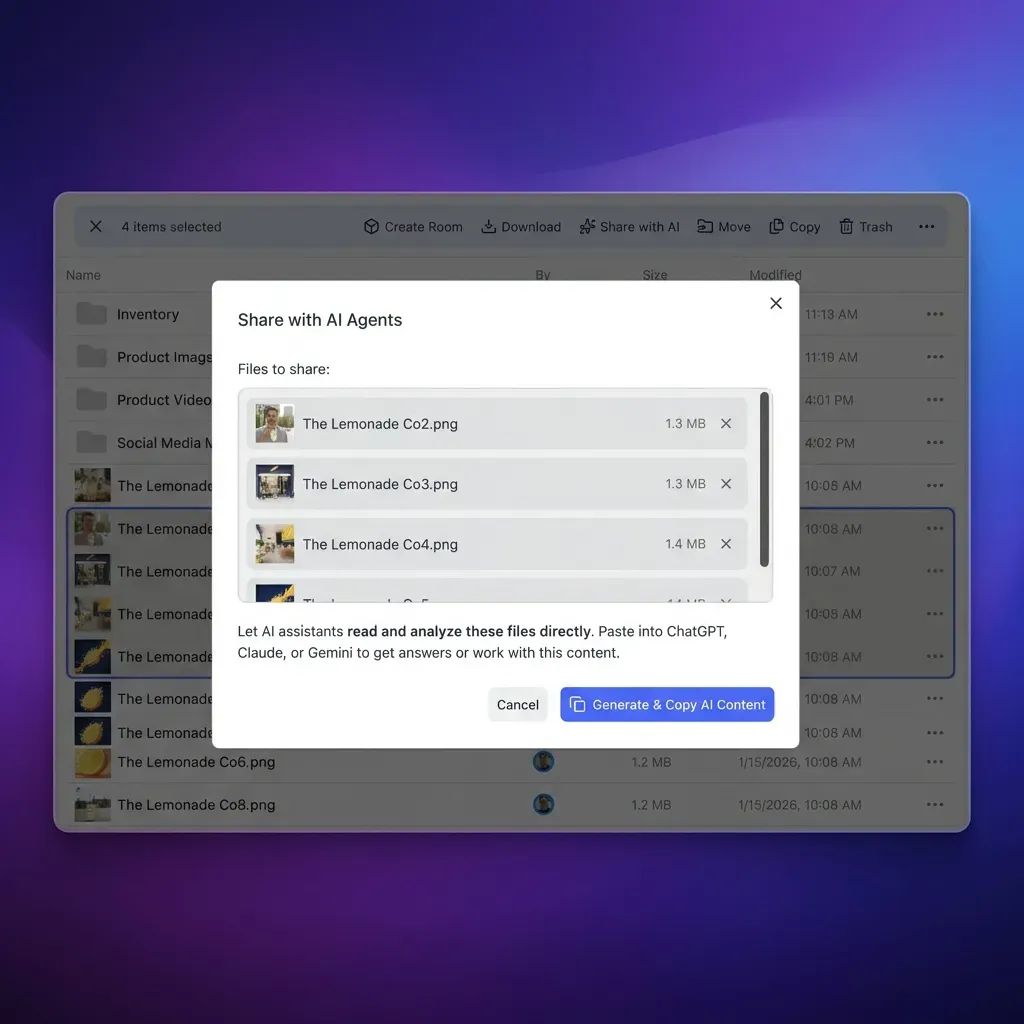


Save Manus agent artifacts to versioned team workspaces
Give your autonomous agents a secure, permanent storage directory with automatic RAG indexing and an MCP server endpoint. Starts with a 14-day free trial.
Steps for Data Extraction and Collaborative Handoff Workflows
Once files are safely transferred to your persistent workspace, you can automate how you analyze and structure the data. Instead of writing custom python code to extract information from every PDF or spreadsheet, developers can use Metadata Views to turn documents into a live, queryable database. When the Manus agent writes PDF reports, Excel models, or scanned images to your workspace, Metadata Views parses them automatically. You describe the columns you want in natural language (such as contract date, counterparty name, or total cost), and the platform builds a structured database layout. The schema supports Text, Integer, Decimal, Boolean, URL, JSON, and Date & Time formats. New columns can be added dynamically without reprocessing existing documents.
Developers can also connect custom agents to Fastio using the Model Context Protocol (MCP) server. Fastio exposes Streamable HTTP at https://mcp.fast.io/mcp/tools for agent integrations, and agents authenticate by sending an API key as an Authorization: Bearer header. The complete tool specifications are available in the Fastio MCP Guide and the developer documents. Using the MCP server, Manus can search folders, upload files, and read document contents directly, bypassing manual export scripts.
Building a workflow and transferring ownership to a client is the final step in the process. The agent can set up the folder structure, configure the Metadata Views, and then hand off the workspace. Fastio supports ownership transfer, allowing an agent to hand over billing and admin rights to a human client. To begin building, monthly plans start with a trial of up to 14 days that requires a credit card to activate [Fastio Pricing]. Fastio offers three subscription plans: Starter is priced at $9.99/mo, Business is priced at $49.99/mo, and Enterprise is priced at $199.99/mo [Fastio Pricing]. After the trial ends, the account transitions to a paid plan. By combining Manus's agent execution with Fastio's intelligent workspace, your team ensures that all task artifacts remain secure and persistent.
Sources
References used to verify factual claims in this guide.
-
Gartner forecasts that 40% of enterprise applications will embed task-specific AI agents by the end of 2026, while less than 11% of organizations have successfully moved agentic AI into production.
-
Manus Academy offers over 30 hours of build-along courses, 20+ real-world use cases, and was launched on July 9, 2026. The training resources cover tutorials ranging from a 13-minute overview to a 30-hour deep dive to teach how to deploy autonomous agents.
-
Manus AI enforces a strict 48-hour deletion policy for all API-uploaded files, with automatic resets after 7 days of non-use for free accounts and 21 days for Pro accounts.
-
The Master Manus AI in 13 Minutes video tutorial provides a fast-paced starting point for business users.
-
Manus AI 101 is an extensive written reference guide containing over 100 prompt templates and use cases.
-
Fastio offers three organization subscription plans: Starter for $9.99/mo, Business for $49.99/mo, and Enterprise for $199.99/mo, starting with a 14-day free trial that requires a credit card.
Frequently Asked Questions
Where can I learn Manus AI?
You can learn Manus AI by signing up for Manus Academy at academy.manus.im, which offers over 30 hours of video training. Additionally, developers can take freeCodeCamp's Complete Course for Developers, and business professionals can access quick video tutorials and written guides like Manus AI 101.
What is Manus Academy?
Manus Academy (academy.manus.im) is the official training platform developed in partnership with Build Club. It provides over 30 hours of build-along courses, 20+ real-world use cases, and role-based learning tracks designed to teach developers and operations teams how to build and scale autonomous agent workflows.
How do I prevent data loss in Manus AI workflows?
Manus AI sandboxes are ephemeral and delete API-uploaded files after 48 hours. To prevent data loss, you should configure your agents to automatically export generated files to a persistent cloud drive. Fastio workspaces provide an ideal persistent layer, offering version history, automated indexing, and MCP tool access.
Related Resources

Save Manus agent artifacts to versioned team workspaces
Give your autonomous agents a secure, permanent storage directory with automatic RAG indexing and an MCP server endpoint. Starts with a 14-day free trial.