Law Firm Workspace: Centralizing Matter Files, Client Portals, and Team Collaboration
Managing active legal matters requires a unified digital environment where attorneys, paralegals, and clients coordinate without losing track of document versions or sensitive files. A modern law firm workspace replaces fragmented storage drives and insecure email attachments with structured matter folders, branded client portals, and automated document data extraction. By centralizing case files, legal practices reduce administrative delays and protect client confidentiality.


Why Fragmented Inboxes and Storage Drives Break Matter Coordination
When a paralegal saves a revised deposition exhibit to local storage, an associate emails draft filings directly to a client as attachments, and a partner searches an unindexed network drive for an executed settlement agreement, the firm does not have a software problem. It has a boundary problem. Disconnected drives and email threads scatter matter records across unmanaged personal silos, leaving legal teams guessing which draft is current and risking privilege leaks every time files leave the office.
According to the American Bar Association, 53% of survey respondents reported that their firm does not offer clients access to a secure client portal. This widespread reliance on legacy transmittal habits creates friction that directly undermines firm profitability. For law practice managers and legal operations leads, this operational sprawl generates ongoing administrative drag. Managing active caseloads across litigation, transactional, and advisory matters requires tight coordination. Yet most legal teams toggle constantly between disparate tools for file storage, client communication, document review, and case administration. This friction slows down turnaround times, complicates conflict checks, and increases non-billable overhead across the practice.
The Hidden Costs of File Dispersion Across Inboxes and Disconnected Drives
The most common failure point in firm administration is the reliance on email inboxes as an informal document repository. When clients send discovery records, corporate contracts, or tax returns as email attachments, those files often remain trapped in the individual attorney's email client. If another attorney or paralegal steps in to cover court appearances or draft motions, they cannot readily access those source materials without requesting forwarded threads.
Version confusion quickly compounds the problem. Team members download attachments, make redline edits locally, and circulate competing files labeled with vague conventions such as final draft, revised final, or client comments. Without centralized file tracking, attorneys risk submitting outdated declarations to court or sharing superseded deal terms with opposing counsel.
Beyond internal confusion, circulating confidential files through standard email attachments introduces genuine data security risks. Transmitting sensitive corporate disclosures, medical histories, or financial statements across unencrypted channels leaves sensitive client data exposed to intercepted messages and misdirected emails.
Why Traditional Document Management Systems Fall Short for Modern Practices
To solve file dispersion, many firms implemented enterprise legal document management systems. While legacy platforms provide central document archives, they frequently create new operational hurdles for boutique and mid-sized practices. These systems were architected around rigid on-premises servers and cumbersome desktop clients, requiring substantial IT administration and extensive staff onboarding.
Attorneys often find traditional document check-out models cumbersome, leading them to save files to their local desktops to bypass the software during fast-paced trial preparation or deal closings. More importantly, legacy platforms typically offer weak external collaboration capabilities. Sharing large document sets with co-counsel, expert witnesses, or corporate clients usually requires exporting files out of the secure archive and uploading them to third-party consumer file transfer services.
Consumer cloud storage platforms like Google Drive, Dropbox, or OneDrive solve accessibility but lack the structured matter taxonomy and governance controls necessary for professional legal practice. They offer no built-in mechanism for structured document data extraction, lack matter-aware search, and force external clients through confusing account creation workflows. A modern law firm workspace bridges this divide by uniting matter organization, secure client exchange, and intelligent document retrieval in one environment.
Related guides
- Legal Tech Solutions: The Modern Law Firm Technology GuideLegal tech solutions encompass software applications and digital platforms engineered to coordinate legal operations,...
- Law Firm Data Security: Operational Guide to Protecting Matter Files and Client DataLaw firm data security requires strict technical controls, matter-level workspace isolation, and encrypted document...
- Law Firm Collaboration Software: Managing Cross-Firm, Co-Counsel, and Client WorkspacesLaw firm collaboration software provides structured, permission-controlled digital workspaces where attorneys,...
- Documate Review: Legal Document Automation and Client PortalsDocumate, now rebranded as Gavel, is a no-code legal automation platform for building customized workflows, client...
- Law Firm Document Sharing: Secure External Delivery for Counsel and ClientsLaw firm document sharing requires controlled, encrypted pathways to distribute privileged files, discovery materials,...
- Box for Law Firms: Secure Document Management AlternativesAn analysis of Box for law firms alongside modern legal document management alternatives. While enterprise cloud...
More on this subject: Legal Teams (211 guides)
How to Structure Case Files in a Law Firm Workspace
A law firm workspace is a centralized, secure digital environment where legal teams organize matter files, manage permissions, collaborate with clients via portals, and query case documents with AI. Rather than treating cloud storage as a generic bucket of files, an effective law firm digital workspace mirrors the operational realities of active legal practice.
Every matter operates as a distinct collaborative space with clear security boundaries, standardized directory structures, and transparent version tracking. This structure ensures that every motion, transcript, exhibit, and piece of correspondence remains indexed and accessible to authorized team members from initial intake through final disposition. By establishing uniform file conventions across every active file, legal administrators ensure that client records remain orderly regardless of how many attorneys contribute to the case.
Designing a Standardized Matter Taxonomy
Predictable organization starts with a consistent directory hierarchy across the firm. Operations leaders should establish a uniform workspace taxonomy divided by client and matter numbers. A proven structure uses high-level organizational directories for each client, containing dedicated matter workspaces underneath.
Within each matter workspace, standard subfolders keep work product distinct:
01_Pleadings_and_Court_Filings: Contains filed complaints, answers, motions, briefs, and court orders, sorted chronologically.02_Discovery_and_Exhibits: Houses document production sets, interrogatory responses, deposition transcripts, and marked trial exhibits.03_Client_Transmittals_and_Intake: Stores client-provided intake materials, corporate records, financial disclosures, and intake questionnaires.04_Work_Product_and_Drafts: Provides internal space for research memoranda, draft agreements, strategy notes, and trial preparation outlines.05_Correspondence: Keeps transmittal letters, formal notices, opposing counsel communications, and regulatory notices.
Standardizing this hierarchy across all practice groups ensures that any attorney, paralegal, or covering partner can locate necessary records within seconds, even when reviewing an unfamiliar file on short notice.
Enforcing Granular Permissions and Ethical Screens
Legal practices manage strict confidentiality duties, including conflict-of-interest rules that require firm-wide ethical screens. A law firm collaborative workspace must provide granular permission controls at the organization, workspace, folder, and individual file level.
Managing partners and IT administrators can configure access rights based on matter staffing. Core trial teams receive full read and write access, while secondary researchers or junior staff are restricted to specific subfolders. When external contract attorneys, expert witnesses, or local counsel join a matter, administrators can grant access strictly to relevant discovery sets or draft pleadings without exposing the firm's broader client list or internal billing files.
If a lateral attorney joins the firm carrying a conflict with an active adversary, administrators can implement an immediate ethical wall. Restricting workspace visibility ensures the conflicted lawyer cannot search, view, or receive notifications regarding that matter, documenting regulatory compliance while preserving workflow continuity for the active litigation team.
Version Control, Advisory File Locks, and Chain of Custody
Drafting complex pleadings and transactional agreements requires multi-author collaboration. Version control must happen automatically at the platform level rather than relying on manual file renaming conventions.
With per-file version history, every saved update creates an immutable revision. Attorneys can compare drafts, see who made specific revisions, and restore earlier language if negotiating positions change. When sharing files externally, recipients always access the latest version, eliminating the risk of counter-parties executing outdated drafts.
To help coordinate edits when multiple team members work on a complex brief simultaneously, Fastio provides advisory per-file locks. An attorney or paralegal can acquire a lock before starting substantial edits, making their active session visible across the team. Colleagues see who holds the advisory lock and can coordinate accordingly, while version history keeps every earlier version if an accidental overwrite happens.
Equally critical for litigation practice is maintaining a defensible chain of custody. A detailed activity log records every user action, including uploads, downloads, link creation, permission adjustments, and file previews. If an evidentiary dispute arises regarding when a disclosure was received or reviewed, the activity log shows who received and opened each file, and when.
How Client Portals Replace Insecure Email Attachments
Client communication is the public face of a law firm. How attorneys deliver work product and collect records directly shapes client confidence. Forcing clients to navigate cumbersome third-party portals, install proprietary software, or create complicated logins creates friction that delays case preparation.
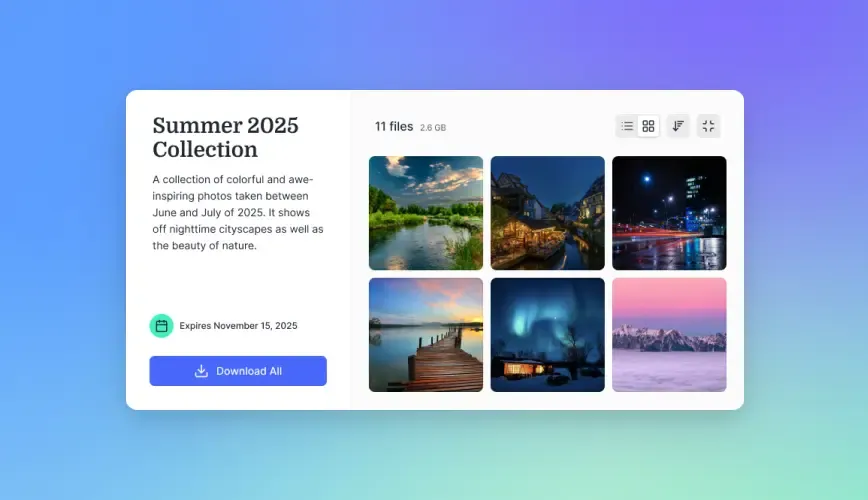
Modern legal practices use branded Content Portals to present a clean, professional exterior while maintaining stringent security controls on the backend. Clients receive custom-branded links displaying the firm's logo and color scheme, reinforcing trust while keeping file transmittals organized. This direct delivery channel eliminates the risks of unencrypted email attachments while keeping a record of all transmittals, retained according to your plan.
Replacing Insecure Attachments with Purpose-Built Shares
Fastio replaces unstructured email attachments with purpose-built share links configured for specific legal workflows:
- Send Shares: Ideal for delivering executed settlement agreements, estate planning binders, corporate closing books, or trial briefs. Administrators can set custom expiration dates, require passwords, and enable download controls to prevent unauthorized distribution.
- Receive Shares: Designed for frictionless client intake. The firm shares a secure upload link where clients can drag and drop tax records, bank statements, or accident photos directly into the matter's intake folder. Clients do not need to register for an account or remember passwords, removing barriers to prompt compliance.
- Exchange Shares: Create two-way collaboration rooms where external co-counsel, expert witnesses, and corporate legal departments can review and contribute materials within a governed workspace boundary.
Because shares are backed directly by live workspace folders, files delivered to the client remain synchronized with internal records. If an attorney replaces a draft motion with the final timestamped court filing, the client portal reflects the updated document immediately without generating another email thread.
Managing Heavy Media, Deposition Video, and Discovery Sets
Litigation practices routinely handle files that overwhelm standard legal practice management software and email servers. Video depositions, high-resolution surveillance footage, digital audio recordings, and massive electronic discovery productions routinely exceed standard file transfer limits.
Firms often resort to mailing physical hard drives or relying on unmanaged consumer file transfer sites to move these heavy assets. This practice introduces security gaps and creates tracking blind spots.
A modern matter workspace handles large-scale legal media through chunked upload architecture. Large discovery archives and high-definition video files upload reliably over standard browser connections. If an internet connection drops during an upload, the session automatically resumes from the last confirmed block without corrupting the file.
Once uploaded, team members can review files directly in their browser without downloading massive assets to local hard drives. The platform supports native in-browser previews for hundreds of document formats, alongside adaptive bitrate video streaming for deposition recordings. Legal teams can scrub through hours of witness testimony smoothly, verify key video evidence, and share specific timestamped clips with co-counsel instantly.


Centralize matter files and client delivery in one workspace
Replace fragmented cloud folders and email attachments with organized matter workspaces, branded client portals, and automated document extraction. Monthly plans start with a trial of up to 14 days (credit card required); annual plans have no trial. Plans are Starter at $9.99/mo, Business at $49.99/mo, and Enterprise at $199.99/mo.
Extracting Case Data and Querying Discovery with Workspace AI
The volume of digital documentation involved in modern litigation and corporate transactions has outpaced traditional manual review methods. Attorneys and paralegals often spend dozens of hours reviewing hundreds of contract pages or sorting through disorganized production responses to locate critical terms.
An intelligent law firm workspace incorporates artificial intelligence directly into the storage layer, allowing teams to analyze, query, and extract structured data from case files without deploying separate data room software or vector databases. This native intelligence enables legal teams to surface factual connections across thousands of pages within seconds, transforming raw files into actionable insights while preserving strict matter isolation.
Structured Contract and Brief Extraction with Metadata Views
Unstructured documents represent the vast majority of legal archives. Converting those files into actionable data typically requires tedious manual data entry or rigid OCR template tools that break whenever document formats vary.
Metadata Views turn unstructured legal documents into a live, queryable database. Rather than building complex regular expressions or rigid rules, legal operations staff describe desired data points in plain English. For example, in a commercial lease dispute or merger review, a legal assistant can instruct the system to extract columns such as:
Effective Date(Date & Time field)Contracting Counterparties(Text field)Governing Law and Jurisdiction(Text field)Termination Notice Window(Integer field representing days)Indemnification Liability Cap(Decimal or Text field)Automatic Renewal Clause(Boolean field)
The underlying intelligence models design a typed schema, match corresponding files across the matter workspace, and populate a structured spreadsheet grid. The system processes scanned PDFs, Word documents, discovery disclosures, and handwritten records. If the trial team later decides they also need to identify non-compete covenants or dispute resolution clauses, they can add new columns incrementally without reprocessing the existing document catalog.
Hybrid Semantic Search Across Case Archives and Pleadings
Locating a critical fact or prior legal argument across thousands of archived case files is often frustrating with basic keyword search. If a paralegal searches for 'indemnification' in a document that uses the phrase 'hold harmless,' traditional keyword matching returns zero results.
When Intelligence Mode is enabled on a matter workspace, files are indexed for Hybrid Search. This combines exact full-text matching with semantic understanding. Attorneys can search for specific Bates numbers, docket codes, or contract clauses using exact text, or search conceptually using natural language queries such as 'provisions requiring mediation prior to arbitration.'
Furthermore, teams can search by extracted metadata values, filtering for contracts governed by Delaware law with liability caps exceeding specific thresholds. When attorneys query their workspace documents, the platform provides answers backed by direct citations pointing to exact document pages, paragraphs, and source snippets. This ensures that every factual assertion can be verified against the original record before appearing in a court filing.
Connecting AI Agents to Matter Workspaces via MCP
Forward-thinking legal operations teams are deploying custom AI agents to assist with legal research, initial document sorting, and draft preparation. However, connecting AI models to sensitive legal repositories presents severe confidentiality risks if access cannot be strictly partitioned.
Fastio supports the Model Context Protocol (MCP) over Streamable HTTP, providing dedicated endpoints for different client environments. Legal engineers can connect coding agents like Claude Code and Cursor to https://mcp.fast.io/mcp/code, signing in with OAuth in the browser without an API key. General MCP clients and Claude apps connect to https://mcp.fast.io/mcp/tools, while headless internal bots authenticate by sending an Authorization: Bearer <api key> header on the connection. Step-by-step setup instructions are available in the Fastio documentation.
Because permissions are enforced at the workspace boundary, an AI agent granted access to Matter A cannot see, search, or leak context from Matter B. The agent can read matter discovery, trigger Metadata Views extraction, and draft synthesis memos directly into Collaborative Notes.
Collaborative Notes provide real-time co-editing where human attorneys and AI agents work within the same live document. The attorney watches the agent summarize key deposition transcripts, reviews citations in real time, and refines the draft directly. Once initial matter setup or document indexing is complete, an automated agent account can transfer workspace ownership to the lead partner, keeping administrative authority firmly in human hands.
How Modern Matter Workspaces Compare to Legacy Legal DMS
Selecting the right technology stack requires understanding the architectural trade-offs between traditional legal document management suites, consumer cloud storage drives, and modern matter workspaces. Legal technology decision-makers must weigh deployment complexity, external collaboration barriers, and artificial intelligence capabilities across daily practice workflows. The primary divergence lies in how systems treat external collaboration and document intelligence. While legacy suites focus primarily on internal document checkout and archival compliance, modern practices require dynamic workspaces that bridge internal drafting with immediate, branded client transmittal. Choosing the right platform directly impacts attorney efficiency, client satisfaction, risk posture, and overall firm profitability across every active practice group.
Comparative Analysis: Evaluating Firm Storage and Collaboration Systems
The following breakdown illustrates how different software models handle core operational requirements:
Firms that migrate from disconnected tools to unified matter workspaces establish a consistent operating rhythm. Attorneys spend less time tracking down missing documents, paralegals automate repetitive data extraction, and clients enjoy a smooth, branded digital experience.
Technical and Security Evaluation Criteria for Practice Leaders
When evaluating workspace technology, legal administrators must verify core technical controls without relying on ungrounded marketing claims.
- Infrastructure and Encryption: Verify that data is protected by encryption in transit and at rest. Fastio runs on certified cloud infrastructure partners, including Google Cloud Platform and Cloudflare, that adhere to industry-leading physical and data security standards.
- Granular Role-Based Access: Ensure permissions can be scoped to specific workspaces, subfolders, and individual files, allowing temporary contractors or external experts to collaborate safely.
- Defensible Audit Trails: Confirm that all user actions, document views, downloads, and link creations generate an immutable, append-only audit log for chain-of-custody tracking.
- Transparent Commercial Terms: Avoid vendors that lock firms into complex multi-year enterprise contracts with hidden per-seat storage fees. Fastio offers transparent monthly and annual subscriptions across Starter, Business, and Enterprise tiers. Monthly plans start with a trial of up to 14 days that requires a credit card, allowing firms to validate workflows before committing.
Steps to Deploy a Unified Matter Workspace Across Your Practice
Transitioning a law firm's active files from on-premises servers or consumer cloud folders to a unified digital workspace requires a structured, phased rollout. Operations leaders should follow a proven implementation roadmap to minimize disruption to ongoing client matters, court appearances, and active litigation deadlines. Careful planning around taxonomy design, data migration, and team onboarding ensures that active court filings and commercial transactional closings proceed without administrative delays during the software transition. A deliberate rollout builds internal confidence, prevents data loss, and establishes consistent operating standards across the entire firm, ensuring long-term staff adoption, reliable file access, and defensible record governance.
Phased Migration and Cloud Import
A successful migration unfolds across four distinct phases:
- Audit Active Matters and Define Standard Templates: Inventory active caseloads and establish standardized folder structures for each practice area (such as litigation, corporate governance, and family law).
- Import Existing Matter Repositories: Use Cloud Import to pull existing case files directly from Google Drive, Dropbox, Box, or OneDrive via secure OAuth connections. For Google Drive, Dropbox, Box, and OneDrive, teams can take advantage of Cloud Sync to maintain ongoing synchronization during transition periods.
- Configure Permissions and Client Portals: Set up administrative permissions, establish ethical screens where required, and generate branded Content Portals for primary corporate clients.
- Deploy Metadata Views for Open Matters: Create structured views across key matter folders to extract active contract dates, docket entries, and discovery indexes, immediately unlocking searchability across existing documents.
Staff Onboarding and Practice-Wide Change Management
Technology adoption ultimately depends on human habits. Firm leaders should conduct short, practical training sessions focusing on daily workflows:
- Retire Email Attachments: Mandate that all external document delivery and client intake occur through branded Send and Receive shares. Provide staff with email signature templates linking to their matter intake portals.
- Practice Version Discipline: Train attorneys and paralegals to edit documents directly within the workspace rather than downloading local copies to desktop folders, relying on version history and advisory locks to coordinate edits.
- Encourage Semantic Inquiries: Show attorneys how to use Intelligence Mode to query complex discovery archives, locate obscure clauses, and verify facts using citation-backed chat.
By following this phased approach, law firms can eliminate file dispersion, enhance data security, and deliver an elevated client experience that distinguishes their practice in a competitive legal marketplace.
Sources
References used to verify factual claims in this guide.
-
According to the American Bar Association, 53% of survey respondents reported that their firm does not offer clients access to a secure client portal.
Frequently Asked Questions
What is a digital workspace for a law firm?
A digital workspace for a law firm is a centralized, secure cloud environment where legal teams organize matter files, manage permissions, collaborate with clients through branded portals, and query documents using search and AI tools. Unlike generic cloud storage, a legal digital workspace provides matter-centric folder taxonomies, advisory file locks, audit trails, and structured document data extraction.
How do law firms organize collaborative matter workspaces?
Law firms organize matter workspaces by establishing a standard directory hierarchy by client and matter number. Within each matter, teams separate files into structured folders such as court pleadings, discovery exhibits, client intake, work product drafts, and correspondence. Granular permissions restrict access based on matter staffing, while ethical screens isolate conflicted personnel.
What features should a law firm workspace include?
An effective law firm workspace should include granular permissions at workspace and folder levels, per-file version history, a detailed activity log, branded client portals, friction-free file intake links, chunked uploads for large discovery files, adaptive video streaming for depositions, and structured document extraction like Metadata Views.
How do client portals in a legal workspace replace email attachments?
Client portals replace email attachments by providing branded, secure web links for file delivery and intake. With Send shares, firms deliver agreements and trial binders with custom expiration dates and download controls. With Receive shares, clients drag and drop confidential records directly into the matter folder without creating an account or managing passwords.
Can a law firm workspace handle large discovery exports and deposition videos?
Yes. A modern legal workspace uses chunked uploads to transfer multi-gigabyte files reliably without browser timeouts. It provides native in-browser document previews and adaptive bitrate streaming, allowing attorneys to review video depositions and audio recordings immediately without downloading massive files to their local machines.
How does AI search and metadata extraction work in a legal workspace?
When workspace intelligence is enabled, files are automatically indexed for full-text and semantic search. Attorneys can ask questions about matter records and receive answers with page-level citations. Additionally, Metadata Views allow legal teams to define typed schema columns in plain English, turning unstructured contracts and briefs into sortable, filterable spreadsheets.
Related Resources

Centralize matter files and client delivery in one workspace
Replace fragmented cloud folders and email attachments with organized matter workspaces, branded client portals, and automated document extraction. Monthly plans start with a trial of up to 14 days (credit card required); annual plans have no trial. Plans are Starter at $9.99/mo, Business at $49.99/mo, and Enterprise at $199.99/mo.