How to Set Up an AI Document Portal for Your Law Firm
Law firms generate thousands of documents per case, and finding the right clause or precedent buried in discovery dumps costs real billable hours. An AI document portal indexes those files for semantic search, generates summaries, and lets AI agents handle review tasks that used to take associates days. This guide walks through what these portals actually do, how to evaluate them, and how to set one up using Fastio workspaces.


What Is a Law Firm AI Document Portal?
A law firm AI document portal is a centralized system where legal documents are stored, indexed by AI, and made searchable using natural language. Instead of hunting through folder hierarchies or relying on exact filename matches, attorneys type queries like "indemnification clauses in the 2024 NDA agreements" and get results with citations pointing to specific pages and passages.
The "AI" part is what separates these portals from traditional document management systems like iManage or NetDocuments. Traditional DMS platforms organize files and control access. AI portals go further: they parse document content, build semantic indexes, generate summaries, and can connect to AI agents that automate review workflows.
The concept is straightforward. Upload your case files, contracts, depositions, and correspondence. The system indexes everything. From that point forward, anyone with access can search by meaning rather than keywords, ask questions about document contents, and get answers grounded in the actual files.
For law firms, the practical impact shows up in three areas: faster document retrieval during case prep, reduced time spent on first-pass contract review, and simpler client delivery through secure sharing portals.

Related guides
- How to Set Up an Immigration Document Portal for Your Law FirmImmigration cases generate dozens of documents from petitioners, beneficiaries, employers, and government agencies. An...
- CounselGO Vendor Portal: Law Firm LEDES Billing and Document SubmissionCounselGO is a cloud-based vendor portal provided by SimpleLegal that allows law firms and legal service providers to...
- How to Build a Law Firm Client PortalLaw firm client portals give clients secure access to case documents. They replace risky email attachments and personal...
- Modern Law Firm Technology: Building an AI-Ready Document HubLegacy document management was built for local servers and paper files, not for attorneys working across offices with...
- How Law Firms Deploy Secure Client Document Upload Portals Without Login WallsCollecting sensitive records from clients is a frequent bottleneck in legal intake, where standard email attachment...
- Immigration Client Portals: Secure Document Intake for Law PracticesImmigration client portals replace chaotic email threads with structured digital workspaces for collecting foreign...
More on this subject: Legal Teams (211 guides)
Why Law Firms Are Adopting AI Document Portals
The legal industry has been slower than most sectors to adopt AI, but the numbers are shifting. According to the 2025 Clio Legal Trends Report, 79% of legal professionals now use some form of AI, and document management ranks as the top operational pain point for 54% of firms. The gap between "we have too many documents" and "we have tools to handle them" is where AI portals fit.
Three forces are driving adoption right now.
Document volume keeps growing. E-discovery alone can produce terabytes of emails, attachments, and metadata per case. Associates spend hours sifting through this material to find relevant evidence. A 2025 Everlaw survey found that lawyers using AI save between 1 and 10 hours per week, with 65% reporting 1 to 5 hours saved weekly. Over a year, that adds up to 32 working days.
Clients expect faster turnaround. Corporate clients increasingly push outside counsel to deliver faster and bill less. AI-assisted review lets firms respond to discovery requests and due diligence questions in hours instead of days. When a partner can run a semantic search across an entire case file and get cited answers before a client call, the firm looks competent and responsive.
Competitors are already moving. The global legal AI software market reached $655 million in 2025 and is projected to hit $837 million in 2026. Platforms like Legora Portal (launching Q1 2026 with firms including Linklaters and Cleary Gottlieb) are building AI-powered collaboration between law firms and in-house teams. Firms that wait risk falling behind on both efficiency and client expectations.
The barriers are real too. Data privacy concerns rank highest at 56%, followed by cost at 47% and AI hallucination risks at 31%. These are legitimate concerns that should shape how you evaluate and deploy a portal, not reasons to avoid the category entirely.
Key Features to Look For
Not every AI document tool is a portal. Some are point solutions for contract analysis or legal research. A proper AI document portal for a law firm needs to handle the full lifecycle: store, index, search, summarize, share, and audit.
Semantic search with citations. The core feature. You need natural language queries that return results based on meaning, not just keyword matching. Critically, every result should cite the specific document, page, and passage. Without citations, you are trusting AI output you cannot verify, which creates ethical problems for attorneys.
Document summarization. Useful for case prep, where a partner needs the key points from a 200-page deposition transcript or a stack of contracts. Good summarization preserves nuance and flags ambiguities rather than just extracting topic sentences.
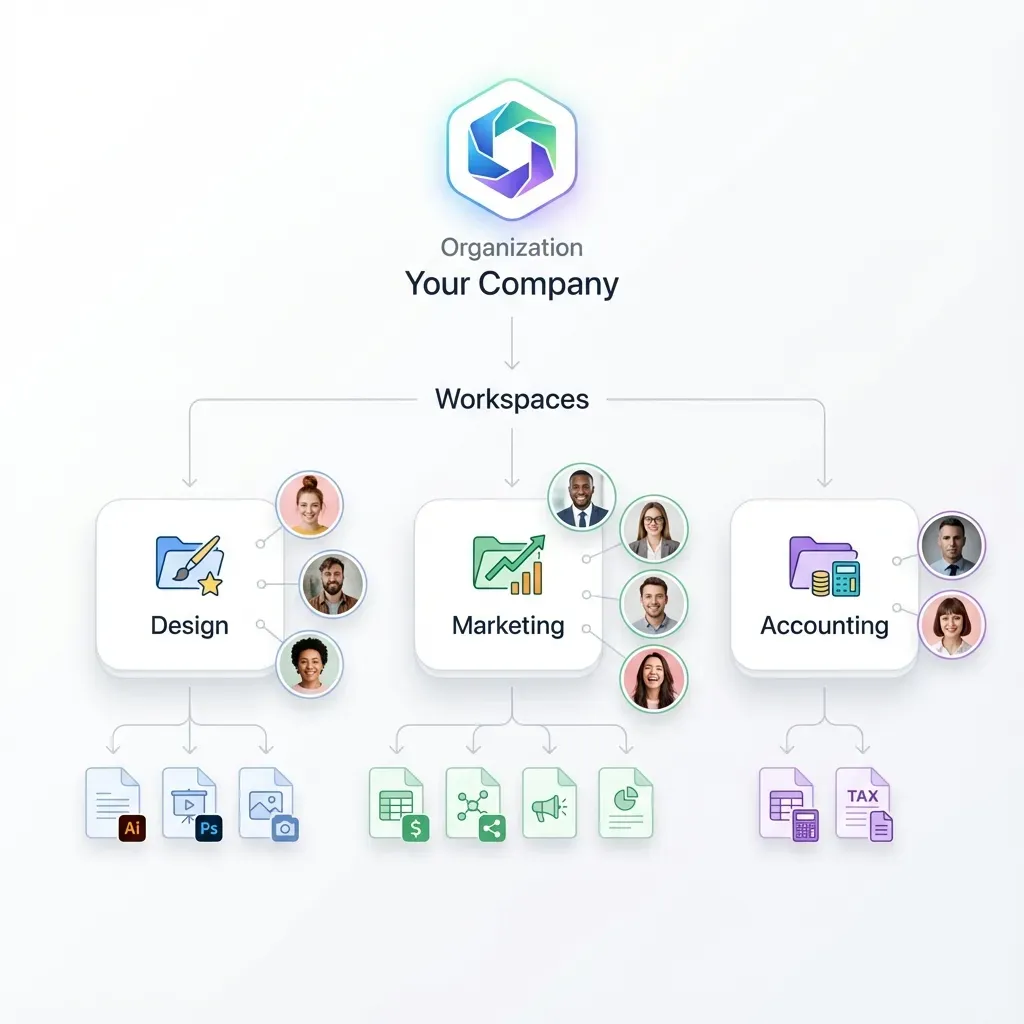
Granular access controls. Law firms handle confidential and privileged material. Your portal needs permissions at multiple levels: organization, workspace or matter, folder, and individual file. Associates working on one case should not see documents from another. Client-facing portals need separate permission boundaries.
Audit trails. Every access, download, search, and share must be logged. This is not optional for legal work. You need to know who viewed what, when, and what they did with it. Some matters require demonstrating chain of custody for documents.
Secure sharing. Clients, co-counsel, and experts need access to specific documents without getting access to your entire system. Look for branded portals with password protection, expiration dates, and download tracking.
Agent and API access. This is the feature gap most legacy platforms miss. AI agents that can read files, run searches, generate summaries, and hand results back to humans through a structured API open up workflows that manual tools cannot match. If you are evaluating portals in 2025 or 2026, agent support should be on your checklist.



Give Your Legal Team an AI-Powered Document Portal
Start with generous storage, semantic search, and AI chat over your case files. Connect AI agents through the MCP server for automated review workflows.
Setting Up a Law Firm Portal with Fastio
Fastio workspaces can serve as AI document portals for law firms. The platform combines file storage, built-in AI (called Intelligence Mode), and an MCP server that lets AI agents interact with your documents programmatically. Here is how the setup works.
Step 1: Create your organization and workspaces. Sign up at fast.io/pricing. The 14-day Business Trial (card required; see /pricing/) lets you create and evaluate case workspaces. Create one workspace per case or matter. Name them clearly: "Smith v. Jones - Discovery" or "Acme Acquisition - Due Diligence."
Step 2: Upload your documents. Drag and drop PDFs, Word documents, emails, and attachments into the workspace. For large discovery sets, use chunked uploads for files up to 25 GB on the Starter plan, 50 GB on Business or 100 GB on Enterprise. If documents live in Google Drive, OneDrive, Box, or Dropbox, use URL Import to pull them in without downloading locally first.
Step 3: Enable Intelligence Mode. This is the switch that turns a file storage workspace into an AI document portal. Once enabled, Fastio automatically indexes every uploaded file for semantic search, summarization, and citation-backed chat. Agent-created workspaces have Intelligence enabled by default. Note that once disabled, Intelligence cannot be re-enabled on that workspace, so plan accordingly.
Step 4: Test your queries. Try natural language searches: "What are the indemnification terms in the NDA with Acme Corp?" or "Summarize the key findings from the March 2024 deposition." Results come back with citations pointing to specific files, pages, and passages. This is the RAG (retrieval-augmented generation) pipeline working over your indexed documents.
Step 5: Set up permissions. Configure access at the workspace, folder, and file level. Give partners edit access, associates read access on sensitive materials, and create separate branded shares for client-facing delivery. Shares support password protection, expiration dates, and download controls.
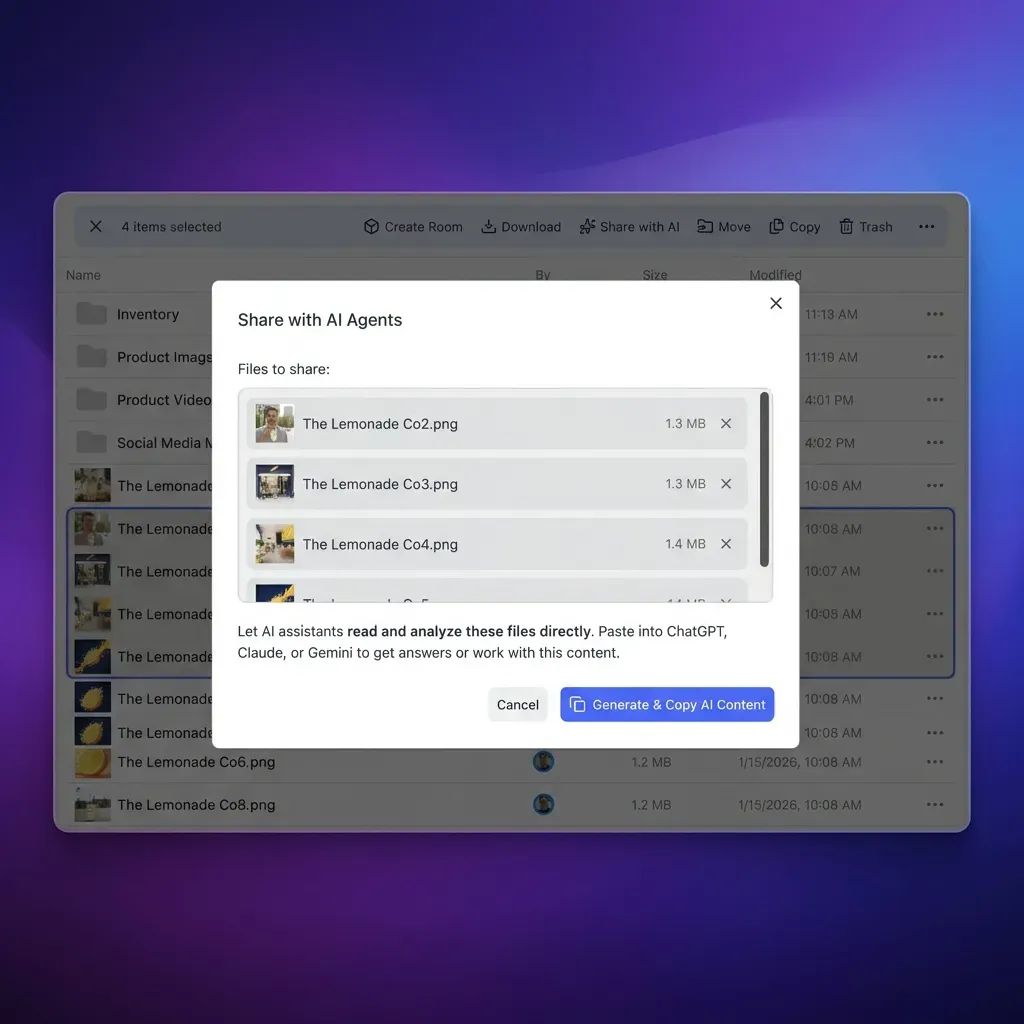
Step 6: Connect AI agents (optional). Fastio exposes an MCP server at mcp.fast.io with Streamable HTTP and legacy SSE endpoints. Agents can authenticate, search indexed documents, retrieve files, acquire advisory file locks before writing to coordinate safely, and hand off completed work to humans through ownership transfer. See the MCP documentation for the full tool surface.
Step 7: Monitor activity. Use audit trails to track every file access, search query, and share interaction. Poll the realtime activity feed or connect to the WebSocket events feed to monitor when new documents are uploaded or when clients access shared materials.
Practical Workflows for Legal Teams
Setting up the portal is the easy part. The real value comes from building it into your daily legal workflows.
E-Discovery Triage
Upload a discovery production into a dedicated workspace. Enable Intelligence Mode and let indexing complete. Now instead of assigning associates to manually review thousands of emails, start with AI-powered triage. Search for "communications between parties regarding breach of contract" or "documents referencing the settlement offer from June 2024." The semantic search catches relevant documents that keyword searches would miss because opposing counsel used different terminology.
Use AI chat to ask follow-up questions: "Which of these emails contain admissions of liability?" The system returns answers with citations you can verify. This does not replace human review for privilege determinations or relevance calls, but it dramatically reduces the volume that needs human eyes.
Contract Review and Comparison
Upload a set of vendor contracts, NDAs, or lease agreements. Ask the portal to identify documents with uncapped liability provisions, missing arbitration clauses, or non-standard termination terms. The semantic index understands legal concepts, so it catches variations in language that keyword searches miss.
For due diligence, upload the target company's contracts into one workspace. Agents can systematically review each document, flag risk areas, and generate a summary report. A partner reviews the flagged items rather than reading every contract from scratch.
Client Document Delivery
Create a branded share for each client matter. Upload the documents they need: finalized agreements, court filings, transaction summaries. The share has your firm's branding, requires a password, expires on a date you set, and logs every view and download. This replaces the email attachment chain that creates version confusion and leaves sensitive documents sitting in inboxes.
For ongoing matters, use a shared folder storage mode so the share stays in sync with your workspace. When you update a document in the workspace, the client portal reflects the change automatically.
Agent-Powered Review Workflows
This is where the gap in most competing platforms becomes obvious. Fastio's MCP server lets AI agents work directly inside your document portal. An agent can:
- Search the indexed workspace for specific legal concepts
- Retrieve and analyze individual documents
- Rely on version history and permissions while performing multi-step analysis to prevent conflicts
- Generate structured reports on findings
- Transfer ownership of completed workspaces to a partner or client
The agent works through the same permission system as human users. It only sees what you grant access to. Audit trails capture every agent action alongside human activity.
Security, Ethics, and Best Practices
Running an AI document portal at a law firm raises questions that do not come up in other industries. Attorney-client privilege, work product doctrine, and professional responsibility rules add requirements beyond standard enterprise security.
Access control is non-negotiable. Configure permissions before uploading any documents. Every workspace should have explicit access lists. Do not rely on security-through-obscurity or "nobody will look at that folder" assumptions. Fastio supports permissions at the organization, workspace, folder, and individual file level. Use all of them.
Audit everything. Enable and regularly review audit trails. For matters involving litigation holds or regulatory investigations, you may need to demonstrate exactly who accessed which documents and when. Fastio's event system logs file operations, AI queries, membership changes, and share activity.
Separate matters rigorously. Use one workspace per case or matter. Do not combine unrelated client materials in a single workspace, even if it seems convenient. Cross-contamination of confidential information between matters is both an ethical violation and a malpractice risk.
Verify AI outputs. AI summaries and search results are tools, not conclusions. Every AI-generated answer should be verified against the source documents before it goes into a brief, a client communication, or a court filing. The citation system makes this verification straightforward, but the responsibility stays with the attorney.
Be transparent with clients. If you are using AI tools to review client documents, your engagement letter or firm policies should address this. Some clients will welcome it. Others may have concerns about data handling. Either way, transparency protects the relationship and meets evolving bar association guidance on AI disclosure.
Start with a pilot. Pick one matter type where document volume is high and the risk profile is moderate. Run the AI portal alongside your existing workflow for a few weeks. Compare search accuracy, time spent on review, and error rates. Use those numbers to build the case for broader adoption.
Fastio provides security features including granular permissions, audit trails, two-factor authentication, and scoped API access. It does not currently hold compliance certifications such as SOC 2 or HIPAA, so evaluate whether your firm's specific compliance requirements need certified infrastructure.
Sources
References used to verify factual claims in this guide.
-
79% of legal professionals now use some form of AI
-
document management ranks as top operational pain point for 54% of firms data privacy concerns rank highest at 56%, cost at 47%, hallucination risks at 31%
-
lawyers using AI save between 1 and 10 hours per week, with 65% reporting 1 to 5 hours saved weekly
-
global legal AI software market reached $655 million in 2025
-
Legora Portal launching Q1 2026 with firms including Linklaters and Cleary Gottlieb
Frequently Asked Questions
What is an AI document portal for law firms?
An AI document portal is a centralized system that stores legal documents and indexes them using AI for semantic search, summarization, and citation-backed retrieval. Unlike traditional document management systems that rely on folder structures and keyword matching, AI portals understand document meaning and let attorneys search using natural language queries like 'find all NDAs with non-compete clauses from 2024.'
What are the benefits of AI for legal document management?
The primary benefits are faster document retrieval, reduced first-pass review time, and better accuracy catching relevant materials. Lawyers using AI tools report saving 1 to 10 hours per week on document-related tasks. AI also catches documents that keyword searches miss because it understands semantic meaning, not just exact matches. For client delivery, AI portals provide secure branded sharing with access tracking.
How does Fastio work as a law firm document portal?
Fastio workspaces serve as AI document portals when Intelligence Mode is enabled. Upload case files and the system automatically indexes them for semantic search and RAG-powered chat with citations. You get granular permissions at the org, workspace, folder, and file level, plus branded shares for client delivery. The MCP server lets AI agents search, retrieve, and analyze documents programmatically.
Can AI agents review legal documents?
Yes. AI agents connected through an MCP server can search indexed documents, retrieve specific files, generate summaries, and flag risk areas. Fastio's MCP server provides tools for file operations, AI queries, and workspace management. Agents work within the same permission system as human users. However, human attorneys must verify all AI-generated analysis before relying on it for legal conclusions.
Is Fastio secure enough for legal documents?
Fastio offers granular permissions, audit trails, two-factor authentication, and scoped API access. Every file operation, search, and share interaction is logged. However, Fastio does not currently hold compliance certifications such as SOC 2 or HIPAA. Firms should evaluate their specific compliance requirements when choosing any document platform.
What does an AI document portal cost for a law firm?
Fastio offers a 14-day Business Trial requiring a credit card, with paid plans starting at Starter ($9.99/mo; see /pricing/). Storage and seats come with the plan, and usage-based credits cover AI operations. This lets firms test the platform on real matters before committing to a paid plan.
How does AI document search differ from keyword search?
Keyword search finds exact text matches. AI semantic search understands meaning, so a query for 'liability limitation' also returns documents discussing 'cap on damages' or 'limitation of exposure.' AI search also returns citations to specific pages and passages, making it practical for legal research where you need to verify every result against the source.
Related Resources

Give Your Legal Team an AI-Powered Document Portal
Start with generous storage, semantic search, and AI chat over your case files. Connect AI agents through the MCP server for automated review workflows.