How to Design and Structure an AI Agent Workflow
A linear agent chain has no way to send work backwards. When the second agent gets incomplete input, it cannot ask the first one for more, so it either halts or invents the missing piece. That limitation is why production agent systems are graphs rather than chains. This guide explains how to design an AI agent workflow, manage state in shared workspaces, and coordinate specialized agents without read-write collisions.


Why Production Systems Need Graph-Based Agent Workflows
Production agent systems converge on graphs rather than chains, and the reason is a single missing capability. A linear chain routes work in one direction only. When developers build applications that rely on a single large language model (LLM) or a basic sequential chain, they quickly encounter reliability issues. A linear workflow routes a task from agent A to agent B in a single direction. If agent B encounters an error or receives incomplete input, it has no way to return the task to agent A for clarification. The process halts, or the system outputs low-quality results.
An AI agent workflow is a structured execution plan that defines how an autonomous agent parses inputs, queries tools, updates its state, and coordinates with other agents or humans. Designing this workflow around a graph structure represents a transition in how teams build AI systems. In a graph-based workflow, developers model agent actions as nodes and control transitions as edges. This architecture allows for cycles and feedback loops. For example, if a writing agent generates code that fails verification, the workflow routes the code back to the writing agent along with the console error logs. The writing agent inspects the logs, refactors the code, and submits it again. This self-correction loop continues until the verification node passes.
Shifting to graph-based agentic workflows design allows developers to set boundaries on agent behavior. Developers do not give the agent complete freedom to choose its next step. Instead, they define a network of permissible paths. The LLM manages the reasoning inside each node, while the graph structure ensures the system follows the correct sequence of operations. This combination of flexibility and structure is critical for building systems that can handle complex enterprise operations without human supervision.
Related guides
- Production-Ready Open Loop System Examples in AI Agent WorkflowsIn high-volume AI workflows, closed-loop validation is often too slow and expensive. Skipping the self-correction loop...
- How to Build an AI Agent Supervisor Pattern for Complex WorkflowsThe AI agent supervisor pattern provides a centralized management layer for coordinating multiple specialized worker...
- How to Design Multi-Tenant Architecture for AI AgentsMulti-tenant architecture lets one system serve many customers while keeping their data and files separate. As more...
- 10 Best AI Tools for Web Design in 2026Most professional web designers say AI is essential to their future, but few use it beyond basic tasks like copy...
- Best AI Interior Design Tools in 2026: Consumer Apps and Professional PlatformsAI room redesign tools now produce photorealistic renders in under 30 seconds, but most roundups lump hobby apps and...
- How to Design AI Agent Microservices Architecture PatternsMonolithic AI agents don't scale. Poor architecture kills many AI projects. Microservices split complex agents into...
More on this subject: Agent Frameworks and Patterns (52 guides)
Core Architectural Components of an Agentic Workflow
Building a production-grade agentic system requires defining the core components of the workflow graph. A graph contains nodes, edges, and a shared state object.
First, nodes represent the units of execution. A node can be an LLM call, a deterministic block of Python or TypeScript code, a database query, or a call to an external tool. In complex systems, a node can even encapsulate a nested multi-agent workflow. For example, a main coordinator graph might have a node that runs a research agent, which itself uses a sequential chain to scrape websites and format results. Developers keep nodes focused on single responsibilities, which makes debugging easier.
Second, edges define the control flow between nodes. Static edges connect nodes in a fixed order, while conditional edges determine the path dynamically. A conditional edge evaluates the current state of the workflow and routes the execution. If an agent completes a document analysis, a conditional edge evaluates whether the document met the formatting criteria. If it passed, the edge routes to the publishing node. If it failed, the edge routes back to the correction node.
Third, state management is the core mechanic of agentic workflows design. Unlike simple chatbots that rely on chat history, stateful agentic workflows maintain a structured, typed state object that persists across node executions. As the execution moves from node to node, each node reads from and writes to this shared state. The state object tracks the current task progress, the outputs of completed tools, and the path history. Keeping this state object clean prevents context window exhaustion, as agents only receive the specific variables they need to complete their current subtask.
Finally, the system requires a distinction between short-term execution state and long-term memory. Short-term memory lives in the transient state object during a single run. Long-term memory requires a persistent storage layer. Agents must be able to read and write files, access historical records, and query organizational knowledge across different execution runs. Without this persistence, agents lose context as soon as the session terminates, forcing developers to pass increasingly large contexts into the LLM, which raises costs and increases error rates.
How to Manage State and Shared Workspaces in Production
In production environments, managing the files and data that agents produce is a significant engineering challenge. Developers often start by using local storage or simple folder directories on a virtual machine. While this works for single-agent prototypes, it fails when scaling to multi-agent teams. Local file systems do not support real-time collaboration or remote human inspection. Moving files to an Amazon S3 bucket provides durable storage, but S3 lacks native file versioning, semantic search, and human-friendly preview interfaces. General consumer storage tools like Google Drive or Dropbox are designed for human office work. Their APIs are slow, lack real-time change events, and do not provide the structured data interfaces that agents require.
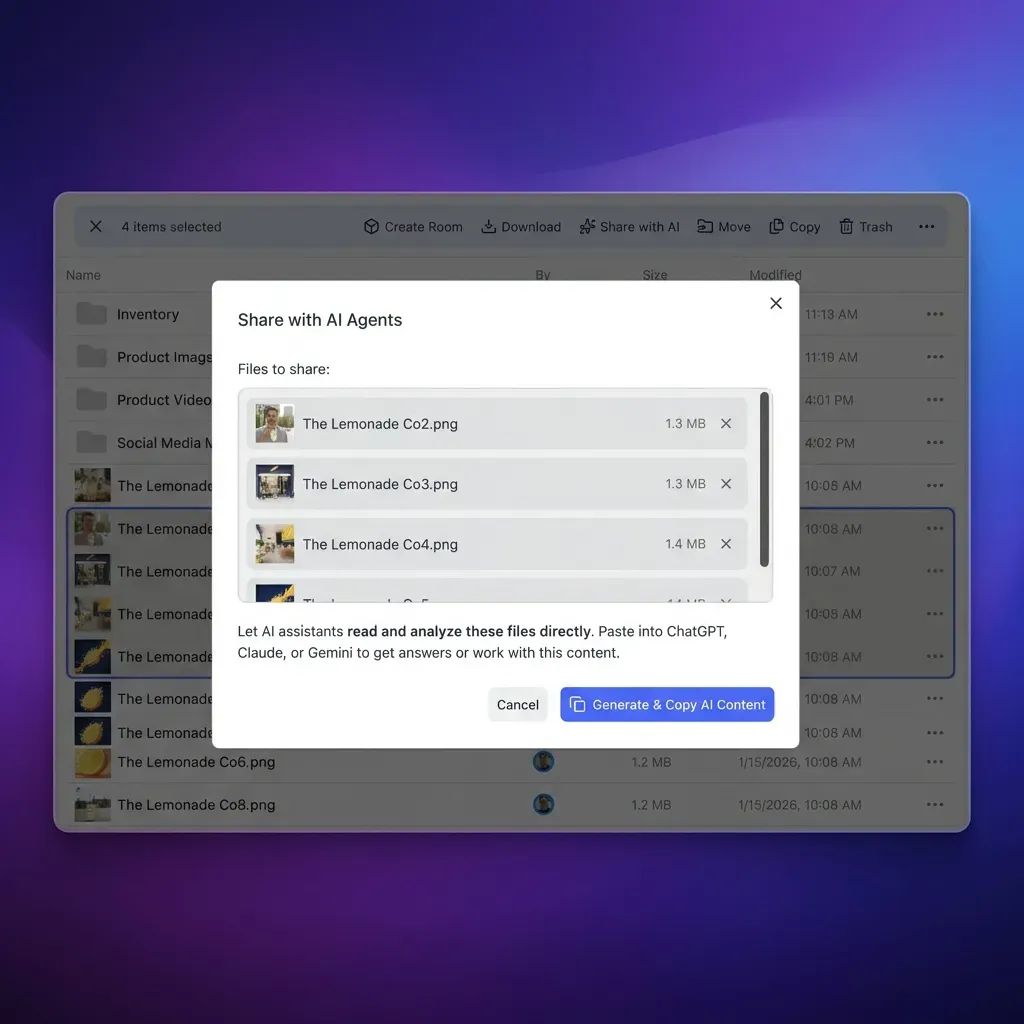
An intelligent workspace platform solves these coordination issues by providing a shared substrate for humans and agents. Fast.io functions as this coordination layer, offering org-owned workspaces where files are stored, versioned, and indexed automatically. Instead of setting up a separate vector database and building custom data ingestion pipelines, developers can enable Intelligence Mode on a Fast.io workspace. The platform automatically indexes all uploaded files for semantic and metadata-based search on arrival. When an agent needs to retrieve context, it queries the workspace through the Fast.io MCP server, which exposes tools via Streamable HTTP at /mcp and legacy Server-Sent Events (SSE) at /sse.
Fast.io supports structured document extraction through Metadata Views, which are documented on the Metadata Views Product Page. Metadata Views turn unstructured documents into a live, queryable database. Users describe the data fields they want to extract in natural language, and the system designs a typed schema. This schema supports seven distinct field types: Text, Integer, Decimal, Boolean, URL, JSON, and Date & Time. The system then processes files in the workspace, including PDFs, Word documents, scanned images, and handwritten notes, and populates a spreadsheet. Agents can create Views, trigger extraction, and query results via the MCP server. This structured extraction layer is distinct from Intelligence Mode: while Intelligence Mode handles semantic search and RAG Q&A, Metadata Views provide the typed data layer needed for programmatically validating document compliance.
To maintain coordination, the workspace provides per-file version history and a detailed activity log. If multiple agents write to the same file concurrently, the platform records every change as a separate version, so concurrent writes never lose earlier work. All actions are logged to the activity feed and audit trail, allowing developers to trace which agent modified a file and when. This persistent history ensures that the workflow remains auditable and that teams can restore prior versions if an agent misbehaves.


Build Your Agentic Workspaces on Fast.io
Get started with a trial of up to 14 days on a monthly Starter, Business, or Enterprise plan to access Model Context Protocol tools, persistent version history, and workspace intelligence.
Designing Branching, Loopbacks, and Self-Correction Patterns
Branching and looping are the features that separate modern agent workflows from basic scripts. When designing an agentic system, developers must plan how the control flow branches based on data inputs, and how the system corrects errors through loopbacks.
Branching logic allows a workflow to handle diverse tasks. The system uses a routing node that inspects the incoming file or state and selects the appropriate path. For example, in an email processing workflow, the routing node reads the incoming message. If the email is a billing inquiry, the graph routes the message to the finance agent. If the email contains a bug report, the graph routes it to the engineering workspace. Implementing this logic requires clear evaluation criteria inside the routing node, ensuring the LLM or code-based parser outputs a predictable classification.
Loopbacks are essential for implementing self-correction patterns. In a typical self-correction loop, a generation node creates an asset, such as a code file or a structured data view. The execution flow then moves to a validation node. The validation node runs a deterministic check, such as executing a test suite, running a linter, or verifying a typed JSON schema. If the validation passes, the workflow routes to the completion node. If the validation fails, the conditional edge routes the execution back to the generation node, passing the error logs along as context. The generation node uses this feedback to correct its work and submits a new draft.
To prevent infinite execution loops, such as when an agent repeatedly fails a validation and continues running indefinitely, developers must implement strict guardrails. The workflow's shared state object must include a retry counter variable. Before routing the execution back to a generation node, the validator node increments this counter. If the counter exceeds a pre-defined threshold, such as three retries, the workflow halts and logs the event to the shared workspace activity feed. This alerts human team members to intervene, preventing runaway API costs and ensuring that systemic bugs are addressed.
Steps for Transferring Workspace Ownership to Human Teams
Autonomous agents are highly efficient at setting up structures, importing documents, and performing initial analysis, but production systems eventually require human oversight. Designing a clean handoff pattern ensures that human teams can review agent output, manage subscriptions, and take control of the project workspaces when needed.
Handoffs are managed through file persistence and real-time co-editing. In an intelligent workspace, agents and humans collaborate inside the same directories. Rather than sending files over email or messaging apps, the agent writes its output to a shared workspace folder. Humans can review the work directly, inspect the per-file version history to see prior drafts, and leave feedback. Through Collaborative Notes, human developers and AI assistants can co-edit document outlines and project specifications in real time. This joint editing environment allows humans to correct the agent's direction before it starts executing code or generating reports.
When an agent builds a workflow for a client, it can initialize the entire workspace structure independently. The agent creates the organization, imports files from cloud services using URL imports, and sets up the Metadata Views. Once the workspace is ready, the agent generates an ownership transfer link. The agent sends this link to the human supervisor, who clicks the link to assume ownership of the organization.
After the transfer, the human supervisor manages the organization's subscription and billing. Fast.io offers three paid plans with seats, storage and monthly credits included, and monthly plans start with a trial of up to 14 days that requires a credit card. The subscription tiers include:
- The Starter plan, which provides 250 GB of storage and 100,000 credits for $9.99 per month.
- The Business plan, which provides 5 TB of storage and 600,000 credits for $49.99 per month.
- The Enterprise plan, which provides 25 TB of storage and 3,000,000 credits for $199.99 per month.
Once the human takes ownership, the agent can continue working as a workspace administrator or member. The human retains full control over permissions and billing, while the agent's actions remain tracked in the activity log. This audit trail records every file read, write, and permission change. If the agent makes an error, the team can review the log to see exactly what happened and restore the prior version from the file history, ensuring that the system remains safe and accountable.
Frameworks and Tools for Implementing Agentic Workspaces
Implementing a graph-based agent workflow requires choosing the right software framework. Developers have access to several specialized frameworks that simplify the creation of stateful agent graphs.
First, LangGraph is the industry standard for building complex, stateful, and cyclic multi-agent systems. Built on top of the LangChain ecosystem, LangGraph allows developers to define nodes as Python or TypeScript functions and edges as control flow paths. Its support for persistence and checkpointing means that developers can pause graphs, save state to a database like Redis, and resume execution without losing progress.
Second, the Microsoft Agent Framework is a popular choice for enterprise environments. It combines the multi-agent patterns of AutoGen with Microsoft's enterprise telemetry and session management. This framework is ideal for teams building workflows within a corporate infrastructure.
Third, CrewAI offers a role-based approach, mapping agents to specific human-like roles and coordinating their execution. Finally, Mastra is a TypeScript-native framework gaining traction for its developer experience and simple primitives.
Regardless of the framework you choose, the orchestration layer must connect to a persistent storage layer. These frameworks do not provide built-in file synchronization, versioning, or human collaboration interfaces. Developers connect their agent graphs to Fast.io workspaces using the Model Context Protocol (MCP). The Fast.io MCP server exposes Streamable HTTP at /mcp and Server-Sent Events (SSE) at /sse, allowing agents to query files, read documents, and write results back programmatically. Developers can learn more about configuring these connections in the Fast.io MCP Server Guide.
By configuring your agent framework to use Fast.io as its MCP database, you ensure that your agents have a shared, versioned workspace to store their files and state. This setup allows your AI agents, regardless of the underlying LLM, to collaborate with each other and with human team members, building a reliable foundation for your production AI agent workflow.
Sources
References used to verify factual claims in this guide.
-
Graph-based orchestration lets a downstream agent return a task upstream for clarification, which a linear chain cannot do. LangGraph models agent systems as stateful graphs rather than linear chains.
Frequently Asked Questions
How do you build an AI agent workflow?
Building an AI agent workflow requires defining a structured graph of execution. Developers design this by creating nodes for specific tasks (such as document analysis or code generation), mapping the control flow with conditional edges, and establishing a shared state object that passes variables between nodes.
What are the best frameworks for agentic workflows?
The best frameworks for stateful agentic workflows include LangGraph, Microsoft Agent Framework, CrewAI, and Mastra. LangGraph is widely used for cyclic graphs and checkpointing, while Mastra provides a TypeScript-native environment for building agent workflows.
How do you maintain state in agent workflows?
Maintaining state in agent workflows requires a central, typed state object that persists across node executions. For long-term file and database storage, developers connect agent frameworks to shared workspaces using the Model Context Protocol (MCP) to manage files, version histories, and metadata views.
Related Resources

Build Your Agentic Workspaces on Fast.io
Get started with a trial of up to 14 days on a monthly Starter, Business, or Enterprise plan to access Model Context Protocol tools, persistent version history, and workspace intelligence.