How to Point AI Agents at Google Files: APIs vs. Agent Rooms
Exposing Google Files to AI agents requires dynamic document conversion into LLM-friendly formats like markdown and caching in a shared workspace. Developers typically choose between direct API integration and collaborative Agent Rooms. While raw APIs offer low-level control, they introduce parsing overhead and OAuth complexity. This guide explains how to use Fastio to import, index, and securely expose documents to developer agents.


Why Raw Google Files create a Context Bottleneck for AI Agents
A large share of corporate document intelligence lives inside Google Workspace. However, developers attempting to expose these documents to autonomous LLM agents face an immediate extraction bottleneck: Google Docs JSON structures contain extensive formatting and style indices that heavily bloat context windows compared to clean markdown representation, increasing API costs and causing retrieval degradation.
When searching for google files, the first results frequently point to Files by Google, the Android file management app. But for software engineers, systems architects, and AI developers, the phrase google files refers to a programmatic challenge: how to extract content from Google Docs, Google Sheets, and Google Slides to feed an AI agent's context window.
Exposing Google Files to AI agents requires dynamic document conversion into LLM-friendly formats (like markdown or JSON) and caching in a shared workspace.
To resolve this challenge, developers typically choose between two paths: direct integration via raw Google Workspace APIs or deploying collaborative agent rooms. Each path has distinct trade-offs for context efficiency, authentication complexity, and multi-agent coordination within a shared intelligent workspace.
Related guides
- File Storage vs Block Storage for Multi-Agent ArchitecturesFile storage organizes data hierarchically in directories and files for concurrent multi-client access, whereas block...
- Google Drive File Size Limits: Workarounds for AI Agent WorkspacesGoogle Drive limits individual file uploads to 5TB and daily uploads to 750GB, which can easily freeze multi-agent...
- How to Fix 'File Too Large for Destination File System' in Agentic WorkspacesThe file too large for destination file system error interrupts AI agents working in containerized environments. This...
- Google Gemini Context Window: Token Limits, Architecture, and Handling Large FilesThe Google Gemini context window spans 1,048,576 input tokens and 65,536 output tokens on current Gemini 3 models such...
- Google Drive RAG: How to Build Retrieval-Augmented Generation Over Drive FilesGoogle Drive RAG is an architecture where AI agents retrieve relevant document chunks from Google Drive storage using...
- Google NotebookLM Context Window: Source Limits, Token Math, and WorkspacesNotebookLM was renamed Gemini Notebook on 16 July 2026. The Gemini Notebook context window combines Gemini's...
More on this subject: Agent Memory and Storage (263 guides)
How to programmatically extract text via Google Docs and Drive APIs
For developers building custom agent loops, the standard starting point is direct integration with the google doc api and Google Drive API. This approach requires establishing an authenticated pipeline to read files directly from the cloud and extract their text content.
To programmatically perform a google files download, you must use the Google Drive API files.export method rather than the Google Docs API. The Docs API is designed for structural edits, whereas the Drive API handles conversion and exporting.
A typical implementation in a Node.js environment involves configuring an OAuth client and fetching the document stream in a raw text or HTML format. Below is a TypeScript example demonstrating how to export a document as plain text:
import { google } from 'googleapis';
import * as fs from 'fs';
async function downloadGoogleFileAsText(fileId: string, authClient: any): Promise<string> {
  const drive = google.drive({ version: 'v3', auth: authClient });
  try {
    const response = await drive.files.export({
      fileId: fileId,
      mimeType: 'text/plain',
    }, { responseType: 'stream' });
    return new Promise((resolve, reject) => {
      let data = '';
      response.data
        .on('data', chunk => {
          data += chunk;
        })
        .on('end', () => {
          resolve(data);
        })
        .on('error', err => {
          reject(err);
        });
    });
  } catch (error) {
    console.error('Error exporting file:', error);
    throw error;
  }
}
While exporting as plain text is straightforward, it strips out document structures such as tables, headers, and bullet points, which are essential for LLM understanding. To preserve this structure, developers must export the file as HTML and convert it to clean markdown.
Below is an example of fetching the document using the google doc api to parse its JSON structure directly, allowing you to extract structured text elements:
import { google } from 'googleapis';
async function extractTextFromGoogleDocJson(documentId: string, authClient: any): Promise<string> {
  const docs = google.docs({ version: 'v1', auth: authClient });
  const doc = await docs.documents.get({ documentId });
  let extractedText = '';
  if (doc.data.body && doc.data.body.content) {
    for (const element of doc.data.body.content) {
      if (element.paragraph && element.paragraph.elements) {
        for (const part of element.paragraph.elements) {
          if (part.textRun && part.textRun.content) {
            extractedText += part.textRun.content;
          }
        }
      }
    }
  }
  return extractedText;
}
Although direct API calls provide granular control, they present significant scaling challenges:
OAuth Management: Your system must safely handle user-scoped access tokens, token refreshing, and security boundaries for every user document.
Context Spikes: A raw Google Doc JSON response is extremely verbose, containing margins, text styles, and color metadata. Passing this directly to an agent consumes unnecessary tokens and degrades reasoning accuracy.
Limited Handoff and Versioning: If an agent writes modifications back to a document, the process requires submitting complex structural insert commands via the google doc api. This makes tracking version changes and managing human review loops difficult to implement from scratch.
Converting HTML and Document Formats to Markdown
When retrieving documents through direct API methods, raw text strips formatting while HTML returns overly verbose web tags. To optimize for LLM reasoning, developers convert the exported HTML stream into clean markdown. This conversion preserves structural semantic indicators like headings, lists, tables, and hyperlinks, while stripping styling nodes, class names, and layout parameters. Using utilities like MarkItDown or custom markdown compilers helps reduce token usage, keeping context windows clean and preventing retrieval models from failing due to parsing noise.
OAuth Scope Management and Security Boundaries
Exposing Google Workspace files programmatically requires broad read permissions. Scopes such as documents.readonly and drive.readonly allow the authentication client to access all matching user documents. Managing these tokens securely is complex, as custom API servers must handle encrypted token storage and rotation. If an agent compromises an OAuth key, the security breach covers the user's entire connected drive. Restricting agent scopes to specific workspace boundaries requires custom routing logic and proxy servers, adding massive developer overhead. Instead of building custom routing proxies, developers can deploy a unified cloud import gateway.
How to expose Google Files to Agents via Collaborative Rooms
To bypass the complexity of custom API endpoints and parsing pipelines, teams are deploying Agent Rooms. An Agent Room is a shared, neutral workspace where human team members and AI agents interact, read, write, and share files. In this architecture, instead of the agent connecting directly to Google Drive, the workspace acts as an intelligent intermediary.
Rather than building custom parsing code for every file type, developers can use a collaborative platform like Fastio. Fastio provides shared workspaces where agents and humans share the same file context, with plans that include seats plus usage-based credits.
By using the cloud import feature, files can be imported directly from Google Drive using OAuth, preserving folder structure without local network overhead. Once imported, the files are handled by Fastio's intelligent storage layer:
Intelligence Mode: When enabled, files are automatically indexed for semantic search, summarization, and citation-backed chat. This allows agents to execute queries using hybrid search, which combines exact full-text matching with semantic meaning retrieval.
Metadata Views: Unlike simple vector search, Metadata Views act as a structured extraction layer that turns documents into a live, queryable database. Users describe the fields they want extracted in natural language, and Fastio's AI designs a typed schema (such as Text, Integer, Decimal, Boolean, URL, JSON, Date & Time). The system matches files in the workspace and populates a sortable spreadsheet. Agents can query these structured views programmatically via the Model Context Protocol (MCP) server, completely avoiding manual regex or layout extraction code. Let's explore how Metadata Views function on the document data extraction product page.
Multi-Agent Access: Agents from different frameworks, including Claude Code, Codex, Cursor, Gemini, OpenClaw, CrewAI, LangGraph, and AutoGen, can connect to Fastio via the MCP server. Fastio exposes Streamable HTTP at
/mcpand legacy SSE at/sse. This means agents can read, write, and update files using the exact same folder structure and permissions as human teammates.Versioning and Auditing: Every file keeps a full version history. If an agent writes an output or updates a document, human team members can view the exact changes, review the version history, and revert updates if necessary. This keeps all autonomous actions fully auditable.
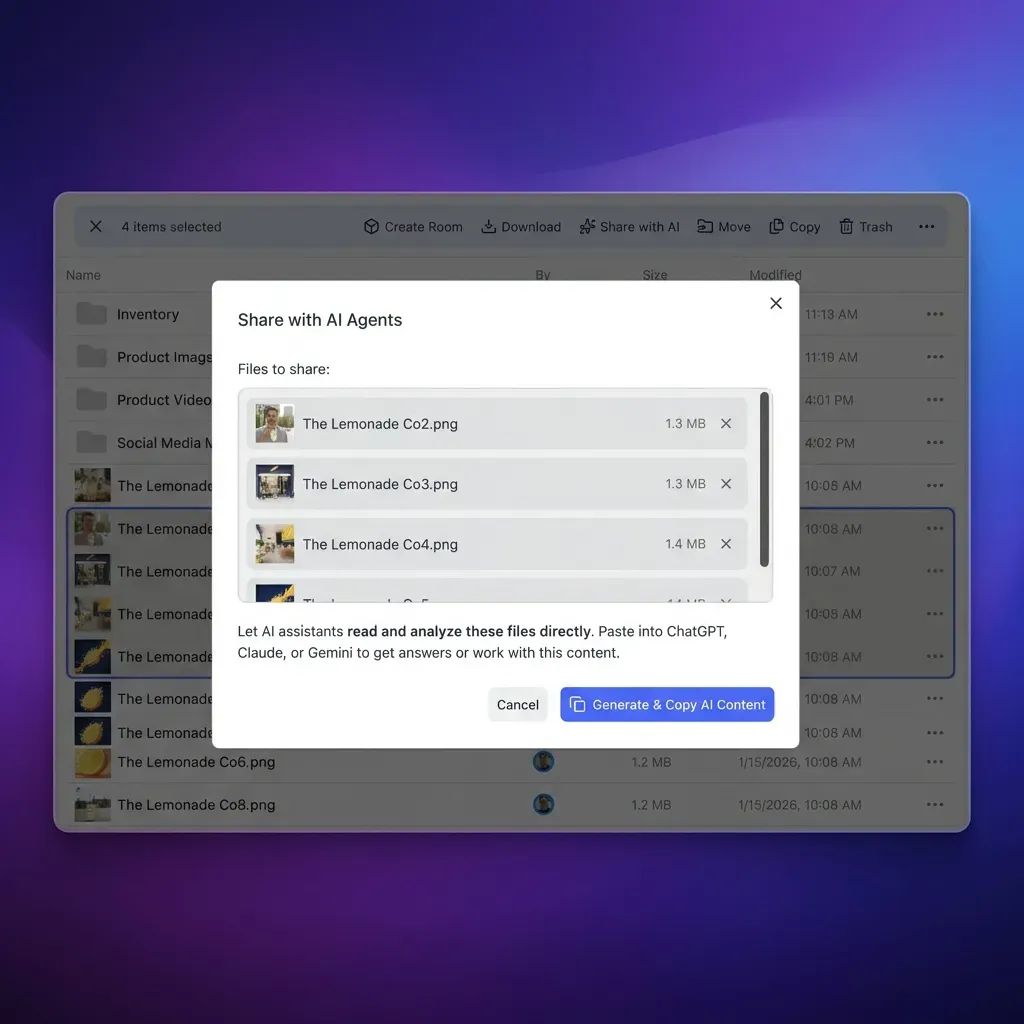
MCP Integration Architecture: Connecting Agents to Rooms
The Fastio MCP server standardizes how agents interact with workspace files. Exposing Streamable HTTP at the /mcp endpoint and Server-Sent Events (SSE) at the /sse endpoint, the server provides agents with a unified toolset. Instead of writing custom API integration scripts for each agent, developers hook their systems into the MCP endpoint. The agent receives a list of tools to list workspaces, read folders, download files, and query metadata views. This interface works with any LLM, allowing developers to switch models without rewrites. To implement this architecture, consult the agent storage configuration guide.
Structured Data Extraction with AI-Driven Metadata Views
Extracting structured variables from documents is a major bottleneck in traditional pipelines. Fastio resolves this with Metadata Views, which turn unstructured files into a queryable data grid. Users specify columns in plain English, and the system designs a typed schema supporting text, numbers, booleans, dates, and JSON. When files are imported, the model automatically populates the grid. Agents query this grid directly via the MCP server. For example, an agent can query the grid for all unsigned agreements with renewal dates before next month, bypassing HTML parsing or document scanning.


Expose your Google documents to AI agents programmatically
Create a shared Fastio workspace with a built-in MCP server, enabling your agents to read files, run semantic search, and extract schemas with versioning and human audit controls. Monthly plans start with a Business Trial of up to 14 days (credit card required); annual plans have no trial.
Compare Direct Workspace APIs vs. Agent Rooms
For teams deciding on an implementation architecture, the choice depends on setup time, security constraints, and how agents collaborate with humans. Below is a detailed comparison of direct API integration against deploying collaborative Agent Rooms:
If you are building a simple, single-purpose script that reads a specific Google Doc, direct API calls using the Google Drive API are suitable. However, if you are coordinating multiple agents, require human verification, or need to extract structured data from hundreds of documents, using a shared Agent Room saves significant engineering overhead.
Step-by-Step Guide: Setting Up Fastio and MCP Agent Workflows
Exposing files to your agentic workflows using Fastio takes only a few minutes. Below is the step-by-step process for importing Google files, exposing them via the Model Context Protocol, and establishing human review loops.
Step 1: Initialize Your Fastio Organization
Before running agent workloads, you must establish an organization. Follow these setup steps:
Create a user account on the Fastio website. Performing active work requires an organization on a paid subscription or active trial.
Start the 14-day Business Trial for your organization, which requires a credit card. Choose a plan that matches your storage requirements:
- Starter Plan: $9.99 monthly (or $99 per year) with 250 GB of storage and 100,000 monthly credits.
- Business Plan: $49.99 monthly (or $499 per year) supporting 10 seats, 5 TB of storage, and 600,000 monthly credits.
- Enterprise Plan: $199.99 monthly (or $1,999 per year) supporting 30 seats, 25 TB of storage, and 3,000,000 monthly credits.
Developer Setup Flow: An agent can create an organization and build out the workspace, folder structures, and Metadata Views. Once complete, the agent performs an ownership transfer, handing the organization over to a human admin via a claim link. The human admin then enters their billing credentials to start the paid subscription.
Step 2: Import Your Google Files
To bring files into the workspace:
In the Fastio dashboard, select your target workspace and choose Cloud Import.
Authenticate with your Google account via OAuth.
Select the folders or specific documents you need to expose. The platform imports them directly from Google Drive, preserving the folder hierarchy. Once Intelligence is enabled for the workspace, Ripley indexes these files on arrival, making them ready for semantic search and summarization.
Step 3: Connect Your Agent via MCP
To expose the imported files to your agent:
In your agent's configuration file (such as for Claude Code, Cursor, or Cline), add the Fastio MCP server.
Fastio exposes the server via Streamable HTTP at the
/mcpendpoint and legacy Server-Sent Events (SSE) at the/sseendpoint.Provide the agent with a long-lived scoped API key generated from the Fastio developer console. This key limits the agent's access to the specific workspace or folder containing your files.
Step 4: Extract Structured Data Using Metadata Views
If your imported Google Files contain invoices, contracts, or structured sheets:
Create a new Metadata View in the workspace.
Define the columns using natural language. For instance, you can type: 'Extract the contract expiration date and the total value'.
Fastio's AI designs the typed schema with field types (Text, Integer, Decimal, Boolean, URL, JSON, Date & Time), matches the files, and extracts the variables.
The agent queries this structured database via the MCP server using standard semantic filters, bypassing the need to read entire raw files or write custom scraping code.
Step 5: Configure Event Feeds and Handoffs
To complete the loop, set up these handoffs:
Connect to the WebSocket events feed or poll the realtime activity feed to notify your own systems whenever an agent uploads a new file or modifies an existing document.
When the agent completes a task, it can write the output to a Collaborative Note or generate a PDF file.
Create a branded share link (Send, Receive, or Exchange) to distribute the file. You can configure the share to be durable or set it to expire, and grant or revoke access on a per-recipient basis.
Configuration Snippet for MCP Agent Integration
Connecting your developer agent to Fastio is achieved by updating your agent's configuration file. Below is a sample .mcp.json configuration for Claude Code, directing the agent to use the Streamable HTTP endpoint (for setup steps, see the Fastio documentation):
{
  "mcpServers": {
    "fastio": {
      "type": "http",
      "url": "https://mcp.fast.io/mcp/code"
    }
  }
}
Then run /mcp inside Claude Code to sign in.
Setting Up Expiring Client Shares and Webhooks
For automated file delivery, Fastio workspaces support dynamic shares alongside realtime event feeds. Rather than relying on traditional webhooks, teams can listen to the WebSocket events feed or poll the realtime activity feed whenever files are created, modified, or updated. Once your agent finishes compiling the output, you can create a branded share. The share can be set with a custom expiration limit and restricted to specific recipients. The recipient receives the file via a web view with full download controls, keeping file exchanges private and compliant. Start the 14-day Business Trial on the Fastio pricing page.
Sources
References used to verify factual claims in this guide.
-
Google Docs JSON structures contain extensive formatting and style indices that heavily bloat context windows compared to clean markdown representation, increasing API costs and causing retrieval degradation.
-
To programmatically perform a google files download, you must use the Google Drive API files.export method rather than the Google Docs API.
-
Fastio exposes the server via Streamable HTTP at the `/mcp` endpoint and legacy Server-Sent Events (SSE) at the `/sse` endpoint.
-
Start the 14-day Business Trial for your organization, which requires a credit card. Starter Plan: $9.99 monthly (or $99 per year) with 250 GB of storage and 100,000 monthly credits. Business Plan: $49.99 monthly (or $499 per year) supporting 10 seats, 5 TB of storage, and 600,000 monthly credits. Enterprise Plan: $199.99 monthly (or $1,999 per year) supporting 30 seats, 25 TB of storage, and 3,000,000 monthly credits.
Frequently Asked Questions
Can AI agents read Google Docs?
AI agents cannot read raw Google Docs directly because Google Workspace uses a proprietary web-document format. To expose them, you must use the Google Drive API to export the document as a plain text or HTML stream, or import the files into an intelligent workspace like Fastio. Fastio automatically converts the documents into clean markdown, enabling agents to parse and interact with the content via the Model Context Protocol.
How do I convert Google Files to markdown for Claude?
To convert Google files to markdown, you can programmatically download the document as HTML using the Google Drive API files.export method and then pass the output through an HTML-to-markdown library such as Turndown. Alternatively, importing files directly into a Fastio workspace performs this conversion automatically, indexing the content for semantic search and presenting it to Claude via a unified MCP interface.
What is the best way to expose Google Workspace files to agents?
The best way to expose Google Workspace files to agents is to use a shared workspace environment that serves as a cached, version-controlled layer. Instead of granting your agent direct access to your entire Google Drive via raw API tokens, you can import target folders into a Fastio workspace. This provides your agent with a secure, MCP-compatible endpoint for reading and writing files while maintaining a complete audit history and allowing human review of all changes.
Related Resources

Expose your Google documents to AI agents programmatically
Create a shared Fastio workspace with a built-in MCP server, enabling your agents to read files, run semantic search, and extract schemas with versioning and human audit controls. Monthly plans start with a Business Trial of up to 14 days (credit card required); annual plans have no trial.