How to Use the Devin IDE to Review and Take Over Agent Work
Nubank reported 8-12x engineering efficiency and over 20x cost savings when people reviewed Devin's changes instead of hand-migrating every class. That handoff only works if you can see live edits, pause cleanly, take over the Devin IDE, and resume with a clear note of what you fixed.


What the Devin IDE is and why takeover matters
Nubank's published case study on Devin reported an 8-12x engineering time efficiency gain and over 20x cost savings when engineers reviewed Devin's changes, made minor adjustments, and merged pull requests instead of hand-migrating every data class. That outcome only holds if the human side of the loop can inspect live diffs, stop conflicting edits, and take over the agent machine without starting over.
The Devin IDE is an interactive VS Code environment inside a Devin session. Official Cognition docs describe it as a fully featured editor loaded with your repos, where you watch code changes in real time, touch up files, run tests, and then resume autonomous work. It is not a separate product you install first. It is one of three session tools (Shell, IDE, and Interactive Browser under the Desktop tab) that ship with every Devin run.
Cognition's Devin 2.0 announcement framed this surface as an agent-native IDE: each parallel Devin gets its own interactive, cloud-based IDE so you can multitask across sessions, step in when needed, and edit with familiar shortcuts such as Cmd/Ctrl+I and Cmd/Ctrl+K. That product bet is the reason this guide exists. Most coverage still describes Devin as a black-box AI engineer. Few articles walk through monitor, pause, take over, test, inform, and resume as a disciplined workflow.
How the Devin IDE differs from local VS Code
Your local editor and the Devin IDE share muscle memory (tabs, jump to definition, autocomplete), but they sit in different places:
- Local VS Code edits your machine or a repo you already cloned. Extensions like Devin Sessions can list cloud runs and open diffs, but the files still live outside Devin's sandbox unless you SSH in.
- Devin IDE runs on Devin's cloud machine with the session's repos already loaded. Edits, terminals, and test runs share the same environment Devin is using.
- Takeover is deliberate. You stop or pause the agent so you and Devin are not writing the same files at once.
Treat the session IDE as pair programming with a remote coworker who types very fast. You stay responsible for direction, conflict avoidance, and durable delivery of the result.
Related guides
- Claude Code Review: How to Use /code-review and UltrareviewClaude Code ships a built-in /code-review command that scans diffs for correctness bugs and improvement opportunities...
- Best OpenClaw Workflows for AI Code ReviewOpenClaw's skills ecosystem includes several code review tools that analyze pull requests, scan for security...
- How Devin AI Sessions Work: Shell, IDE, Browser, and ProgressDataForSEO records about 50 US monthly searches for "devin session," with related interest in shell and browser tools...
- How to Try Devin AI for FreeA Devin AI free trial is Free at $0 per month with limited agent usage, not a short coupon clock. Pro starts at $20 per...
- How to Use Devin AI: A Developer's Getting Started TutorialLearn how to use Devin AI as an autonomous software engineer to solve coding tickets from scratch. This developer...
- How to Install and Use the Devin AI CLICognition positions Devin AI CLI as a local coding agent that runs on your machine, separate from cloud Devin in a VM....
More on this subject: Devin (103 guides)
Session tools around the IDE
Before you live in the IDE, know how it sits next to Shell and Desktop. Cognition's session tools documentation puts all three under a Progress tab so shell commands, code edits, and browser activity share one timeline.
Shell
Shell shows every command Devin ran, with output previews, copy actions, and time navigation. Greyed-out commands are later in the session; click earlier ones to reconstruct how Devin arrived at a failing test or a bad install. When you take over the machine, terminals can switch from read-only to writable so you can run diagnostics yourself.
Use Shell when the question is "what did Devin try?" Failed package installs, wrong working directories, and flaky test loops show up faster in command history than in chat text.
Devin IDE
The IDE answers "what files changed and can I fix them here?" You open files in new tabs, review diffs, generate terminal commands with Cmd/Ctrl+K, ask quick edit questions with Cmd/Ctrl+I, and use tab autocomplete. Official best practices say pause Devin before you take over, then tell Devin what you changed when you resume.
Desktop (Interactive Browser)
The Desktop tab is the interactive browser (and full desktop) for visual checks, local app testing, CAPTCHA, MFA, and OAuth flows Devin cannot finish alone. Cookies persist for the rest of the session after you authenticate once. Use Desktop when the failure is in the UI or an auth gate, not in a pure code path.
Progress tab as the control room
Click any step in Progress to see shell, edits, and browser activity for that step. A practical review order:
- Scan Progress for steps that look off-track.
- Open shell history for that step if tests or installs failed.
- Open the IDE for the files Devin touched.
- Open Desktop only if you need visual or auth intervention.
Parallel execution is normal. Devin can run shell commands while reading files and using the browser. That speed is useful until two writers collide on the same path. Progress helps you spot the collision early.

Review and takeover workflow in the Devin IDE
This is the workflow most product pages skip. Use it when Devin is mid-task and you need human judgment without throwing away the session.
1. Monitor diffs and progress without interrupting
Start the session and let Devin produce a few progress steps. Watch the IDE as files open and change. Prefer reading the diff view and Progress notes over retyping the whole plan. Early red flags:
- Devin is editing the wrong package or monorepo folder
- The same failing test command repeats in shell history
- Scope expands into unrelated files
- The plan diverges from the acceptance criteria you set in Interactive Planning
Devin 2.0's Interactive Planning path matters here. When a session starts, Devin can return relevant files and a preliminary plan quickly so you can correct course before autonomous work burns ACUs. If you skipped planning and the first diffs already look wrong, intervene now rather than after a messy PR.
2. Pause or stop the agent before you type
Official IDE best practices are explicit: make sure Devin is paused before you take over the IDE so you avoid simultaneous, conflicting changes. Do not "help" by editing a file while Devin is still writing it. That is how you get half-applied refactors and confused resumes.
Click to stop or pause the session, then confirm the agent is no longer actively editing before you open a terminal or save your own changes.
3. Take over the IDE
After the pause:
- Open the files you need from the repo tree or from Progress-linked edits
- Use jump to definition and search as you would locally
- Toggle terminals from read-only to writable when you need to run commands
- Use Cmd/Ctrl+K for natural-language terminal help and Cmd/Ctrl+I for short edit questions
Keep the takeover focused. Fix the broken path, the bad assumption, or the missing test, not every stylistic nit. The goal is a clean state Devin can continue from, not a full human rewrite of the branch.
4. Test inside the same environment
Run the same checks Devin should have run: unit tests, typecheck, lint, or a local server. Use Desktop to open a local build when the task is frontend. Screenshots and browser recordings can document visual QA before you hand control back.
Prefer testing on Devin's machine over "it works on my laptop." Environment drift is a common reason agent PRs fail CI after a human-only local pass.
5. Inform Devin what you changed
Before resume, write a short note in the session chat. Good notes include:
- Files you edited and why
- Commands you ran and their outcomes
- Constraints Devin missed (API version, branch policy, feature flag)
- What you want Devin to do next
Official docs call this out as a best practice: let Devin know about your changes when you resume. Without that handoff, Devin may reapply a discarded approach or overwrite your fix.
6. Resume autonomous work
Resume the session and watch the next Progress steps. Confirm Devin is building on your fix rather than reopening the same rabbit hole. If it drifts again, pause early. Cognition's collaboration tips emphasize intervening early when direction is wrong rather than waiting for a finished bad PR.
Worked example
Suppose you asked Devin to add pagination to an internal admin list API. Progress shows Devin editing the handler, but shell history shows repeated failures against the wrong test path. You pause, take over the IDE, fix the test root in the monorepo config, run the suite green, and message Devin: "Fixed jest root for packages/admin. Pagination handler is correct. Continue with OpenAPI docs and PR description only." Devin resumes without re-fighting the test runner.
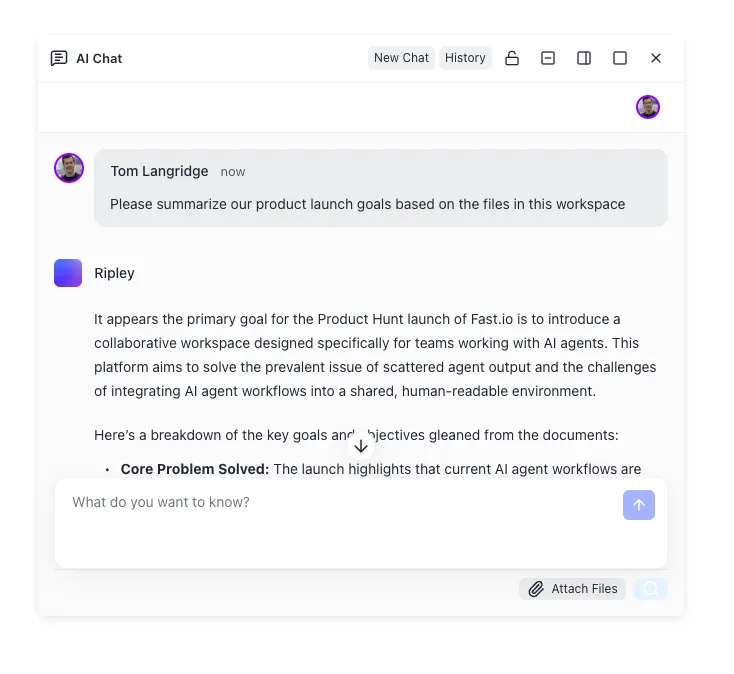


Keep Devin session artifacts in one shared workspace
Store migration notes, screenshots, and handoff docs beside the PR with version history, Intelligence Mode search, and MCP access for agents. Start with a 14-day free trial on a paid org plan.
Avoiding conflicts when you share the machine
Takeover fails most often for social and timing reasons, not missing shortcuts. Treat the agent machine like a shared remote workstation.
Do not co-edit hot files
If Devin is still generating a file, your keystrokes race the agent. Pause first. If you only need a tiny fix, wait for the current step to finish, pause, then edit. For larger redirections, stop the session and rewrite the next instruction before resume.
Prefer one writer at a time
A simple protocol:
- Devin writing: you only read Progress, shell history, and diffs
- You writing: Devin is paused; terminals are writable only because you took over
- Resume: you stop editing, save files, post the change note, then resume
That protocol is boring on purpose. It prevents the most expensive class of agent failure: silent overwrite of a correct human fix.
Use shell history to decide when IDE takeover is worth it
Not every failure needs the IDE. If Devin is stuck on a missing env var or wrong package manager, a writable terminal and a one-line fix may be enough. Escalate to full IDE takeover when:
- Logic in multiple files is wrong
- You need jump-to-definition to understand a bad abstraction
- Diffs show broad drive-by refactors you must prune
- You need to redesign a small module before Devin continues
Keep Desktop for human-only gates
Completing MFA or CAPTCHA in Desktop while Devin is paused is normal. Completing those flows while Devin is still driving the browser is a good way to scramble session state. Pause, authenticate, confirm cookies stuck, then resume and tell Devin the service is logged in.
Scope the takeover like a PR review
When Nubank engineers used Devin for large ETL migrations, the human job was review and minor adjustment, not redoing the full migration by hand. Apply the same discipline in the IDE. Reject drive-by renames, keep the branch small, and leave mechanical work to the agent after you correct course.
Keeping agent output durable after the session
The Devin IDE lives inside a session environment. Code that matters still needs a durable home outside the sandbox: a Git remote, an object store, or a shared team workspace. Local-only copies and ad hoc downloads get lost when sessions end or when a different engineer picks up the work.
Common persistence options:
- GitHub, GitLab, or similar remotes: primary path for code. Devin opens PRs; humans review and merge. Always confirm the branch and remote match your team policy before you resume large follow-up work.
- Object storage (S3, GCS) or personal cloud drives: fine for large binaries, datasets, or one-off dumps. Weak for multi-person agent workflows that need permissions, search, and handoff.
- Shared intelligent workspaces: useful when agents and humans need the same files, version history, and search after the coding session ends.
Fast.io workspaces fit that last case. Agents and people can share org-owned workspaces with per-file version history, granular permissions, and a detailed activity log. Intelligence Mode and built-in AI index files for hybrid search (full-text, semantic, and metadata-value search) so a human can ask what an agent produced without grepping zip archives. For structured handoffs (run reports, migration checklists, design notes), Metadata Views turn documents into queryable fields instead of leaving everything as free-form markdown. Agents can reach the same workspace through Fast.io's consolidated MCP toolset over Streamable HTTP at /mcp (legacy SSE at /sse), with a path documented for agent storage at /storage-for-agents/.
A practical pattern for Devin-heavy teams:
- Devin works in the session IDE and opens a PR for code.
- Supporting artifacts (benchmarks, migration notes, screenshots exported from Desktop) land in a shared Fast.io workspace, not only in chat.
- Ownership transfer moves the workspace from an agent-created setup to the human owner when the project is ready for the business team, while the agent can retain admin where policy allows.
- The workspace activity feed (over WebSocket or long-poll) tells downstream systems when files change so review workflows do not depend on polling the session UI.
Plans start with a 14-day free trial on a paid organization (Starter $9.99/mo, Business $49.99/mo, Enterprise $199.99/mo). Creating a user account is free, but real workspace work runs on an org subscription with ongoing paid storage for agent outputs.
The Devin IDE solves interactive control during a run. Durable storage solves the day after the run. You need both if agent work is going to survive shift changes and multi-week migrations.
When to intervene and when to let Devin finish
Not every session needs takeover. Over-intervening burns time and confuses the agent. Under-intervening wastes ACUs on a bad path.
Intervene early when
- Progress shows the wrong repository area or feature flag
- Shell history loops on the same failure with no new hypothesis
- Diffs expand far outside the agreed plan
- Auth or CAPTCHA blocks browser work Devin cannot complete
- You know a one-line environment fix that Devin has not discovered after several attempts
Let Devin continue when
- Diffs match the plan and tests are progressing
- Devin is exploring a reasonable alternative after a single failed approach
- Remaining work is mechanical (repetitive renames, boilerplate, docs) after you corrected the hard part
- You already left a clear success criterion and the agent is meeting it step by step
Parallel sessions without thrash
Devin 2.0 highlighted spinning up multiple parallel Devins, each with its own IDE. Parallelism helps large migrations and multi-repo chores. It also multiplies conflict risk if two sessions edit the same branch. Give each session a distinct branch, package, or repo slice. Review each IDE on its own Progress timeline. Do not take over two sessions that share a branch at the same time.
Resume checklist
Before you click resume:
- Save all IDE buffers.
- Confirm tests or typecheck status for the area you touched.
- Post a change note with files, commands, and next goal.
- Leave Desktop auth state in a known-good place if the task needs the browser.
- Watch the first new Progress steps for confirmation that Devin absorbed the note.
If resume immediately reintroduces the bad approach, pause again and tighten the instruction. A short, explicit constraint beats a long chat history dump.
Bottom line
The Devin IDE is the interactive VS Code surface where you review live work, take over the agent machine, and hand control back without abandoning the session. Pair it with Shell for command truth, Desktop for visual and auth gates, and durable storage outside the sandbox for anything the team must keep. Master the pause-edit-inform-resume loop and the agent stops being a mysterious black box. It becomes a fast junior pair that you can steer with the same editor habits you already have.
Sources
References used to verify factual claims in this guide.
-
Nubank reported 8-12x engineering time efficiency gains and over 20x cost savings using Devin for large ETL migration review workflows
-
Devin sessions provide Shell, IDE, and Interactive Browser (Desktop) tools with a Progress tab that unifies activity Official docs require pausing Devin before IDE takeover and informing Devin of human changes on resume
-
Devin 2.0 introduced an agent-native IDE experience with parallel Devins each having an interactive cloud IDE, plus plans starting at $20
Frequently Asked Questions
What is the Devin IDE?
The Devin IDE is an interactive VS Code environment that runs inside a Devin session with your repositories loaded. Official Cognition docs describe it as the place to watch code changes in real time, touch up files, run tests, and take over Devin's machine without leaving the web app. It sits alongside Shell and the Interactive Browser (Desktop) as one of the three primary session tools.
Can I edit code while Devin is working?
You should not co-edit the same files while Devin is still actively writing them. Official best practices say to pause or stop the session before taking over the IDE so you avoid simultaneous, conflicting changes. After you finish testing and post a note about what you changed, you can resume autonomous work.
How do I take over a Devin session in the IDE?
Open the session, monitor Progress and diffs, then click to stop or pause Devin. Once the agent is no longer editing, use the IDE to open files, toggle terminals from read-only to writable, run tests, and fix what you need. Shortcuts such as Cmd/Ctrl+K and Cmd/Ctrl+I are available during takeover. When you are done, tell Devin what you changed and resume the session.
How do I resume Devin after editing in the IDE?
Save your files, confirm the relevant tests or checks, and send a short chat note listing what you changed, what you verified, and what Devin should do next. Official docs stress informing Devin about human edits on resume so the agent does not reapply a discarded approach or overwrite your fix.
What is the difference between the Devin IDE and connecting local VS Code?
The Devin IDE is the cloud VS Code environment on Devin's session machine. Local VS Code with a Devin Sessions extension manages sessions and diffs from your laptop and can SSH into a session, but the native session IDE is already wired to Devin's repos, terminals, and Progress timeline. Use local VS Code when you prefer your installed extensions; use the session IDE when you want zero-friction takeover inside the same sandbox Devin uses.
When should I use Shell or Desktop instead of the IDE?
Use Shell when you need command history, failing installs, or writable terminal diagnostics. Use Desktop when you need visual QA, CAPTCHA, MFA, OAuth, or local app verification in a browser. Use the IDE when you need to read or edit source, prune bad diffs, or restructure code before resume. The Progress tab ties all three together for each session step.
Related Resources

Keep Devin session artifacts in one shared workspace
Store migration notes, screenshots, and handoff docs beside the PR with version history, Intelligence Mode search, and MCP access for agents. Start with a 14-day free trial on a paid org plan.