Custom GPT File Limit: Knowledge Base Caps and Large-Corpus Search
OpenAI restricts Custom GPT Knowledge bases to a hard ceiling of 10 files, 512MB per file, and 2 million tokens per document. While standard workarounds suggest merging text into giant documents, large knowledge bases quickly degrade prompt precision and retrieval accuracy. Connecting external workspace storage through remote Model Context Protocol servers enables assistants to search extensive document libraries on demand without hitting file count caps.


How the Custom GPT File Limit Restricts Knowledge Bases
The Custom GPT file limit restricts GPT creators to uploading a maximum of 10 files into the GPT Knowledge base, with each file capped at 512MB and 2 million tokens. According to official OpenAI documentation on file uploads and custom GPTs, all files uploaded to a GPT or a ChatGPT conversation have a hard limit of 512MB per file. While 10 files may suffice for a personal assistant or a concise style guide, teams building production assistants for documentation libraries, codebase references, customer support archives, or compliance repositories routinely hit this boundary within their first week of configuration.
OpenAI enforces three distinct layers of limits on Custom GPT knowledge:
- File Count Limit: Exactly 10 files maximum per custom GPT across the lifetime of the GPT configuration.
- Per-File Size Limit: 512MB maximum per file for text, documents, and standard archives.
- Document Token Ceiling: 2 million tokens maximum per document file, covering formats such as PDF, DOCX, and TXT.
- Spreadsheet Constraints: Spreadsheets and CSV files bypass document token ceilings but face operational size limits of approximately 50MB, governed by row density and parsing complexity.
- Image File Threshold: Standalone image uploads are capped at dedicated lower file size boundaries.
- Account Storage Quotas: Total accumulated uploads across an account face global storage limits that apply across all GPTs and chats.
When a creator attempts to upload an 11th file in the GPT Builder interface, the web dashboard rejects the upload immediately with a generic error dialog. This restriction is hard-coded into OpenAI's GPT configuration model. The platform indexes uploaded knowledge files into an internal vector retrieval system managed entirely by OpenAI, which extracts text chunks, computes embeddings, and performs top-k semantic retrieval during chat sessions.
Understanding how Custom GPT caps compare to other agentic platforms clarifies why teams look for architectural alternatives:
In Claude Projects, project knowledge is limited by the context window, 30MB per file (see https://support.claude.com/en/articles/8241126-upload-files-to-claude), while Custom GPT creators hit the hard 10-file wall even earlier. When real-world projects expand to hundreds of policy documents, legal agreements, technical manuals, or operational briefs, uploading files directly into the assistant's configuration UI ceases to be viable.
Related guides
- ChatGPT Projects File Limit: Plan Caps, Workarounds, and Large-Corpus SearchThe ChatGPT Projects file limit restricts workspace knowledge to 5 files on Free, 25 on Plus, and 40 on Enterprise,...
- SharePoint Semantic Search: How to Enable AI Vector Search Across SharePointTraditional SharePoint search relies on lexical Keyword Query Language (KQL) matching, leaving relevant files hidden...
- DeepSeek File Upload Limit: File Constraints and Large-Corpus IndexingDeepSeek limits attachments to 50 files and 100MB per document in web chat, while its Files API caps individual uploads...
- CSV File Size Limits: AI Assistant Upload Caps, Parsing Ceilings, and FixesCSV file size limits vary from strict row boundaries in spreadsheets to memory and token constraints in AI chat...
- OpenAI Assistant File Limits: Upload Caps, Size Limits, and SolutionsOpenAI assistant file limits balance responsiveness against overhead, restricting direct attachments while capping...
- Perplexity Spaces File Limit: Upload Caps, Supported Formats, and Storage WorkaroundsPerplexity Spaces enforces a 25MB per-file upload limit and a 50-document ceiling per project on Pro accounts. While...
More on this subject: Agent File and Document Workflows (269 guides)
Why Concatenating Documents Fails for Large Knowledge Sets
The most common recommendation in online forums and developer threads is to merge multiple documents into a single massive file. Creators write Python scripts to concatenate 50 PDF manuals or 100 markdown files into one 400-page mega-document before uploading it to satisfy the 10-file restriction. While this tactic technically circumvents the file count counter, it introduces severe operational and architectural failures that degrade assistant quality.
First, concatenating diverse files destroys document boundary signals. When OpenAI's ingestion pipeline chunks a single monolithic text, sections from entirely different source files blend together across sliding chunk windows. A paragraph describing product return terms in customer support documentation can easily merge with warranty terms from hardware documentation, causing the model to generate contradictory citations.
Second, retrieval accuracy drops sharply as document volume grows inside a single vector namespace. In an internal retrieval system, each query triggers an embedding match across stored chunks. When an assistant searches a dense 500-page concatenated document, the top-k retrieved chunks frequently miss subtle, highly specific clauses located in middle sections. This retrieval failure, often described as semantic dilution, causes the model to state that information is missing even when the text exists inside the uploaded composite file.
Third, maintaining and updating a concatenated knowledge base creates continuous friction. If a team updates a single paragraph in an internal policy or modifies one API schema definition, the creator must:
- Locate the source document in their local file system.
- Re-run the concatenation script across the entire document set.
- Delete the previous monolithic file from the Custom GPT Knowledge tab.
- Upload the newly generated composite file.
- Wait for OpenAI's background embedding process to re-index the entire multi-megabyte payload.
During this re-indexing period, the Custom GPT often exhibits degraded responses or fails to answer queries accurately. If an engineer forgets which source files were merged into all_company_docs_v3_final.pdf, version drift becomes permanent.
Spreadsheets present an even steeper failure mode when merged into text files. Converting relational tables or dense CSV logs into plain markdown tables balloons token consumption rapidly. Once a table spans thousands of rows, the file risks exceeding token processing ceilings or exhausting the GPT's retrieval context, stripping the structured rows of their analytical value.
Decoupling Storage from Assistant Prompts with External Retrieval
To support hundreds or thousands of files without hitting platform caps, engineering teams decouple storage from the model's configuration interface. Instead of treating the assistant's knowledge tab as a document repository, the assistant remains a compute engine that connects to an external, indexed storage layer on demand.
This architecture relies on active querying through tool protocols rather than static file attachment. When a user asks a question, the assistant does not search a pre-loaded internal 10-file bundle. Instead, the assistant generates a targeted search query, calls an external workspace tool, retrieves only the relevant paragraphs or file extracts, and synthesizes the response with verifiable citations.
Decoupling storage from prompt configuration delivers four distinct architectural benefits:
- Corpus Independence: The document library can grow from 10 files to thousands of documents without requiring changes to the assistant's system instructions or knowledge settings.
- Live Document Synchronization: Updating a file in the workspace immediately reflects in the assistant's next query result, eliminating manual re-exports and re-uploads.
- Access Governance and Audit Trails: Enterprise documents remain protected by granular folder permissions and detailed activity logs rather than sitting in an unmanaged chat assistant upload bucket.
- Model Portability: The same indexed workspace can serve a Custom GPT, a Claude desktop assistant, an internal coding agent, or an autonomous backend script without duplicating storage.
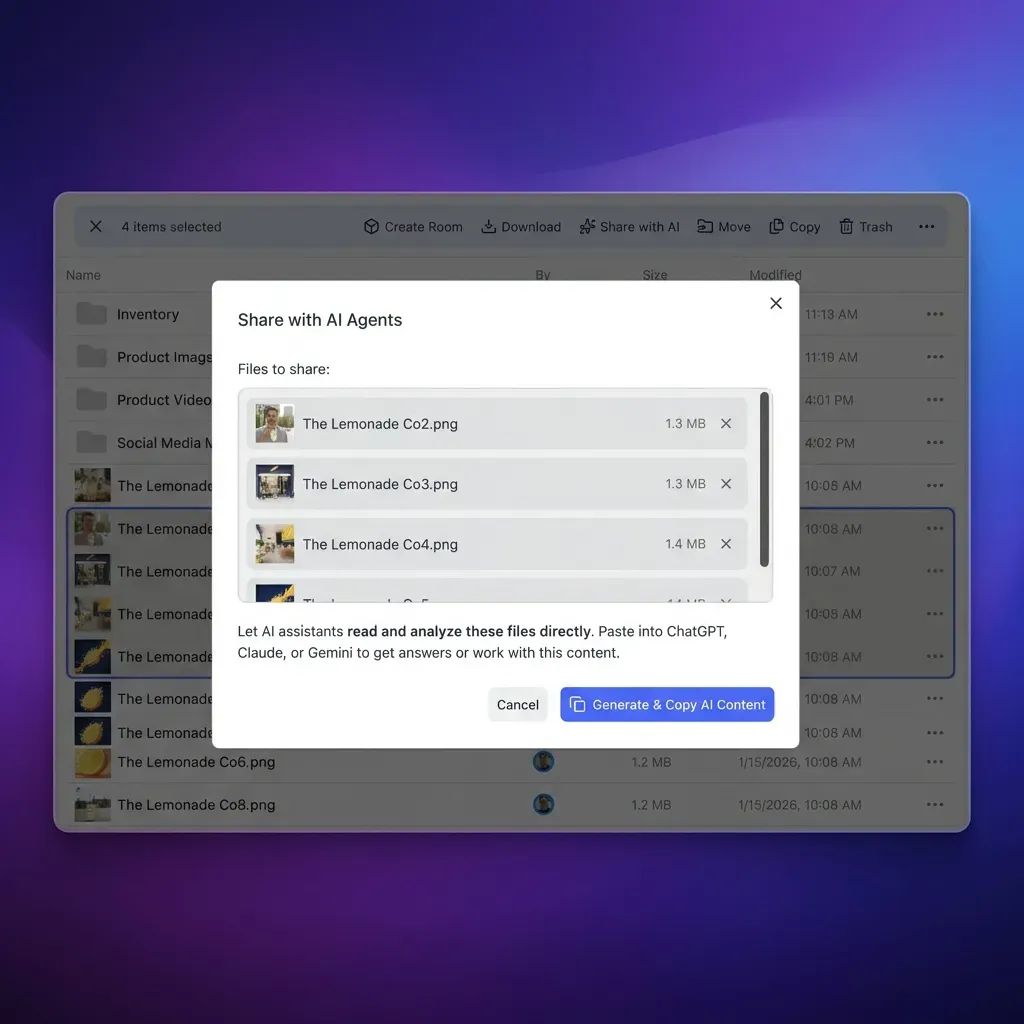


Connect Large Document Knowledge to AI Assistants
Bypass the 10-file knowledge ceiling by connecting your assistants to indexed workspaces with remote MCP search tools, version history, and audit logs. Monthly plans start with a trial of up to 30 days (credit card required); annual plans have no trial.
Steps to Connect Large Document Corpora to Assistants Using Fast.io and MCP
Connecting an external corpus to a Custom GPT or agentic assistant requires an intelligent storage layer and an open connection standard. The Model Context Protocol (MCP) provides this bridge. Fast.io serves as an intelligent cloud workspace platform where documents are indexed on arrival for semantic and full-text search, and exposed to AI assistants through a remote MCP server.
Fast.io does not alter OpenAI's native 10-file upload limit inside the GPT Builder. Instead, it provides an external retrieval path that bypasses the need to upload files into the GPT Builder at all.
1. Ingesting Files into an Intelligent Workspace
The first step is establishing an organization-owned workspace in Fast.io to hold your target corpus. You can upload large collections of PDFs, Word documents, text files, and spreadsheets directly through the browser using chunked uploads, which handle multi-gigabyte files without artificial size caps.
If your team already maintains document collections in existing cloud providers, you can import them directly into the workspace. Fast.io supports importing files from Google Drive, Microsoft OneDrive, Dropbox, and Box. For ongoing synchronization, Cloud Sync is supported for Dropbox, Box, and OneDrive. Google Drive imports today, with sync coming soon.
2. Enabling Workspace Intelligence for Auto-Indexing
Once files land in the workspace, enable Intelligence Mode in the workspace settings. Fast.io automatically processes incoming documents:
- Text content is parsed and indexed for hybrid search, combining full-text keyword matching with semantic vector similarity.
- Document summaries and key topics are generated in the background.
- Per-file version history tracks every modification, allowing assistants to query current content while preserving audit records of historical revisions.
Because indexing occurs on the storage platform itself, your assistant does not consume context window tokens or vector ingestion quotas during startup.
3. Connecting Assistants via the Remote Fast.io MCP Server
In ChatGPT, install the Fast.io plugin from ChatGPT's plugin directory in one click. If you connect ChatGPT through a custom MCP server instead, use https://mcp.fast.io/mcp/operations. Fast.io provides a remote MCP server hosted at mcp.fast.io over Streamable HTTP, with setup steps at mcp.fast.io/docs. Interactive clients sign in with OAuth in the browser and carry no API key in their configuration.
For Custom GPTs that support custom Actions via OpenAPI specifications, or for agentic clients like Claude Code, Cursor, and Cline, the MCP server provides a consolidated toolset for workspace search. When configuring Claude Code, add the Fast.io server definition to the project's .mcp.json file, then run /mcp inside Claude Code to sign in:
{
  "mcpServers": {
    "fastio": {
      "type": "http",
      "url": "https://mcp.fast.io/mcp/code"
    }
  }
}
When an assistant runs with this tool definition, it gains access to actions such as listing workspaces, searching documents, and retrieving file contents. When a user asks a complex question about company policy, the assistant calls the search tool:
{
  "name": "search",
  "arguments": {
    "workspace_id": "ws_legal_ops_2026",
    "query": "intellectual property assignment clause independent contractors",
    "limit": 5
  }
}
The MCP server returns matching text passages along with document identifiers and file names. The assistant reads the extracted context and formulates its response, citing the exact workspace document and version number.
4. Querying Tabular and Structured Data with Metadata Views
For tabular datasets, legal contracts, and financial records where vector search alone struggles, Fast.io provides Metadata Views. Metadata Views turn unstructured documents into a live, queryable database.
Users describe the target fields in natural language, such as contract effective dates, counterparties, governing law, and total value. Fast.io designs a typed schema across formats including Text, Integer, Decimal, Boolean, URL, JSON, and Date & Time, extracts the structured data from PDFs, scanned pages, and spreadsheets, and populates a filterable view. AI assistants can query these structured Metadata Views through MCP, allowing them to answer quantitative and relational questions that standard Custom GPT file uploads fail to process reliably.
Managing Expanding Enterprise Knowledge Across AI Teams
As organizations deploy multiple specialized assistants across departments, managing knowledge through fragmented 10-file upload buckets creates operational risk. Team members duplicate files across private GPTs, outdated documents remain live in production assistants, and proprietary information disperses into unmonitored consumer accounts.
Establishing a centralized workspace architecture resolves these operational bottlenecks through structured practices:
Centralized Workspace Governance
Maintain single sources of truth by organizing documents into structured workspaces dedicated to specific operational domains, such as engineering specifications, human resources policies, or customer support procedures. Rather than permitting each team member to upload local desktop files into individual Custom GPTs, all assistants connect to authorized workspace folders through scoped permissions.
When human contributors update an employee benefits guide or publish a new software release note in Fast.io, every connected assistant references the updated document on its subsequent query.
Real-Time Co-Editing and Auditability
Collaborative Notes in Fast.io allow humans and AI assistants to co-edit operational playbooks and documentation in real time. An agent can draft a summary of recent technical changes directly into a shared note, while an engineering lead reviews and refines the text in the same interface.
Every document change, share creation, and agent query is recorded in Fast.io's activity log. This provides security teams with clear visibility into which assistants accessed specific files and when those interactions occurred.
Collaborative Handoffs and Access Control
When building specialized AI assistants for external clients or cross-functional departments, agency teams can configure workspaces, ingest knowledge libraries, and verify MCP retrieval before executing an ownership transfer. An agency developer can build the organization workspace, transfer primary ownership to the client, and retain administrative access to maintain the assistant's retrieval tools.
To share finished assets or collected project outputs with external collaborators who do not operate AI agents, teams generate branded shares:
- Send Shares: Deliver packaged project deliverables with password controls and download tracking.
- Receive Shares: Collect source documentation from external partners directly into an indexed workspace folder without requiring them to register an account.
- Exchange Shares: Establish bidirectional collaboration spaces where external vendors and internal staff share versioned project files.
By replacing the fragile 10-file knowledge tab with a governed workspace infrastructure, organizations eliminate upload ceilings, maintain strict version control, and equip AI assistants with reliable access to comprehensive enterprise knowledge.
Sources
References used to verify factual claims in this guide.
-
OpenAI documentation specifies that files uploaded to a GPT or ChatGPT conversation have a hard limit of 512MB per file, with text documents capped at 2 million tokens, spreadsheets capped around 50MB, and custom GPT knowledge bases limited to 10 files.
Frequently Asked Questions
How many files can I upload to a custom GPT?
You can upload a maximum of 10 files into the Knowledge section of a single Custom GPT. This 10-file cap is enforced by OpenAI across the entire lifetime of that GPT configuration. Individual files cannot exceed 512MB, and text documents are capped at 2 million tokens per file.
What is the knowledge file limit for custom GPTs?
The knowledge file limit for Custom GPTs comprises three distinct ceilings: a maximum of 10 uploaded files per GPT, a hard size ceiling of 512MB per file, and a processing limit of 2 million tokens per text document. Spreadsheets are exempt from the token limit but are generally constrained to approximately 50MB, while images face separate per-file thresholds.
How can you add knowledge beyond the 10-file custom GPT limit?
To expand knowledge beyond the 10-file ceiling without concatenating documents into unmanageable mega-files, connect your Custom GPT to an external intelligent storage platform using Actions or the Model Context Protocol (MCP). By hosting your documents in an external workspace like Fast.io with Intelligence enabled, your assistant can query thousands of indexed files via remote MCP search tools at runtime.
Does Fast.io raise OpenAI's native custom GPT upload limit?
No. Fast.io does not alter or raise OpenAI's internal 10-file upload limit within the Custom GPT Builder. Instead, Fast.io provides an external retrieval architecture. You store and index your entire document library within a Fast.io workspace and connect the assistant to an indexed workspace via [Fast.io Storage for Agents](/storage-for-agents/) by installing the Fast.io plugin from ChatGPT's plugin directory or using the remote MCP endpoint `https://mcp.fast.io/mcp/operations`, allowing the assistant to search external files on demand instead of uploading them directly.
Why does combining multiple files into one large document fail in custom GPTs?
Concatenating dozens of documents into a single massive file degrades retrieval accuracy. Merging distinct files causes topic boundaries to blur across text chunks, dilutes semantic search ranking, and increases the likelihood of hallucinations. Additionally, updating even one sentence requires re-exporting, re-uploading, and re-indexing the entire multi-megabyte composite file.
How do Claude Projects file limits compare to custom GPTs?
While Custom GPTs enforce a hard limit of 10 files in their Knowledge tab, in Claude Projects project knowledge is limited by the context window, 30MB per file (see https://support.claude.com/en/articles/8241126-upload-files-to-claude). Both systems face fundamental scaling boundaries when relying on native file attachments, making external indexed storage via MCP the preferred approach for large corpora.
Related Resources

Connect Large Document Knowledge to AI Assistants
Bypass the 10-file knowledge ceiling by connecting your assistants to indexed workspaces with remote MCP search tools, version history, and audit logs. Monthly plans start with a trial of up to 30 days (credit card required); annual plans have no trial.