Clio Document Management Alternatives: Upgrading Your Firm's File Storage
Clio document management alternatives are dedicated document management systems that connect to or replace Clio's built-in file storage to provide advanced search, version control, and client portal capabilities. This guide compares traditional systems like NetDocuments and iManage with modern workspaces like Fast.io, explaining how to upgrade your firm's file storage without abandoning Clio for practice management.


Why Clio Built-In Storage Creates a Document Management Gap
According to Clio's benchmarks, the average lawyer captures only 3.0 billable hours in a standard 8-hour workday. The remaining 5 hours of the day are consumed by non-billable administrative tasks, including document handling and searching for files. This productivity bottleneck is particularly acute in firms that rely solely on basic practice management systems for document storage. While Clio serves as an excellent central database for billing, calendars, and matter tracking, its built-in document storage uses a simple folder tree that lacks advanced search, automatic versioning, and document data extraction.
To solve this, firms look for Clio document management alternatives. Clio document management alternatives are dedicated document management systems (DMS) that connect to or replace Clio's built-in file storage to provide advanced search, version control, and client portal capabilities. The cost of failing to address these storage limitations is high. IDC research shows that the knowledge worker spends about 2.5 hours per day, or roughly 30% of the workday, searching for information. For a firm with several attorneys, this wasted time directly reduces billable capacity.
Many technology consultants advise firms to undergo a complete suite migration, replacing Clio entirely with an enterprise-level platform. However, complete migrations are expensive, require extensive training, and disrupt client operations. A more practical approach is to keep Clio as the core practice management system and pair it with a dedicated matter workspace. This lets the firm maintain its billing and calendar workflows while upgrading its file storage and retrieval capabilities.
Understanding Clio Built-In Storage Limits
Clio built-in storage acts as a basic file repository, organizing documents in a flat folder structure tied to clients and matters. While this structure is sufficient for simple case files, it struggles to handle document-heavy practices. For example, the built-in storage does not run character recognition on uploaded PDFs. This means scanned files, including contracts, pleadings, and discovery documents, are invisible to search queries unless the exact filename is matched.
Additionally, Clio storage does not support automatic metadata extraction. Paralegals and attorneys must manually read documents and type key dates, values, and counterparty names into custom fields. This manual data entry creates a constant flow of non-billable administrative work that accumulates throughout the workday.
The Reality of Non-Billable Time Leakage
When document retrieval is slow, time leakage is the inevitable result. In a typical law firm, a significant portion of an associate's or paralegal's day is spent searching for a past contract template, digging through email threads for an attachment, or recreating a lost document from scratch. Because this administrative time cannot be billed to clients, it represents a direct loss in firm profitability.
Upgrading to a dedicated storage workspace addresses this leak. By indexing every document and scanned page on upload, a dedicated document management system cuts the time spent searching for files from hours to seconds, allowing firms to recover lost billable capacity.
Related guides
- Box for Law Firms: Secure Document Management AlternativesAn analysis of Box for law firms alongside modern legal document management alternatives. While enterprise cloud...
- DocketBird Review: Court Docket Tracking and Law Firm File IntegrationDocketBird automates court docket tracking and document retrieval across federal and state courts, capturing new...
- Aderant Legal Software: Enterprise Law Firm Practice and Financial ManagementAderant legal software serves as the operational and financial backbone for enterprise law firms, powering timekeeping,...
- Box for Lawyers: Enterprise Document Storage, Security, and Legal WorkflowsDeploying Box for lawyers requires balancing enterprise cloud storage with matter-centric document organization. While...
- Clio for Co-Counsel: Setting Up Joint Matter Collaboration and Secure File SharingClio for co-counsel enables law firms to share matter files, notes, and billable time entries with partnering attorneys...
- Cloud-Based Legal Practice Management Software: Architecture, Security, and File WorkspacesCloud-based legal practice management software centralizes matter tracking, billing, and document administration on...
More on this subject: Legal Teams (211 guides)
How NetDocuments and iManage Compare as Traditional Alternatives
Dedicated legal document management systems have long been the standard for mid-sized and large law firms. There are two primary options that dominate this category: NetDocuments and iManage. Both tools provide deep compliance features and organize files by matter, but they come with significant administrative overhead and high entry costs.
NetDocuments operates as a cloud-native document management platform designed specifically for the legal sector. It organizes documents into structured workspaces based on client and matter codes, making it easier for attorneys to navigate files. Its search engine indexes the full text of documents, allowing users to find specific clauses or terms quickly. However, NetDocuments has a steep learning curve and requires a premium per-user subscription. The implementation process often takes months and requires specialized consultants to map database fields.
iManage Work is a veteran legal document management system, widely used in large corporate legal departments and global firms. It excels at email management, allowing lawyers to drag and drop Outlook emails directly into matter folders. It also connects directly to Microsoft Office applications. Despite these advantages, iManage is highly complex. The platform is designed for firms with dedicated IT departments, and its custom pricing is geared toward enterprise budgets. For small to mid-sized law firms, iManage presents a level of administrative complexity that is difficult to justify.
NetDocuments in Mid-Sized Practices
NetDocuments connects to Clio using Clio's partner directory. When a new matter is created in Clio, the connection creates a corresponding workspace in NetDocuments. This matter-centric approach keeps files organized, but configuring NetDocuments requires detailed database administration.
Firms must define cabinet layouts, profile attributes, and workspaces. For small to mid-sized firms without a dedicated IT manager, this setup process is often too complex, leading to poor adoption and incomplete compliance with internal folder guidelines.
The Enterprise Burden of iManage
iManage Work offers deep document security and email archiving capabilities, but it requires a substantial administrative commitment. Even cloud-hosted iManage deployments often require external consultants to configure database schemas and user groups.
iManage pricing also starts with high user minimums, making the software cost-prohibitive for solo attorneys and boutique practices. The administrative burden of managing iManage databases can quickly outweigh the benefits for small teams.
Modern Document Workspaces for Coordinated Matter Management
For firms seeking a more flexible alternative to traditional legal document management systems, modern workspaces like Fast.io offer a fresh approach. Instead of replacing your practice management tools, Fast.io serves as an intelligent document layer that coordinates with Clio. This setup keeps your client billing, time tracking, and court calendars in Clio while upgrading your file storage to an intelligent workspace. For detailed legal workflows, read about file sharing for law firms.
In Fast.io, files are organized into shared workspaces owned by the organization rather than individual users. This structure ensures that when an attorney or paralegal leaves the firm, case documents remain accessible in the workspace. The platform tracks a complete version history for every file. When multiple people review a draft settlement, each upload creates a new version, allowing users to restore previous drafts and track changes without creating duplicate files.
Security and activity tracking are handled through a detailed activity log. This log records every file upload, download, and permission change, creating a clear chain of custody that is critical during discovery. Granular permissions allow administrators to restrict access at the organization, workspace, folder, or file level. This ensures that associates and contract attorneys only see the folders related to their assigned matters, while partners maintain firm-wide visibility. These features provide strong access controls without the administrative burden of traditional enterprise systems.
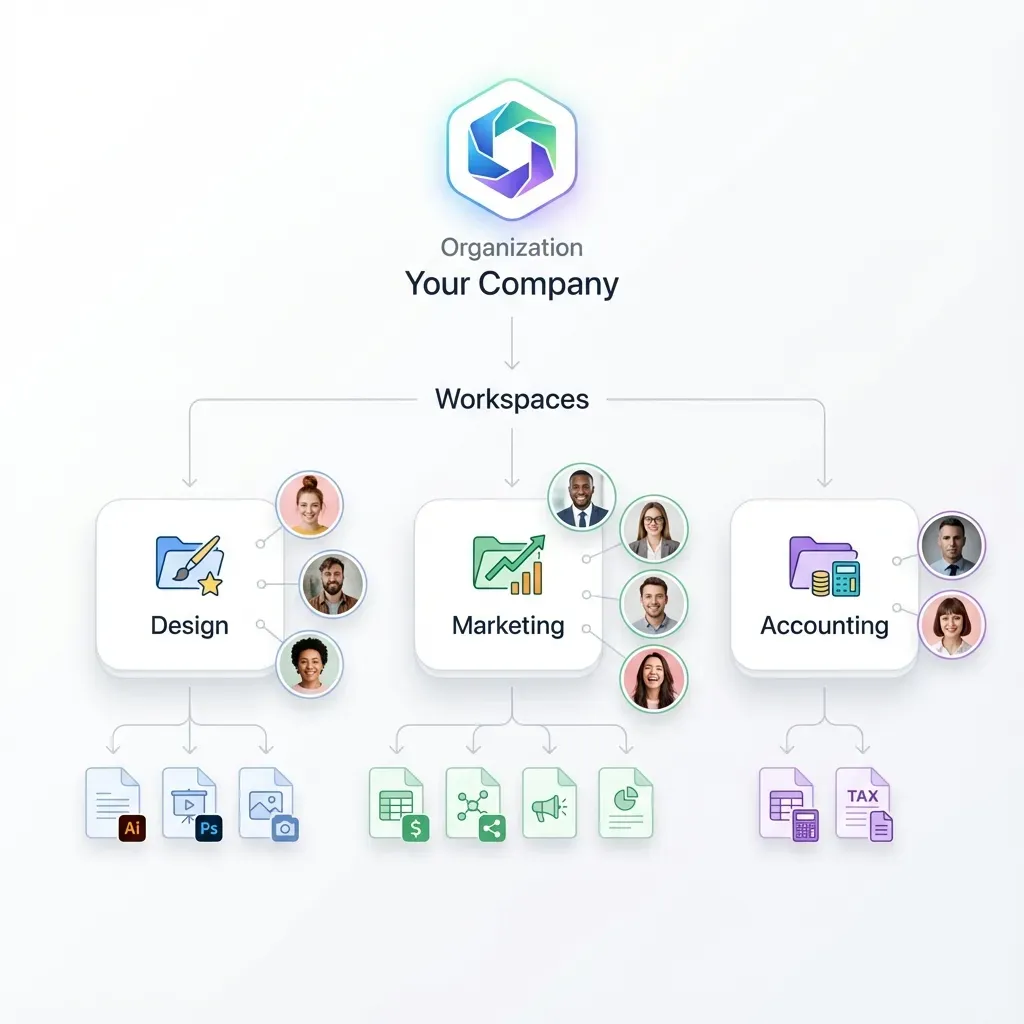
Coordinated Matter Workspaces
Unlike comprehensive legal suites that require you to migrate all your billing and contact records, a coordinated document workspace operates alongside Clio. Clio remains the master database for practice management. When a new matter begins, you create a corresponding workspace in your document platform.
This workspace handles the file-heavy operations, such as storing litigation videos, staging large discovery collections, and managing client intake folders. This separation of concerns ensures that a system issue in one platform does not bring your entire firm to a halt.
Audit Trails and Version Security
Modern legal practice requires detailed activity tracking. The activity log in Fast.io records the username, action, file path, IP address, and timestamp for every document interaction. If a client questions whether a document was delivered, or if a partner needs to verify when a pleading was finalized, the information is immediately accessible.
Version history works alongside this audit trail. Instead of overwriting files, the system maintains all versions, preserving an auditable record of draft development that can be restored instantly if errors occur.


Upgrade your legal document storage
Centralize your case files in secure matter workspaces, share discovery documents via branded client portals, and extract contract metadata automatically. Monthly plans start with a trial of up to 14 days (credit card required); annual plans have no trial.
How AI-Powered Metadata Views and Hybrid Search Retrieve Files
The primary difference between basic storage and a dedicated document workspace lies in search and retrieval. Simple cloud folders require users to navigate deep folder paths or guess the exact filename. Modern document systems solve this with hybrid search, which combines full-text index matching with semantic search. This means lawyers can search by the meaning of a clause, not just the exact words, and preview matching passages directly in the search results.
Modern workspaces also include AI-powered data extraction tools that turn raw documents into structured databases. Fast.io achieves this through Metadata Views. Metadata Views turn legal documents into a live, queryable database. Users describe the fields they want extracted in natural language, and the AI designs a typed schema (such as Text, Integer, Decimal, Boolean, URL, JSON, and Date & Time), matches the files in the workspace, and populates a sortable, filterable spreadsheet. No templates or manual OCR rules are required. This works with contract PDFs, scanned documents, and handwritten notes. Columns can be added without reprocessing.
For example, a litigation team can create a workspace for a complex case and upload hundreds of PDFs of medical records, contracts, and deposition transcripts. By creating a Metadata View, the team can instruct the AI to extract fields such as the document date, the author, the counterparty, and key medical terms. The workspace automatically parses the files and displays the results in a spreadsheet. This structured data grid allows attorneys to sort and filter documents by date or key terms, reducing the hours spent manually indexing files.
Hybrid Search for Case Preparation
Hybrid search resolves the limitations of keyword matching by combining exact text search with semantic search. During discovery, attorneys often search for concepts rather than specific phrases. For example, a search for "safety violations" will retrieve documents containing "negligent maintenance" or "unsafe work conditions," even if the word "safety" never appears in the text.
This conceptual retrieval is supported by workspace intelligence, which auto-indexes all documents upon arrival. It provides page-level citations for every search result, allowing legal teams to verify the source of each finding instantly.
Automating Contract Review with Metadata Views
During corporate transactions, contract review often consumes dozens of billable hours. Using Metadata Views, a firm can upload dozens of vendor agreements to a workspace and define an extraction schema in natural language: "extract the effective date, the counterparty name, the contract value, the governing law, and whether the contract contains an automatic renewal clause."
The AI designs the schema, classifying the effective date as a Date & Time field, the value as a Decimal field, the governing law as a Text field, and the renewal clause as a Boolean field. The platform extracts the data into a queryable grid, letting lawyers sort agreements by jurisdiction or renewal date. This structured layer eliminates manual data entry while maintaining direct links to the source files. For more details on structured data extraction, read about Metadata Views.
Steps to Upgrade Your Firm's File Storage Without Disruption
Upgrading your firm's document storage does not require a disruptive software migration. By keeping Clio for practice management and pairing it with a high-performance workspace, you can transition your files in a few structured steps.
First, design a matter-centric workspace structure. Create a workspace for each active client or practice area, and name folders using a consistent convention, such as the year, matter number, and client name. This mirrors the database structure in Clio, making it easy for staff to cross-reference files.
Second, connect your existing cloud storage using Cloud Import. If your firm currently stores case files in Google Drive, Dropbox, Box, or OneDrive, you can import them into your new workspace. Once imported, you can use secure data rooms to organize discovery files for external parties.
Third, establish secure client portals for document collection and delivery. Instead of sending sensitive discovery files as email attachments, set up branded client portals. These portals allow clients to download documents and upload their own files securely without creating user accounts. Access links can be configured to expire automatically or require passwords, ensuring that access is revoked once a matter is resolved. By keeping Clio for case administration and using a dedicated workspace for files, your firm can eliminate file-hunting delays and protect client confidentiality.
Designing the Matter Hierarchy
A consistent hierarchy is the foundation of secure document storage. Firms should create a standard template folder structure for every new matter. For example, a litigation matter workspace should always contain subfolders for pleadings, discovery, correspondence, and client documents.
By standardizing this structure, paralegals and attorneys can locate files in any client workspace without having to ask the matter lead where a document was saved. This organization also makes it easier to assign scoped folder permissions to external co-counsel when collaboration is required.
Setting Up Secure Client Portals
Client portals, or branded Content Portals, solve the security risks of sharing documents via email. When a matter requires sharing large records, such as deposition videos or medical history files, a portal provides a secure delivery path. Clients access the portal using a password-protected link, allowing them to view and download files without creating a user account.
The portal tracks viewer analytics, letting the firm know when a client has accessed the files. The portals also support expiring access links, ensuring that client access is automatically revoked once the case is closed or the representation is complete.
Sources
References used to verify factual claims in this guide.
-
The average lawyer captures 3.0 billable hours in an eight-hour workday.
-
Knowledge workers spend about 2.5 hours per day, roughly 30% of the workday, searching for information.
Frequently Asked Questions
Does Clio have document management?
Clio has basic built-in document storage that allows law firms to upload files and organize them into standard folders tied to matters. However, it lacks advanced document management system (DMS) capabilities, such as OCR for scanned PDFs, automated version tracking, semantic search, and AI-powered metadata extraction. Firms with heavy document requirements often pair Clio with a dedicated DMS or workspace.
What is the best document management system for lawyers?
The best document management system depends on firm size and budget. Traditional legal DMS platforms like NetDocuments and iManage offer advanced compliance and search features but carry high setup costs and user minimums, making them best suited for mid-sized to large law firms. Agile, boutique, and solo firms often prefer modern workspaces like Fast.io, which provide semantic search, branded client portals, and automatic metadata extraction with simple pricing.
Can I keep Clio for practice management if I use another document system?
Yes. Most firms keeping Clio as their core practice management system use a dedicated workspace or document management system alongside it. Clio continues to manage calendars, time tracking, billing, and matter records, while the secondary system handles secure file sharing, large discovery files, and intelligent search. This coordinated approach provides advanced document features without disrupting the firm's billing workflows.
How does legal document search work with AI workspaces?
AI-powered document workspaces use hybrid search, which combines traditional keyword matching with semantic search. This allows lawyers to search for files based on the conceptual meaning of the query rather than guessing exact filenames or phrases. When documents are uploaded, the system automatically indexes the full text, including scanned PDFs, providing page-level citations for every search result.
Related Resources

Upgrade your legal document storage
Centralize your case files in secure matter workspaces, share discovery documents via branded client portals, and extract contract metadata automatically. Monthly plans start with a trial of up to 14 days (credit card required); annual plans have no trial.