How to Use Cline Plan Mode Effectively
Cline Plan mode is read-only by design. Official docs separate thinking from doing, with three task-size paths and optional dual models for Plan vs Act. This guide covers the five-step Plan to Act workflow, /deep-planning, cost tactics, and saving plan markdown so humans can review strategy before code lands.


What Cline Plan Mode Actually Does
Official Cline Plan & Act docs document a five-step Plan-to-Act workflow and three task-size tiers (Act only, Plan then Act, and /deep-planning). Related US search volume is modest, about 20 monthly queries for "cline plan mode" and 10 for "cline act mode" per DataForSEO keyword estimates, so most writeups stay at the mode toggle. The operational detail is what changes outcomes: when to plan, which model to assign, and how to keep the plan reviewable by a human.
Cline Plan mode is a read-only collaboration mode for exploring code and agreeing on strategy before switching to Act mode to implement changes with full tool access. In Plan mode, Cline can read the codebase, run searches, and discuss approach. It cannot modify files or execute commands. That constraint is intentional. It keeps the conversation on understanding and planning, not on partial edits that ship before you have agreed on the design.
Act mode is the execution half. Once you switch, Cline keeps the full conversation context from planning, then can edit files, run commands, and implement the strategy you already discussed. You do not need to restate the plan. Context carries over.
Use Plan mode when you are:
- Exploring an unfamiliar codebase before changing it
- Debating architecture tradeoffs
- Surfacing edge cases early
- Building a clear implementation strategy
- Reviewing code or tracing complex workflows
Use Act mode when you already know the approach and need implementation, tests, routine changes that follow existing patterns, or quick fixes where the fix is obvious.
The product framing on Cline's site and docs is simple: think first, then build. Plan & Act is the dual-mode system that enforces that order without forcing you into planning for every typo fix.
Related guides
- How to Use Claude Code Plan Mode for Safer Autonomous CodingAI-generated pull requests contain 75% more logic errors than human-written code, and those mistakes compound across...
- How to Use Claude Cowork Intelligence ModeClaude Cowork Intelligence Mode lets the agent read and write files directly on your machine. Instead of copying and...
- What Is Cline? Open-Source AI Coding Agent ExplainedCline reports 8.0M+ installs across platforms and ships as Apache 2.0 open source, which is why developers keep asking...
- Kilo Code vs Cline: Open-Source Coding Agent ComparisonCline is free for individual developers under Apache 2.0, with its public repo past 64,000 GitHub stars, while pairwise...
- Cline vs Aider: IDE Agent vs Git CLI PairingCline vs Aider is less a quality contest and more a control-model choice. Cline is an approval-gated multi-surface...
- How to Run Cline as a Background Agent for Autonomous WorkflowsRunning Cline as a background agent transforms the coding assistant from a reactive sidebar extension into an...
More on this subject: Cline (105 guides)
The Five-Step Plan to Act Workflow
Cline's official Plan & Act documentation describes a typical workflow in five steps. Treat this as the default loop for any change that is not trivial:
- Start in Plan mode and describe what you want to build
- Let Cline explore relevant files and understand the codebase
- Discuss the approach, including edge cases and potential issues
- When you are confident in the plan, switch to Act mode
- Let Cline implement based on the planning session
On complex projects you will often cycle between modes more than once. Hit unexpected complexity in Act mode? Switch back to Plan mode, re-scope the approach, then return to Act to continue. Pushing through in Act when the model is confused usually produces thrash: larger diffs, weaker tests, and more rework.
A practical way to run step 3 is to force specificity before you unlock tools:
- Name the files or modules that should change
- Name the files that must not change
- List acceptance checks (tests to run, API contracts to preserve, UI states to verify)
- Call out unknowns that still need investigation
If Cline cannot name affected files or tests, you are not ready for Act mode. Stay in Plan mode, use file mentions to point at relevant paths, and keep iterating until the plan is concrete enough that a teammate could implement it without reopening the design debate.
Before you flip to Act, enable Checkpoints when available so you can roll back if the first implementation pass goes wrong. Official tips also recommend asking Cline for a todo list during planning so you can track steps during Act mode. That list becomes the shared scoreboard for multi-step work.
Task Size Rules for Plan, Act, and Deep Planning
The biggest gap in most Plan/Act writeups is task sizing. Official docs split work into three tiers. Matching the tier to the work is how you avoid both under-planning (broken refactors) and over-planning (wasted tokens on a one-line fix).
Small tasks: Act mode only
For quick fixes, start directly in Act mode. Planning adds overhead when the solution is obvious.
Examples: fix a typo, add a missing import, update a config value, rename a local variable, follow an established pattern that already exists nearby in the tree.
Rule of thumb: if you could merge the change from a 30-second PR description with no design discussion, skip Plan mode.
Medium tasks: Plan, then Act
For most day-to-day development, start in Plan mode to understand scope and approach, then switch to Act mode to implement. This is the sweet spot for work that touches a few files and has real complexity.
Examples: add a new API endpoint, implement a UI component, fix a bug that needs investigation, refactor a single module.
Rule of thumb: if two or more files might change, or if you are unsure where the bug lives, use Plan mode first. Spend enough time in Plan that Act has a clear sequence of edits and tests.
Large tasks: use /deep-planning
For features that span many files, require architecture decisions, or will take more than one session, use the /deep-planning slash command. This is not a longer chat in Plan mode. It is a structured planning run optimized per model family.
Official command docs describe a four-step deep planning process:
- Silent investigation - Cline explores codebase structure and patterns
- Discussion - targeted questions about requirements and approach
- Plan creation - generates
implementation_plan.mdwith detailed specifications - Task creation - creates a new task with trackable implementation steps
Examples: add a feature across frontend and backend, major cross-repo style refactors, new system or integration, multi-step migrations.
Rule of thumb: if you would open a design doc before coding, use /deep-planning. If the work will not finish in one context window, plan for handoff with /newtask later so later sessions inherit the plan without the noise of intermediate tool calls.
Pair large plans with context management. /smol (alias /compact) compresses conversation history while keeping essential context in the same task. /newtask starts a fresh task with distilled context (plan, work done, relevant files, next steps). Use /smol when you want continuity in the same thread. Use /newtask when the context window is cluttered with tool noise after several completed steps.
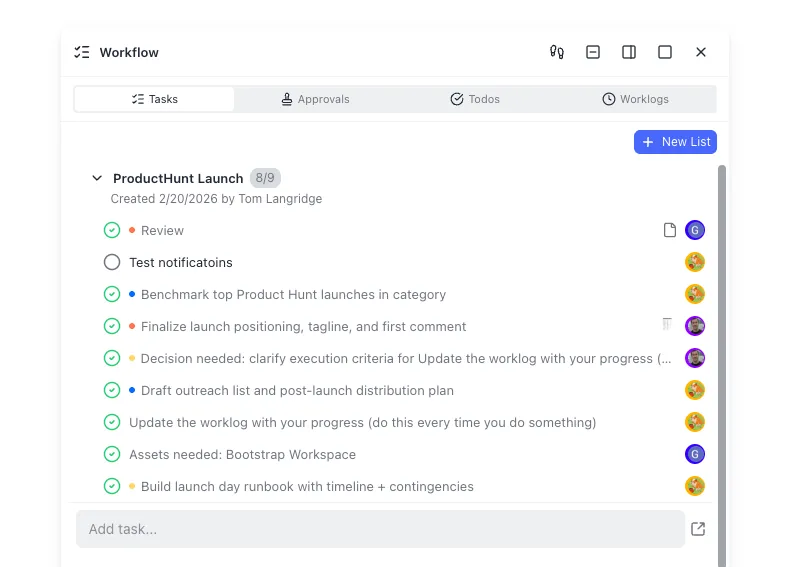


Keep Cline plans where the team can review them
Store implementation_plan.md and design notes in a shared Fast.io workspace with MCP access, version history, and semantic search so Plan mode decisions survive the chat. Start with a 14-day Business Trial.
Dual Models, Cost Tactics, and Plan Markdown Review
Cline lets you configure separate models for Plan mode and Act mode. Open Cline Settings, enable "Use different models for Plan and Act," then pick a model for each mode. Switching modes then switches models automatically. Your selection is preserved when you switch back.
Official example configurations show the intent clearly:
- Cost optimization: stronger or cheaper planning model for Plan, fast code model for Act (docs list examples such as GLM 4.6 for Plan and Grok Code Fast for Act)
- Maximum quality: top reasoning model for Plan, strong coding model for Act (docs list Claude Opus for Plan and Claude Sonnet for Act)
- Speed-focused: very fast models for both (docs list Gemini 3 Flash for Plan and Cerebras for Act)
Treat those rows as patterns, not permanent product pricing. Model availability changes. The durable tactic is the split itself: spend reasoning budget where ambiguity is high (Plan), spend throughput where the path is already agreed (Act).
Cost tactics that actually move the bill
- Do not plan small work. Act-only for typos and pattern-following edits avoids unnecessary planning tokens.
- Plan with the model that reasons well. Architecture mistakes are more expensive than a higher Plan-mode rate.
- Act with a faster model once the plan is locked. Implementation is often more mechanical than design.
- Save the plan to markdown. Official tips say to have Cline write a markdown file summarizing the plan for future reference. Deep planning already produces
implementation_plan.md. Reuse that file instead of re-planning in every session. - Compress or hand off context mid-work.
/smoland/newtaskkeep later Act steps from replaying the entire investigation transcript. - Switch back to Plan when Act stalls. Continuing a bad approach multiplies token spend on rewrites.
Saving plan markdown for human review
This is the part most tutorials skip. A plan that lives only in chat is hard for a teammate (or your future self) to review.
Ask Cline in Plan mode or after /deep-planning to write a durable artifact, for example:
# Implementation plan: add export API

## Goal
Add authenticated CSV export for reports without changing billing logic.

## Files to change
- src/api/reports/export.ts (new)
- src/api/reports/routes.ts
- tests/api/reports/export.test.ts (new)

## Files out of scope
- billing/*
- frontend dashboard charts

## Steps
1. Define export request/response types
2. Add route + auth check
3. Stream CSV from existing report query
4. Add tests for auth failure and empty results

## Acceptance checks
- Unit tests pass
- Manual curl with valid token returns CSV
- No schema migrations required
Then do a human review pass before Act mode:
- Is the goal still correct?
- Are out-of-scope files truly untouched?
- Are tests and rollout steps named?
- Are permissions and data exposure considered?
For solo work, the markdown file is enough. For teams, put the plan where reviewers already look: the PR description, a design note, or a shared workspace. Local git is fine for personal machines. Object storage such as S3 works for scripts. Shared drives work for casual handoffs. When agents and humans need the same plan artifact with version history, search, and an MCP endpoint, a shared intelligent workspace is a better fit than a private chat transcript.
Keeping Plan Artifacts Shared for Humans and Agents
Cline Plan mode produces strategy, file lists, and often markdown plans. Those artifacts matter after the IDE session ends: code review, security review, handoff to another engineer, or a second agent continuing the work tomorrow.
Common storage choices each have tradeoffs. A local docs/plans/ folder in git is simple and reviewable in PRs, but it only exists where the repo is checked out. A personal notes app is easy to write and hard for agents to query consistently. Cloud buckets store files well but usually lack conversation-friendly search and human-friendly review flows.
Fast.io is one option for the persistence and handoff layer around Cline, not a built-in Cline feature. You can keep plan markdown, implementation_plan.md outputs, and related design notes in an org-owned workspace that both people and agents use. Humans work in the UI. Agents connect through the Fast.io MCP server (Streamable HTTP at /mcp, legacy SSE at /sse; see mcp.fast.io/skill.md and fast.io/llms.txt).
Concrete workflow pattern:
- Run Plan mode or
/deep-planningin Cline until the approach is solid - Save the plan markdown into a shared workspace folder (for example
plans/2026-07-export-api.md) - Enable Intelligence Mode on the workspace so plan docs are indexed for semantic search later
- Have a human review the plan in the UI and give the go-ahead in a comment before Act mode
- Switch Cline to Act mode against the repo, using the agreed plan as the source of truth
- Upload diffs, summaries, or test reports back to the same workspace for auditability
- Use ownership transfer when an agent assembled the workspace and a human should own the org going forward
Fast.io also gives you per-file version history, granular permissions, a detailed activity log, branded shares for external reviewers, Collaborative Notes for real-time co-editing, anchored comments, and a WebSocket events feed. Every organization runs on a paid subscription (Starter $9.99/mo, Business $49.99/mo, Enterprise $199.99/mo) and starts with a 14-day Business Trial that requires a credit card. See /pricing/.
The point is not to replace Cline Plan mode. Plan mode is where strategy is built. The workspace is where strategy becomes team memory after the chat ends.
Mistakes That Waste Plan Mode and How to Fix Them
Starting every task in Plan mode. Small, obvious edits do not need a planning tax. Use Act only when the path is clear.
Jumping to Act without a named file list. If Cline cannot list the files it will touch, keep planning. File mentions help focus the investigation.
Never saving the plan. Chat context ages out and is hard to review. Write markdown. Prefer implementation_plan.md from deep planning when the work is large.
Using one expensive model for everything. Dual models exist so Plan can reason hard and Act can execute quickly. Configure the setting explicitly.
Refusing to leave Act mode when stuck. Official guidance is to return to Plan mode when you hit unexpected complexity instead of forcing a bad path.
Treating /deep-planning as optional ceremony for huge changes. Multi-file architecture work without a durable plan is how agent sessions thrash. Deep planning is the documented path for that tier.
Ignoring context hygiene. Long Act sessions fill the window with tool noise. Use /smol to compress, or /newtask to hand off a clean package of plan, progress, files, and next steps.
No rollback posture. Enable Checkpoints before Act mode when the feature is available so a bad first pass does not strand you.
A healthy session looks boring: Plan until the approach is boringly clear, write the plan down, review it, Act in short loops, re-plan only when reality disagrees with the document. That rhythm is what "use Cline Plan mode effectively" means in practice.
Sources
References used to verify factual claims in this guide.
-
US search volume is about 20 monthly queries for "cline plan mode" and about 10 for "cline act mode" (DataForSEO keyword estimates used in topic research).
-
Plan mode can read and search but cannot modify files or execute commands; Act mode implements with retained conversation context; dual models and a five-step typical workflow are documented. Task-size guidance recommends Act-only for small tasks, Plan then Act for medium tasks, and /deep-planning for large multi-file work; tips include saving plan markdown and enabling Checkpoints before Act.
-
/deep-planning investigates the codebase, discusses requirements, creates implementation_plan.md, and creates a new task with trackable steps; /newtask and /smol manage context across long work.
-
Cline markets Plan & Act as a dual-mode system for structured development (think first, then build).
Frequently Asked Questions
What is Cline Plan mode?
Cline Plan mode is a read-only collaboration mode where Cline can read your codebase, search, and discuss strategy, but cannot modify files or run commands. You use it to agree on an approach before switching to Act mode, which implements changes with full tool access while retaining the planning conversation.
When should I use Plan mode vs Act mode?
Use Plan mode for architecture decisions, debugging when the cause is unclear, multi-file features, code review, and learning a new codebase. Use Act mode for implementing an agreed plan, routine changes with a clear approach, following established patterns, running tests and adjustments, and obvious quick fixes. Official docs map scenarios to each mode in a recommendation table on the Plan & Act page.
What is /deep-planning in Cline?
/deep-planning is a slash command that runs an extended planning session for large work. Cline investigates the codebase, asks clarifying questions, writes a detailed implementation_plan.md, and creates a new task with trackable steps. Use it for multi-file features, architectural changes, integrations, and multi-session migrations rather than for small fixes.
Can I use different models for Plan and Act in Cline?
Yes. In Cline Settings, enable "Use different models for Plan and Act" and select a model for each mode. Mode switches then switch models automatically. A common pattern is a stronger reasoning model for Plan and a faster coding model for Act so you spend budget where ambiguity is highest.
How do I save a Cline plan for human review?
Ask Cline to write a markdown summary of the plan (official tips recommend this), or use /deep-planning which generates implementation_plan.md. Review that file before switching to Act mode. Store it in git, a shared drive, or a shared workspace so teammates can comment without replaying the full chat.
Should I switch back to Plan mode after Act starts?
Yes when you hit unexpected complexity or need to rethink the approach. Official docs describe cycling between modes on complex projects. Re-plan, update the markdown plan if needed, then return to Act rather than forcing a failing implementation path.
Related Resources

Keep Cline plans where the team can review them
Store implementation_plan.md and design notes in a shared Fast.io workspace with MCP access, version history, and semantic search so Plan mode decisions survive the chat. Start with a 14-day Business Trial.