Claude Enterprise Plan: Features, Security, Compliance, and Deployment Options
Claude Enterprise bundles four product surfaces, Chat, Code, Cowork, and Security, under one admin umbrella with SOC 2 and ISO 27001 certification and a HIPAA-ready configuration. This guide covers what the plan includes, how the 28 security and compliance integrations work, deployment options across AWS Bedrock, Google Cloud Vertex AI, and Azure Foundry, and what the seat-plus-usage pricing model costs in practice.


What Each Product Surface Does
Anthropic connected Claude Enterprise to 28 security and compliance platforms in 2026, spanning CrowdStrike, Palo Alto Networks, Okta, and vendors across DLP, SIEM, identity management, and eDiscovery. That expansion signals a shift in how organizations think about AI deployment. The challenge is no longer whether to adopt generative AI. It is whether you can govern what you adopt.
Claude Enterprise addresses this by packaging four distinct product surfaces under a single administrative umbrella. Each surface shares the same SSO, role-based access, and audit infrastructure, so IT teams manage one platform instead of four separate tools.
Claude Chat is the general-purpose thinking partner. It runs on web, desktop, and mobile, with connectors to Gmail, Google Drive, Slack, HubSpot, Asana, and Microsoft 365. Teams use it for drafting, analysis, brainstorming, and research. Chat includes web search, memory across conversations, file creation, and project organization.
Claude Code brings AI into the software development workflow. Developers access it through terminal, IDE extensions, Slack, or the web interface. Code handles building, debugging, refactoring, and shipping, with the same admin controls and audit logging applied to every session.
Claude Cowork lets users delegate longer-running tasks. Instead of a back-and-forth conversation, you hand Cowork a research question, a document to draft, or data to analyze, and it works through the problem independently. Think of it as a capable junior colleague who can execute multi-step projects while you focus elsewhere. Claude Cowork is where Enterprise unlocks the most time savings for knowledge workers, since delegated tasks run asynchronously and produce structured output ready for review.
Claude Security entered public beta in April 2026. It scans codebases for vulnerabilities using the Claude Opus 4.7 model, tracing data flows and examining how components interact across files and modules. Results include severity ratings, confidence levels, impact assessments, reproduction steps, and actionable patch instructions. Admins enable it from the admin console, and findings export to CSV, Markdown, or via webhooks to Slack and Jira. Security is currently available to Enterprise customers, with Team and Max access planned.
The value of bundling these surfaces is administrative, not just functional. A single SCIM directory syncs users across all four. One set of audit logs captures activity in Chat, Code, Cowork, and Security. Spend controls apply uniformly. For organizations that would otherwise need to evaluate and govern four separate AI tools, this consolidation reduces procurement and compliance overhead.
Helpful references: Fast.io Workspaces, Fast.io Collaboration, and Fast.io AI.
Related guides
- Devin AI Enterprise: Features, Security Controls, and Team SetupCognition lists Devin Teams at $80 per month plus $40 per full developer seat, while Devin Enterprise is only 'Let's...
- How to Secure OpenClaw for Enterprise EnvironmentsSecuring OpenClaw takes more than a firewall. Agents in production bring risks like prompt injection and supply chain...
- How to Use Claude Code Plan Mode for Safer Autonomous CodingAI-generated pull requests contain 75% more logic errors than human-written code, and those mistakes compound across...
- How to Set Up SSO for Claude: Okta, Google Workspace, Entra ID, and OneLoginClaude supports SAML-based single sign-on on Team, Enterprise, and Console plans through Okta, Google Workspace,...
- Claude Teams Plan Guide: Pricing, Cowork, and AdministrationAnthropic's Team plan supports 5 to 150 members with SSO, enterprise search across Google Drive, Slack, and Microsoft...
- Claude Desktop App: Features, Setup, and TipsThe Claude desktop app bundles Chat, Cowork, and Code into a single native application for Mac, Windows, and ChromeOS....
More on this subject: Claude and Claude Code (278 guides)
Security Certifications and the Compliance API
Anthropic holds SOC 2 Type I and Type II and ISO 27001:2022 certifications, plus ISO/IEC 42001:2023 for AI management systems. Enterprise organizations, self-serve or sales-assisted, can also enable a HIPAA-ready configuration from organization settings and accept a Business Associate Agreement (BAA) there. If your organization handles protected health information, you need that configuration; Team and individual plans cannot enable it.
On the data protection side, Anthropic enforces AES-256 encryption for data at rest and TLS 1.2+ for data in transit. The company states explicitly that prompts, data, and results are not used to train models by default. Organizations that need additional assurance can review Anthropic's Trust Center for detailed data handling practices.
The Compliance API
The Compliance API gives IT and security teams programmatic access to two data streams. The first is conversation content from Claude Enterprise: chats, uploaded files, and projects. The second is activity event logs from both Claude Enterprise and the Claude Platform, covering user logins, admin actions, and configuration changes.
This matters because it lets security teams apply existing monitoring and governance policies to Claude the same way they handle other workplace software. If you already run DLP scanning on Slack messages or email, the Compliance API gives you equivalent visibility into Claude conversations.
28 Security Integrations
Anthropic announced integrations with 28 security and compliance vendors in 2026. The partner list includes CrowdStrike, Palo Alto Networks, Microsoft, Okta, Zscaler, Netskope, Cloudflare, Datadog, Fortinet, Wiz, SailPoint, Relativity, Snyk, Proofpoint, Varonis, and IBM, among others. These integrations cover six categories:
- Data loss prevention (DLP)
- Secure access service edge (SASE)
- Security information and event management (SIEM)
- Identity management
- eDiscovery
- AI observability
For teams already running CrowdStrike or Palo Alto for endpoint protection, the integration means Claude activity feeds into the same dashboards and alert pipelines. No separate monitoring stack required.

Administration and Governance Controls
Enterprise administration starts with identity. Claude Enterprise supports SSO via SAML, so employees authenticate through your existing identity provider. SCIM provisioning automates user lifecycle management, creating accounts when people join, updating roles when they move, and deactivating access when they leave. Domain capture ensures that any employee who signs up for Claude with a company email address is automatically routed into the organization's managed account.
Role-based access control (RBAC) determines what each person can do inside the platform. Admins assign roles at the organization level, controlling who can access Claude Security, who can create projects, and who gets premium usage tiers. This is not just an on/off switch. Granular roles let you give the security team access to vulnerability scanning while keeping that surface hidden from marketing.
Spend and Usage Controls
Claude Enterprise uses a seat-plus-usage pricing model, which means usage can scale unpredictably if left unmanaged. To address this, admins can set spend limits at both the organizational and individual user levels. Usage analytics provide visibility into which teams and individuals consume the most tokens, helping finance teams forecast costs and identify runaway usage before it hits the invoice.
Audit Logging and Monitoring
Audit logs capture user actions, system events, and data access across all four product surfaces. These logs feed into the Compliance API, which means they are available for export to your existing SIEM or compliance tooling.
For teams that need real-time observability, Claude Enterprise supports OpenTelemetry monitoring. This lets you route telemetry data into Datadog, Grafana, or whatever observability stack you already run, alongside metrics from your other enterprise applications.
Data retention controls let administrators set custom policies governing how long conversation data, uploaded files, and activity logs persist. This is particularly relevant for organizations in regulated industries where retention requirements are non-negotiable.
Workplace Connectors
Claude Enterprise connects to Gmail, Google Drive, Google Calendar, GitHub, Microsoft 365, and Slack. These connectors let Claude pull context from existing tools during conversations, so an employee asking Claude to summarize a project can reference documents in Drive or threads in Slack without manually uploading files.
For teams that need persistent file storage beyond these connectors, options like S3, Google Drive, or agent-oriented workspaces like Fast.io provide MCP-compatible endpoints where Claude Code and Claude Cowork can read, write, and organize output. Fast.io provides shared workspaces with remote MCP access at https://mcp.fast.io/mcp/tools for Claude and Cowork (https://mcp.fast.io/mcp/code for Claude Code) and a 14-day Business Trial.
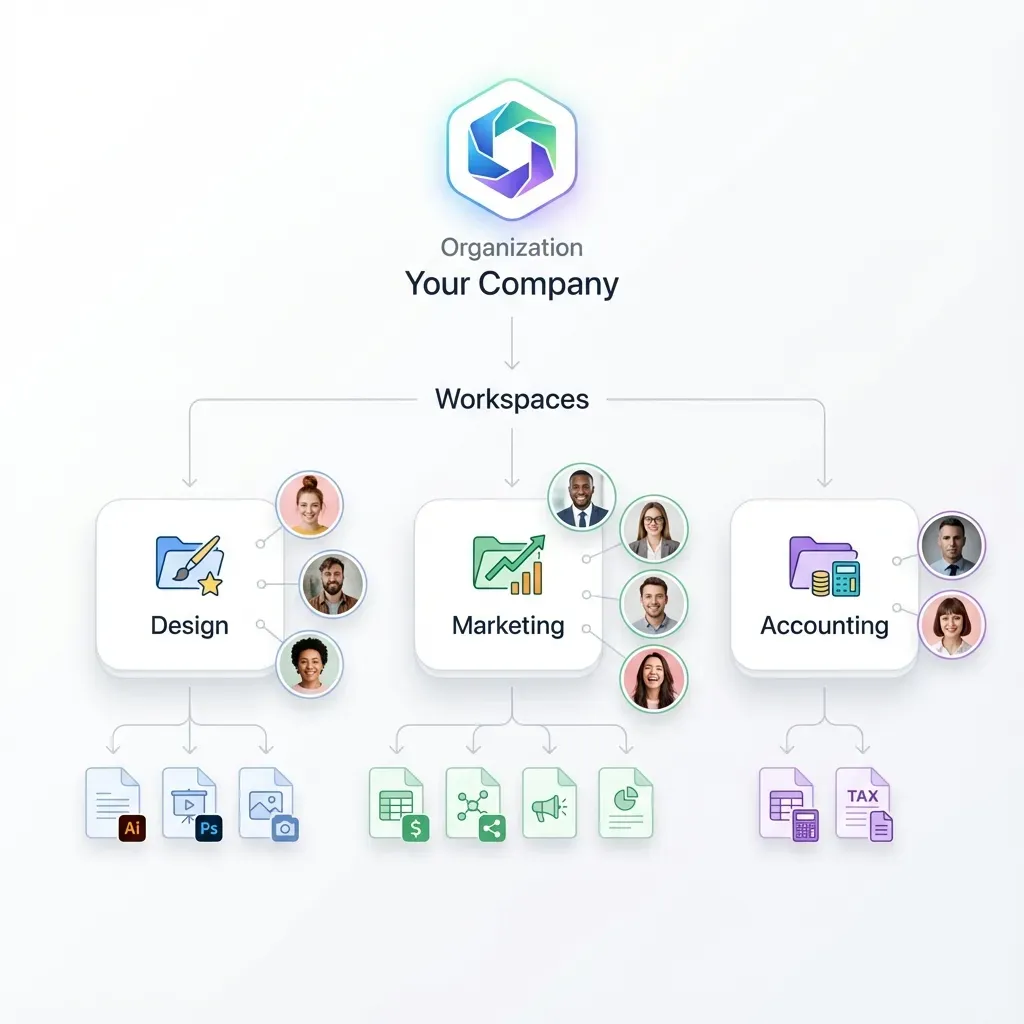


Give Claude a persistent workspace for file handoffs
Persistent storage with MCP-ready endpoints for reads, writes, and shares, backed by granular permissions.
How to Choose a Cloud Deployment Option
Claude is currently the only frontier AI model available on all three major cloud platforms. Organizations can deploy through four channels, each with different tradeoffs around data residency, billing, and operational control.
Anthropic Direct (SaaS) is the simplest path. You access Claude through claude.com or the API, and Anthropic handles infrastructure. This channel gets new model versions first and provides direct access to Anthropic support. The tradeoff is that data processing happens on Anthropic's infrastructure, which may not satisfy data residency requirements for some organizations.
AWS Bedrock integrates Claude into the AWS ecosystem. Authentication runs through IAM, network traffic stays within your VPC, and billing consolidates into your existing AWS account. If your organization already has an Enterprise Discount Program with AWS, Bedrock usage may count toward committed spend. Regional availability lets you keep data processing within specific AWS regions for compliance purposes.
Google Cloud Vertex AI offers a similar integration for GCP-native organizations. You get IAM-based auth, VPC-level network controls, and consolidated GCP billing. Vertex AI also supports Model Garden, which gives teams a consistent interface for evaluating and deploying multiple AI models alongside Claude.
Microsoft Azure Foundry is the newest option. It brings Claude to organizations that run primarily on Azure infrastructure, with the same IAM and network isolation benefits as the other cloud providers.
How to Choose
The decision usually comes down to three factors. First, existing infrastructure: if 80% of your workloads run on AWS, Bedrock avoids introducing a new billing relationship and vendor management process. Second, data residency: if you need data processed in a specific country or region, check which cloud provider offers Claude in that region. Third, procurement: if your organization has committed cloud spend, running Claude through that provider may be more cost-efficient than a direct Anthropic contract.
Most mature enterprise deployments in 2026 use a hybrid approach. They run Bedrock or Vertex AI for inference workloads and the direct Anthropic API for agent-platform features like Claude Code and Claude Cowork, which benefit from early access to new capabilities.
Pricing and Seat Economics
Claude Enterprise uses a seat-plus-usage model. The seat fee covers platform access. All token consumption is billed separately at standard API rates. There are no per-seat usage allowances or included token bundles, which is a significant structural difference from competitors that bundle unlimited usage into a flat per-seat price.
Self-Serve vs. Sales-Assisted
Self-serve Enterprise starts at $20 per seat per month with a minimum of 20 seats. Payment is by credit card or ACH in USD. You get the same Enterprise features as sales-assisted plans, including HIPAA-readiness with a BAA, and you can scale seats up or down without contacting sales.
Sales-assisted Enterprise requires a minimum of 50 seats and supports invoicing, multi-currency billing, and custom contract terms. Pricing is negotiated based on expected usage volume.
Usage Costs
All consumption beyond the seat fee is billed at Anthropic's published API rates:
- Claude Opus 4.8: $5.00 per million input tokens, $25.00 per million output tokens
- Claude Sonnet 4.6: $3.00 per million input tokens, $15.00 per million output tokens
- Claude Haiku 4.5: $1.00 per million input tokens, $5.00 per million output tokens
Two features reduce these costs. The Batch API applies a flat 50% discount on all token costs for workloads that tolerate asynchronous processing. Prompt caching reduces repeated input costs to roughly 10% of standard rates, which matters for applications that send the same system prompt or document context across many requests.
Comparison to Team Plans
The Team plan offers two seat types. Standard seats cost $20 per month (annual billing) or $25 monthly, and include a usage allowance within the seat price. Premium seats cost $100 per month (annual) or $125 monthly, with higher usage limits and Claude Code access.
The Enterprise plan flips this model. The seat fee is lower, but usage is uncapped and billed separately. For organizations with moderate, predictable usage per employee, the Team plan may be cheaper. For organizations with highly variable usage, where a few power users consume far more tokens than average, Enterprise's usage-based billing avoids overpaying for seats that barely get used.
Managing Costs
Admins can set spend limits at the organization level and per individual user. Usage analytics show which teams consume the most tokens, broken down by model and product surface. These controls matter because the seat-plus-usage model can produce surprise bills if a team discovers Claude Code and starts running it heavily without guardrails in place.
Sources
References used to verify factual claims in this guide.
-
Anthropic connected Claude Enterprise to 28 security and compliance platforms in 2026
-
Claude Security entered public beta in April 2026 using the Claude Opus 4.7 model
-
Self-serve Enterprise starts at $20 per seat plus usage-based API costs
-
HIPAA-readiness with a BAA is available on both self-serve and sales-assisted Enterprise plans
-
Anthropic maintains SOC 2 Type I and Type II, ISO 27001:2022 and ISO/IEC 42001:2023 credentials and a HIPAA-ready configuration (BAA available)
-
Anthropic enforces AES-256 encryption at rest and TLS 1.2+ in transit
-
Claude Opus 4.8 costs $5.00 input / $25.00 output per million tokens
Frequently Asked Questions
How much does Claude Enterprise cost?
Self-serve Enterprise starts at $20 per seat per month with a minimum of 20 seats. The seat fee covers platform access only. All token usage is billed separately at standard API rates. Sales-assisted plans require 50 seats minimum and include custom pricing, invoicing, and multi-currency support.
Is Claude HIPAA compliant?
Claude Enterprise offers a HIPAA-ready configuration with a Business Associate Agreement (BAA) on both self-serve and sales-assisted Enterprise plans. The organization's Primary Owner enables it from organization settings and accepts the BAA there; Team and individual plans cannot enable it. Organizations handling protected health information need this configuration before processing PHI through Claude.
What security features does Claude Enterprise include?
Anthropic holds SOC 2 Type I and Type II, ISO 27001:2022 and ISO/IEC 42001:2023 certifications. Claude Enterprise includes SSO/SAML authentication, SCIM provisioning, role-based access control, audit logging, OpenTelemetry monitoring, data retention controls, and a Compliance API. Anthropic also launched 28 security integrations in 2026 covering DLP, SIEM, identity management, and eDiscovery.
How does Claude Enterprise compare to ChatGPT Enterprise?
The main structural difference is pricing. ChatGPT Enterprise uses a flat per-seat model with usage included, while Claude Enterprise charges a lower seat fee plus usage-based API costs. Claude Enterprise bundles four product surfaces (Chat, Code, Cowork, and Security) and is available on AWS Bedrock, Google Cloud Vertex AI, and Azure Foundry. Feature comparisons depend on your specific needs around compliance certifications, deployment flexibility, and cost predictability.
What is Claude Security?
Claude Security is a public beta feature that scans codebases for vulnerabilities using the Claude Opus 4.7 model. It traces data flows across files and modules, generates severity ratings and confidence levels, and produces actionable patch instructions. Currently available to Enterprise customers, with planned expansion to Team and Max plans.
Can I deploy Claude Enterprise on AWS?
Yes. Claude is available on AWS through Amazon Bedrock, with IAM authentication, VPC network isolation, and consolidated AWS billing. It is also available on Google Cloud Vertex AI and Microsoft Azure Foundry. Claude is currently the only frontier AI model available on all three major cloud platforms.
Related Resources

Give Claude a persistent workspace for file handoffs
Persistent storage with MCP-ready endpoints for reads, writes, and shares, backed by granular permissions.