Best OpenClaw Skills for AI Note-Taking and Knowledge Capture
Meta deployed an AI second brain to 63,000 employees in early 2026, yet most OpenClaw guides still limit PKM coverage to Obsidian and Notion. ClawHub lists 69 dedicated notes and PKM skills spanning traditional note apps, AI-native memory engines, and content capture tools. This guide maps all three categories and shows how to combine them into a working knowledge stack.

69 PKM Skills, and Most Guides Cover Two
Meta's analytics team deployed an AI "second brain" to 63,000 employees in early 2026, with roughly 10,000 using it daily across engineering, legal, finance, and sales. The system tracks projects, reads meeting notes, surfaces connections, and builds on prior conversations. Knowledge capture at that scale isn't a nice-to-have. It's infrastructure.
OpenClaw's skill ecosystem reflects the same demand at the individual level. The awesome-openclaw-skills catalog lists 69 dedicated skills in its Notes and PKM category, spanning everything from vault connectors for Obsidian and Bear to full knowledge-graph engines like cortex-memory. Most "best OpenClaw skills" articles mention Obsidian and Notion, then move on.
The gap matters because note-taking skills and AI memory systems solve different problems. Connecting to Obsidian lets your agent read and write notes in a vault you already use. An AI memory skill like agent-memory-ultimate gives your agent its own persistent recall layer with semantic search and automatic consolidation. Content capture tools handle the ingest side, pulling web clips, transcriptions, and social posts into structured notes.
Here is how the 69 skills break down:
Traditional Note Apps (8 skills)
- Obsidian, Notion, Bear Notes, Apple Notes, Craft, BookStack, UpNote, Flomo
AI-Native Memory Systems (13 skills)
- agent-memory-ultimate, cortex-memory, braindb, chaos-mind, rune, elite-longterm-memory, session-memory, and others
Content Capture and Processing (6+ skills)
- Cubox, Anki Connect, voice-notes-pro, tweet-processor, meeting-to-action, and others
This guide covers the most useful skills in each category, explains what distinguishes them from each other, and shows how to combine them into a working knowledge pipeline.
Related guides
- How to Use Claude Code Skills in ClineAccording to GitHub's Octoverse 2024 report, the number of developers building with generative AI on the platform...
- How to Use Devin Knowledge to Onboard the AgentCognition's Knowledge guide lets you pin each note to no repo, one repo, or all repos, so onboarding Devin is a...
- Best OpenClaw Skills for AI Knowledge Base CreationSelf-Improving Agent tops ClawHub at 419K+ downloads, and Ontology has crossed 182K, yet most guides on agent knowledge...
- Best OpenClaw Skills for Web ResearchWeb research skills let OpenClaw agents find and read information on the live web. Without them, your AI is stuck with...
- 10 Best OpenClaw Skills for File ManagementOpenClaw skills are reusable, installable capabilities for Claude Code that add specialized tools for file management,...
- How to Automate Infrastructure: Top OpenClaw Skills for Network EngineersNetwork automation used to require writing complex Python scripts or wrestling with Ansible playbooks. Today, OpenClaw...
More on this subject: OpenClaw Skills (109 guides)
How We Evaluated These Skills
We tested each skill against five criteria specific to knowledge capture workflows:
Persistence model: Does knowledge survive session restarts and context compaction? Local files, SQLite databases, and cloud sync each have tradeoffs in durability and portability.
Query capability: Can the skill handle semantic search, keyword matching, or graph traversal? Flat keyword lookup scored lower than multi-hop retrieval.
Sync and portability: Will your notes stay accessible across machines? Skills tied to a single macOS install (Apple Notes, Bear) scored lower for teams running OpenClaw on servers.
Integration surface: Does the skill share data with other OpenClaw tools, or does it silo knowledge? Cross-skill entity access matters for multi-tool workflows.
Setup friction: How many steps from install to first working note? OAuth configuration, external app dependencies, and manual schema work all add cost.
Download counts on ClawHub served as a signal of community trust, but we weighted practical capability over popularity.
Best Traditional Note App Skills for OpenClaw
These skills connect OpenClaw to note-taking applications you already use. They bridge your agent into an existing workflow rather than replacing it.
1. Obsidian
The obsidian skill gives your agent full read and write access to an Obsidian vault. It can search notes, create new ones, link concepts together, update frontmatter, and manage tasks. Since February 2026, Obsidian's official obsidian-headless client supports background sync through Obsidian Sync, keeping your agent and desktop app in lockstep without manual git operations. Alternative sync methods include Obsidian Git, Remotely Save, and the Local REST API.
With a vault of 10,000+ notes, the skill handles targeted searches efficiently because it delegates to the obsidian CLI rather than scanning files directly. Your agent can create daily notes, append to existing entries, and link new discoveries to related concepts from any conversation.
Best for: developers who already think in linked markdown. The vault-as-filesystem model means your agent's notes are just files you can version, grep, and back up with existing tools.
2. Notion
The notion skill connects to your Notion workspace through the Notion API. It queries databases with filters and sorts, creates pages with rich block content, appends to existing pages, and inspects database schemas. One detail worth knowing: Notion integrations have zero access by default. You must share each page or database with the integration through Notion's Share menu before the skill can read or write anything.
The database support is where this skill separates from simpler note-taking integrations. Your agent can create a new database row when it finishes a research task, update a status column when work completes, or query all entries matching specific criteria. That makes Notion particularly strong for structured, queryable knowledge.
Best for: teams running project management and documentation in Notion. The database layer makes it a good fit for CRMs, content calendars, research trackers, and any workflow that benefits from tabular knowledge.
3. Bear Notes
The bear-notes skill manages Bear notes through the grizzly CLI. It handles creation, search, tagging, and organization. Like Apple Notes, Bear only runs on macOS.
Best for: Mac users who prefer tag-based organization over folder hierarchies.
4. Apple Notes
The apple-notes skill uses the memo CLI to create, search, edit, move, and export notes. Notes sync to iOS through iCloud, but the skill itself requires macOS. It can export to HTML and Markdown for interoperability with other tools.
Best for: users deep in the Apple ecosystem who want their agent writing to the same notes app they check on their phone.
5. Craft and BookStack
The craft skill provides REST API access to Craft.do documents, while bookstack connects to BookStack's self-hosted wiki and documentation API. Both are lighter-weight options for teams that don't need the full scope of Obsidian or Notion.
Best for: self-hosted documentation (BookStack) or Craft's block-based editor for individual use.
How AI-Native Memory Systems Give Agents Persistent Recall
These skills give your agent its own memory layer, independent of any note-taking app. Instead of writing to Obsidian or Notion, the agent maintains a structured internal knowledge store that persists across sessions, survives context compaction, and improves retrieval precision over time. Note apps manage documents you create and edit manually. Memory systems track everything the agent encounters and learns.
1. agent-memory-ultimate
The most production-ready option in this category. It stores memories in a local SQLite database using FTS5 for keyword search, combines vector retrieval with BM25 ranking, and runs sleep consolidation to merge and prune memories between sessions. The result is a 60 to 80 percent reduction in token usage per recall, bringing typical retrievals from thousands of tokens down to 200 to 800 tokens.
Everything runs locally with zero cloud calls, zero external dependencies, and no data leaving your machine. Daily logs track what the agent learned, and the consolidation process compresses aging memories while preserving important patterns. It also includes WhatsApp, ChatGPT, and VCF importers for bootstrapping memory from existing conversations.
Best for: production agents that need efficient, private, long-running memory without external infrastructure.
2. cortex-memory
Where agent-memory-ultimate focuses on efficient recall, cortex-memory builds a temporal knowledge graph. It extracts entities, facts, and relationships from conversations and organizes them into three tiers: episodes (raw conversation chunks), entities (people, projects, tools as graph nodes), and communities (auto-detected clusters with summaries).
Every fact carries four timestamps: when it became true, when it stopped being true, when the system learned it, and when it recorded it as expired. This enables temporal queries like "where did Alice work in 2024?" Benchmarks show 11x fewer tokens than a baseline OpenClaw plus LanceDB configuration. The skill comes with SKILL, CLI, API, and MCP interfaces, plus an insights dashboard for visualizing the knowledge graph.
Best for: agents that need to track evolving relationships between people, projects, and concepts over extended periods.
3. braindb
Semantic memory persistence focused on meaning-based storage and retrieval. Rather than keyword matching, braindb indexes the semantic content of memories so your agent can recall information based on conceptual similarity rather than exact phrasing.
Best for: agents that retrieve knowledge by meaning rather than exact wording.
4. chaos-mind
Hybrid search memory combining multiple retrieval strategies for broader recall coverage. It merges keyword, semantic, and structural search paths into a single query pipeline.
Best for: agents working across diverse knowledge domains where no single retrieval method covers every query type.
5. rune
Self-improving memory with adaptive learning. The recall system adjusts its retrieval weights based on which memories proved useful in past interactions, getting more accurate the longer it runs.
Best for: long-running agents where memory quality compounds over weeks and months of use.



Give your agent persistent knowledge storage
Persistent workspace with built-in AI search. Connect through the Fastio MCP server and keep captured notes accessible to your whole team.
Content Capture and Processing Tools
The third tier handles the input side of knowledge management: pulling information from external sources into structured notes your agent can process.
1. Cubox
Saves webpages and memos through its Open API. When your agent encounters a useful page during research, it can clip it directly to Cubox for later extraction. Cubox handles the parsing, cleaning, and storage so the agent works with clean text rather than raw HTML.
2. Anki Connect
Bridges OpenClaw to Anki's spaced-repetition flashcard system. Your agent can create cards, query existing decks, and schedule reviews. Useful for building study-based learning systems or generating review materials from research output.
3. voice-notes-pro
Transcribes and categorizes voice recordings, turning spoken notes into structured text. If you dictate ideas or capture field notes by voice, this skill converts them into searchable entries your agent can index and cross-reference.
4. tweet-processor
Extracts structured insights from tweets, useful for tracking industry conversations or building a research corpus from social media discussions. Each extracted insight gets filed as a structured note rather than a raw link.
5. meeting-to-action
Converts meeting transcriptions into clear summaries, decisions, and action items. It bridges the gap between raw meeting audio and structured knowledge your agent can reference in future sessions.
6. flomo-notes
Saves quick notes via automation hooks. A lightweight capture endpoint for rapid-fire ideas that need to be logged but not immediately organized.
These capture tools work best when paired with a memory system from the previous section. Cubox captures the webpage, agent-memory-ultimate stores the extracted knowledge, and Obsidian gets the human-readable summary.
Which Skills Should You Install First?
Running three tiers of PKM skills generates a lot of files. Notes accumulate in Obsidian vaults, memories fill SQLite databases, and captured content flows in from web clips and transcriptions. The practical question is where this data lives when you need to share it, back it up, or hand it to a colleague.
Local storage works for a single agent on your laptop. It breaks when you move to server-based agents, collaborate with teammates, or need to deliver captured knowledge to a client.
Here is a practical starting stack:
Pick one note app skill that matches your existing workflow. Obsidian if you want local markdown files. Notion if you need shared team access.
Add one memory system. agent-memory-ultimate for private, efficient recall. cortex-memory if you need relationship tracking across people and projects.
Add capture tools as needed. Cubox for web content, voice-notes-pro for audio, meeting-to-action for calls.
Add a persistent workspace for sharing. Your agent writes notes and memories locally, then syncs finished knowledge artifacts to a shared workspace where humans can search and collaborate.
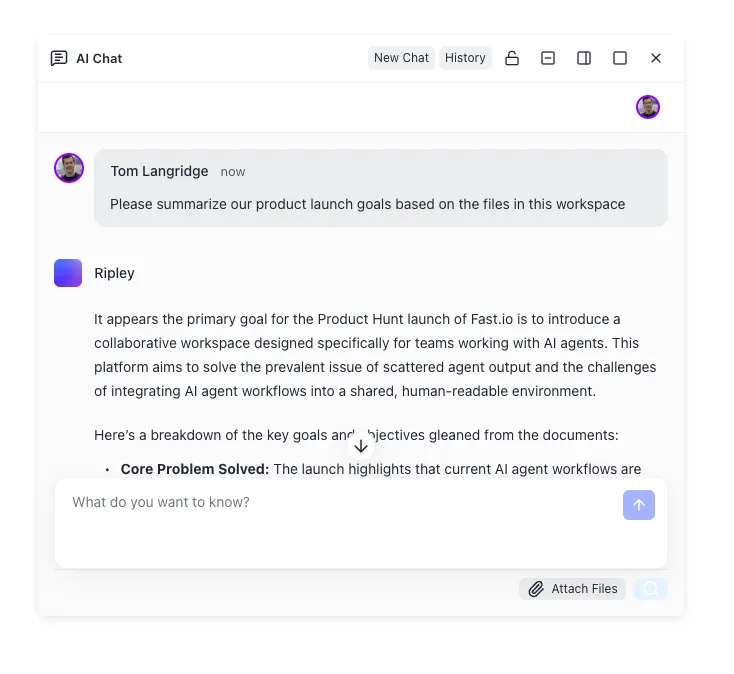
Fastio fits step four. Agents connect through the MCP server to read and write files in shared workspaces. Enable Intelligence Mode on a workspace and every uploaded file gets automatically indexed for semantic search and RAG-powered Q&A, no separate vector database required. When the capture phase wraps up, ownership transfer lets you hand the workspace to a human collaborator while keeping admin access.
Fastio offers a 14-day Business Trial, card required; see /pricing/. Alternatives like S3 or Google Drive handle raw file storage but don't index content for AI search or provide the built-in RAG layer that makes captured knowledge immediately queryable.
The workflow in practice: your agent captures notes and memories locally using the skills above, then syncs finished knowledge artifacts to a Fastio workspace where both agents and humans can search, query, and collaborate on them.
Sources
References used to verify factual claims in this guide.
-
Meta deployed an AI second brain to 63,000 employees with roughly 10,000 daily active users
-
69 dedicated Notes and PKM skills cataloged on ClawHub
-
agent-memory-ultimate achieves 60 to 80 percent token reduction per recall
-
cortex-memory uses 11x fewer tokens than a baseline OpenClaw plus LanceDB setup
Frequently Asked Questions
What are the best OpenClaw skills for note-taking?
The top choices depend on your existing tools. The obsidian skill is strongest for linked markdown workflows. The notion skill works best for teams needing structured databases. For AI-native memory that runs independently of any note app, agent-memory-ultimate provides production-grade recall with SQLite and FTS5, while cortex-memory adds knowledge graphs with temporal entity tracking.
Can OpenClaw connect to Obsidian?
Yes. The official obsidian skill gives your agent read and write access to your vault through the obsidian CLI. It can search, create, edit, and link notes. For sync between your agent and your desktop Obsidian app, you can use obsidian-headless (Obsidian's official headless sync client released in February 2026), Obsidian Git, Remotely Save, or the Local REST API.
How does OpenClaw persistent memory work?
OpenClaw memory skills store knowledge in local databases that survive session restarts and context compaction. agent-memory-ultimate uses SQLite with FTS5 indexing, combining vector search and BM25 ranking with automatic sleep consolidation. cortex-memory takes a different approach, building a temporal knowledge graph of entities and relationships. Both run entirely on your machine with no cloud dependencies.
What is the best PKM setup for OpenClaw?
Start with one note app skill (Obsidian or Notion) for human-readable notes, add one memory system (agent-memory-ultimate for private recall or cortex-memory for relationship tracking), and layer in capture tools as needed (Cubox for web, voice-notes-pro for audio). For sharing agent-captured knowledge with teammates, add a persistent workspace like Fastio that auto-indexes files for AI search.
Do OpenClaw memory skills work offline?
Most do. agent-memory-ultimate, braindb, chaos-mind, and rune all store data locally in SQLite or file-based storage with no cloud API calls. cortex-memory also runs locally. The note app skills (Obsidian, Bear, Apple Notes) work offline for local operations, though sync features like Obsidian Sync or iCloud require a connection.
Related Resources

Give your agent persistent knowledge storage
Persistent workspace with built-in AI search. Connect through the Fastio MCP server and keep captured notes accessible to your whole team.