Best Open Source AI Tools in 2026
Hugging Face hosts over 2.2 million models, but the top 50 account for 80% of all downloads. Most developers don't need more choice. They need a shorter list of tools that actually work. This guide evaluates the open source AI tools worth deploying in 2026, with honest assessments of hardware requirements, license implications, and maintenance costs that most roundups skip.


Why Most Open Source AI Lists Are Noise
Hugging Face's Spring 2026 State of Open Source report puts the platform at over 2.2 million public models, yet the top 50 account for roughly 80% of all downloads. That concentration tells you something important: the open source AI ecosystem is enormous but unevenly useful. Thousands of fine-tunes and forks exist for every popular base model, and most are abandoned experiments with no documentation, no benchmarks, and no community support.
This guide cuts through the noise. Instead of listing every project with an AI label, we focus on the ten tools that developers are actually shipping with in production. We organized them into three groups: large language models, application frameworks and runners, and specialized tools for images, code, and agent infrastructure.
Here is a quick overview of what we cover, sorted by category:
Large Language Models
- DeepSeek V4 Pro (MIT): Highest open source coding score at 80.6% SWE-bench Verified, 1M token context
- Llama 4 Scout (Llama Community License): 10M token context window for massive document processing
- Qwen 3.5 (Apache 2.0): Strongest multilingual coverage at 201 languages
Frameworks and Runners
- Ollama (MIT): Simplest local LLM runner with 170K GitHub stars
- LangChain (MIT): Most adopted LLM application framework with 126K GitHub stars
- CrewAI (MIT): Leading multi-agent orchestration with A2A protocol support
Specialized Tools
- FLUX.2 (Apache 2.0): Best photorealistic image generation among open models
- Open WebUI (MIT): Self-hosted ChatGPT alternative with multi-user support
- Tabby (Apache 2.0): Self-hosted GitHub Copilot replacement for teams with IP restrictions
- Fastio (commercial workspace): Persistent workspace and remote MCP server for AI agent output
Related guides
- DeepSeek AI Review 2026: Models, Pricing, and Developer VerdictDeepSeek AI ships open-weight models that match frontier benchmarks at a fraction of the cost, but the tradeoffs around...
- Top 10 Open Source AI Agents You Can Run Locally in 2026Open source AI agents are autonomous software programs that run LLMs locally, with full source code available to...
- AI Model Comparison 2026: Claude vs GPT vs Gemini vs Open SourceThe Artificial Analysis Intelligence Index ranks 381 AI models across ten benchmarks as of June 2026, and the gap...
- OpenFuture AI Review 2026: What the Directory Gets Right and WrongOpenFuture AI is a free directory indexing over 40,000 AI tools across 70+ categories, updated daily. This review...
- Best Free AI Agent Tools 2026: Top 12 Platforms ComparedBuilding autonomous agents doesn't have to be expensive. The free AI agent ecosystem now offers professional frameworks...
- Best Tools for LangChain Development in 2026The LangChain ecosystem has expanded beyond the core library to include specialized tools for observability,...
More on this subject: AI Tool Directories and Comparisons (231 guides)
How We Picked These Ten Tools
Most roundups rank tools by GitHub stars or release date. Neither metric tells you whether something works in production. We evaluated each tool across five criteria that matter more to teams actually building with open source AI.
Community activity and maintenance. Is the project actively maintained? How quickly do maintainers respond to issues? A tool with 100K stars and six-month-old bugs is worse than one with 10K stars and weekly releases.
License implications. Apache 2.0 and MIT let you do almost anything commercially. The Llama Community License caps usage at 700 million monthly active users. Some projects marketed as "open source" use non-commercial licenses that block business use entirely. We flag these differences for each tool.
Hardware requirements. Can you run it on a laptop, or does it need a data center? We include VRAM estimates and quantization options so you can match tools to your actual hardware.
Deployment difficulty. How long from zero to a working setup? Tools that need extensive configuration or custom infrastructure lose points here.
Maintenance burden. Open source is free to download but not free to run. We note which tools need ongoing attention for model updates, security patches, and infrastructure scaling, and which are closer to install-and-forget.
The LLMs Worth Running in Production
Open source LLMs closed the gap with proprietary models during 2025, and the distance kept shrinking into 2026. DeepSeek V4 Pro now leads the open weight leaderboard for agentic coding tasks. Llama 4 Scout introduced a 10 million token context window that no proprietary model currently matches. The licensing landscape also shifted: Apache 2.0 became the dominant permissive license, with Qwen, Gemma, and Mistral all shipping under it.
Three models stand out for different reasons, and choosing between them depends on what you're building.

DeepSeek V4 Pro
DeepSeek V4 Pro tops the open source coding leaderboard at 80.6% on SWE-bench Verified, matching or exceeding most proprietary models on code generation. It uses a Mixture of Experts architecture that keeps inference costs manageable despite its large total parameter count, and ships under the MIT license with a 1 million token context window.
Key strengths:
- Highest SWE-bench score among open models (80.6%)
- MIT license allows unrestricted commercial use
- 1M token context handles entire codebases in a single prompt
Limitations:
- Too large to run on consumer hardware; requires API access or cloud GPUs (8x H200, roughly $36/hour)
- Documentation is primarily in Chinese, which can slow onboarding for English-speaking teams
Best for: Production coding agents, reasoning-heavy workflows, and agentic tasks that need long context.
Pricing: Free weights under MIT. Self-host on cloud GPUs or use the DeepSeek API.
Llama 4 Scout
Meta's Llama 4 Scout brought a 10 million token context window to open source. That is enough to process an entire codebase, a shelf of research papers, or 20 hours of video transcription in a single prompt. It uses a MoE architecture with 109 billion total parameters but only 17 billion active, which means it fits on a single H100 GPU.
Key strengths:
- 10M token context window, the largest among production-ready open models
- Runs on a single H100 GPU thanks to efficient MoE architecture
- Strong general performance (the Maverick variant scores 85.5% on MMLU)
Limitations:
- Llama Community License restricts companies with over 700 million monthly active users
- Not truly "open source" by OSI standards due to license terms
Best for: Processing massive documents, legal discovery, full-repository code review, and research analysis.
Pricing: Free weights. License review recommended for large-scale commercial use.
Qwen 3.5
Alibaba's Qwen 3.5 supports 201 languages under Apache 2.0, making it the cleanest choice for commercial multilingual applications. The full 397B model delivers strong reasoning, while smaller variants (27B and 7B) run comfortably on consumer hardware with quantization.
Key strengths:
- Apache 2.0 license with zero commercial restrictions
- 201 languages with strong performance across all of them
- Family of sizes from 7B to 397B to fit different hardware budgets
Limitations:
- Full 397B model requires significant GPU resources for self-hosting
- Smaller variants trade reasoning quality for accessibility
Best for: Commercial multilingual applications, enterprise deployments where license clarity matters, and teams that need a range of model sizes for different tasks.
Pricing: Completely free under Apache 2.0. Smaller variants run on consumer GPUs; the 397B model needs cloud infrastructure.
Runners, Frameworks, and Agent Orchestration
Models alone don't build applications. You need runners to serve them locally, frameworks to chain them into workflows, and orchestration layers when a single agent isn't enough. This section covers the infrastructure that turns a downloaded model into something you can ship.
Ollama
Ollama is the simplest way to run LLMs on your own machine. Install it, pull a model, and start querying through a local REST API. That is the entire setup. It supports over 100 models including Llama 4, DeepSeek, Qwen, and Gemma, and its OpenAI-compatible API at localhost:11434 means most tools built for OpenAI work with Ollama without code changes.
Key strengths:
- 170K GitHub stars and 52 million monthly downloads as of Q1 2026
- One-command model management (ollama pull llama4)
- OpenAI-compatible REST API works as a drop-in replacement
Limitations:
- No built-in chat interface; pair with Open WebUI for a graphical frontend
- Limited fine-tuning support compared to vLLM or raw llama.cpp
Best for: Developers who want local LLMs running in minutes with zero configuration.
Pricing: Completely free, MIT license.
LangChain
LangChain remains the most widely adopted framework for building LLM-powered applications, with 126K GitHub stars and the broadest integration ecosystem. It provides modular abstractions for chains, agents, memory, and retrieval. LangGraph extends it with graph-based state management for complex agent workflows, and LangSmith adds production observability.
Key strengths:
- Largest ecosystem of integrations and community-contributed components
- LangGraph adds stateful, graph-based workflows for multi-step agents
- LangSmith provides production-grade tracing and evaluation
Limitations:
- Abstraction layers can make debugging harder in production
- Steeper learning curve than lighter alternatives like LlamaIndex
Best for: Production LLM applications with complex retrieval pipelines, multi-step reasoning, and orchestrated agent workflows.
Pricing: MIT license for the core framework. LangSmith observability is a separate paid service.
CrewAI
CrewAI takes a role-based approach to multi-agent systems. You define agents with specific roles and tasks, then let them collaborate on a shared goal. It is the fastest way to prototype multi-agent workflows, and it recently added A2A (Agent-to-Agent) protocol support for cross-framework communication.
Key strengths:
- Intuitive role-based agent design with the lowest barrier to entry among agent frameworks
- A2A protocol support lets agents from different frameworks communicate
- Active development with a growing ecosystem of tools and integrations
Limitations:
- Less battle-tested in production than LangGraph
- Limited checkpointing and state recovery compared to graph-based alternatives
Best for: Teams prototyping multi-agent workflows where agents have clearly defined roles and tasks.
Pricing: MIT license, completely free.


Give Your AI Agents a Persistent Workspace
Persistent cloud storage, a remote MCP server with a consolidated toolset, and built-in semantic search once Intelligence is enabled.
Image Generation, Coding Assistants, and Workspaces
Open source AI goes well beyond text generation. Image models, coding assistants, chat interfaces, and workspace platforms round out the toolkit that development teams use daily. These four tools address gaps that LLMs alone cannot fill.
FLUX.2
Black Forest Labs released FLUX.2 in November 2025, and it quickly became the photorealism leader among open source image generators. It supports up to 10 reference images per generation for consistent character and product rendering. Prompt adherence is noticeably better than earlier diffusion models, especially for complex scene descriptions with specific layout and lighting requirements.
Key strengths:
- Best photorealism among open source image models in 2026
- Multi-reference consistency for branded content and recurring characters
- Apache 2.0 license for unrestricted commercial use
Limitations:
- Higher VRAM requirements than Stable Diffusion (12GB+ GPU recommended)
- Smaller LoRA fine-tuning ecosystem than Stable Diffusion's more mature community
Best for: Product photography, portrait generation, and workflows that need photorealistic quality from an open model.
Pricing: Free weights under Apache 2.0. Needs a GPU with 12GB+ VRAM for local inference.
Open WebUI
Open WebUI gives your team a ChatGPT-style interface for any local or remote LLM backend. It supports multi-user access with role-based permissions, built-in RAG for document uploads, voice input and output, and SSO through OIDC or OAuth. It turns Ollama into something non-technical team members can actually use.
Key strengths:
- Multi-user support with role-based access control
- Built-in RAG for document-based conversations without extra infrastructure
- Works with any OpenAI-compatible API backend
Limitations:
- Requires Docker for deployment
- Backend LLM setup (Ollama or similar) is a separate step you manage yourself
Best for: Teams of 2 to 20 who want a shared, private AI assistant without sending data to third-party APIs.
Pricing: MIT license, completely free.
Tabby
Tabby is a self-hosted alternative to GitHub Copilot. It integrates with VS Code and JetBrains IDEs, indexes your repositories for context-aware code suggestions, and runs entirely on your own infrastructure. For engineering teams that cannot send source code to external services, Tabby fills the gap.
Key strengths:
- Full IDE integration (VS Code, JetBrains) with repository indexing for better context
- Team server mode for shared model configuration and management
- Apache 2.0 license with no telemetry by default
Limitations:
- NVIDIA GPU strongly recommended for acceptable completion latency
- Model selection is more limited than hosted alternatives like Copilot
Best for: Engineering teams with intellectual property restrictions or compliance requirements that prevent cloud-based code completion.
Pricing: Free under Apache 2.0. Self-hosted; hardware costs apply.
Fastio
Fastio is not an open source tool. It is a commercial workspace platform with a 14-day Business Trial, and it addresses a problem that open source AI tools frequently ignore: where do agents store their output, and how do humans access it?
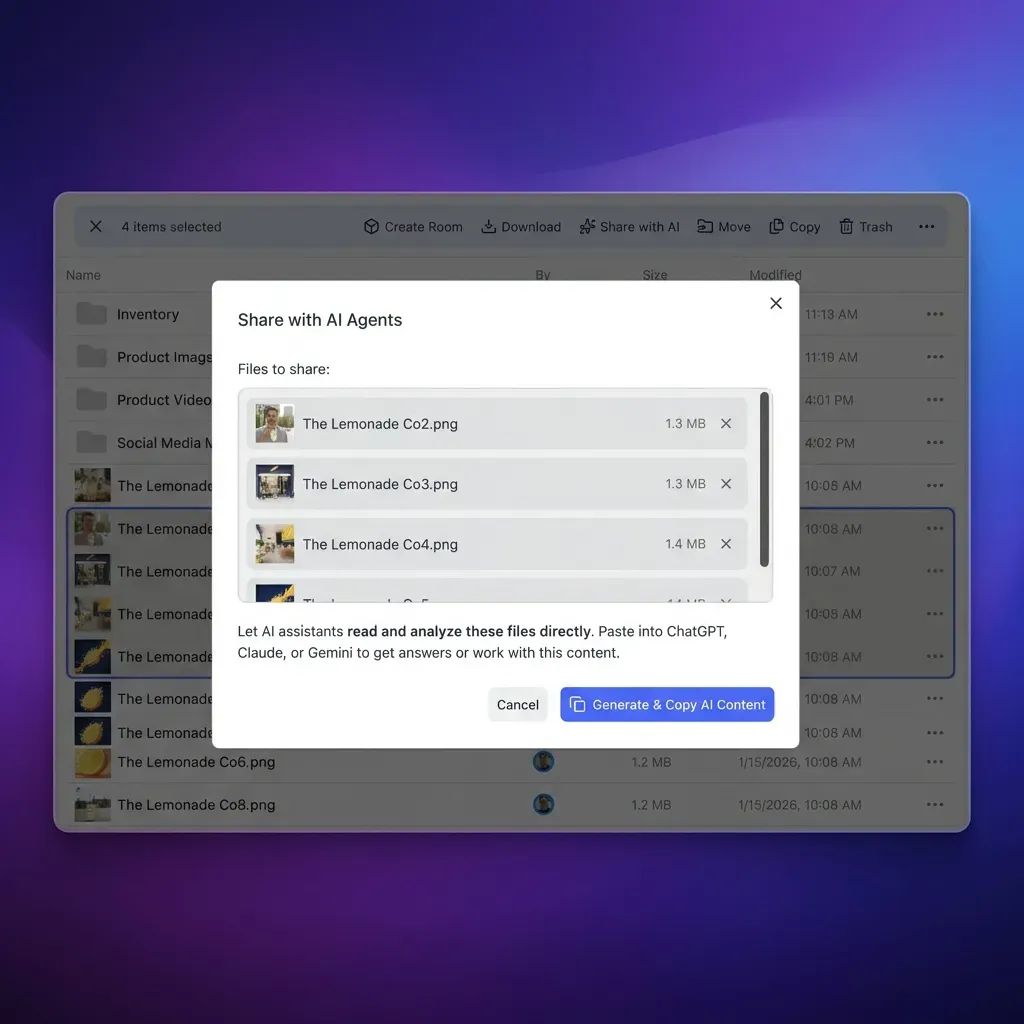
Fastio provides shared workspaces where AI agents and humans collaborate on the same files. Once Intelligence is enabled for the workspace, uploaded documents are indexed for semantic search and citation-backed chat without requiring a separate vector database. The remote MCP server exposes a consolidated toolset for storage, AI search, and metadata operations. When an agent finishes building something, ownership transfer lets it hand everything to a human while keeping admin access.
Key strengths:
- Business Trial: 14-day trial requiring a credit card, with plans starting at $9.99/month
- Remote MCP server at /mcp (Streamable HTTP) and /sse (legacy) for any MCP-compatible client
- Intelligence Mode indexes files for RAG once enabled for the workspace
- Ownership transfer: agents build workspaces and shares, then transfer them to humans
Limitations:
- Not open source; it is a commercial cloud service with paid plans and a 14-day Business Trial
- Usage-based credits with per-plan seat and storage limits
- No self-hosted deployment option
Best for: AI agents that need persistent storage, file sharing with humans, and a structured handoff workflow. Works with any LLM or framework on this list.
Pricing: Plans start at $9.99/month (Starter) with a 14-day Business Trial requiring a credit card (fast.io/pricing).
Hardware Requirements and License Comparison
Your hardware budget determines which of these tools you can actually run. Here is a practical breakdown by setup.
Consumer GPU (8 to 24GB VRAM: RTX 3060 through RTX 4090)
- 7B to 13B parameter models through Ollama with good performance
- FLUX.2 image generation at reasonable speeds
- Tabby code completion with smaller coding models
- Quantized versions of Qwen 3.5 27B and Phi-4 14B
Apple Silicon Mac (32 to 128GB unified memory)
- Unified memory acts as VRAM, so an M3 Max with 64GB handles models that need a dedicated GPU on other platforms
- Ollama and Open WebUI run well for local development
- 70B+ parameter models work but with slower token generation
Cloud GPUs (H100, H200, A100)
- Required for full-size DeepSeek V4 Pro, Llama 4 Scout, and Qwen 3.5 397B
- A single H100 at roughly $2.50/hour runs Llama 4 Scout
- DeepSeek V4 Pro needs 8x H200 GPUs at roughly $36/hour
License quick reference
- No restrictions (Apache 2.0): Qwen 3.5, FLUX.2, Tabby, Gemma 4, Mistral Large 3
- No restrictions (MIT): DeepSeek V4 Pro, Ollama, Open WebUI, LangChain, CrewAI
- Commercial limits: Llama 4 (Llama Community License, 700M MAU cap)
The right stack depends on your constraints. If you need legal clarity for a commercial product, stick with Apache 2.0 or MIT licensed tools. If you are running locally on limited hardware, Ollama plus a quantized Qwen or Phi model gets you surprisingly far. If you have cloud budget and need the best quality available, DeepSeek V4 Pro for coding, Qwen 3.5 for multilingual work, and Llama 4 Scout for long-context tasks give you coverage across most production needs.
For teams where AI agents produce work that humans need to review, edit, and deliver, a workspace layer like Fastio bridges the gap between what agents generate and what teams actually ship.
Sources
References used to verify factual claims in this guide.
-
Hugging Face hosts over 2.2 million public models, with the top 50 accounting for 80% of all downloads
-
DeepSeek V4 Pro scores 80.6% on SWE-bench Verified
-
Ollama has 170K GitHub stars and 52 million monthly downloads as of Q1 2026
-
LangChain has over 126K GitHub stars
-
Llama 4 Scout has a 10 million token context window with 109B total parameters (17B active)
-
FLUX.2 released November 2025 with multi-reference consistency supporting up to 10 reference images
-
Qwen 3.5 supports 201 languages under Apache 2.0
Frequently Asked Questions
What is the best open source AI tool?
It depends on what you are building. DeepSeek V4 Pro leads for coding and reasoning tasks with 80.6% on SWE-bench Verified. Llama 4 Scout is best for processing massive documents with its 10M token context window. Qwen 3.5 is the strongest choice for multilingual commercial applications under Apache 2.0. For running any of these locally, Ollama is the most straightforward option.
Is there a free open source alternative to ChatGPT?
Yes. Pair Ollama (local LLM runner) with Open WebUI (ChatGPT-style interface) and you get a private, self-hosted chat assistant in about 20 minutes. Both are MIT licensed and completely free. The experience covers roughly 80% of what ChatGPT does for everyday tasks, with the added benefit that your data never leaves your machine.
What open source AI can I run locally?
On a machine with 16GB of RAM and a GPU with 8GB+ VRAM, you can run 7B to 13B parameter models through Ollama with good performance. Apple Silicon Macs with 32GB+ unified memory handle even larger models. Quantized versions of Qwen 3.5 27B and Phi-4 14B run well on consumer hardware. For image generation, FLUX.2 needs a GPU with at least 12GB VRAM.
Which open source AI model is best for coding?
DeepSeek V4 Pro currently holds the top spot at 80.6% on SWE-bench Verified, but it requires cloud GPUs to run. For local code completion, Tabby paired with a smaller coding model like Qwen Coder or Devstral Small (24B parameters, runs on a single RTX 4090) provides a self-hosted alternative to GitHub Copilot.
What hardware do I need to run open source AI locally?
The practical minimum is 16GB of system RAM and a GPU with 6GB+ VRAM, enough for 3B to 7B models at 4-bit quantization. For comfortable use with 13B+ models, 32GB RAM and 16GB+ VRAM is a much better starting point. Apple Silicon Macs use unified memory as VRAM, so an M3 Max with 64GB handles models that would normally need a data center GPU on other platforms.
What is the difference between open source and open weight AI models?
Open source means the model weights, training code, and training data are all publicly available under a permissive license. Open weight means only the trained model weights are released, while training code and data remain proprietary. Most models marketed as 'open source' in 2026, including Llama 4 and DeepSeek, are technically open weight. Qwen 3.5 under Apache 2.0 and Ollama under MIT are closer to true open source by the OSI definition.
Related Resources

Give Your AI Agents a Persistent Workspace
Persistent cloud storage, a remote MCP server with a consolidated toolset, and built-in semantic search once Intelligence is enabled.