Best Business File Transfer Software: Top 7 Tools for 2026
Guide to business file transfer software: Moving files is only the first step. For a business, you also need to track where data goes, keep it secure, and manage the massive amounts of information your team shares every week. With remote teams and high-res media, standard tools often fall short. This guide looks at the top tools based on speed, security, and cost to help you find the best tool for your team's needs.


What is Business File Transfer Software?
Business file transfer software lets you share large files with teams and clients securely. Unlike consumer apps, these platforms are designed for huge data volumes, keeping security tight and providing clear audit logs. In a professional setting, sending the file is only part of the job. You also need to know the data arrived safely, stayed encrypted, and left a record of who accessed it and when.
Businesses are sending more data than ever. High-res video, huge datasets, and hybrid cloud setups mean most teams now handle gigabytes or terabytes on a regular basis. Because of this, most IT leaders now put security and compliance at the top of their list when picking a transfer tool. Whether you are sending video dailies or syncing financial records, the right software keeps your data safe from the risks of "shadow IT."
Helpful references: Fastio Workspaces, Fastio Collaboration, and Fastio AI.
Related guides
- How to Replace FTP With a Modern File Transfer SolutionFTP was designed in 1971 when network security meant locking the server room door. Today, it remains a liability:...
- How to Secure Large File Transfer for Small BusinessSmall businesses share large files with clients and teams. They deal with sensitive documents, videos, and designs too...
- How to Send Large Files for Free (Without the Hidden Catches)Free large file transfer services let you send files too big for email without paying subscription fees. But "free"...
- How to Transfer Files Between Cloud Storage ServicesCloud-to-cloud file transfer moves files directly between storage providers without downloading to a local device...
- How to Transfer Files Faster: The Complete Speed GuideFast file transfer means using methods optimized to move large files quickly, often through parallel connections,...
- Best Gofile Alternatives for Business File SharingGofile is a free file hosting service popular for quick uploads, but it lacks SLA guarantees, permanent storage, and...
More on this subject: File Sharing (155 guides)
Quick Comparison: Top Business File Transfer Tools
If you are in a rush, this table shows how the top options compare. We focused on what matters most to growing businesses: file size limits, security, and tracking.
1. Fastio: The Intelligent Workspace for Modern Teams
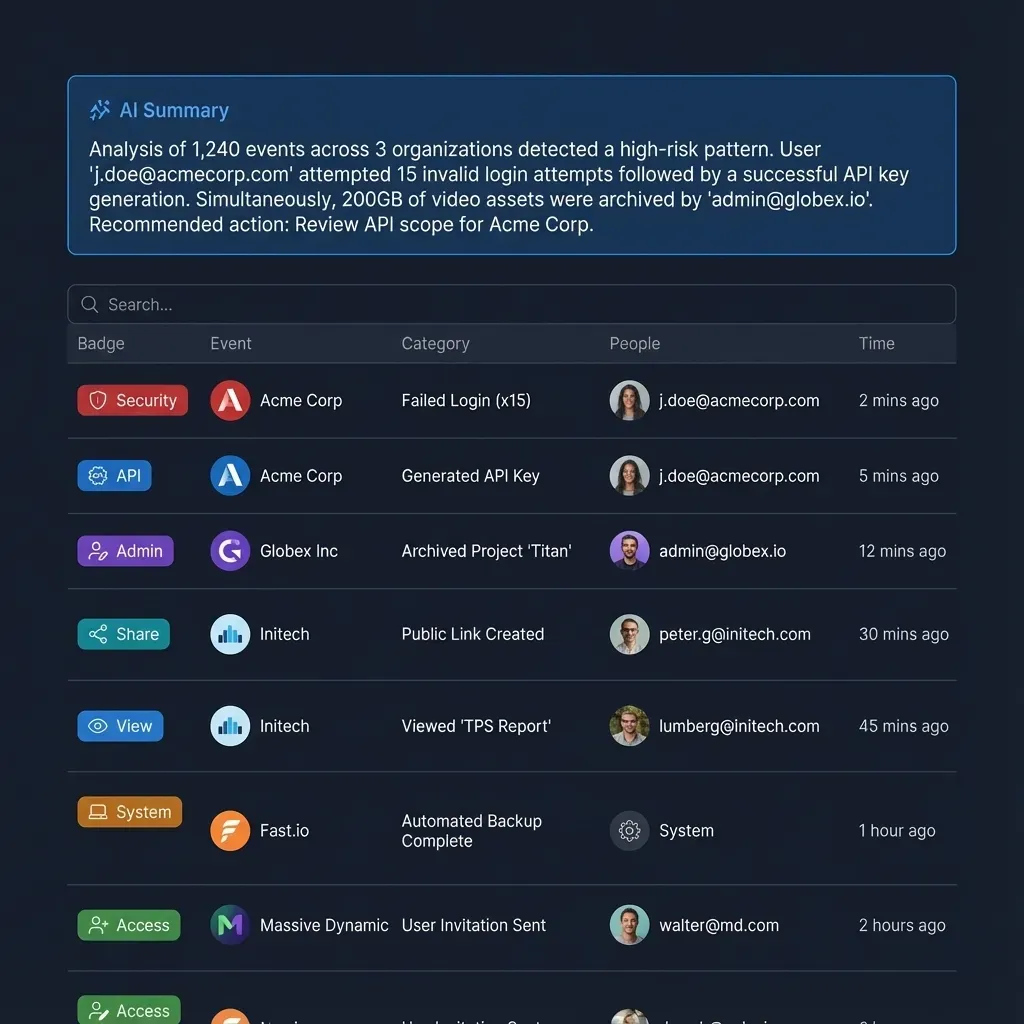
Fastio builds intelligence directly into secure file storage. It works as a shared space where teams and AI agents can manage data together. For businesses that need to track every move, Fastio offers visibility that standard storage providers miss. Every file in a workspace is indexed once Intelligence is enabled, so you can search by what is inside the file rather than just the name.
For example, a marketing agency can upload gigabytes of assets and then ask the workspace which files have specific branding. For developers and AI teams, Fastio provides a big advantage with its consolidated Model Context Protocol (MCP) toolset. You can connect LLMs directly to your storage, letting agents manage files, generate summaries, and transfer ownership on their own.
Pros:
- Agent-Ready Architecture: Built for AI agent workflows with remote MCP connectivity and ownership transfer.
- Intelligence Mode: Built-in RAG (Retrieval-Augmented Generation) lets you search your file library with citations.
- Ownership Transfer: Easily move workspaces from an agent's account to a client or team member.
- URL Import: Pull files from Google Drive, Dropbox, or Box via OAuth without using your own bandwidth.
Cons:
- Does not have the same document co-editing features as Google Workspace.
- Best for teams moving toward AI workflows rather than just manual storage.
Pricing: Plans start at $9.99/month with a 14-day Business Trial (card required; see /pricing/).
2. Dropbox Business: Reliable Sync for Teams
Dropbox is still a top choice for businesses because of its sync engine. It handles "delta sync" better than most, meaning it only uploads the parts of a file that changed. This saves a lot of time on big projects. For teams working with many different document types, Dropbox provides a home that feels familiar and fast.
The "Dropbox Transfer" feature is great for business users who need to send finished work. It lets you deliver up to 100GB with your own branding and password protection. You also get a notification the moment the client downloads the file, so you know it was delivered.
Pros:
- User Experience: easy for new employees to learn.
- Dropbox Transfer: High-capacity delivery without the recipient needing an account.
- Integrations: Works with thousands of apps like Slack, Zoom, and Trello.
Cons:
- Storage costs can go up quickly for large teams.
- Security is strong but has fewer granular controls than tools like Box.
Pricing: Dropbox Business plans are priced per user per month (billed annually); see vendor pricing.


Need Secure, Trackable Business File Transfers?
Fastio offers high-speed, secure file sharing with detailed tracking and plans that include seats. Get generous storage for your team today. Built for secure business workflows. Built for business file transfer software workflows.
3. Box: Security and Governance for Enterprise
If your business is in a regulated field like finance, law, or healthcare, Box is often the best fit. While it handles standard file sharing, its real strength is in its security layers. Box Shield uses machine learning to find odd behavior, like a user downloading too many sensitive files, and can block that action automatically.
Box is also great at "Content Cloud" management. It lets you set up auto-retention policies, add watermarks to previews, and manage encryption keys. For businesses that need to show compliance to auditors, Box has some of the most detailed reporting available.
Pros:
- Top-Tier Security: Includes watermarking and AI-powered threat detection.
- Granular Permissions: Seven levels of access control for every folder.
- Box Sign: Built-in e-signature tools included in most plans.
Cons:
- The interface can feel a bit cluttered compared to Dropbox.
- The best security features usually require the more expensive Enterprise tiers.
Pricing: Box Business plans are priced per user per month (billed annually); see vendor pricing.
4. MASV: Fast Transfers for Big Data
Creative agencies and video teams often need to move multi-terabyte files around the world quickly. MASV was built for these massive files. It uses a global network of servers to get around the usual bottlenecks of the public internet.
Unlike other tools, MASV does not charge per user. Instead, you pay for what you use per GB, or you can get a monthly subscription for high-volume work. This is ideal for projects where you might send terabytes one week and nothing the next. There is no software to install; it all runs through your web browser.
Pros:
- High Speed: Built for virtually infinite file and package sizes.
- No Per-User Fees: Pay only for the data you send.
- Automation: Use "Watch Folders" to automatically upload files as you save them.
Cons:
- Not built for long-term file storage or collaboration.
- Costs can be hard to predict if your transfer volume changes a lot.
Pricing: Pay-as-you-go starts at $0.25 per GB; subscription tiers are also available.
5. GoAnywhere MFT: Best for Complex Automation
For large companies that need to automate thousands of file transfers every day, Managed File Transfer (MFT) software like GoAnywhere is the way to go. It does more than just share files; it lets you build workflows that move data between databases, cloud storage, and older servers without any coding.
GoAnywhere is often used for batch jobs. For instance, it can pull sales data from multiple stores, encrypt it, and send it to a data warehouse every night. It gives you a central spot to manage all data in motion, making sure no file is lost and every transfer is compliant. Organizations using GoAnywhere report an 85% reduction in manual work for IT teams.
Pros:
- Automation: No-code workflow builder for data pipelines.
- Compliance: Meets strict rules for security, privacy, and payment requirements.
- Protocol Support: Handles FTP, SFTP, FTPS, AS2, and more.
Cons:
- Takes time and technical skill to set up.
- Too much for small businesses that just need to share images or PDFs.
Pricing: Enterprise pricing depends on how you use it.
6. OneDrive for Business: Microsoft Ecosystem Integration
For organizations already using the Microsoft ecosystem, OneDrive is the most natural fit. It provides deep integration with Word, Excel, and Teams, making it easy to share files during meetings or co-edit documents in real-time.
OneDrive has increased its limits, and the OneDrive maximum file size limit is 250GB per file. This makes it suitable for most business documents and even moderate-sized video files. Its security is managed through the Microsoft Entra ID (formerly Azure AD), providing enterprise-grade access control.
Pros:
- Ecosystem: Perfect if you are already on the Microsoft stack.
- Real-time Collaboration: Best-in-class co-editing features.
- Cost Effective: Usually included in existing Microsoft 365 subscriptions.
Cons:
- External sharing can sometimes be cumbersome compared to Dropbox.
- Sync issues can occur with deep folder structures.
Pricing: Included in Microsoft 365 plans; standalone plans are priced per user per month.
7. WeTransfer: Streamlined Client Delivery
While often thought of as a consumer tool, WeTransfer's business and premium tiers are designed for professional use. It is the easiest tool for sending a specific set of files to a client without them needing an account.
The WeTransfer Premium supports transfers up to 200GB, which is a massive jump from the free version's large limit. It also allows for custom branding on your download pages, giving your client a professional experience the moment they click the link.
Pros:
- Simplicity: No account required for recipients.
- Branding: Professional, custom-branded transfer pages.
- Large Limits: The 200GB limit is more than enough for most creative projects.
Cons:
- Not a replacement for long-term storage or complex folder management.
- Fewer administrative controls than Box or Fastio.
Pricing: Premium plans are available with monthly and annual subscriptions; see vendor pricing.
The Data: Why File Transfer Security Matters
Choosing the right software is about more than just picking a tool; it is about protecting your business. The move to remote work has made the transfer layer a target for attacks.
- Security Gaps: The Verizon 2024 Data Breach Investigations Report (DBIR) found that vulnerabilities were the initial entry vector for 14% of all breaches, a 180% increase from the previous year. This is why most IT leaders now put security over simple convenience.
- Data Volume: Businesses now transfer massive amounts of data every week, and global data volume is expected to reach 181 zettabytes by 2025 as professionals handle increasingly large datasets.
- Saving Time: Organizations using automated tools like GoAnywhere report an 85% reduction in manual work for IT teams, giving them time to work on higher-priority projects.
These numbers show that "free" or unmanaged tools can be a risk. A single breach or a failed deadline from a slow transfer can cost a business thousands in lost work or legal fees.

How We Picked These Tools
We looked at four main things when picking these business file transfer solutions. We analyzed how each platform works in real-world professional situations.
1. Security and Encryption We looked for advanced encryption and TLS/SSL during transfer. We also looked for tools that have multi-factor authentication (MFA) and SSO, which are required for most enterprise setups.
2. Speed and Reliability A tool only works if it can handle big files without crashing. We tested how these platforms manage slow connections and whether they support "resumable uploads" so you don't have to restart if your Wi-Fi cuts out.
3. Tracking and Visibility Tracking is often ignored in these lists. We looked at how easily a manager can see who downloaded a file, when they did it, and from which IP. This audit trail is key for project management and legal safety.
4. Pricing and Growth We looked for clear pricing that does not punish you as you grow. We checked for "unlimited" capacity and how the cost per user changes as a team gets bigger.
Which Business File Transfer Software Should You Choose?
The best software for you depends on where your business gets stuck. If you need speed for huge video files, MASV is the best choice. Its pay-as-you-go model is flexible for creative pros.
If you are building an AI-integrated workflow, Fastio is the best choice. Its built-in intelligence once enabled and consolidated MCP toolset let you do more than just store files. You can query document contents with citations and coordinate deliverables between agents and humans. For teams that want to be ready for the future, it is a great place to start.
For large-scale automation, GoAnywhere MFT is the heavy-duty solution. It takes more setup, but the ability to build data pipelines is useful for big organizations. For daily team collaboration, Dropbox and Box are reliable, with Box being the better pick if security is your top concern.
Sources
References used to verify factual claims in this guide.
-
vulnerabilities were the initial entry vector for 14% of all breaches, a 180% increase from the previous year
-
global data volume is expected to reach 181 zettabytes by 2025
-
85% reduction in manual work for IT teams
-
Fastio plans start at $9.99/month with a 14-day Business Trial
-
deliver up to 100GB with your own branding
-
Dropbox Business starts at about $18 per user per month
-
Box supports large files on Enterprise Plus plans Box Business plans usually start at $15 per user per month
-
Seven levels of access control for every folder
-
OneDrive maximum file size limit is 250GB
-
WeTransfer Premium supports transfers up to 200GB
-
virtually infinite file and package sizes
-
pay-as-you-go starts at $0.25 per GB
-
consolidated MCP toolset for file operations
Frequently Asked Questions
What is the top file transfer for business?
The top file transfer for business depends on your needs. For AI-integrated workflows and detailed tracking, Fastio is excellent. For massive media files, MASV offers the best speed. For general team collaboration, Dropbox is the industry standard.
Are there secure file transfer options for SMBs?
Yes. SMBs should look for tools that offer advanced encryption and multi-factor authentication. Fastio offers a Business Trial with enterprise-grade security, making it a great starting point for small teams without a large budget.
What is the difference between FTP and secure file transfer software?
Standard FTP is unencrypted, meaning data can be intercepted during transfer. Secure file transfer software uses protocols like SFTP or HTTPS to encrypt data in transit and at rest, while also providing audit logs and access controls that FTP lacks.
How can I send a large file for business?
To send a large file, use a service like Fastio, MASV, or Dropbox Transfer. These services are built to handle large data volumes and offer resumable uploads, ensuring the transfer completes even if the connection is interrupted.
Do I need a dedicated MFT solution?
You likely need Managed File Transfer (MFT) if you must automate thousands of transfers daily or if you have strict compliance or security requirements. For ad-hoc sharing and team collaboration, standard secure cloud storage is usually sufficient.
Related Resources

Need Secure, Trackable Business File Transfers?
Fastio offers high-speed, secure file sharing with detailed tracking and plans that include seats. Get generous storage for your team today. Built for secure business workflows. Built for business file transfer software workflows.