Best AI for Social Media Marketing in 2026
89.7% of social media marketers use AI daily or multiple times per week, but 78.4% still edit outputs heavily before publishing. Nine tools across content creation, scheduling, analytics, and social listening compared here, with real pricing and honest trade-offs for each.


What Separates Useful Social Media AI from Noise
89.7% of social media marketers now use AI daily or multiple times per week, according to Sociality.io's 2026 AI in Social Media Marketing survey. But the part that rarely makes the headline: 78.4% of those same marketers apply moderate to extensive editing before publishing anything AI-generated. And 50% of Gen Z consumers have already unfollowed or muted a brand because its content felt like AI slop, per Sprout Social's Q1 2026 Pulse Survey of 2,250 users across the US, UK, and Australia.
The gap between "we use AI" and "AI makes our content better" is where tool selection actually matters. The tools that help aren't the ones promising to run your entire social presence on autopilot. They're the ones that speed up specific bottlenecks, like writing first drafts, analyzing what performed, or resizing visuals, while leaving room for your team's voice.
We evaluated nine tools across five criteria:
- Content quality: Does the AI output need minor tweaks or a full rewrite?
- Platform awareness: Does it adapt for LinkedIn vs. TikTok vs. Instagram, or produce generic copy?
- Analytics depth: Can it show you what's working and why, not just vanity metrics?
- Pricing transparency: Are AI features included or gated behind expensive add-ons?
- Editing workflow: How easily can a human review, adjust, and approve before publishing?
Here's a quick comparison before the full breakdown.
At a Glance
- Sprout Social: Analytics and social listening, from $199/user/mo
- Hootsuite: Enterprise scheduling with OwlyWriter AI, from $99/user/mo
- Buffer: Cross-platform content adaptation, from free
- Predis.ai: End-to-end AI content (text, image, video), from $19/mo
- Canva: Visual content with Magic Design, from free
- Blaze: Full marketing automation, from $79/mo
- Publer: Budget-friendly AI scheduling, from free
- Social Champ: Agency scheduling with the Switch AI assistant, from free
- Brandwatch: Social intelligence and trend detection, custom pricing
Related guides
- Best AI Voice Changers in 2026: 10 Tools for Real-Time and Post-ProductionRoughly 9,900 people search for 'ai voice changer' every month in the US, yet most comparison articles lump real-time...
- Best AI for Copywriting in 2026: Tools for Ads, Emails, and Landing Pages97% of content marketers plan to use AI for copywriting in 2026, yet most still rely on general-purpose chatbots for...
- 10 Best AI Tools for Content Creators in 202685% of marketers now use AI for content creation, up from 61% in 2023, yet most still limit AI to a single workflow...
- How to Build an AI Agent Social Media Automation WorkflowAI agent social media automation goes far beyond simple scheduling tools. By autonomously handling research, drafting,...
- Best AI Tools for Content Marketing in 202687% of marketers use generative AI in at least one workflow, but most teams stop at a writing assistant and leave the...
- 15 Best AI Tools for Creative Teams in 2026AI tools for creative teams go beyond image generators. The strongest ones handle design, video production, asset...
More on this subject: AI Content and Media Generation (46 guides)
Best Tools for Content Creation
Content creation is where most social teams first reach for AI. Writing captions for five platforms, generating images for each, and keeping everything on-brand takes hours. These three tools cover different parts of that pipeline.
1. Buffer
Buffer's AI Assistant detects which social channel you're writing for and adapts the output accordingly. A LinkedIn post gets a different structure and tone than an Instagram caption or a tweet, without you specifying each one separately. This platform awareness is what sets it apart from general-purpose AI writing tools.
Key strengths:
- Channel-aware content adaptation that adjusts tone, length, and formatting per platform
- Optimal posting time suggestions based on your audience's actual engagement patterns
- Clean interface that most teams learn in under an hour
Limitations:
- Costs scale per channel ($5/mo each), so managing 10+ accounts adds up
- No social listening or competitive analysis features
Best for: Small to mid-size teams managing 3-10 social accounts who want AI help with copy without paying for a full analytics suite.
Pricing: Free for 3 channels and 10 scheduled posts per channel. Paid plans from $5/month per channel.
2. Predis.ai
Predis.ai generates complete social posts from a text prompt: caption, static image, and even short video. It collapses the work that normally requires a copywriter, a designer, and a video editor working in sequence into a single input-output step.
Key strengths:
- Text-to-post generation including captions, static images, and short videos in one flow
- Competitor analysis that shows what's performing for similar brands on each platform
- Ad creative generation for paid social campaigns on Meta and Google
Limitations:
- Generated visuals sometimes need cleanup in a dedicated editor like Canva or Photoshop
- The interface packs a lot of options, which can overwhelm new users
Best for: Solo marketers or small teams who need to produce volume across platforms without hiring specialists for each format.
Pricing: Free tier available with limited generations. Paid plans from $19/month.
3. Canva
Canva's Magic Design generates social graphics from a text description, and its brand kit enforces fonts, colors, and logos automatically across every asset. For teams producing dozens of posts per week, it removes the back-and-forth between writers and designers by letting anyone on the team create on-brand visuals.
Key strengths:
- Magic Design generates complete layouts from descriptions, not just fills in templates
- Brand kit enforces visual consistency across your entire team without manual checks
- Built-in background removal, one-click image resizing for every platform, and animation tools
Limitations:
- AI image generation quality trails dedicated tools like Adobe Firefly for complex compositions
- Background remover, brand kit, and premium templates require the Pro plan
Best for: Teams that produce high volumes of visual content and need brand consistency without a dedicated designer on staff.
Pricing: Free tier with basic features. Pro plan at $15/month per person.
Best Tools for Scheduling and Management
Scheduling tools have moved beyond "pick a time and post." The best ones now write first drafts, recycle top-performing content, and adapt posts for each platform automatically. The four options below span enterprise-grade to budget-friendly.
4. Hootsuite
Hootsuite's OwlyWriter AI writes captions using copywriting frameworks like AIDA (Attention, Interest, Desire, Action) and PAS (Problem, Agitation, Solution), not just generic text completion. It also repurposes your top-performing posts and suggests holiday-specific content localized by region, which is useful for brands operating across multiple markets.
Key strengths:
- OwlyWriter AI with structured copywriting frameworks produces more focused copy than free-form generators
- Unified DM inbox pulls messages from every connected platform into one queue
- Content repurposing engine identifies your best performers and refreshes them with new angles
Limitations:
- Starting at $99/user/month, it's priced for mid-size and enterprise teams
- The feature set has grown over years, creating a steeper learning curve than simpler alternatives
Best for: Teams managing 10+ social accounts that need structured content creation alongside a unified inbox for customer messages.
Pricing: Standard plan from $99/user/month (billed annually). Advanced plan from $149/user/month. Enterprise pricing on request.
5. Blaze
Blaze takes a fundamentally different approach: give it your business information, and it generates a 12-month content strategy with two months of pre-written posts ready to review. It then publishes automatically across eight channels, including social media, blogs, email, and Google My Business, and adjusts strategy based on what performs.
Key strengths:
- Generates a complete content strategy from your business profile, not just individual posts
- Learning Loop analyzes performance data and refines future content automatically
- Covers organic social, paid ads, landing pages, and reputation management in one platform
Limitations:
- Less granular control over individual posts compared to Buffer or Hootsuite
- The managed service tier starts at $899/month, pricing out smaller teams from the full offering
Best for: Small businesses or solopreneurs who want marketing output without hiring a dedicated social media manager or agency.
Pricing: Starter plan from $79/month. Growth plan from $149/month. Managed service from $899/month.
6. Publer
Publer combines scheduling with built-in AI text and image generation at a price that undercuts most competitors. Its text-to-image feature means you can create a post with AI-generated copy and a matching visual without switching tools or paying for a separate design subscription.
Key strengths:
- Built-in text-to-image generation alongside post scheduling, no separate design tool needed
- Brand voice training so generated captions match your established style and terminology
- Performance chat assistant that answers natural language questions about your analytics
Limitations:
- Automation features are still developing compared to Hootsuite or Sprout Social
- Free plan is limited to 3 accounts and 10 scheduled posts total
Best for: Freelancers, agencies, and small teams looking for AI-assisted scheduling without enterprise-tier pricing.
Pricing: Free for 3 accounts. Professional plan from $4/month per channel (billed annually).
7. Social Champ
Social Champ schedules and publishes to 12+ platforms, including Facebook, Instagram, LinkedIn, TikTok, YouTube, Threads, Bluesky, and WhatsApp Business. Its AI assistant, Switch, works on request inside the app: it drafts and schedules posts, generates images, suggests hashtags, and rewrites captions. Posts come back ready to review, and you can customize the preview for each network before anything goes out.
Key strengths:
- Brand Voice keeps Switch's captions and images consistent with your brand, and agencies can keep a separate brand profile for each client
- Approval workflows on paid bundles, from a single sign-off on Standard to multi-step approvals on Professional and above
- An MCP server lets external AI assistants manage your content calendar
Limitations:
- AI caption and image generation runs on credits that vary by plan; extra packs cost $9 per 100 credits, or you can connect your own OpenAI key
- Publishing to X (Twitter) is a paid per-profile add-on, and social listening is included only on Growth, Agency, and Enterprise (or as a $29/month add-on on Professional)
Best for: Agencies and small teams managing many client accounts who want an AI assistant for drafting and scheduling at a per-account price.
Pricing: Free for 3 social accounts, 1 user, and 15 scheduled posts per account. Starter from $5/month per account ($4 billed annually) and Growth from $9/month per account ($8 billed annually). Flat-rate bundles at $29, $59, and $149/month, with Enterprise pricing on request.


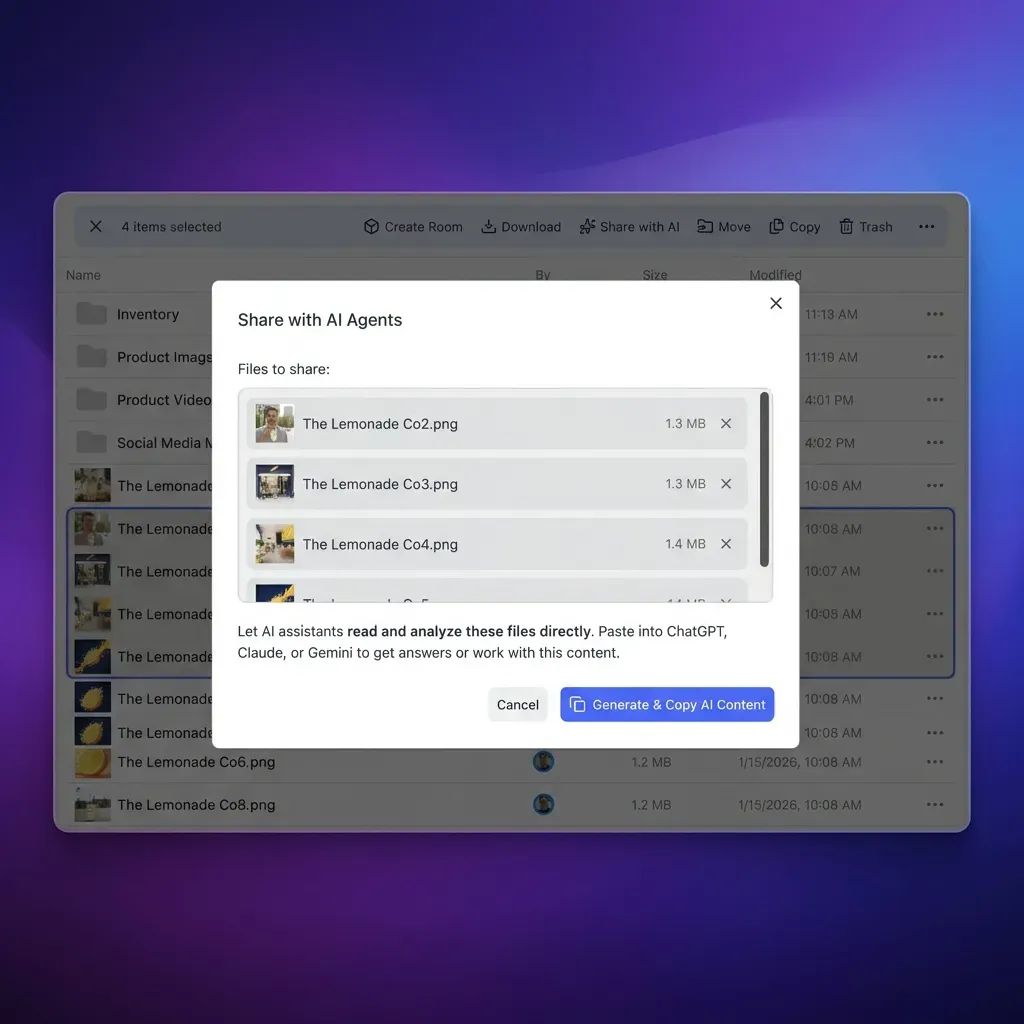
Centralize your social media assets in one searchable workspace
Generous storage with MCP server access for connecting your social tools, and Intelligence Mode for finding any asset once enabled.
Best Tools for Analytics and Listening
Creating content is half the job. The other half is understanding what resonates, what falls flat, and what your audience is saying about your brand when they're not talking to you directly. These two tools focus on measurement and intelligence.

8. Sprout Social
Sprout Social processes over 30 billion social messages daily through its listening engine. Its AI Assist summarizes sentiment trends and surfaces real customer voice quotes, so your team reads actionable summaries instead of scanning thousands of individual mentions. The reporting automation turns raw engagement data into executive-ready presentations without manual formatting.
Key strengths:
- Social listening at massive scale with AI-generated sentiment summaries and customer quotes
- Automated reporting that produces board-ready presentations from raw data
- Customer service tools including smart inbox prioritization and suggested responses
Limitations:
- Starting at $199/user/month, it's the most expensive option on this list
- The depth of features means onboarding takes longer than simpler tools
Best for: Mid-size to enterprise teams that need social listening, competitive intelligence, and customer service management in one platform.
Pricing: From $199/user/month. Enterprise pricing available.
9. Brandwatch
Brandwatch focuses on social intelligence rather than publishing. It tracks brand perception across channels, monitors competitors by name, and spots emerging trends before they hit mainstream conversation. Its AI-powered alerts notify you when mention volume spikes unexpectedly, giving your team time to prepare a response rather than scramble after the fact.
Key strengths:
- Competitive benchmarking that tracks your share of voice against named competitors over time
- Smart alerts for sudden spikes in mentions, sentiment shifts, or emerging crisis signals
- Collaborative content calendar for coordinating team responses to trends and events
Limitations:
- Custom pricing requires a sales conversation, making budgeting harder upfront
- It's primarily an intelligence tool, so you'll still need a separate platform for publishing
Best for: Brands that need to understand market perception, track competitive positioning, and detect emerging conversations across social channels.
Pricing: Custom pricing based on data volume and features.
How to Build Your Social Media AI Stack
No single tool covers every function well. Most effective social teams run two or three tools that handle different parts of the pipeline, rather than trying to find one platform that does everything.
A practical starting stack for a team of 2-5 people:
- Content creation: Buffer (free tier) or Predis.ai ($19/mo) for AI-generated posts
- Visual design: Canva (free or $15/mo) for graphics, carousels, and short animations
- Scheduling: Hootsuite ($99/user/mo) or Publer ($4/channel/mo) depending on budget
- Analytics: Sprout Social ($199/user/mo) if you need listening, or your scheduler's built-in analytics if you don't
The part most teams overlook is asset management. Social campaigns generate hundreds of images, videos, brand guidelines, and content calendars that end up scattered across Google Drive folders, Slack threads, and local desktops. This fragmentation gets worse as AI tools multiply the volume of drafts and variations your team produces.
Fastio solves this by giving your team an AI-powered workspace. Once Intelligence Mode is enabled on a workspace, uploaded files are automatically indexed for search, and your team can find any asset by describing what they need rather than remembering filenames or folder structures. AI agents and automation tools can access the same workspace through the remote Fastio MCP server, which makes it possible to connect your social tools to a central, searchable asset library. Plans start at $9.99/mo with a 14-day Business Trial.
The 44.7% of marketers who report that AI-assisted content performs better aren't using more tools than everyone else. They're using fewer tools more deliberately, and they're keeping a human in the loop for the editing and judgment that AI still can't match. Start with one tool that addresses your biggest bottleneck, learn its limits, and expand from there.
Sources
References used to verify factual claims in this guide.
-
89.7% of social media marketers use AI daily or multiple times per week 78.4% apply moderate or extensive editing before publishing AI-generated content 59.5% of social media marketers use AI for analytics and reporting 44.7% report AI-assisted content performs better than non-AI content
-
50% of Gen Z have unfollowed or muted a brand because content felt like AI slop
-
Sprout Social processes over 30 billion social messages daily
Frequently Asked Questions
What is the best AI tool for social media marketing?
It depends on your primary bottleneck. Buffer is the best value for AI-assisted content creation and cross-platform posting. Sprout Social leads for analytics and social listening at enterprise scale. Hootsuite works best for mid-size teams that need structured copywriting with OwlyWriter AI. For visual content production, Canva's Magic Design is hard to beat at its price point.
Can AI manage social media accounts?
AI can handle specific parts of social media management: writing first-draft captions, suggesting optimal posting times, generating images, and summarizing analytics. But 78.4% of marketers still edit AI output before publishing, according to Sociality.io's 2026 survey. The most effective approach uses AI for speed and scale while keeping human judgment for tone, timing, and brand voice decisions.
How do marketers use AI for social media?
The most common uses are analytics and reporting (59.5% of marketers) and content ideation and trend research (59.5%), followed by caption writing (45.9%) and visual or video creation (40.5%), according to Sociality.io's 2026 survey. Most teams use AI to accelerate existing workflows rather than fully automate them.
What AI tools create social media content?
Buffer's AI Assistant generates platform-specific post copy that adapts tone for each channel. Predis.ai creates complete posts with captions, images, and video from a text prompt. Canva's Magic Design generates graphics from text descriptions. Hootsuite's OwlyWriter AI writes captions using structured copywriting frameworks like AIDA and PAS. Each focuses on a different part of the creation process.
How much do AI social media tools cost?
Prices range from free to over $199/user/month. Buffer and Canva offer free tiers with basic AI features. Predis.ai starts at $19/month and Publer at $4/channel/month. Mid-range tools like Hootsuite start at $99/user/month. Enterprise platforms like Sprout Social start at $199/user/month. Most teams can build a functional AI stack for $50-150/month total.
Related Resources

Centralize your social media assets in one searchable workspace
Generous storage with MCP server access for connecting your social tools, and Intelligence Mode for finding any asset once enabled.