Best AI Virtual Assistants in 2026: Top Picks for Work and Personal Use
Gartner forecasts that 40% of enterprise apps will embed task-specific AI agents by the end of 2026, up from under 5% in 2025. This guide compares the 10 best AI virtual assistants across general productivity, business automation, and ecosystem integration, with specific recommendations for each use case.


What Changed for AI Virtual Assistants in 2026
Gartner forecasts that 40% of enterprise applications will embed task-specific AI agents by the end of 2026, up from under 5% in 2025. That 8x increase in a single year reflects a shift in what people expect from an AI virtual assistant: not just answers to questions, but actions completed on your behalf.
The intelligent virtual assistant market hit $25.7 billion in 2026, growing at a 31% compound annual rate according to Mordor Intelligence. Consumer assistants like Siri and Alexa got smarter. Business tools like Copilot and Notion AI started running multi-step workflows. A new class of automation-first assistants like Lindy entered the market to fill the gap between conversational chatbots and full enterprise software.
An AI virtual assistant is software that uses natural language processing and machine learning to understand requests, complete tasks, and provide information through voice or text interaction. The best ones in 2026 go further, connecting to your existing tools and executing work without step-by-step instructions.
Here are the 10 AI virtual assistants that stood out in our evaluation:
- ChatGPT by OpenAI, best overall generalist for writing, coding, and research
- Google Gemini, best for users deep in the Google ecosystem
- Claude by Anthropic, best for long-context reasoning and code generation
- Microsoft Copilot, best for teams on Microsoft 365
- Siri AI by Apple, best for device integration and on-device privacy
- Alexa+ by Amazon, best for smart home and voice-first routines
- Lindy AI, best for no-code business automation
- Notion AI, best for knowledge management and workspace tasks
- Reclaim AI, best for calendar optimization and scheduling
- Fast.io, best for agentic file operations and team sharing
Related guides
- How to Bypass GPT Detection: 5 Methods That Actually Work in 2026AI content detectors mislabel 61.3% of non-native English speaker essays as machine-generated, according to research...
- Best UI Frameworks for AI Agents in 2026The UI framework you pick determines how users interact with your AI agents. This guide compares 8 options, from the...
- Best No-Code AI Agent Builders in 2026No-code AI agent builders let you design agentic workflows with drag-and-drop interfaces instead of writing Python from...
- How to Design Multi-Tenant Architecture for AI AgentsMulti-tenant architecture lets one system serve many customers while keeping their data and files separate. As more...
- Best Open Source AI Chatbot Frameworks in 2026Open source chatbot frameworks split into two camps in 2026: traditional NLU pipelines like Rasa and LLM-native...
- How to Build Retry Logic for Reliable AI AgentsRetry patterns for AI agents are fault-tolerance strategies that automatically re-attempt failed LLM calls, tool...
More on this subject: Agent Frameworks and Patterns (52 guides)
How We Picked These 10 Assistants
We evaluated over 20 AI virtual assistants against five criteria:
Capability range. Can it handle more than Q&A? We prioritized assistants that take actions: scheduling meetings, drafting documents, managing files, or running multi-step workflows.
Integration depth. An assistant locked to one app is a feature, not a product. We favored tools that connect to calendars, email, project management, cloud storage, and third-party services.
Accuracy and reliability. We tested each assistant on factual questions, code generation, document summarization, and task execution. Consistency mattered more than peak performance.
Pricing transparency. Hidden costs like per-action fees, premium model surcharges, and credit systems were flagged as limitations.
Audience fit. Some assistants serve individuals. Others target teams or enterprises. We identified who each tool works best for rather than declaring one winner.
Best General-Purpose AI Virtual Assistants
These five assistants handle a broad range of tasks across personal and professional use. They understand natural language, generate content, answer questions, and increasingly take actions across connected apps.
1. ChatGPT
OpenAI's ChatGPT remains the most widely used AI assistant in 2026. GPT-5 powers its latest models, with Agent Mode letting it control a virtual computer to complete tasks autonomously. Canvas provides side-by-side document editing, and Advanced Voice Mode on mobile enables real-time visual assistance through your camera.
Key strengths:
- Broadest capability range of any general-purpose assistant
- Agent Mode executes multi-step tasks without constant supervision
- Voice, text, image, and video input support across all platforms
Key limitations:
- Pro plan ($200/month) required for best model access and highest usage limits
- Agent Mode still struggles with complex multi-app workflows
Best for: Anyone who needs a single assistant for writing, coding, research, and task execution.
Pricing: Free, Go ($8/mo), Plus ($20/mo), Pro ($200/mo), Business ($25/user/mo), Enterprise (~$60/user/mo).
2. Google Gemini
Google is replacing its classic Assistant with Gemini across Android devices in 2026. Gemini 3.1 Pro handles complex multi-step reasoning, and Gemini Spark acts as a proactive planner that manages your inbox and calendar without being asked. Personal Intelligence connects to Gmail, Photos, and other Google services for personalized responses.
Key strengths:
- Deep integration with Gmail, Calendar, Drive, and Photos
- Gemini Spark proactively organizes your daily schedule and inbox
- Multimodal input including text, voice, images, and video
Key limitations:
- Advanced features require Google AI Pro or Ultra subscription
- Less effective outside the Google ecosystem
Best for: Users invested in Google Workspace who want an assistant woven into their existing tools.
Pricing: Free tier available. Google AI Plus, Pro, and Ultra subscriptions unlock progressively more capable models.
3. Claude
Anthropic's Claude stands out for extended reasoning and large-context work. Its latest models process up to 1 million tokens in a single prompt, enough for entire codebases or book-length documents. Claude Code handles autonomous coding tasks, and Computer Use lets Claude interact with your screen directly by clicking, typing, and navigating applications.
Key strengths:
- 1 million token context window for analyzing large documents and codebases
- Claude Code is among the most capable AI coding tools available
- Strong accuracy and safety on factual questions
Key limitations:
- Smaller integration ecosystem compared to ChatGPT or Gemini
- Pro plan required for extended features and higher usage limits
Best for: Developers, researchers, and professionals who need deep reasoning over long documents or complex code.
Pricing: Free tier, Pro ($20/mo), Team ($30/seat/mo), Enterprise (custom).
4. Microsoft Copilot
Copilot is embedded across Word, Excel, PowerPoint, Teams, and Outlook. It drafts documents, analyzes spreadsheets, summarizes meetings, and creates presentations from prompts. Copilot Studio lets businesses build custom AI agents, and 2026 updates added computer use for automating web and desktop applications.
Key strengths:
- Works inside the apps most enterprise teams already use daily
- Copilot Studio enables custom AI agent creation without code
- Data stays within Microsoft 365 security and compliance boundaries
Key limitations:
- Costs $30/user/month on top of an existing Microsoft 365 license
- Performance varies by application, stronger in Word and Outlook than Excel
Best for: Teams already on Microsoft 365 who want AI capabilities without switching platforms.
Pricing: Copilot Pro ($20/mo for individuals), Microsoft 365 Copilot ($30/user/mo for business).
5. Siri AI
Apple announced Siri AI at WWDC 2026, rebuilding its assistant with large language model capabilities. It handles open-ended conversations, takes actions across apps, and uses Visual Intelligence to understand objects, text, and scenes through the camera. Personal data stays on-device or within Private Cloud Compute for server-side processing.
Key strengths:
- Privacy-first architecture keeps personal data on-device when possible
- Visual Intelligence identifies objects and text through the camera in real time
- Works across iPhone, iPad, Mac, Apple Watch, and HomePod
Key limitations:
- Still catching up to ChatGPT and Gemini in reasoning ability
- Rolling out gradually through 2026, not all features available on day one
Best for: Apple users who want an AI assistant integrated into their devices with strong privacy protections.
Pricing: Included with compatible Apple devices running the latest software updates.
Best AI Assistants for Workflow Automation
These five tools focus less on conversation and more on getting specific work done. They connect to your existing tools and automate tasks that would otherwise eat hours of your week.

6. Alexa+
Amazon's Alexa+ launched nationwide in early 2026 with conversational AI that goes well beyond simple voice commands. It handles planning, smart-home coordination, and multi-step task execution with contextual awareness. Amazon reports that users have two to three times more conversations with Alexa+ than they did with the original assistant.
Key strengths:
- Best smart home integration of any AI assistant
- Free for Amazon Prime members ($19.99/mo otherwise)
- Available on Echo devices, the mobile app, and Alexa.com
Key limitations:
- Weaker at knowledge work like writing, coding, and analysis than text-first assistants
- Shopping and media recommendations skew toward Amazon services
Best for: Users who want a voice-first assistant for home automation, planning, and daily routines.
Pricing: Free for Prime members. $19.99/month for non-Prime users.
7. Lindy AI
Lindy is an AI executive assistant with a no-code agent builder. Describe what you need in plain language and it assembles a workflow from over 100 templates covering email triage, meeting prep, lead research, and customer support. It connects to over 4,000 apps including Gmail, Slack, HubSpot, and Salesforce.
Key strengths:
- No-code workflow builder creates custom automations in minutes
- Over 4,000 app integrations for connecting your full tool stack
- Gaia voice agent with sub-second response time for phone-based tasks
Key limitations:
- Credit-based pricing means costs scale unpredictably with heavy usage
- Using premium AI models like GPT-4o or Claude Opus burns credits faster
Best for: Business users who want to automate repetitive tasks like email management and meeting scheduling without writing code.
Pricing: Plus ($49.99/mo), Pro ($99.99/mo), Max ($199.99/mo), Enterprise (custom). 7-day free trial on paid plans.
8. Notion AI
Notion turned its workspace into an AI agent platform in 2026. Notion Agent works autonomously for up to 20 minutes, completing multi-step tasks across your workspace: building project plans, compiling research, drafting reports, and updating databases at scale. Custom Agents run on schedules or triggers without human input.
Key strengths:
- AI operates directly inside your existing knowledge base and documents
- Custom Agents automate recurring workspace tasks on a schedule
- Enterprise Search spans Notion plus connected apps like Slack and Google Drive
Key limitations:
- Full AI features only available on Business plan ($20/user/mo) and above
- Credit-based system for Agent usage can run dry during heavy use
Best for: Teams that already use Notion and want AI that understands their existing content and workflows.
Pricing: Free (limited AI trial), Plus ($10/user/mo, limited AI), Business ($20/user/mo, full AI), Enterprise (custom).
9. Reclaim AI
Reclaim focuses on one problem and solves it well: calendar overload. Its AI reads your meetings, tasks, and habits, then automatically schedules work blocks, focus time, and breaks around your commitments. When your calendar changes, it reshuffles everything without you lifting a finger.
Key strengths:
- Automatic calendar optimization that adapts in real time as priorities shift
- Integrates with ClickUp, Asana, Todoist, Linear, and Jira for task scheduling
- Habit scheduling defends recurring commitments like exercise and weekly reviews
Key limitations:
- Focused only on calendar and scheduling, not a general-purpose assistant
- Team analytics and custom branding require the Business plan
Best for: Professionals who lose hours each week to calendar management and want AI to handle scheduling decisions.
Pricing: Free (limited), Starter ($8/user/mo), Business ($12/user/mo), Enterprise (custom).
10. Fast.io
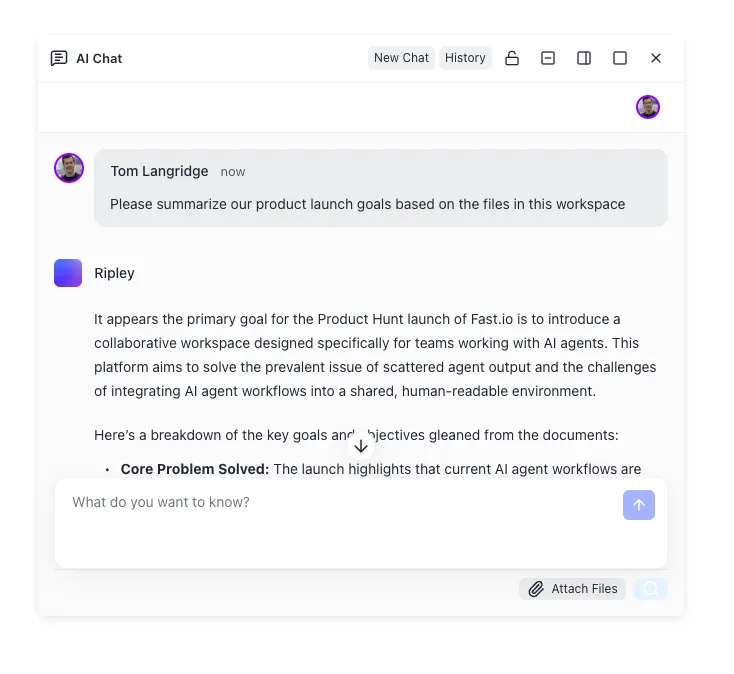
Fast.io approaches virtual assistance from the file layer. Instead of chatting with you directly, it gives AI agents and humans a shared workspace where files are automatically indexed, searchable by meaning, and queryable through conversation. Agents connect through a consolidated MCP toolset or REST API to read, write, search, and share files across workspaces.
Key strengths:
- Intelligence Mode auto-indexes files for semantic search and RAG without separate vector database setup
- Consolidated MCP toolset works with Claude, ChatGPT, Gemini, and any MCP-compatible agent
- Ownership transfer lets agents build workspaces and hand them off to humans with full audit trails
Key limitations:
- Not a conversational assistant on its own, it complements one rather than replacing it
- Requires pairing with another AI assistant for chat or voice interaction
Best for: Teams running AI agents that need persistent, searchable file storage with built-in intelligence and sharing.
Pricing: Starter ($9.99/mo), Business ($49.99/mo), Enterprise ($199.99/mo). 14-day free trial.


Give Your AI Assistant a Shared Workspace
Fast.io workspaces connect to any AI assistant through MCP. Files are indexed for search, versioned automatically, and shareable with teammates or clients. Start with a 14-day trial.
How to Pick the Right AI Virtual Assistant
The right AI virtual assistant depends on what you actually need automated.
Start with your primary workflow. If you spend most of your day in Microsoft 365, Copilot adds AI without switching tools. If Google Workspace is your hub, Gemini fits naturally. Apple users get Siri AI at no extra cost with compatible hardware.
For general Q&A and creative work, ChatGPT offers the widest capability range. Claude is stronger when you need reasoning over long documents or reliable code generation.
For automating repetitive business tasks, Lindy and Notion AI let you build workflows without writing code. Reclaim handles the specific problem of calendar overload better than any general-purpose assistant can.
For voice-first and smart home use, Alexa+ is the clear leader, especially for Prime members who get it included with their subscription.
For AI agents that work with files, Fast.io provides the shared workspace layer where agents store, search, and share their output. It pairs with any of the conversational assistants above to give agents persistent storage and collaboration tools.
Most people will end up using two or three of these tools together. A typical setup might pair ChatGPT or Claude for thinking and drafting, Reclaim for scheduling, and a file workspace like Fast.io or Google Drive for storage. The assistants that stick are the ones fitting your existing workflow without adding friction.
Sources
References used to verify factual claims in this guide.
-
40% of enterprise applications will embed task-specific AI agents by end of 2026, up from under 5% in 2025
-
Intelligent virtual assistant market valued at $25.7 billion in 2026, growing at 31% CAGR
-
Alexa+ users have two to three times more conversations than with original Alexa
Frequently Asked Questions
What is the best AI virtual assistant in 2026?
ChatGPT is the best general-purpose AI virtual assistant for most users, with the broadest capabilities across writing, coding, research, and task execution. For specific use cases, Google Gemini is stronger for Google Workspace users, Microsoft Copilot for Microsoft 365 teams, and Claude for long-document analysis and code generation.
Are AI virtual assistants worth it for business?
For most businesses, yes. Gartner projects that 40% of enterprise applications will embed AI agents by the end of 2026. Businesses that deploy AI assistants for repetitive tasks like email triage, meeting scheduling, and document generation typically see measurable time savings within the first month. Tools like Copilot, Lindy, and Notion AI are designed specifically for business workflows.
What is the difference between an AI assistant and a virtual assistant?
A traditional virtual assistant is a human professional who handles administrative tasks remotely. An AI virtual assistant is software that performs similar tasks using natural language processing and machine learning. AI assistants handle conversations, scheduling, research, and automation at scale. Many businesses now use both: AI assistants for repetitive, high-volume tasks and human virtual assistants for work requiring judgment and relationship management.
Which AI assistant is most accurate?
Accuracy depends on the task. ChatGPT and Claude lead on factual knowledge and reasoning benchmarks. Google Gemini is strongest when answering questions that draw on your personal Google data like emails, calendar events, and photos. For coding accuracy specifically, Claude and ChatGPT Pro consistently outperform other options. No single assistant is most accurate across every category.
How much do AI virtual assistants cost?
Prices range from free to over $200 per month. ChatGPT starts free with a Plus plan at $20/month. Google Gemini has a free tier with paid upgrades. Microsoft Copilot costs $30/user/month for business. Alexa+ is free for Prime members. Specialized tools like Lindy start at $49.99/month, Notion AI is included with the $20/user/month Business plan, and Reclaim starts at $8/user/month.
Related Resources

Give Your AI Assistant a Shared Workspace
Fast.io workspaces connect to any AI assistant through MCP. Files are indexed for search, versioned automatically, and shareable with teammates or clients. Start with a 14-day trial.