Best No-Code AI Agent Builders in 2026
No-code AI agent builders let you design agentic workflows with drag-and-drop interfaces instead of writing Python from scratch. This guide compares seven platforms across pricing, hosting options, and real-world strengths so you can pick the right one for your team.


Why No-Code Agent Builders Are Growing Fast
Building an AI agent from scratch means wiring together LLM calls, tool integrations, memory management, and error handling. That's weeks of development work before you even test the idea. No-code builders compress that timeline to hours.
The AI agents market hit $7.63 billion in 2025, according to Grand View Research, and is projected to grow at nearly 50% CAGR through 2033. A big chunk of that growth comes from visual builder platforms that let product managers, sales teams, and domain experts create agents without waiting on engineering.
The tradeoff is real, though. Visual builders sacrifice some flexibility for speed. You get faster prototyping and lower barrier to entry, but you may hit walls on custom logic or advanced orchestration. The best platforms handle this by offering a "code escape hatch" that lets you drop into Python or JavaScript when the visual canvas isn't enough.
Before diving into specific tools, here's what to evaluate:
- Hosting model: Self-hosted gives you data control. Cloud-hosted means less maintenance. Some tools offer both.
- LLM support: Can you use Claude, GPT-4, Gemini, open-source models, or only one provider?
- Integration depth: How many external tools (APIs, databases, CRMs) can your agent actually use?
- Pricing at scale: Free tiers are common, but costs per execution or per prediction can add up fast.
- Community and ecosystem: Larger communities mean more templates, tutorials, and faster bug fixes.
Related guides
- Best AI App Builders in 2026: 9 Platforms ComparedGartner forecasts that 75% of new applications will use low-code or no-code tools by the end of 2026, yet most "best AI...
- Best UI Frameworks for AI Agents in 2026The UI framework you pick determines how users interact with your AI agents. This guide compares 8 options, from the...
- Best AI Agent Frameworks for Java in 2026Java developers building AI agents no longer need to switch to Python. Eight production-viable frameworks now offer...
- How to Design Multi-Tenant Architecture for AI AgentsMulti-tenant architecture lets one system serve many customers while keeping their data and files separate. As more...
- Best Open Source AI Chatbot Frameworks in 2026Open source chatbot frameworks split into two camps in 2026: traditional NLU pipelines like Rasa and LLM-native...
- How to Build Retry Logic for Reliable AI AgentsRetry patterns for AI agents are fault-tolerance strategies that automatically re-attempt failed LLM calls, tool...
More on this subject: Agent Frameworks and Patterns (52 guides)
How We Evaluated These Platforms
We tested each platform against five criteria:
- Ease of use: Can someone with no programming background build a working agent in under an hour?
- Agent capabilities: Does it support multi-step reasoning, tool use, memory, and multi-agent coordination?
- Deployment flexibility: Can you self-host, deploy to cloud, or both?
- Pricing transparency: Are costs predictable, or do they spike with usage?
- Production readiness: Does it handle error recovery, logging, and scaling for real workloads?
We prioritized platforms that balance accessibility with depth. A tool that's easy to start but impossible to scale didn't make the list.
The 7 Best No-Code AI Agent Builders
Here's a quick comparison before the detailed breakdown:
1. Flowise
Flowise is an open-source visual builder for LLM applications and AI agents. It runs on Node.js and offers three distinct building modes: Agentflow for multi-agent systems, Chatflow for single-agent RAG pipelines, and a classic mode for simpler LLM chains. With over 50,000 GitHub stars and an Apache 2.0 license, it's one of the most trusted self-hosted options.
Key strengths:
- Full Apache 2.0 license with no usage restrictions. You own your deployment entirely.
- Over 100 integrations with LLMs, vector databases, and external tools. Supports horizontal scaling via message queues for production workloads.
- Developer-friendly REST APIs, SDKs, and embeddable chat widgets. Built-in "human in the loop" review steps for quality control.
Limitations:
- The free cloud tier caps you at 2 flows and 100 predictions per month, so most serious teams self-host.
- Three separate builder modes (Agentflow, Chatflow, legacy) create a learning curve for new users who need to understand which mode fits their use case.
Pricing: Free self-hosting with no limits. Cloud starts at $35/month for Starter (10,000 predictions) and $65/month for Pro (50,000 predictions, unlimited workspaces).
Best for: Technical teams that want full control over their agent infrastructure and prefer self-hosting to avoid vendor lock-in. Particularly strong if your team already works in the Node.js ecosystem.
Recent update: Version 3.1.0 (March 2026) brought LangChain v1 migration, an AgentFlow SDK with ConditionBuilder and dynamic output ports, plus Azure Blob Storage support. Flowise was also acquired by Workday.
2. Langflow
Langflow is the most popular open-source option by community size, with over 146,000 GitHub stars. Built on Python, it combines a visual drag-and-drop canvas with the ability to customize any component in Python code. DataStax acquired the project and now offers managed cloud hosting alongside the free self-hosted option.
Key strengths:
- MIT license and the largest open-source community in this category. No usage restrictions whatsoever.
- Every visual component exposes its underlying Python, so you're never locked into the visual interface. Start with drag-and-drop, then customize in code when you hit limits.
- Supports MCP server deployment, LangSmith and LangFuse observability integrations, and new V2 Workflow APIs (beta in v1.8).
Limitations:
- Had critical security vulnerabilities (CVEs) in versions before 1.7.1, including a serious
.envhandling bug. Staying current on patches is important for any production deployment. - The component library is enormous, which can overwhelm beginners who just want to build a simple chatbot without reading documentation first.
Pricing: Self-hosted is free. Cloud hosting is available through DataStax with a free tier included.
Best for: Python developers and data engineers who want maximum flexibility. If you're comfortable reading Python but prefer a visual starting point for prototyping, Langflow is the strongest pick. The Flowise vs. Langflow decision often comes down to whether your team prefers Node.js or Python.
3. n8n
n8n is a workflow automation platform that added native AI agent capabilities built on LangChain. It's not a pure AI agent builder, and that's actually its advantage: it connects agents to over 400 real business integrations out of the box.
Key strengths:
- Widest integration coverage of any tool on this list. Your agent can update Salesforce, send Slack messages, query Postgres, and call external APIs without writing custom integration code.
- JavaScript and Python code nodes let you escape the visual canvas when you need custom logic that the pre-built nodes don't cover.
- Multi-agent support through connected workflows. Each workflow acts as a specialized agent, and they coordinate by passing data between them.
Limitations:
- AI agent features are layered onto a general automation platform, so agent-specific primitives (like structured memory or reflection loops) are less mature than dedicated builders.
- The Sustainable Use License means commercial self-hosted deployments require a paid license once you reach a certain scale.
Pricing: Community self-hosted edition is free. Cloud plans are usage-based. Check n8n.io/pricing for current tiers.
Best for: Teams that need AI agents embedded in existing business workflows. If your agent needs to talk to HubSpot, Jira, and Postgres in the same flow, n8n is hard to beat. It's the natural choice when "AI agent" is one piece of a larger automation pipeline.

More Builders Worth Evaluating
4. Dify
Dify combines a workflow builder, RAG pipeline, agent system, and LLMOps observability into a single platform. It supports hundreds of LLMs from dozens of inference providers, making it one of the most model-flexible options available. With 133,000 GitHub stars, it has a massive community behind it.
Key strengths:
- All-in-one platform. You get workflow building, RAG, agents, and monitoring without stitching together separate tools or running additional infrastructure.
- Backend-as-a-Service mode lets you publish AI apps as APIs without building deployment infrastructure. Ship an agent-powered feature to your product in an afternoon.
- The new "Agent x Skills" framework (v1.14, February 2026) adds sandboxed runtimes and reusable SOP blocks with
@toolinline calling. Version 1.13 added collaborative editing with shared drafts and comments.
Limitations:
- The license is "based on Apache 2.0 with additional conditions," including restrictions on building competing products. Read the fine print before committing to a production deployment.
- Self-hosting via Docker Compose can be complex to maintain long-term, especially when upgrading between major versions.
Pricing: Cloud has a free tier with trial credits. Self-hosted Community Edition is free. Enterprise licensing is custom.
Best for: Product teams shipping AI-powered applications who want built-in observability without running separate monitoring infrastructure. If you need to go from prototype to production API endpoint quickly, Dify streamlines that path.
5. CrewAI
CrewAI offers both an open-source Python framework (46,500 GitHub stars, MIT license) and a proprietary enterprise platform called AMP with a visual no-code Studio. The dual architecture lets you start with code-first experimentation and graduate to a managed platform.
Key strengths:
- Two orchestration models that cover different needs: Crews for autonomous collaborative agents that work together, and Flows for event-driven production workflows with deterministic control.
- The no-code Studio includes an AI Copilot that helps non-technical users build agents visually without touching the Python framework.
- Enterprise deployment options include self-hosted on AWS, Azure, or GCP via Kubernetes, which matters for regulated industries.
Limitations:
- The free tier allows only 50 workflow executions per month. The Professional plan charges $0.50 per additional execution beyond the included 100, which adds up for high-volume workloads.
- The open-source framework is Python-only. The visual Studio requires the proprietary AMP platform, so there's a gap between the free OSS experience and the full product.
Pricing: Free tier with 50 executions/month. Professional at $25/month with 100 executions plus $0.50 per overage. Enterprise is custom with up to 30,000 executions and SOC2 compliance.
Best for: Teams that want to prototype multi-agent systems with the open-source framework and then graduate to an enterprise platform for coordinated multi-agent workflows. CrewAI handles agent-to-agent communication patterns that simpler builders can't express.
6. Relevance AI
Relevance AI takes a different approach. Instead of a general-purpose builder, it's a purpose-built platform for sales and go-to-market teams. It ships with pre-built agent templates for BDR outreach, inbound qualification, research, and customer support.
Key strengths:
- Pre-built GTM agents that work out of the box. Connect HubSpot, Salesforce, LinkedIn, Apollo, and Gmail without custom integration work.
- Over 2,000 integrations with SOC 2 Type II and GDPR compliance included. Enterprise security isn't an add-on.
- Pricing starts at $19/month (annual) for the Pro plan with 2,500 actions, which is accessible for small teams testing autonomous sales workflows.
Limitations:
- No self-hosting option. All data flows through Relevance AI's cloud infrastructure, which may be a blocker for teams with strict data residency requirements.
- Narrow focus. If you're building agents for engineering, creative production, or operations use cases, this isn't the right tool.
Pricing: Free tier with 200 actions/month. Pro at $19/month. Team at $234/month with 7,000 actions and A/B testing. Enterprise is custom.
Best for: Sales-led organizations that want autonomous SDR agents and research assistants running immediately. The pre-built templates and GTM integrations make it the fastest path to deployed sales automation.
7. Botpress
Botpress is an AI agent platform focused on customer experience. It deploys agents across WhatsApp, Instagram, Messenger, Slack, and web widgets with built-in human handoff for conversations that need a real person.
Key strengths:
- Generous free tier with $5 in AI credits per month and 500 messages. Low barrier to testing a conversational agent concept.
- Multi-channel deployment out of the box. Build one agent that serves every messaging platform your customers use.
- Built-in knowledge bases and custom data tables for structured storage within the platform. No external database required for basic use cases.
Limitations:
- Costs escalate at scale. The Team plan starts at $445/month and the Managed tier hits $1,495/month for expert-built agents.
- The "Managed" tier, where Botpress experts build your agents for you, suggests that complex use cases benefit from professional services rather than self-serve building.
Pricing: Free tier with 500 messages/month. Plus at $79/month. Team at $445/month. Managed at $995/month.
Best for: Customer support and sales teams deploying conversational agents across social and messaging channels. Particularly strong when you need human handoff for escalated conversations.


Give Your Agents a Workspace That Keeps Up
Fastio provides intelligent workspaces with built-in RAG, MCP access, and generous storage. Your agents build, your team reviews.
Self-Hosted vs. Cloud-Hosted: Picking the Right Model
The hosting question often matters more than the feature list. Here's how the tradeoffs break down in practice.
Self-hosted advantages:
- Full data control. Sensitive documents, customer data, and proprietary workflows stay on your infrastructure. This isn't just a nice-to-have for regulated industries.
- No per-prediction or per-execution fees. Your costs are server infrastructure, not metered API calls that scale linearly with usage.
- Freedom to customize. Fork the code, modify components, integrate internal tools that cloud platforms don't support.
Cloud-hosted advantages:
- Zero infrastructure maintenance. No Docker updates, no server monitoring, no on-call rotation for your agent platform.
- Faster onboarding. Sign up and start building in minutes rather than spending a day on deployment and configuration.
- Managed security patches and automatic updates. Someone else handles the CVEs.
The hybrid approach is increasingly common. Flowise, Langflow, Dify, and CrewAI all offer both models. Start on cloud to validate your agent concept, then move to self-hosted once the workload justifies dedicated infrastructure.
One gap that affects both models: where does agent output go? Most builders focus on the orchestration layer but leave storage as an afterthought. Agents generate files, reports, datasets, and analysis results that need to persist somewhere accessible to both the agent and the humans reviewing the work.
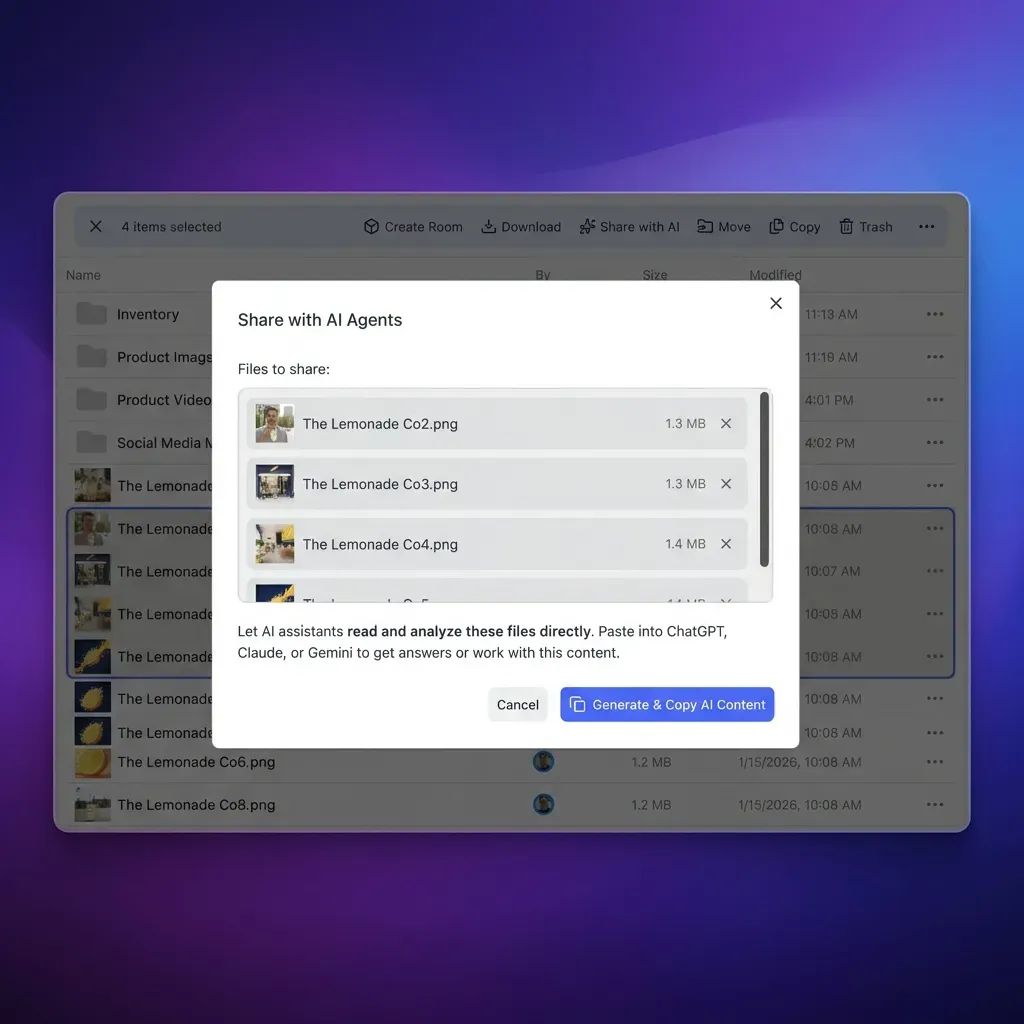
This is where a shared workspace becomes valuable. Fastio provides intelligent workspaces where agents and humans collaborate on the same files. Enable Intelligence Mode on a workspace and uploaded files are automatically indexed for semantic search and RAG queries, no separate vector database needed. Agents access workspaces through the MCP server or REST API, while humans use the web interface. Fastio offers a 14-day Business Trial (card required) for teams to evaluate workspaces and agent tooling.
For teams running self-hosted builders like Flowise or Langflow, Fastio solves the "where do agent outputs land?" problem without building custom storage infrastructure. Your agent processes data in the builder, then writes results to a Fastio workspace where your team can review, annotate, and share them.
Which Builder Should You Choose?
The right tool depends on your team's technical depth and what you're building.
You want full control and self-hosting: Pick Flowise or Langflow. Both are open source with strong communities. Choose Flowise if you prefer Node.js and a structured multi-mode builder. Choose Langflow if you want Python customization and the largest community.
You need business workflow integration: Pick n8n. No other tool matches its breadth of integrations with CRMs, databases, and SaaS tools. The AI agent layer sits on top of a mature automation engine with years of production use.
You want an all-in-one platform: Pick Dify. It bundles the agent builder, RAG pipeline, and observability into one deployment. Less flexible than assembling your own stack, but much faster to get running.
You need multi-agent coordination: Pick CrewAI. The Crews + Flows architecture handles complex multi-agent scenarios that simpler builders can't express. Start with the open-source framework, upgrade to AMP when you need the visual Studio.
You're a sales team: Pick Relevance AI. It ships with ready-made GTM agents and 2,000+ integrations tuned for sales workflows.
You need customer-facing chatbots: Pick Botpress. Multi-channel deployment and human handoff are built in, with strong support across WhatsApp, Slack, and web widgets.
Whichever platform you choose, think about where agent-generated files will live and how your team will access them. Building the agent is step one. Making its output useful to your organization is step two. A shared, intelligent workspace like Fastio bridges that gap by giving agents and humans a common place to store, search, and hand off work.
Sources
References used to verify factual claims in this guide.
-
AI agents market hit $7.63 billion in 2025 Projected to grow at nearly 50% CAGR through 2033
-
Flowise has over 50,000 GitHub stars and Apache 2.0 license
-
Langflow has over 146,000 GitHub stars with MIT license
-
Dify has 133,000 GitHub stars
-
CrewAI has 46,500 GitHub stars
Frequently Asked Questions
Can I build an AI agent without coding?
Yes. Platforms like Flowise, Langflow, n8n, and Dify provide visual drag-and-drop interfaces for building AI agents. You connect pre-built components like LLM calls, tool integrations, and memory stores on a canvas rather than writing code. Most also offer a code escape hatch for advanced customization when you hit limits.
Is Flowise free?
Flowise is open source under the Apache 2.0 license, so self-hosting is completely free with no usage limits. The cloud-hosted version has a free tier limited to 2 flows and 100 predictions per month. Paid cloud plans start at $35 per month for 10,000 predictions.
What is the difference between Langflow and Flowise?
Langflow is Python-based with an MIT license and 146,000 GitHub stars, making it the larger community. Flowise is Node.js-based with Apache 2.0 licensing and about 51,000 stars. Langflow offers deeper code customization since every component exposes Python, while Flowise provides a more structured experience with three distinct builder modes: Agentflow, Chatflow, and classic.
Do no-code AI agent builders work with open-source LLMs?
Most of the builders on this list support open-source models. Flowise and Langflow integrate with Ollama and other local model runners. Dify supports hundreds of models from dozens of providers. n8n connects to any LLM that exposes an API endpoint. Check each platform's documentation for your specific model.
How much do no-code AI agent builders cost?
Costs range from free to enterprise pricing. Open-source tools like Flowise and Langflow are free to self-host. Cloud-hosted options charge per execution or prediction: Flowise cloud starts at $35 per month, CrewAI at $25 per month, and Relevance AI at $19 per month. Enterprise plans from platforms like CrewAI and Botpress require contacting sales.
What should I look for in a no-code AI agent builder?
Focus on five factors: hosting flexibility (self-hosted vs cloud), LLM support breadth, integration depth with your existing tools, pricing predictability at your expected scale, and community size for troubleshooting and templates. Also consider where agent-generated files will be stored and how your team will access them.
Can no-code agents handle production workloads?
Yes, with caveats. Platforms like Flowise, n8n, and Dify support horizontal scaling, error recovery, and logging for production use. The key constraint is usually cost at scale, since cloud-hosted per-execution pricing can add up quickly. Self-hosted deployments give you more control over scaling costs but require DevOps investment.
Related Resources

Give Your Agents a Workspace That Keeps Up
Fastio provides intelligent workspaces with built-in RAG, MCP access, and generous storage. Your agents build, your team reviews.