Slack AI Review 2026: What It Does, What It Costs, and Where It Falls Short
Slack AI posts sub-1% hallucination rates on summarization tasks, beating Microsoft Copilot at 3.2% and Google Gemini at 4.1%, because it recaps existing messages rather than generating new content. This review covers each Slack AI feature in detail, breaks down what you actually pay across Slack's four plan tiers, and compares the platform against Teams Copilot and Google Workspace Gemini on price, accuracy, and capability.


How Slack AI Compares to Copilot and Gemini
Slack AI hallucinated in fewer than 1% of summarization outputs during 2025 enterprise benchmarks, compared to 3.2% for Microsoft 365 Copilot and 4.1% for Google Gemini. That gap exists because Slack AI summarizes existing conversations rather than generating new content. It is a retrieval tool, not a creation tool, and that constraint turns out to be its biggest advantage.
With roughly 47 million daily active users and 77% of Fortune 100 companies on the platform, Slack is where a large share of enterprise communication already lives. The AI layer sits on top of that existing message graph. When you ask it a question, it pulls from channels, threads, and connected apps you already have access to. It does not hallucinate a plausible-sounding answer from training data.
Here is how the three major enterprise AI chat tools compare:
Slack AI (Business+)
- AI cost: Included at $15/user/month
- Core strength: Channel and thread summarization with sub-1% hallucination
- Content creation: No
- Meeting features: Huddle notes and transcription
- Cross-app search: Yes (Google Drive, Salesforce, and others)
- Data privacy: Does not train on customer data
Microsoft Teams Copilot
- AI cost: $18-30/user/month add-on (requires M365 base license)
- Core strength: Meeting recaps with action items, cross-app content generation
- Content creation: Yes (Word, Excel, PowerPoint, Outlook)
- Meeting features: Full transcription, customizable recap templates
- Cross-app search: Microsoft 365 ecosystem
- Data privacy: Does not train on customer data
Google Workspace Gemini
- AI cost: Included in Standard ($14/user/month)
- Core strength: Content drafting across Gmail, Docs, Sheets, Slides
- Content creation: Yes (all Google Workspace apps)
- Meeting features: Meet transcription and summarization
- Cross-app search: Google Drive and Workspace apps
- Data privacy: Does not train on customer data
The pricing math favors Google if you need content creation. It favors Slack if your team already lives in Slack and primarily needs to catch up on missed conversations. Microsoft sits in between, but the add-on cost means you are paying $50-80/user/month total once you factor in the base M365 license.
Related guides
- Fireflies AI Review 2026: Features, Pricing, and Honest VerdictFireflies.ai hit a $1 billion valuation in mid-2025 on the strength of 500,000+ organizations and over 2 billion...
- Best AI Note Taking Apps in 2026: 10 Tools We Actually TestedAI note taking apps now go far beyond basic transcription. The best ones identify speakers, extract action items, and...
- WriteHuman AI Review 2026: Does It Actually Bypass AI Detectors?In a 53-sample test, WriteHuman AI passed GPTZero 82% of the time but fooled Originality.ai only 19% of the time. This...
- Stealth AI Review 2026: What It Does, What It Misses, and Whether It's Worth ItThe AI content detection market hit $980 million in 2026, and the tools designed to beat those detectors are growing...
- DeepSearch AI: Features, Use Cases, and Best Alternatives in 2026ChatGPT holds roughly 60% of AI search traffic, yet its Deep Research mode caps free users at five queries per month....
- Luma AI Review 2026: Dream Machine, 3D Capture, and Agents TestedLuma AI raised $900 million at a $4 billion valuation in late 2025, then launched Agents in March 2026 to handle...
More on this subject: AI Tool Directories and Comparisons (231 guides)
Channel and Thread Summaries
Channel summaries are the feature most Slack AI users interact with daily. Click the three-dot menu at the top of any channel and select "Summarize channel" to get a condensed version of recent activity. You can summarize just your unread messages, the last seven days, or a custom date range on desktop.
Thread summaries work the same way. Open a long thread, tap "Summarize" in the top right, and Slack condenses dozens of replies into key takeaways. Both formats include citations that link back to the original messages, so you can verify anything that looks off.
In practice, channel summaries work best on high-volume channels where you would otherwise spend 15-20 minutes scrolling through messages each morning. The output is concise and rarely misattributes who said what. Thread summaries shine in decision-making threads with many participants. Instead of reading 47 replies to figure out what the team agreed on, you get the conclusion in seconds.
The limitation is nuance. Slack AI does not understand sarcasm, internal context, or political subtext in messages. If your team uses a lot of shorthand or inside references, the summary may strip those out. It also struggles with channels where conversations overlap. If three different topics are being discussed simultaneously, the summary can blend them into a confusing paragraph.
Summaries can take longer to generate for larger time frames. Slack notifies you when the summary is ready, so you can keep working while it processes.
AI-Powered Search Across Channels and Apps
Slack AI search accepts natural language queries like "slides Sarah made for the marketing meeting last week" and automatically applies the right filters. You do not need to remember exact channel names or date ranges. The search engine parses your intent and returns relevant messages, files, and threads.
Answers come with citations that reference the source messages or files. Tap a citation to jump directly to the original conversation. This is useful when you need to verify a claim or see the surrounding context that led to a decision.
The cross-app integration is where Slack AI search gets genuinely interesting. It pulls results from Google Drive, Salesforce, and other connected apps, not just Slack messages. If someone shared a Google Doc in a channel three months ago, you can find it by describing what it contained rather than remembering which channel it was in.
Search scope follows your existing permissions. You can only find messages and files in channels you belong to. Slack AI will not surface private conversations from channels you do not have access to, and it will not bypass your organization's data governance rules.
Two practical limitations worth noting. First, search quality degrades on channels with very sparse activity. If a channel has only a handful of messages, the AI does not have enough context to give useful answers. Second, cross-app search depends on proper integration setup. If your Salesforce or Google Drive connector is misconfigured, those results will not appear regardless of how well-phrased your query is.


Get document intelligence that goes beyond chat summaries
Fast.io auto-indexes your files for semantic search and AI Q&A with citations, with MCP server access included. Monthly plans start with a trial of up to 14 days.
Huddle Notes, Daily Recaps, and Workflow Actions
Huddle notes address a real gap in most teams' workflows: informal meetings that nobody takes notes for. When you start a huddle (Slack's lightweight audio/video call feature), Slack AI transcribes the conversation and produces a summary with key points and action items.
This works best for quick sync-ups and standup-style meetings. For longer, more structured meetings with screensharing and presentations, Microsoft Teams Copilot still offers more depth. Teams generates customizable recap templates like speaker summaries and executive summaries, and it can reference visuals from shared screens. Slack's huddle notes give you the highlights but not that level of structure.
Daily channel recaps let you subscribe to automated summaries for channels you want to monitor without reading every message. These arrive as digest notifications, giving you the key updates without the noise. This is particularly useful for cross-functional channels where you need awareness but not deep engagement.
Slack AI also integrates with Workflow Builder. You can set up a workflow that summarizes a channel every Friday and posts the recap to a different channel, or one that answers common questions based on pinned messages and canvas content. These automations work within Slack's existing permission model, so you do not need to grant additional access.
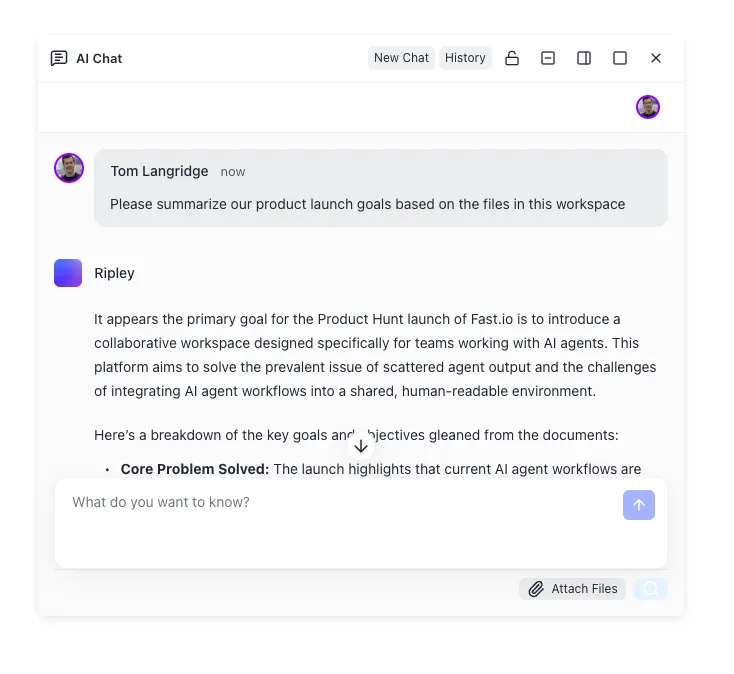
For teams that need file intelligence beyond what chat summaries provide, tools like Fast.io add a workspace layer where uploaded documents are automatically indexed for semantic search and AI-powered Q&A. Where Slack AI answers "what did the team say about X," a file intelligence layer answers "what do the actual documents say about X." The two serve different retrieval needs.

What Each Slack Plan Includes for AI
Slack restructured its pricing in 2025, bundling AI features into existing tiers rather than selling them as a separate add-on. The trade-off: Business+ pricing jumped 20% from $12.50 to $15/user/month. You pay for AI whether you use it or not.
Free Plan
- 90-day message history
- No AI features
- 1:1 huddles only
- Basic integrations
Pro ($7.25/user/month, billed annually)
- Full message history
- Basic AI: thread and conversation summaries, huddle notes
- Group huddles up to 50 people
- Unlimited integrations
Business+ ($15/user/month, billed annually)
- Everything in Pro
- Advanced AI: channel recaps, AI-powered search, workflow AI actions
- 99.99% uptime SLA
- SCIM provisioning
- Compliance-grade data exports
Enterprise Grid (custom pricing)
- Everything in Business+
- Unlimited workspaces
- Advanced security and compliance
- Dedicated support
The jump from Pro to Business+ is where most teams feel the friction. Basic summaries at $7.25/user/month are useful but limited. The full AI search and channel recap features require Business+, which more than doubles the per-seat cost.
For comparison, Google Workspace includes Gemini AI features starting at $14/user/month on Business Standard, which also covers Gmail, Docs, Sheets, and Drive. Microsoft 365 Copilot adds $18-21/user/month on top of your existing M365 license, making the all-in cost $50-80/user/month depending on your base plan.
According to Vendr's analysis of 535 verified enterprise purchases, Slack Enterprise Grid typically costs $22-28/user/month in practice, with most companies negotiating 10-20% below list price based on seat volume.
Where Slack AI Falls Short
Slack AI does one thing well: it recaps conversations with high accuracy. But that narrow focus creates real gaps for teams that need more from their AI tooling.
No content creation. Slack AI cannot draft messages, write documents, or generate reports. Microsoft Copilot and Google Gemini both create content across their respective app ecosystems. If you need an AI that writes, Slack AI is not it.
No standalone file analysis. Slack AI can find files shared in conversations, but it cannot deeply analyze document contents the way a dedicated RAG system can. If someone uploads a 50-page contract to a channel, Slack AI might tell you it was shared, but it will not answer detailed questions about specific clauses on page 37.
For teams that need document-level intelligence, dedicated workspace tools handle this better. Fast.io's Intelligence Mode auto-indexes uploaded files for semantic search and chat-based Q&A with citations, giving you the document analysis layer that Slack AI lacks. Plans start at $9.99/mo for Starter and $49.99/mo for Business, with storage, monthly credits, and MCP server access included; monthly plans start with a trial of up to 14 days (credit card required).
Limited meeting support. Huddle notes cover informal audio calls, but Slack has no equivalent to Teams' full meeting transcription with speaker identification, action item extraction, and customizable recap templates. If structured meetings are a significant part of your workflow, Teams Copilot handles that better.
Forced bundling. The 20% price increase on Business+ was unpopular because it applies whether you enable AI features or not. You cannot opt out of paying for AI to get the previous $12.50/user/month price point. Users on enterprise review sites consistently flag this as a forced upsell.
Accuracy on complex queries. While Slack AI's sub-1% hallucination rate is impressive for summarization, that number comes from straightforward recap tasks. On complex retrieval tasks that require synthesizing information across channels and long time periods, enterprise AI hallucination rates run significantly higher. The sub-1% figure reflects Slack AI's best case, not its average case across all query types.
Sources
References used to verify factual claims in this guide.
-
Slack AI and Zoom AI Companion had hallucination rates below 1%, compared to 3.2% for Microsoft 365 Copilot and 4.1% for Google Gemini
-
Slack has approximately 47 million daily active users and 77% of Fortune 100 companies use the platform
-
Business+ pricing increased 20% from $12.50 to $15/user/month in 2025 to reflect bundled AI features
-
Microsoft 365 Copilot Business costs $18/user/month, increasing to $21/user/month in July 2026; Enterprise Copilot is $30/user/month
-
Enterprise Grid typically costs $22-28/user/month based on analysis of 535 verified purchases
Frequently Asked Questions
Is Slack AI included in my plan?
Basic AI features like thread summaries and huddle notes are available on all paid Slack plans, including Pro at $7.25/user/month. Advanced features like AI-powered search, channel recaps, and workflow AI actions require Business+ at $15/user/month or Enterprise Grid.
How much does Slack AI cost?
Slack AI is bundled into existing plans, not sold as a separate add-on. Pro plans cost $7.25/user/month and include basic AI summaries. Business+ plans cost $15/user/month and include the full AI feature set. Enterprise Grid pricing is custom. You cannot disable AI to get a lower price on any tier.
Can Slack AI search all channels?
Slack AI search respects your existing channel permissions. It can search any public channel and any private channel you have been invited to. It cannot access channels you are not a member of, and it will not bypass your organization's data governance rules. Cross-app search for Google Drive, Salesforce, and other connected tools requires those integrations to be configured by an admin.
Is Slack AI better than Microsoft Copilot?
Slack AI is more accurate for summarization, with sub-1% hallucination rates compared to Copilot's 3.2%. But Copilot creates content across Office apps, handles full meeting transcription, and works across the entire Microsoft 365 suite. Choose Slack AI if your team primarily needs conversation recaps. Choose Copilot if you need an AI that writes documents and processes meeting recordings.
Does Slack use my data to train AI models?
No. Slack does not share customer data with LLM providers and does not use customer data to train its AI models. Slack AI processes your data to generate summaries and search results, but that data stays within your organization's Slack instance.
What is the difference between Slack AI and ChatGPT?
Slack AI is a retrieval and summarization tool built into the Slack platform. It recaps your existing conversations and searches your message history. ChatGPT is a general-purpose AI that generates new content from its training data. Slack AI is more accurate for workplace questions because it pulls from real conversations rather than generating answers from a general model.
Related Resources

Get document intelligence that goes beyond chat summaries
Fast.io auto-indexes your files for semantic search and AI Q&A with citations, with MCP server access included. Monthly plans start with a trial of up to 14 days.