How to Set Up a Manus AI Persistent Database Connection
Establishing a persistent database connection in Manus AI enables agents to write, read, and retain operational data. Because default container sandboxes are ephemeral, developer workflows require dedicated connection bridges to maintain state. This guide outlines how to build custom Model Context Protocol (MCP) servers, configure direct scripts in the Cloud Computer VM, and link Postgres or SQLite to shared team workspaces.


Ephemerality Challenges in Agentic Database Workloads
According to a 2025 infrastructure case study of Manus AI, agentic workloads generate extreme write traffic, where over 90% of new database instances are created directly by AI agents and 99% are single-use, transient environments [PingCAP 2025 Case Study]. This rapid lifecycle requires developers to build persistent connections to ensure operational data is saved. When developers run agents inside transient virtual machines, any local database file or state is deleted once the execution container shuts down. Creating a persistent bridge allows agents to fetch schemas, write updates, and pass results across sessions.
When Manus AI executes a user request, it provisions a temporary sandbox container in the cloud. This environment acts as a clean slate, containing standard runtimes and system packages. However, once the agent completes the task or the session times out, the container is destroyed. Any data written to the local disk, such as debug logs, database files, or query exports, is lost. This ephemerality is a security feature, preventing malware persistence and workspace contamination, but it makes long-term tasks difficult to orchestrate.
For developers building workflows, this container lifecycle is a major bottleneck. Standard databases require stable connection points, but agents spinning up in sandbox environments lack a static network identity. If the agent generates query exports or updates database tables, those operations must connect to a persistent database or store their state externally.
To handle this persistent data layer, developers often look at a few options:
- Local database files on a developer laptop: Saving files locally keeps data private but locks execution to a single physical device, exposes the local system to security risks from agent-generated code, and prevents team members from accessing the files concurrently.
- Standard cloud database hosting (Amazon RDS): Writing database files to Amazon RDS is highly durable, but configuring access keys and managing database credentials within agent scripts adds administrative overhead. Relational databases also lack user-friendly previews for non-technical team members.
- Fast.io workspaces: A shared space designed for developer teams and AI agents. By saving query outputs, schema definitions, and credentials to a versioned workspace, teams can collaborate on the data alongside their agents. Fastio collaborative workspaces keep file versions secure and searchable in shared workspaces.
Related guides
- How to Set Up Persistent Storage in OpenClawOpenClaw agents forget their state between sessions. Persistent storage lets them save memory, files, and data to...
- How to Set Up Devin AI Desktop App with Persistent WorkspacesCoordinating local files and cloud agent fleets often leads to overwrites and lost context. This guide explains how to...
- How to Set Up a Manus AI File Handoff WorkflowA Manus file handoff workflow is the automated pipeline that retrieves files from a completed agent task sandbox and...
- How to Set Up a Manus AI Agent-to-Human Transfer WorkspaceMoving deliverables out of temporary agent environments requires a persistent delivery pipeline. This guide explains...
- Is Manus AI Free? Free Plan, Credits, and LimitsManus AI is free to start on a limited-credit Free plan, but heavier autonomous agent work usually needs paid Pro or...
- How to Use the Manus AI API for Agent TasksFiles uploaded through the Manus API are automatically deleted 48 hours after upload, so production integrations need...
More on this subject: Manus (52 guides)
How to Establish a Manus AI Persistent Database Connection
To establish a persistent connection between Manus and your database, developers use one of three primary methods:
- Custom Model Context Protocol (MCP) servers: This method connects external database services directly to Manus settings.
- Direct scripts running in the Cloud Computer VM: This approach runs local SQLite databases or connects directly via terminal operations inside the virtual machine.
- Secure API integrations: This method uses an intermediate API layer or database proxy to route queries without exposing direct database ports.
Using a custom MCP server allows the agent to communicate with a database using a standardized protocol. Manus can call database tools natively to fetch records, insert rows, or describe table structures. This approach isolates the database credentials from the agent, as the MCP server holds the connection secrets.
Direct scripts in the Cloud Computer VM are useful for local SQLite setups where the database runs in the same environment as the agent. The Cloud Computer VM provides a persistent file system, making it suitable for storing local database files.
Secure API integrations act as a gatekeeper, holding database secrets in a secure middleware layer. This prevents Manus from having direct access to database connection strings or database credentials, reducing the risk of SQL injection or unauthorized access. Teams looking for agentic storage solutions can use Fastio to archive these logs and exports securely.
How to Connect PostgreSQL via Custom MCP Servers
How do I connect Manus AI to a PostgreSQL database? Establishing a connection to a remote PostgreSQL database requires configuring a secure gateway. According to database connection security guidelines from Skywork, routing agent connections through an API proxy or secure middleware layer is the default security recommendation for agentic database integration, enforcing TLS 1.2+ encryption [Skywork 2025 Guide]. This architecture prevents direct database exposure to the agent's virtual machine.
To connect PostgreSQL to Manus via an MCP server:
- Open the Manus settings sidebar.
- Select the Connectors menu.
- Click the add connector option.
- Select Custom MCP direct configuration.
- Enter the server URL of your PostgreSQL MCP server (e.g., https://api.example.com/mcp-postgres).
- Add the authorization headers containing your API token.
The PostgreSQL MCP server translates Model Context Protocol standard tool calls into SQL queries. The server runs commands like query_database or get_schema. Because the agent only interacts with the MCP server, database credentials remain safe.
Security is critical when configuring this bridge. Always enforce TLS 1.2+ encryption for connections crossing public networks. Restrict the database user permissions using the principle of least privilege. For PostgreSQL, create a read-only role (app_ro) that only has access to specific schemas and tables. Avoid exposing the database on public IP addresses. Use a private network endpoint or an SSH tunnel to secure the connection, as documented in the Fastio MCP documentation.
For example, when setting up the PostgreSQL database user, run this script:
-- Create a read-only role
CREATE ROLE app_ro WITH LOGIN PASSWORD 'your_secure_password';

-- Grant connection permissions
GRANT CONNECT ON DATABASE production_db TO app_ro;

-- Grant usage on schemas
GRANT USAGE ON SCHEMA public TO app_ro;

-- Grant select permissions on tables
GRANT SELECT ON ALL TABLES IN SCHEMA public TO app_ro;
ALTER DEFAULT PRIVILEGES IN SCHEMA public GRANT SELECT ON TABLES TO app_ro;
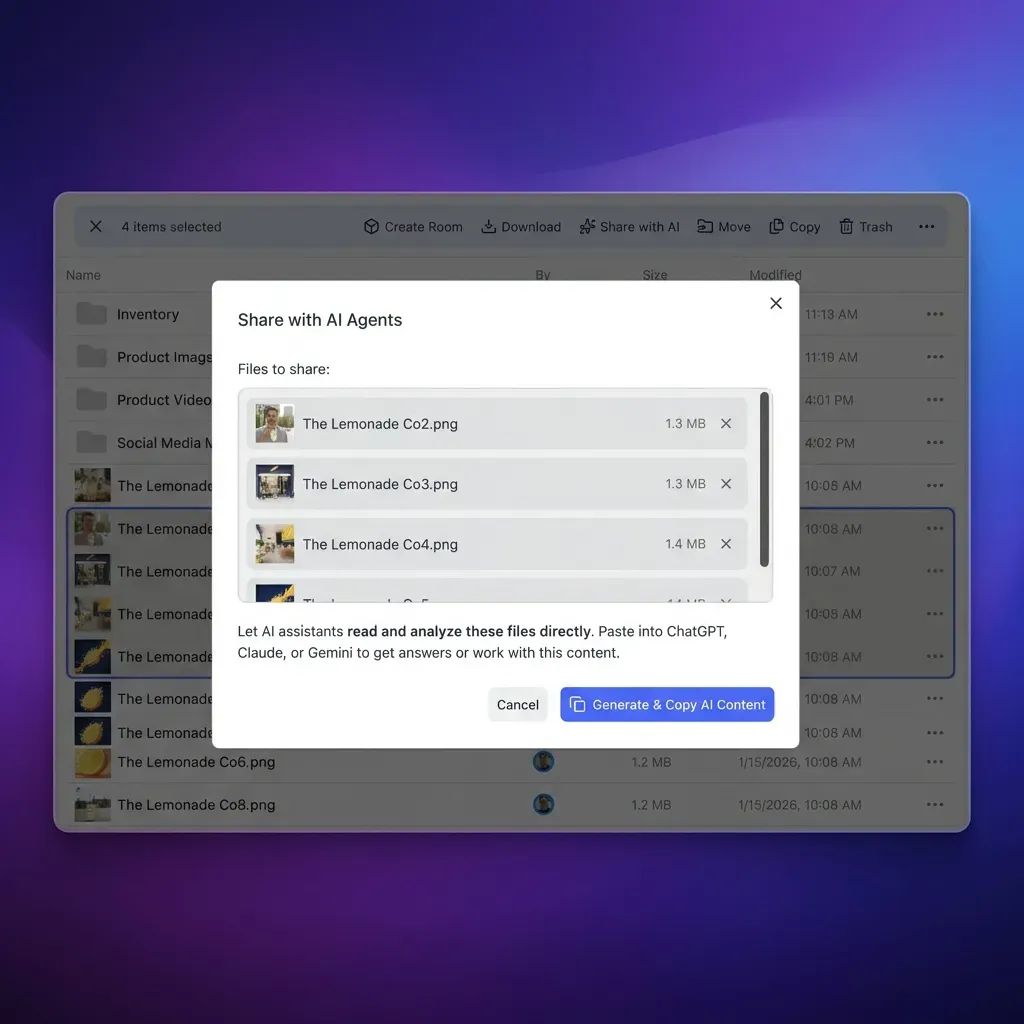


Persist Manus AI database outputs in structured workspaces
Create a shared workspace with Metadata Views and auto-indexing RAG capabilities to capture database query exports, schemas, and credentials securely. Starts with a 14-day free trial, credit card required.
How to Run SQLite in the Manus Cloud Computer VM
Does Manus AI support Model Context Protocol database servers? Yes. Manus supports custom MCP servers and also includes a persistent Cloud Computer VM environment that runs 24/7 [Manus Documentation]. If your workflow does not require a large relational database, you can run a local SQLite database directly inside the Manus Cloud Computer.
The Manus Cloud Computer is an always-on virtual machine that runs 24/7. Unlike ephemeral chat sandboxes, the Cloud Computer persists its file system between sessions. You can install SQLite inside the VM, write local database files, and run scripts to process data.
To run a persistent SQLite workflow:
- Instruct Manus to open the terminal in the Cloud Computer VM.
- Run a command to initialize a SQLite database file (e.g.,
sqlite3 workspace_data.db). - Create your tables and insert your seed data.
- Run your agent tasks, allowing Manus to write query results to the local SQLite database.
Because the Cloud Computer persists files, your SQLite database remains intact when the task finishes. You can run cron tasks or scheduled scripts to back up the database file to a remote folder. However, sharing a raw SQLite database file with a team can be difficult. This is where an intelligent cloud workspace simplifies the process.
For instance, your agent can execute a Python script to write data:
import sqlite3

conn = sqlite3.connect('/home/user/workspace_data.db')
cursor = conn.cursor()

cursor.execute('''
    CREATE TABLE IF NOT EXISTS task_history (
        id INTEGER PRIMARY KEY AUTOINCREMENT,
        task_name TEXT NOT NULL,
        status TEXT NOT NULL,
        completed_at TIMESTAMP DEFAULT CURRENT_TIMESTAMP
    )
''')

cursor.execute('''
    INSERT INTO task_history (task_name, status)
    VALUES (?, ?)
''', ('Database Connection Test', 'Success'))

conn.commit()
conn.close()
How to Structure Database Query Exports with Metadata Views
When your Manus agent queries PostgreSQL or updates a local SQLite database, you need a way to share and analyze the results. Rather than writing custom dashboard code, you can export query results, schema definitions, or CSV data directly to a shared Fastio workspace.
Fastio Metadata Views can turn these database exports and CSV files into a live, queryable database. Developers define extraction columns in plain English (such as 'invoice total', 'build status', or 'transaction date'). The platform's AI then designs a typed schema, scans files in the workspace, and populates a filterable spreadsheet. The schema supports Text, Integer, Decimal, Boolean, URL, JSON, and Date & Time fields. You can add new columns at any time without reprocessing existing files. This structured extraction layer is detailed at the Metadata Views product page: /product/document-data-extraction/.
For example, when your agent extracts a database dump to a CSV file in the workspace, Fastio automatically indexes the file. You can configure a Metadata View to pull the record counts, query runtimes, and status flags into a clean table that your team can sort, filter, and export.
Using Fastio also simplifies team handoffs. The agent can set up the workspace, populate the Metadata Views, and then perform an ownership transfer to pass the organization to a human manager. Monthly plans start with a trial of up to 14 days that requires a credit card to activate [Fast.io Pricing]. Paid subscriptions start with the Starter plan at $9.99/mo, the Business plan at $49.99/mo, and the Enterprise plan at $199.99/mo, as detailed on the Fastio pricing plans page. By combining Manus agents with Fastio workspaces, developers create a secure, persistent, and collaborative environment for database workflows.

Sources
References used to verify factual claims in this guide.
-
According to a 2025 infrastructure case study of Manus AI, agentic workloads generate extreme write traffic, where over 90% of new database instances are created directly by AI agents and 99% are single-use, transient environments.
-
According to database connection security guidelines from Skywork, routing agent connections through an API proxy or secure middleware layer is the default security recommendation for agentic database integration, enforcing TLS 1.2+ encryption.
-
Fast.io Starter plans cost $9.99 per month, Business plans cost $49.99 per month, and Enterprise plans cost $199.99 per month, with monthly plans starting with a trial of up to 14 days that requires a credit card to activate.
-
Manus supports custom MCP servers and also includes a persistent Cloud Computer VM environment that runs 24/7.
Frequently Asked Questions
How do I connect Manus AI to a PostgreSQL database?
Connecting Manus AI to a PostgreSQL database requires configuring a custom MCP server. In the Manus sidebar, click Settings, navigate to Connectors, and choose '+ Add connectors'. Enter your PostgreSQL MCP server URL (using secure HTTPS) and enter your authorization headers. To ensure security, restrict the database user role with read-only permissions and avoid public IP routing.
Does Manus AI support Model Context Protocol database servers?
Yes, Manus AI officially supports Model Context Protocol (MCP). You can connect Manus to custom database servers or storage servers like Fastio by registering their HTTP endpoints in the Settings Connectors dashboard. Once saved, the agent can call database tools natively to write queries and structure schemas.
How do I keep database credentials secure in Manus AI?
Keep credentials secure by routing database queries through an intermediate MCP server or API proxy instead of exposing the database port directly to Manus. In addition, use the principle of least privilege to restrict the database user access, enforce TLS 1.2+ encryption for transit security, and keep credentials stored in secure middleware environments.
Related Resources

Persist Manus AI database outputs in structured workspaces
Create a shared workspace with Metadata Views and auto-indexing RAG capabilities to capture database query exports, schemas, and credentials securely. Starts with a 14-day free trial, credit card required.