Google Workspace Shared Drive: Connecting Organization Storage to AI Agents
A Google Workspace Shared Drive provides organization-owned storage where files belong to the team rather than an individual. Connecting a Google Workspace Shared Drive to a Fast.io workspace enables AI agents to query indexed files via a remote Model Context Protocol (MCP) server without exposing domain credentials. This guide examines shared drive permissions, synchronization workflows, and how to connect shared drive assets to autonomous agents.


What Is a Google Workspace Shared Drive?
Files created inside a personal Google Drive account disappear or break upstream agent workflows the moment an employee account is suspended or deleted. In contrast, a Google Workspace Shared Drive keeps files owned by the organization itself, but granting an AI agent direct service account credentials to that drive often risks over-permissioning or exposing the entire corporate domain.
A Google Workspace Shared Drive is an organization-owned storage location where files belong to the team rather than an individual, which can be imported into a Fast.io workspace for agent search via remote MCP. Because files in a shared drive do not rely on an individual owner, projects remain intact through organizational turnover, team reassignments, and administrative transitions. When autonomous systems interact with company data, choosing a shared drive over personal storage prevents orphaned dependencies and ensures assets persist across changing team rosters.

My Drive Versus Shared Drive Architecture
Understanding how storage architecture impacts AI agents requires examining the structural differences between personal Google Drive storage and Google Workspace Shared Drives. Personal My Drive spaces tie every uploaded document, spreadsheet, and slide presentation to the individual user account that created or uploaded it. If that user departs the organization and IT deprovisions the account, files stored in My Drive are scheduled for permanent purging unless an administrator manually reassigns ownership.
In contrast, files in a Google Workspace Shared Drive belong collectively to the organization. When an employee leaves, the documents stay in place. This makes Shared Drives the corporate standard for team repositories, project documentation, and corporate policies.
The following table compares personal My Drive storage with Google Workspace Shared Drives when serving as knowledge bases for autonomous AI agents:
While Shared Drives solve the file ownership problem, connecting them directly to AI agents introduces permission and indexing hurdles that general cloud storage was never built to handle.
Google Shared Drive Permissions and Access Levels
Google Workspace Shared Drives enforce a strict role-based permission system across all members. Unlike My Drive, where permissions can be applied loosely to individual files, a shared drive assigns permissions to users or Google Groups across the entire drive:
- Manager: The administrator role. Managers can add or remove members, adjust permission levels, delete the shared drive, and permanently remove files from the trash.
- Content Manager: The default role for primary contributors. Content managers can upload, edit, move, and trash files, but they cannot alter membership or permanently delete items.
- Contributor: A restricted creation role. Contributors can add and edit files, but they cannot move files between folders or trash existing assets.
- Commenter: A review role. Commenters can view files and insert comments or suggestions without making direct edits.
- Viewer: A read-only role. Viewers can search, read, and download files, but they cannot edit or comment.
When connecting an automated system or autonomous agent, choosing the right access level is critical. Assigning an agent a Manager role grants excessive authority, including user management. Conversely, assigning a Contributor role prevents the agent from reorganizing directories or archiving outdated documents.
Storage Limits and File Governance
Google Workspace Shared Drives operate under specific infrastructure constraints that technical teams must plan around. A single shared drive operates under an item ceiling that includes files, folders, shortcuts, and items currently resting in the drive's trash. While this item ceiling is generous for human teams, autonomous agents that generate automated analysis, log outputs, and transformed media can accumulate thousands of small files rapidly, approaching organizational limits faster than expected.
Additionally, Google Drive APIs enforce daily upload limits and strict per-minute request quotas. When multiple agent instances query, parse, and upload files simultaneously, applications frequently run into rate-limit errors that halt execution pipelines.
Related guides
- ChatGPT Cloud Storage: Connect Cloud Drives Without Rate LimitsConnecting ChatGPT to cloud storage often triggers strict rate limits and context saturation when querying multi-file...
- How to Connect Google Gemini to Cloud Storage: Drive, OneDrive, and BoxGemini cloud storage connectors link Google's Gemini models to enterprise file repositories across providers, indexing...
- How to Set Up an AI Agent Shared WorkspaceA shared workspace gives multiple AI agents a single place to read, write, and organize files without stepping on each...
- Google Drive File Size Limits: Workarounds for AI Agent WorkspacesGoogle Drive limits individual file uploads to 5TB and daily uploads to 750GB, which can easily freeze multi-agent...
- Fastio API vs Google Cloud Storage for AI Agents: 2026 ComparisonWhen building persistent memory for AI agents, developers often start with a raw object store. While Google Cloud...
- Google Drive RAG: How to Build Retrieval-Augmented Generation Over Drive FilesGoogle Drive RAG is an architecture where AI agents retrieve relevant document chunks from Google Drive storage using...
More on this subject: Agent Memory and Storage (250 guides)
Why Native AI Connectors Struggle with Google Workspace Shared Drives
Many development teams initially attempt to connect AI assistants to their corporate storage using native cloud connectors provided by foundation model vendors. While these direct connectors work well for casual desktop queries, production agent pipelines encounter significant operational friction. Native connectors are typically engineered for human chat sessions rather than autonomous machine execution.
When an agent must coordinate multi-step workflows across shared drives, direct API connections create bottlenecks. Between administrative security blocks, recursive folder crawling, and the absence of concurrent file reservation, raw cloud storage connectors struggle to meet the reliability demands of autonomous software. Understanding these limitations explains why engineering teams place a dedicated workspace layer between Google Workspace and their agents.
Administrative Gates and Domain Exposure Risks
The first barrier developers face when setting up a native connector is organizational governance. Connecting tools like Claude or ChatGPT directly to Google Drive requires domain-level administrative approval. In enterprise environments, security teams frequently block third-party OAuth applications that request broad scopes such as drive.readonly or drive.file.
Obtaining domain-wide admin consent often triggers lengthy IT security reviews. Even when approved, native connectors authenticate through a single user account or a domain-wide service account. Using a domain-wide service account exposes corporate assets outside the project scope, making it difficult to enforce least-privilege security boundaries for external contractors or specialized AI models.
Recursive Folder Traversal and Context Window Bloat
Native connectors rely on the Google Drive API to search and retrieve files. Because Google Drive lacks a built-in semantic retrieval layer tailored for language models, native integrations locate content by executing text searches across file names and raw document contents.
When an agent needs context across multiple project folders, the connector must traverse directory trees recursively, downloading entire file bodies. An agent inspecting several lengthy PDF reports or large spreadsheet files will quickly exhaust its context window. Ingesting whole documents into context consumes thousands of unnecessary input tokens, increases prompt latency, and drives up API costs.
Concurrent Agent Coordination and File Overwrites
In modern agentic architectures, tasks are distributed across specialized agents. For example, a research agent gathers data, an analysis agent formats metrics, and a reporting agent drafts client presentations.
Google Drive was designed for asynchronous human collaboration, relying on Google Docs operational transforms for real-time human typing. It does not provide programmatic file reservation or locking primitives for autonomous agents. If two autonomous agents attempt to update the same markdown specification or data export simultaneously, one write overwrites the other, or Drive generates a duplicate file with a numeric suffix (such as report (1).pdf). This uncoordinated duplication causes file sprawl and corrupts automated downstream workflows.


Connect Your Google Workspace Shared Drive to AI Agents
Give your AI agents fast search and versioned storage over your Google Workspace Shared Drive with remote MCP tools. Monthly plans start with a 14-day free trial, which requires a credit card. Plans are Starter at $9.99/mo, Business at $49.99/mo, and Enterprise at $199.99/mo.
Fast.io Workspaces and Published Connector Benchmarks
To bridge the gap between enterprise Google Workspace storage and autonomous AI agents, organizations use Fast.io workspaces as an intelligent coordination layer. Instead of granting AI agents direct, unmonitored access to Google Drive APIs, teams connect their storage to Fast.io workspaces.
This architecture allows organizations to keep their primary files in Google Drive while providing agents with high-performance search and write primitives. Fast.io indexes incoming documents on arrival, eliminating the need to pull raw files across external APIs during agent execution. By separating storage persistence from agent execution, teams gain predictable response times, lower token expenses, and reliable multi-agent coordination across their entire document library.
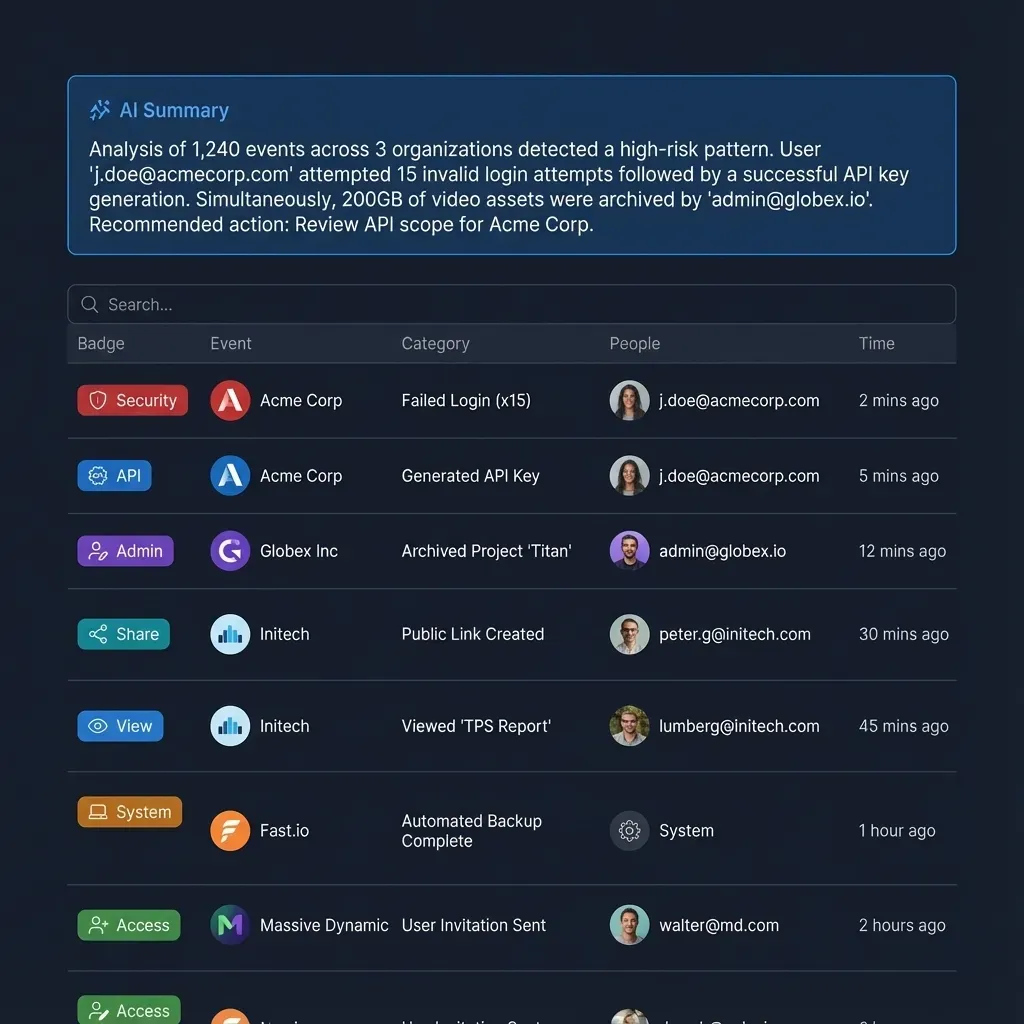
Bridging Shared Drives to Intelligent Workspaces
Fast.io allows organizations to preserve their established storage infrastructure while providing AI agents with modern tooling. Cloud Sync connects Google Drive, Dropbox, Box and OneDrive folders to a workspace, one-way or two-way, on a schedule or on demand. Teams can also bring in files as a one-time cloud import.
Once files land in a Fast.io workspace, Intelligence Mode indexes the content automatically. The workspace generates full-text and semantic embeddings across text files, PDFs, spreadsheets, presentations, and images. Rather than requiring an external vector database or writing custom chunking scripts, developers can connect an agent that queries the workspace directly using semantic search, retrieving relevant paragraphs and citations without pulling whole files into the context window.
Published Storage Connector Benchmark Results
The efficiency of retrieving information from cloud storage directly impacts agent execution speed and operational cost. Connecting an agent to raw cloud APIs often forces the model through dozens of tool calls to list directories, download files, and filter relevant passages.
Independent evaluations of agent storage connectors demonstrate this performance divergence. In published connector benchmarks comparing native cloud storage integrations, Fast.io was measured the fastest and the lowest cost of the providers tested. The full benchmark methodology and comparative results are published at /benchmarks/.
By resolving searches server-side against an indexed workspace, Fast.io allows agents to locate specific data points in a single tool call, eliminating the recursive file download loops that slow down traditional cloud connectors.
Advisory File Locks and Version Protection
Fast.io workspaces provide native coordination mechanisms designed specifically for multi-agent workflows. When an agent prepares to modify a shared document, it acquires an advisory per-file lease using the storage_manage tool with the lock-acquire action. Other agents and human team members inspect active leases using the storage tool with the lock-status action.
Advisory locks automatically expire unless heartbeated by the working agent, ensuring that a crashed agent session does not freeze workspace operations indefinitely. Because these locks are advisory, concurrent writes are never blocked outright; instead, Fast.io's per-file version history preserves every version, allowing teams to inspect historical revisions and restore earlier versions if needed.
Connecting a Google Workspace Shared Drive to AI Agents
Connecting a Google Workspace Shared Drive to an AI agent involves setting up a Fast.io workspace, configuring folder synchronization, and connecting the agent runtime through the Model Context Protocol. This pattern provides agents with direct search and file manipulation capabilities without requiring custom API integration code.
Developers can configure automated synchronization so that updates made by human team members in Google Drive reflect in the agent workspace on a defined schedule or on demand. The agent then connects to Fast.io using remote MCP endpoints, issuing structured tool calls to read, search, and manage assets. The following steps walk through the complete deployment workflow from workspace creation to live query execution.
Step 1: Create a Project Workspace and Configure Cloud Sync
Begin by establishing a dedicated workspace for the project:
- Sign in to your Fast.io organization dashboard.
- Create a new workspace dedicated to your agent workflow (for example,
market-research-workspace). - Navigate to the import and sync settings.
- Select Google Drive and authorize your Google Workspace account through standard OAuth.
- Choose the specific Google Workspace Shared Drive folder containing your project assets.
- Configure Cloud Sync to run on your preferred schedule (such as hourly or daily), or trigger on-demand synchronization when updates occur.
Files from the Shared Drive sync directly into the workspace, where Intelligence Mode automatically indexes them for hybrid semantic and keyword retrieval.
Step 2: Connect AI Agents Through the Fast.io MCP Server
Fast.io exposes a consolidated Model Context Protocol server over Streamable HTTP. The server provides dedicated endpoints optimized for different client environments:
- Claude and General Agent Runtimes: Connect personal assistants and desktop apps (Claude Desktop, Claude mobile, OpenClaw, Hermes Agent) at
https://mcp.fast.io/mcp/tools. - Coding Agents and IDEs: Connect developer tools (Claude Code, Cursor, VS Code Copilot agent mode, Gemini CLI, Cline) at
https://mcp.fast.io/mcp/code. - ChatGPT and Codex: Install the Fastio plugin from the ChatGPT plugin directory, or configure a custom connector at
https://mcp.fast.io/mcp/operations.
Interactive clients sign in with OAuth in the browser. Headless code sends Authorization: Bearer <api key> on the connection.
In client configurations that take JSON, such as Claude Desktop (claude_desktop_config.json) or general MCP clients, add the server entry:
{
  "mcpServers": {
    "fastio": {
      "url": "https://mcp.fast.io/mcp/tools"
    }
  }
}
Step 3: Query Files Using Action-Based MCP Tools
Once connected, agents do not need complex SDKs or direct Google Drive API calls. The Fast.io MCP server consolidates file operations into standardized tools:
- Read operations execute through the
storagetool using actions such assearch,list,details, andlock-status. - Write and management operations execute through the
storage_managetool using actions such aslock-acquire,lock-release,move, anddelete.
For example, when an agent needs to locate specific quarterly figures from a synced financial spreadsheet, it calls the storage tool with the search action:
{
  "tool": "storage",
  "arguments": {
    "action": "search",
    "query": "Q3 recurring revenue and churn metrics"
  }
}
The workspace returns relevant excerpts and document citations directly, enabling the agent to formulate answers without loading thousands of spreadsheet rows into memory.
Step 4: Extract Structured Records with Metadata Views
For workflows requiring structured document extraction across dozens of Shared Drive files, developers use Metadata Views. Metadata Views turn unstructured documents into typed, queryable databases without manual OCR templates or extraction scripts.
Users describe the desired fields in natural language (such as vendor name, contract start date, total value, and renewal term). Fast.io matches documents in the workspace, extracts the fields into a typed schema (Text, Date & Time, Decimal, URL, or JSON), and populates a filterable table. AI agents can create Metadata Views, trigger extraction runs, and query structured records via MCP, transforming chaotic shared drive folders into organized data feeds.
Security Boundaries and Governance Across Agent Workspaces
Enterprise IT teams must ensure that deploying AI agents does not compromise cloud security, dilute data governance, or leak sensitive organizational documents. When granting autonomous software access to corporate files, standard shared drive access models often expose broader directory structures than necessary. A service account with domain-wide delegation can inadvertently read confidential human resources records, financial plans, or executive correspondence.
By routing agent interactions through dedicated project workspaces, organizations establish clear operational perimeters. System administrators can control exactly which folders sync into the agent environment, review detailed logs of every automated change, and distribute agent outputs to external clients through branded shares. This multi-layered approach balances autonomous developer productivity with rigorous data protection standards.
Scoped Credentials Versus Domain-Wide Service Accounts
Direct integrations with Google Workspace frequently require broad administrative service accounts that can read every file across the organization. If an agent script running in a cloud container is compromised, the exposed credentials can grant access to the entire Google Workspace domain.
Fast.io workspaces establish strict security boundaries. Permissions in Fast.io are set per organization, workspace, and share through member roles. By creating a dedicated workspace and syncing only the specific Shared Drive folder needed for a project, administrators isolate agent access. Even if an agent runtime holds a read-write API key, that key cannot access files outside its assigned workspace, preventing cross-project data exposure.
Change Auditing with the Detailed Activity Log
Enterprise governance requires knowing exactly what changes occurred within a shared project space. Fast.io maintains a detailed activity log that records all structural and content modifications made by human members and AI agents alike.
The detailed activity log captures uploads, file edits, directory moves, deletions, membership updates, and share creations. When an agent updates a technical specification or archives an obsolete file, the activity log records the exact agent identity, timestamp, and action taken. This comprehensive record allows security teams and project managers to audit automated operations and track data lineage across the workspace.
Selective Distribution with Branded Shares
Once an agent processes raw files from a Google Workspace Shared Drive and generates finished deliverables, teams need a secure way to distribute those assets to external stakeholders without inviting them into the internal Shared Drive.
Fast.io provides branded shares (Send, Receive, and Exchange) that can be durable or expiring with per-recipient access controls. Teams can configure shares to disable file downloads for sensitive reviews, or use Receive shares to collect project files from external partners directly into the workspace. Furthermore, teams can send completed agreements for signature using built-in e-signature, which includes a tamper-evident audit certificate and files the executed document directly back into the workspace.
Sources
References used to verify factual claims in this guide.
-
Files in a Google Workspace shared drive belong to the organization and team rather than an individual.
-
Enabling native Google Workspace connectors on Claude Team and Enterprise plans requires organization-level administrator authorization.
Frequently Asked Questions
How do AI agents access Google Workspace Shared Drives?
AI agents can access Google Workspace Shared Drives either through direct Google Drive API service accounts or by syncing Shared Drive folders into an intelligent workspace like Fast.io. Connecting through Fast.io allows agents to query indexed files using standardized Model Context Protocol (MCP) tools rather than making repetitive folder-walking API requests.
What is the difference between My Drive and Shared Drive for AI workflows?
In My Drive, files belong to individual user accounts and can be purged if an employee leaves the company, breaking downstream agent pipelines. In a Google Workspace Shared Drive, files belong to the organization and persist independently of individual employee accounts. Shared Drives also enforce centralized member roles rather than individual file-sharing settings.
How do I import a Google Workspace Shared Drive into an MCP workspace?
In Fast.io, navigate to workspace settings, select Google Drive, and authenticate via OAuth. Select the target Shared Drive folder to configure Cloud Sync, which connects Google Drive folders on a schedule or on demand. Once synced, connect your AI agent using the remote Fast.io MCP endpoint at https://mcp.fast.io/mcp/tools (setup docs at https://mcp.fast.io/docs) or see the storage for agents guide at /storage-for-agents/.
Does Fast.io sync with Google Drive?
Yes. Cloud Sync connects Google Drive, Dropbox, Box and OneDrive folders to a workspace, one-way or two-way, on a schedule or on demand. Teams can also bring in files as a one-time cloud import.
How do Google Workspace Shared Drive permissions affect AI agent integrations?
Shared Drive permissions (Manager, Content Manager, Contributor, Commenter, Viewer) dictate whether an authenticated user or service account can read, edit, or delete files across the drive. Because native connectors inherit these permissions broadly, teams use Fast.io workspaces to enforce tighter boundaries, scoping an agent's access strictly to designated project workspaces.
Can multiple AI agents safely modify files synced from a Shared Drive?
Yes. In a Fast.io workspace, multi-agent pipelines coordinate updates using advisory per-file leases acquired via the storage_manage tool with the lock-acquire action. If concurrent edits occur, per-file version history preserves all revisions so prior versions can be restored.
Related Resources

Connect Your Google Workspace Shared Drive to AI Agents
Give your AI agents fast search and versioned storage over your Google Workspace Shared Drive with remote MCP tools. Monthly plans start with a 14-day free trial, which requires a credit card. Plans are Starter at $9.99/mo, Business at $49.99/mo, and Enterprise at $199.99/mo.