GitHub Copilot Token Limit: Context Windows, Chat Caps, and MCP Solutions
The GitHub Copilot token limit restricts inline code completion to a sliding window of approximately 2,048 to 4,096 tokens around the cursor, while standard Copilot Chat sessions allocate between 8,192 and 128,000 tokens depending on the active model. Extended context tiers support up to one million tokens for complex refactors. Offloading reference files to an external index via the Model Context Protocol keeps the active chat window lean.


How the GitHub Copilot Token Limit Divides Inline Code and Chat
The GitHub Copilot token limit restricts inline code completion to a sliding window of approximately 2,048 to 4,096 tokens around the cursor, while standard Copilot Chat sessions allocate between 8,192 and 128,000 tokens depending on the chosen model.
Many teams conflate GitHub Copilot with Microsoft Copilot, formerly known as Microsoft 365 Copilot or Bing Chat Enterprise. Microsoft Copilot operates across corporate productivity suites, indexing Word documents, spreadsheets, presentations, and email threads through Microsoft Graph. That tool enforces strict conversational turn caps and message character quotas tailored for office productivity. GitHub Copilot, in contrast, integrates directly with code editors such as Visual Studio Code, Visual Studio, JetBrains IDEs, and terminal environments. It focuses on source code syntax, abstract syntax tree nodes, import graphs, and active project files.
The GitHub Copilot token limit refers to the maximum context window allocated for inline code completions (typically 2,048 to 4,096 tokens) and Copilot Chat interactions (ranging from 8,192 to 128,000 tokens depending on the active model).
Inline code suggestions, known internally as GhostText, must generate predictions while developers type. To prevent noticeable typing lag, GhostText requires immediate sub-second response latency. Running an inference request across a 128,000-token context window for every typed character would saturate GPU memory, introduce multi-second latency, and break the flow of programming. For this reason, the inline completion engine uses a compact prompt budget capped between 2,048 and 4,096 tokens.
This sliding window collects context from multiple local sources:
- Prefix code: The lines immediately preceding the cursor in the active document.
- Suffix code: The lines immediately following the cursor, helping the model predict closing brackets, return statements, and argument completions.
- Neighboring editor tabs: Snippets extracted from other open files in your editor, ranked using Jaccard token similarity against the current file.
- File metadata: Relative file paths, language identifiers, and project markers like package manifests.
Related guides
- Cursor Token Limit: Composer Windows, Agent Caps, and File Context WorkaroundsThe Cursor token limit defines the maximum token capacity allocated for codebase context, prompt history, and agent...
- OpenAI Codex Token Limits: Context Windows, Request Caps, and WorkaroundsThe Codex token limit refers to the maximum number of prompt and generation tokens permitted in a single OpenAI Codex...
- Managing the GitHub Copilot Context Window & Token LimitsManaging the active token memory in GitHub Copilot is essential for complex repository operations. This guide details...
- GitHub Copilot Limits: Plan Quotas, Rate Caps, and Context BoundariesUnderstanding GitHub Copilot limits requires tracking how monthly quotas, chat throttling, and workspace indexing rules...
- Copilot Context Window: Limits in Chat, CLI, and Agent ModeThe Copilot context window determines how many tokens of code, conversation history, and system instructions GitHub...
- How to Connect GitHub Copilot to OneDrive via MCPConnecting GitHub Copilot to OneDrive via MCP enables developers to query enterprise specifications and technical...
More on this subject: GitHub Copilot (125 guides)
Context Window Budgets Across Copilot Chat Models
Copilot Chat operates on larger context windows than inline completions because interactive conversations tolerate multi-second response latency. When you query Copilot Chat in Visual Studio Code, JetBrains, or the terminal, your prompt routes to foundational models provided by OpenAI, Anthropic, or Google, such as GPT-5, Claude Sonnet, Claude Opus, or Gemini Flash. Standard chat conversations typically allocate between 8,192 and 128,000 tokens for context, depending on the active model and client configuration.
On June 4, 2026, GitHub expanded these boundaries by introducing extended context options: GitHub Copilot supports one-million-token context windows for complex multi-file projects across VS Code, Copilot CLI, and the Copilot app. This expanded context allows developers to evaluate large codebases and complex multi-file changes without losing track of architectural requirements.
However, operating with extended context alters how resources are consumed. As GitHub documented in that release, selecting a larger context window or higher reasoning level consumes more AI credits per interaction. Routine tasks like writing a single unit test or fixing a regex syntax error do not require hundreds of thousands of tokens. Keeping everyday development on standard context windows preserves credits, while reserving extended windows for architectural refactors prevents unnecessary resource depletion.
Inside any active context window, Copilot divides available space among several competing components:
- Base system prompt: Core behavioral guardrails, markdown rendering rules, and role definitions.
- Custom instructions: Workspace rules loaded from
.github/copilot-instructions.md. - System tool definitions: Schemas for built-in functions like file reading, terminal execution, and workspace search.
- Model Context Protocol tool schemas: External tool definitions contributed by configured MCP servers.
- Active message history: User prompts and prior assistant responses from the current session.
- Response buffer: Headroom reserved for model generation so the model can complete answers without abrupt truncation.
In the Copilot CLI, developers can inspect this allocation directly using the /context command. The command displays current token usage, total capacity, and the proportion consumed by system instructions, custom rules, MCP tools, and conversation history. When conversational history fills most of the context window, Copilot CLI initiates background compaction. Compaction summarizes previous turns, preserving key technical decisions while clearing conversational noise so work can continue without hitting a hard limit.


Scale Copilot Context with External Persistent Workspaces
Connect GitHub Copilot to indexed team workspaces via Model Context Protocol. Search documentation and large codebases on demand without exhausting active context windows. Monthly plans start with a 30-day free trial that requires a credit card.
Why Referencing Large Files Triggers Silent Truncation
When working on complex projects, developers frequently use the #file variable or @workspace command to supply relevant implementation details. However, referencing extensive files can silently exceed prompt token budgets, producing incomplete context and degraded code output.
To prevent a single tool response from consuming too much of the context window, tool output larger than 20 KiB is saved to a temporary file by default. The model receives the file path and a preview instead of the full output. This applies to all tools, including tools provided by MCP servers.
When a referenced file exceeds available token limits, Copilot truncates the content to fit inside the prompt budget. Unlike a compiler error, this truncation happens silently. The model generates code based on an incomplete snapshot, which manifests in predictable failure modes:
- Hallucinated method signatures: When an interface definition or class header is cut off, Copilot invents missing method names, parameters, or return types.
- Regressive implementation logic: In multi-turn chat sessions, older constraints discussed five messages earlier get dropped during prompt compaction, leading Copilot to reintroduce previously discarded bugs.
- Repeated boilerplate: When Copilot cannot view the full file structure, it emits redundant imports, duplicated helper utilities, or misplaced namespace declarations.
- Lost in the middle degradation: Even when an entire file fits within a 128,000-token or one-million-token window, neural attention models often suffer from decreased recall for facts located in the middle of long contexts. Critical configuration flags or boundary constraints placed midway through a massive prompt receive weaker attention than tokens at the beginning or end.
Attempting to solve file limitations by pasting full file contents directly into chat windows quickly exhausts session budgets. A more sustainable architecture offloads large documents and codebase indexes to external retrieval systems.
Connecting Copilot to External Retrieval Through Model Context Protocol
Rather than forcing full files into the active context window, developers can connect GitHub Copilot to external knowledge repositories using the Model Context Protocol. MCP establishes an open standard for AI clients to query tools, files, and databases on demand.
Visual Studio Code supports MCP servers natively. Instead of attaching 20 source files totaling 60,000 tokens to a prompt, Copilot queries an external index through MCP tools. The model receives only the specific 300 to 500 tokens relevant to the immediate query, leaving the rest of the context window open for conversation history and code generation.
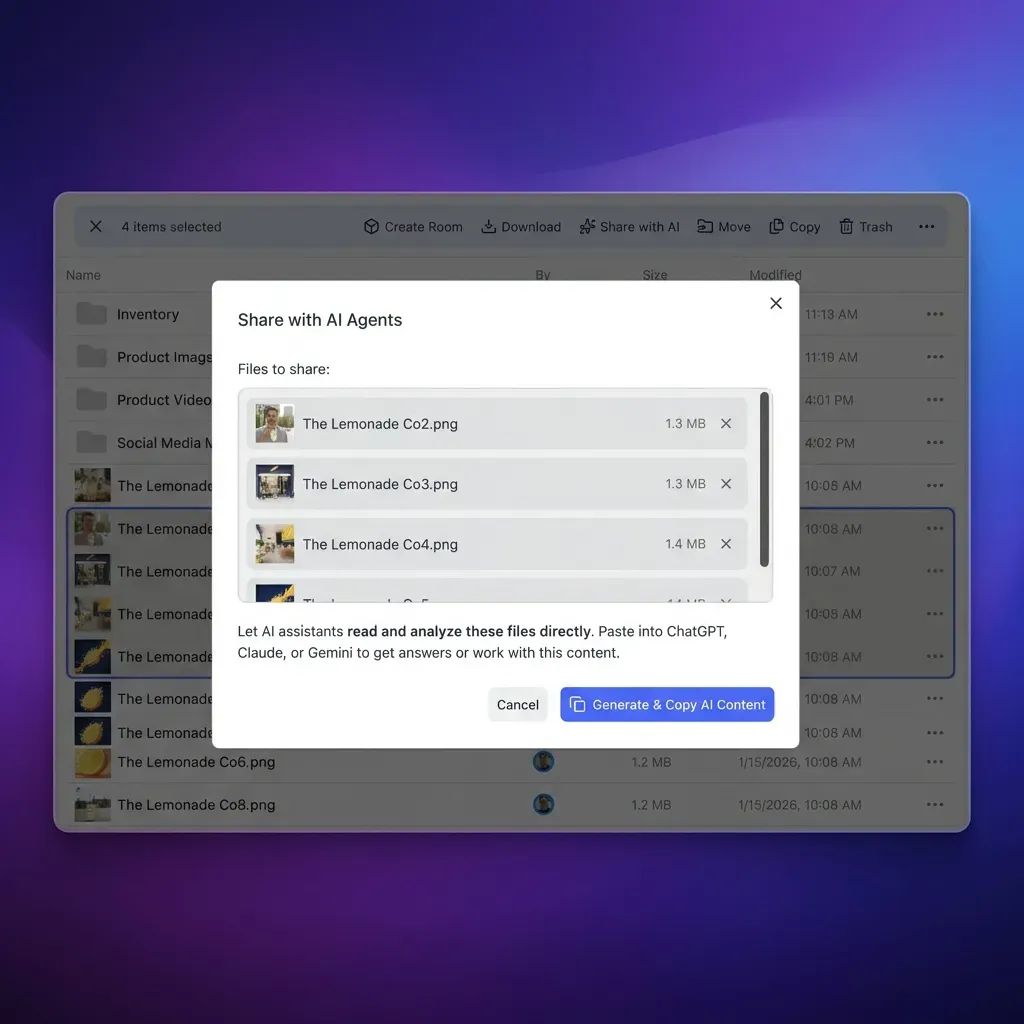
Fast.io provides an intelligent workspace platform designed for agentic teams and developer assistants. When you store architectural specifications, API documentation, legacy codebases, and database schemas in a Fast.io workspace, Intelligence Mode indexes the content for both full-text and semantic search. Agents connect to the workspace through a consolidated MCP toolset over Streamable HTTP.
Configure the remote MCP connection in your workspace .vscode/mcp.json file:
{
  "servers": {
    "fastio-workspace": {
      "type": "http",
      "url": "https://mcp.fast.io/mcp/code"
    }
  }
}
Sign in to Fast.io with OAuth in the browser when prompted. The Review Permissions screen lets you select Read Only or Read & Write access and choose which organizations and workspaces the connection can reach.
With this configuration, Copilot in VS Code uses the MCP search tool to locate relevant code snippets, design documents, and schema contracts on demand. Instead of attaching raw files that risk silent truncation, the assistant pulls precise context as needed. The workspace maintains per-file version history, so updates made by team members or automated agents remain trackable without cluttering IDE memory. For complete protocol documentation, review the Fast.io MCP documentation or inspect Fast.io agent onboarding.
Fast.io workspaces support URL-based cloud import from Dropbox, Box, OneDrive, and Google Drive (Google Drive is import today, with sync coming soon). For ongoing folder synchronization, Cloud Sync connects Dropbox, Box, and OneDrive on a schedule or on demand. This setup allows developer teams to aggregate design documents from cloud storage into one searchable workspace that Copilot queries via MCP. Teams evaluating dedicated cloud storage for coding assistants can review Fast.io agent storage options and compare subscription plans.
Context Optimization Strategies for Daily Development
Managing context effectively requires disciplined workflow habits alongside architectural solutions. Applying specific context hygiene practices keeps Copilot accurate and prevents unexpected truncation during intensive coding sessions.
1. Target file references precisely
Avoid broad @workspace commands when you know the exact module or function requiring modification. Reference specific files using #file:src/auth/session.ts or highlight relevant lines in the editor before invoking inline chat (Ctrl+I or Cmd+I). This provides the model with exact code lines without exhausting the token budget on unrelated modules.
2. Keep custom instructions modular
The .github/copilot-instructions.md file loads into every chat session. If this file contains thousands of lines of documentation or style guides, it permanently reduces the free context available for conversation and tool output. Limit custom instructions to high-level architectural rules, preferred test runners, and formatting standards. Store detailed documentation in an external workspace queried via MCP.
3. Refresh chat sessions between milestones
Long conversational threads accumulate hundreds of turns of stale code and debugging attempts. When you complete an implementation phase or switch to an unrelated task, open a new chat session. In the Copilot CLI, use the /compact command to summarize prior steps, or review earlier progress using /session checkpoints.
4. Use advisory file locks for multi-agent coordination
When multiple agents or developers work within the same shared workspace, concurrent writes can produce confusing merge conflicts. Fast.io supports advisory per-file leases through the MCP storage tool using lock-acquire, lock-status, and lock-release actions. An advisory lock signals that an agent is modifying a file, while the workspace keeps every version in version history so concurrent updates are never permanently lost.
5. Separate reference data from prompt context
For large datasets, benchmark logs, and full API specifications, avoid direct prompt inclusion. Upload reference documents to an indexed Fast.io workspace. Copilot queries the workspace via MCP, retrieves targeted excerpts, and constructs precise solutions while remaining well within prompt limits.
Sources
References used to verify factual claims in this guide.
- 1 GitHub Changelog: Larger context windows and configurable reasoning levels for GitHub Copilot Accessed
GitHub Copilot supports one-million-token context windows for complex multi-file projects across VS Code, Copilot CLI, and the Copilot app.
-
GitHub Copilot CLI caps tool output at 20 KiB by default to prevent large responses from consuming the context window.
Frequently Asked Questions
What is the token limit for GitHub Copilot?
Inline code completion uses a sliding context window of approximately 2,048 to 4,096 tokens around your cursor to maintain sub-second latency. Copilot Chat context limits range from 8,192 to 128,000 tokens depending on the underlying model, with extended options supporting up to 1,000,000 tokens for complex multi-file tasks.
How many tokens can GitHub Copilot Chat handle?
Standard Copilot Chat sessions handle between 8,192 and 128,000 tokens across models like GPT-5, Claude Sonnet, and Gemini Flash. Supported models in VS Code, Copilot CLI, and Copilot apps can also access an extended one-million-token context window when enabled.
Why does GitHub Copilot truncate my files in Chat?
GitHub Copilot truncates files when the total volume of referenced code, system prompts, chat history, and tool definitions exceeds the active model token budget. In the Copilot CLI, tool outputs exceeding 20 KiB are also saved to temporary files by default, providing only a preview to prevent context exhaustion.
How can I expand GitHub Copilot context window using MCP?
You can expand effective context by connecting Copilot to an external Model Context Protocol server. In VS Code, configure `.vscode/mcp.json` with a remote HTTP server like Fast.io. The assistant then queries indexed files and documentation via semantic search on demand, retrieving only necessary snippets instead of loading full files into the prompt.
What is the difference between inline completion tokens and chat tokens?
Inline completions require fast sub-second response times while you type, using a compact 2,048 to 4,096 token window focused on immediate cursor surroundings. Copilot Chat tolerates multi-second response times, enabling larger context windows between 8,192 and 128,000 tokens or up to 1,000,000 tokens in extended modes.
Does GitHub Copilot 1M token mode consume extra credits?
Using extended context windows or higher reasoning levels consumes more AI credits per interaction than standard chat. GitHub recommends keeping everyday coding tasks on default context windows and reserving extended context for large architectural reviews and complex multi-file refactors.
Related Resources

Scale Copilot Context with External Persistent Workspaces
Connect GitHub Copilot to indexed team workspaces via Model Context Protocol. Search documentation and large codebases on demand without exhausting active context windows. Monthly plans start with a 30-day free trial that requires a credit card.